Parking Lot to Mixed-Use Conversion
Cities convert underused parking lots into housing as zoning reform and housing shortages align.
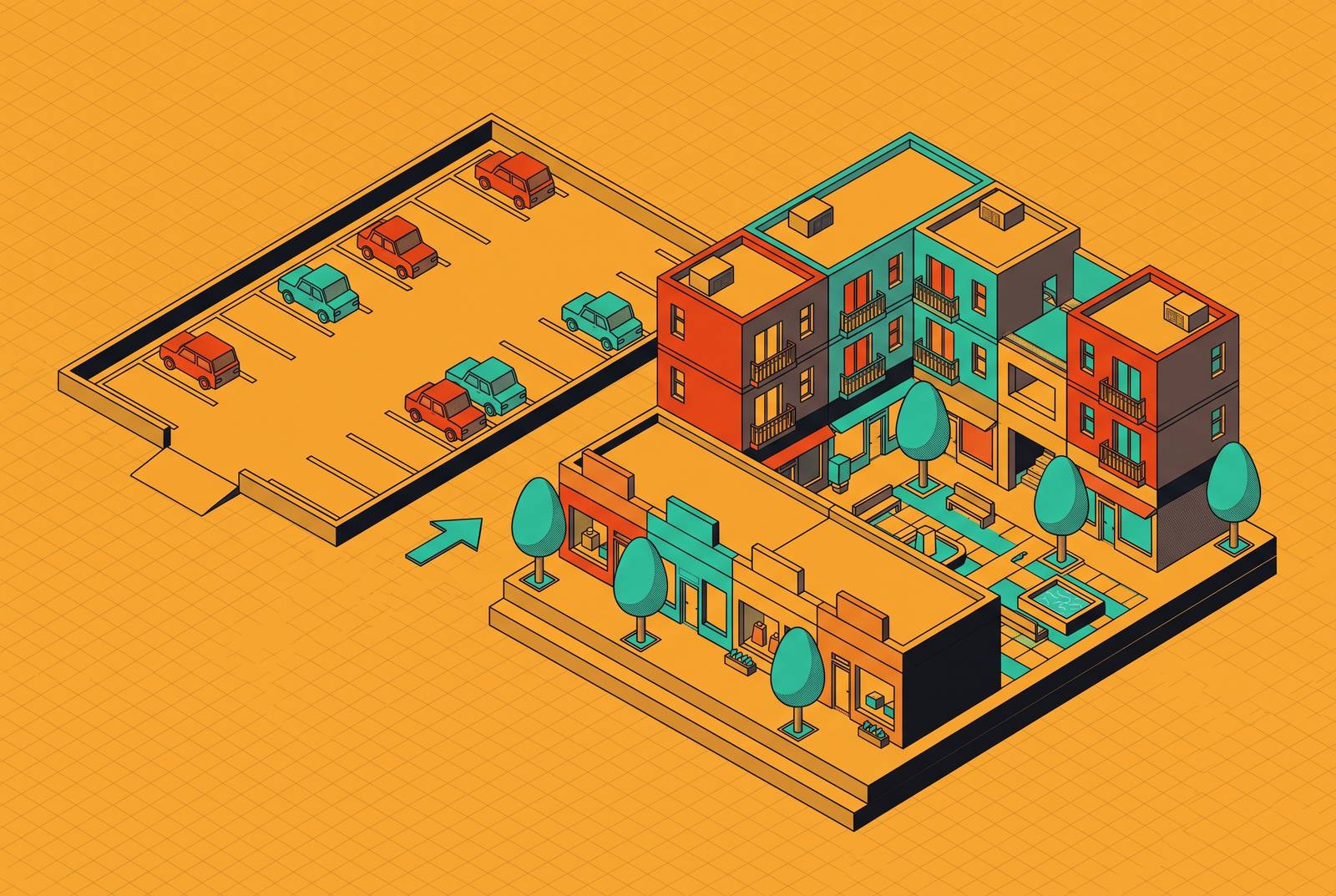
The U.S. has roughly eight parking spaces for every person, close to two billion total, sitting on land while the country runs a housing shortage near two million units. No one planned this outcome deliberately. It's just what happens when zoning code writes checks the market never had to cash, parking minimums chief among them, and now cities are finally converting asphalt into apartments.
The scale of this is easy to undersell. In Los Angeles County alone, parking took up around 200 square miles of land in 2010, bigger than the city of Denver, with roughly 10 million off-street, nonresidential spaces sitting idle most of the day. Across major U.S. cities, a quarter of all land is parking on average, and San Bernardino devotes half its urban footprint to cars. Studies have found that more than a third of parking spaces sit empty at any given moment, which means the surplus is structural and chronic rather than a fluke of bad timing. Parking has become one of the primary uses of urban land in American cities, and the gap between what it holds now and what it could hold is the whole story.
Why conversion is accelerating now
The housing math is the main driver. The country needs something like four to five million more homes, and over 40% of renters are already cost-burdened, spending more than 30% of their income on rent. Home prices are outpacing wage growth in 80% of U.S. markets, and at some point, leaving a flat, empty, transit-accessible lot sitting idle stops being a neutral choice and starts looking like a policy failure.
Retail collapse is the other major factor. E-commerce gutted the anchor tenants that large parking fields were built to serve, so mall owners and big-box landlords are sitting on acreage they can no longer fill. Residential development fills that gap in two ways: it replaces lost rent, and it puts residents within walking distance of whatever retail remains, giving surviving stores a reason to stay open.
Younger renters and downsizing retirees are both gravitating toward walkable neighborhoods, and developer incentives are following that demographic shift. A dead mall parking lot becomes a stranded asset exactly when urban housing demand peaks, and that timing is doing substantial work in accelerating these conversions.
How zoning reform removed the main barrier
Some cities have dropped parking minimums entirely, and by now dozens have joined the movement. New York enacted parking mandate reforms covering transit-rich areas, and multiple states have since passed laws reducing or eliminating parking requirements for at least some new development categories. This has become a legislative pattern spreading state by state.
Not every jurisdiction is going full abolition. Some take a middle path: lower requirements, flexible by site and use, rather than zeroing them out. Either way, the practical effect is the same: a developer converting a surface lot no longer has to replace every space before laying a foundation, and that single change rewrites the entire project budget.
Friction still exists. Plenty of these parcels aren't zoned for mixed-use to begin with, so developers still need rezoning applications or conditional use permits, adding time and risk even in cities that have dropped their parking mandates.
What surface lots cost versus conversion returns
A surface lot sits on some of the priciest land in the city while producing little revenue, and property tax policy quietly rewards owners for leaving it undeveloped. Structured parking is where the real math gets difficult: per Cumming Group, above-ground garage spaces in Boston ran $34,000 to $59,000 per space in the fourth quarter of 2025, and underground spaces ran $106,000 to $152,000. Those costs either land on tenants or get absorbed into the developer's pro forma, and either way they are often the line item that kills the deal.
The upside of conversion is equally concrete. The Urban Land Institute has found that a 10-point bump in Walk Score tends to lift commercial property values 5 to 8%. Converting a parking lot into a walkable block raises the value of every parcel on the surrounding street, not just the one that was redeveloped.
There is also a household transportation cost angle. Households in drivable suburbs spend on average 24% of their income on transportation, a significantly higher share than those in walkable neighborhoods. The Center for Neighborhood Technology estimates this gap at $700 billion a year nationally.
How mixed-use conversions get financed
Construction loans for mixed-use projects are typically more conservative than single-use projects because lenders see more moving parts, and rates reflect the broader interest rate environment. Pre-leasing the commercial space reduces lender-perceived risk, and that reduction shows up directly in loan terms.
Tax Increment Financing, a land value capture tool widely authorized across many states, lets local governments borrow against the future property tax increase a project will generate, then use that money for roads, sewer lines, remediation, and demolition. TIF districts typically run for a fixed term long enough to retire the borrowed funds.
Transit agencies are also stepping into deals directly, with some leasing rather than selling land to retain long-term control while collecting steady rent. On the federal side, programs supporting transit-oriented development planning have directed funding toward these conversions, signaling that parking-to-TOD conversion is now a federal funding priority.
A typical deal stacks up like this: developer equity, a construction loan, TIF or another public subsidy for infrastructure, and, when there is an affordable component, Low-Income Housing Tax Credits or state housing funds layered on top.
How conversion reverses asphalt's environmental damage
Dark asphalt absorbs heat all day and releases it overnight, which is a significant contributor to the urban heat island effect, stressing public health and local ecosystems. Impermeable pavement also blocks rain from soaking into the ground, so stormwater rushes off in larger, faster volumes, carrying pollutants into rivers and streams with nothing to filter or slow it.
Removing pavement reverses each of those problems: more tree canopy, less impermeable surface, better stormwater infiltration, and restored ecological connections where pavement previously blocked them. Paris has removed 70,000 on-street parking spaces, half its previous total of 140,000, as a deliberate policy choice, and the logic is spreading beyond France.
Density adds a compounding environmental benefit. Mixed-use buildings cut vehicle miles traveled, support transit ridership, and shorten commutes, so the climate gains extend well beyond the footprint of the original parking lot.
What recent projects reveal about conversions
In Hell's Kitchen, a parking lot at 621 West 45th Street is becoming two connected towers with 1,127 homes, including 338 affordable units, plus museum space and a public park. The project illustrates how much public land disposition drives conversion at this scale.
Jersey City is converting 10 acres of county-owned parking across four sites into 1,500 mixed-income homes, with one site near Journal Square Transportation Center targeting up to 700 units on its own. Transit adjacency there justifies the density and removes the parking-replacement debate from the table.
Transit agencies in other cities are similarly converting agency-owned parking into housing, retail, and public space, and retaining an ownership stake rather than simply selling the land reflects a broader shift in how they approach these projects. San Francisco's Mason on Mariposa takes a different path: a privately led conversion of a 3.4-acre surface lot at the base of Potrero Hill into nearly 300 market-rate units. In Washington D.C., a $200 million redevelopment of underused WMATA land around the Takoma Metro station is adding housing, retail, and neighborhood amenities while strengthening the connection to the station itself.
These projects share a recognizable pattern: the smoothest conversions involve transit adjacency, public or institutional land ownership, and an affordable-housing component that unlocks public subsidy. Projects missing one of those three tend to stall.
Site constraints that determine whether conversions succeed
Parcel shape matters more here than on a greenfield site. Surface lots are often oddly configured, split across multiple owners, or constrained by adjacent structures, so title and easement due diligence has to happen early in the process.
Soil contamination is common. Decades of vehicle runoff leave behind residue that requires testing and often remediation before any foundation work begins, and that cost belongs in the pro forma from the start.
Ground-floor design determines how a place feels to pedestrians. Retail, restaurants, or community space at street level is the difference between a building that activates the block and one that ignores the sidewalk. Parking replacement remains the most complicated variable: how much to provide, for whom, and in what form, whether structured, underground, or shared with adjacent buildings, shapes both project cost and building configuration.
Larger sites typically need to phase development. Converting 10 acres at once rarely pencils out, so early phases fund later ones and allow the developer to test demand assumptions before committing fully. The quality of public space, including plazas, through-block walkways, and street trees, is what distinguishes a project that reads as a neighborhood from one that simply occupies a former parking lot. A dense mixed-use project still fails on its own terms if the site does not connect to transit, bike lanes, and pedestrian routes.
What blocks promising sites from getting built
Zoning still creates obstacles even after parking minimums disappear. Mixed-use entitlements, height variances, and affordable-unit requirements all require negotiation, and community opposition can stretch a timeline by years before construction begins.
Financing is its own challenge. Stacking construction debt, TIF, tax credits, and public land leases requires structuring expertise and lender relationships built specifically around mixed-use risk, and not every market has enough people with that experience.
Ownership fragmentation can stop a deal entirely. A surface lot split across multiple owners, or encumbered by reciprocal easement agreements with adjacent retailers, cannot be assembled unless every party agrees to terms.
Eliminating the parking lot does not eliminate parking demand; it relocates it. Neighboring businesses and residents who relied on that lot often oppose the conversion because they need the spaces, and no site plan resolves that conflict on its own.
The sites that convert successfully tend to share the same characteristics: single ownership or a consolidated ownership group, proximity to transit, a public or institutional partner with access to subsidy tools, and a housing market tight enough to absorb the new units quickly. The opportunity is real, the land is available, and the policy environment is favorable. Whether any particular lot actually gets built depends entirely on the particulars of that parcel, and statewide zoning reform does not change that calculus one site at a time.