Blockchain Applications in Urban Property Registries
Blockchain could fix land registries plagued by fraud and missing records.
Land is the biggest asset class on the planet, and the systems that keep track of who owns it are, in a lot of places, held together with paper clips and good intentions. Property makes up close to 60% of total global assets, inside a real estate market worth more than $280 trillion Chainlink. That's the scale of what's at stake. And yet the actual record of who owns what still runs on paper trails, manual data entry, and a small number of centralized offices that can lose a file, misfile a file, or in some cases, just make a new file up.
The failures aren't abstract. In Honduras, officials altered the land database itself to steal beachfront property Blockchain-Based Property Registries May Help Lift Poor People Out of…. Brazil has around 3,400 private cartório agents who can each issue land documents, and when they create conflicting documents, resolving those conflicts is extremely difficult Blockchain-Based Property Registries May Help Lift Poor People Out of…. Haiti's 2010 earthquake destroyed physical records outright, because a registry stored in filing cabinets is only as durable as the building around it Blockchain-Based Property Registries May Help Lift Poor People Out of…. In Ghana, 78% of land is unregistered in the first place Blockchain-Based Property Registries May Help Lift Poor People Out of….
That last point connects to what economist Hernando de Soto called "dead capital Blockchain-Based Property Registries May Help Lift Poor People Out of…." Land you can't prove you own is land you can't borrow against, can't sell with confidence, and can't use as collateral. Worldwide, that adds up to an estimated $20 trillion in property value sitting frozen, govtech.com reports Blockchain-Based Property Registries May Help Lift Poor People Out of…. Rapidly urbanizing regions and emerging markets feel this hardest, since their cadastral systems were often weak from the start. Fraud and forgery, fragmented or missing records, transfers that move slowly, and title that's simply inaccessible to poor people are the four failure types that keep appearing across these systems. Those four map directly onto blockchain's core capabilities, which is why the technology has attracted serious government attention.
What Blockchain Actually Does to Property Records
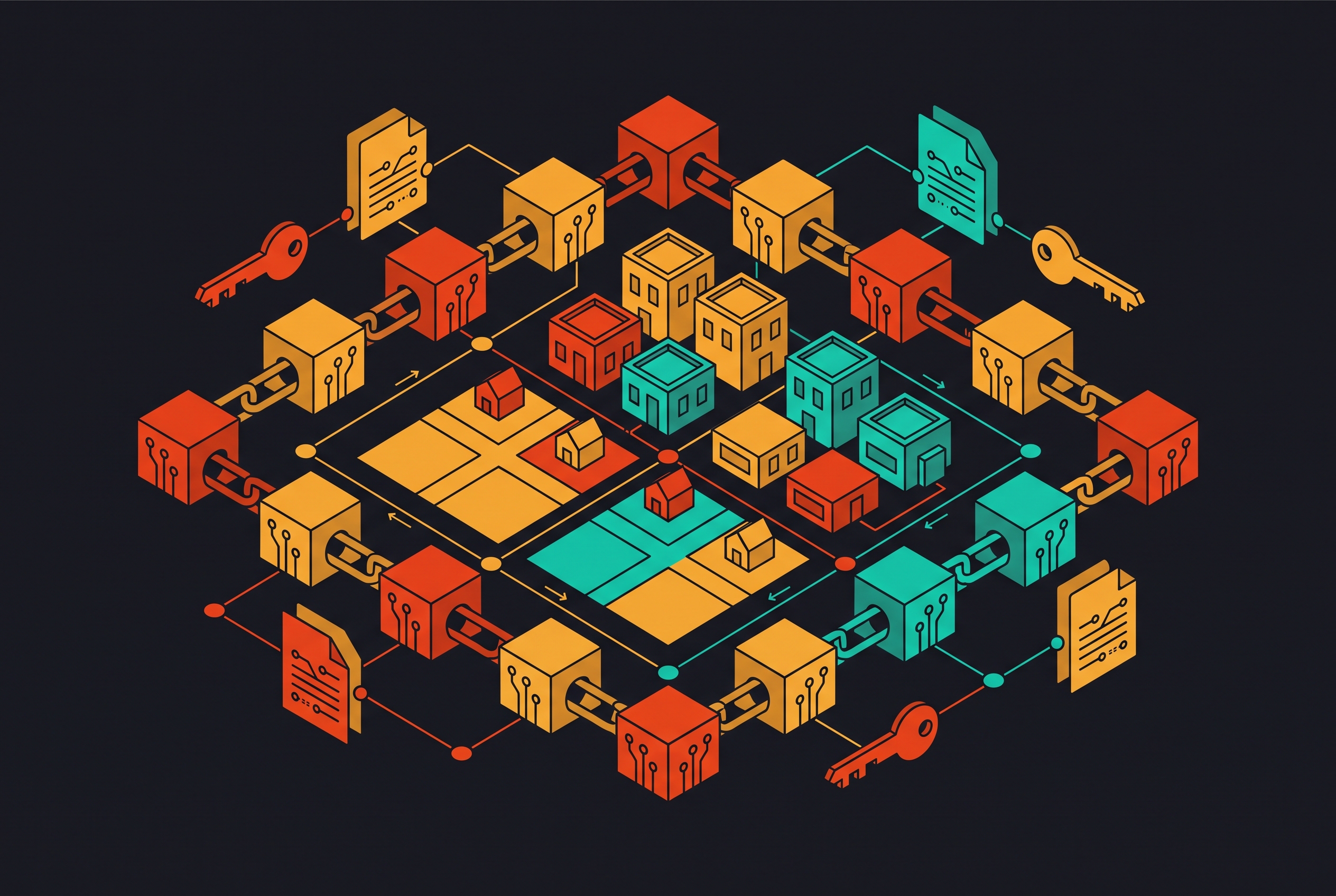
Strip away the hype, and a blockchain land registry is a distributed ledger where each property gets a unique digital token, every transaction carries a cryptographic signature, and there's no single office whose flood or fire can wipe out the record. Trust moves from a clerk's signature to cryptographic proof. That's a genuinely different foundation than a filing cabinet.
But immutability cuts one way. If someone enters a false identity or a fraudulent title at the point of intake, the blockchain will store that lie just as faithfully as it stores the truth. Smart contracts add automation on top: they can release funds from escrow, settle payment and title transfer at the same instant (called atomic settlement), and cut out the risk that one party pays and the other doesn't deliver Blockchain-Based Property Registries May Help Lift Poor People Out of…. What smart contracts cannot do is stand in for notarization or the other formal, legally protective steps that most jurisdictions still require, since those depend on institutional validation rather than code executing on schedule Blockchain-Based Property Registries May Help Lift Poor People Out of….
A registry that's faster to query is not the same thing as a transaction that closes faster, and conflating the two is the single most common misread of this whole space Chainlink. Most government programs also run on permissioned blockchains rather than public ones, meaning only approved parties can see transaction details, with privacy layers protecting identity. A peer-reviewed study found blockchain-based registries can cut property fraud by up to 60% and trim administrative costs by roughly 35 to 40%. Those figures describe what that study measured, not a guarantee that transfers to every country that tries this.
Georgia and Sweden Reveal Two Adoption Patterns
Georgia is the earliest large-scale example. Starting in 2016, the country partnered with Bitfury Group to register land titles on a private blockchain anchored to Bitcoin, and processing times fell from days down to minutes. The program has kept expanding since. Georgia was working with a post-Soviet registry carrying real corruption problems and disputed records, so blockchain was patching something that was already broken.
Sweden's Lantmäteriet (the national land survey agency) ran its pilot the same year, aiming at a process that normally took three to six months Chainlink. Transaction times dropped from three or four months down to under two weeks, with projected savings for taxpayers north of €100 million a year from cutting paperwork Chainlink. But the project slowed because of governance challenges, not technical ones. Sweden had one of the best-functioning land registries anywhere already, and it still hit friction that had nothing to do with the code Blockchain-Based Property Registries May Help Lift Poor People Out of….
Putting those two together shows a clear pattern Chainlink. Speed gains from blockchain are real and repeatable. But in developed economies, the thing that actually blocks full deployment is institutional and governance friction, not whether the technology works. The ledger gets faster, but the surrounding bureaucracy doesn't, unless someone builds additional coordination layers to address that separately.
Dubai's Token Certificate Goes Beyond Record-Keeping
In 2025, the Dubai Land Department released what's being called the world's first property token ownership certificate, tying blockchain directly into formal title systems rather than running it alongside them. The mechanism links cadastral records directly to tokenized certificates, aiming to cut transaction times, reduce disputes, and let transfers happen in real time. Dubai built this with partners Prypco and Ctrl Alt Solutions.
The significant addition here is fractional ownership. A tokenized property can be split into pieces, letting international investors buy in without needing the full purchase price, letting owners sell partial equity instead of the whole asset, and letting that stake trade on secondary markets around the clock. That's a new asset class, not just a quicker version of the old one, and it opens the door to tokenized property rights being used as collateral inside broader financial systems. Georgia and Sweden made the registry faster Chainlink. Dubai changed what the underlying asset can do.
Fractional tokenization requires a legal framework built to support it, and most jurisdictions don't have one yet. The Central African Republic illustrates the risk: CAR launched efforts to tokenize land rights on the Solana blockchain, but without the governance and institutional infrastructure that Dubai spent years building, tokenization there risks making ownership more uncertain rather than less. The technology is the same in both cases; the institutional context is what determines the outcome.
US Pilots Show Mature Legal Systems Move Slowly
Bergen County, New Jersey, is running the largest blockchain-based land-record project in the country Real Estate Tokenization: Recent Developments in New Jersey and Dubai. Under a five-year agreement with the blockchain firm Balcony, roughly 370,000 deeds, representing about $240 billion in real property value, are being digitized and moved onto the Avalanche blockchain Real Estate Tokenization: Recent Developments in New Jersey and Dubai.
Baltimore took a narrower approach. Its pilot launched in December 2023, focused on roughly 13,600 vacant properties, with the goal of speeding up transactions, cutting title fraud, and getting vacant homes rehabbed faster Real Estate Tokenization: Recent Developments in New Jersey and Dubai. Vacant properties are where fragmented and unclear title does the most damage, since investors are reluctant to renovate a property when ownership is contested. At the state level, Maryland passed a Blockchain-Based Real Property Title Pilot Program Act aiming for implementation by January 1, 2027.
For a sense of what adjacent infrastructure can handle, California's DMV has already put more than 42 million vehicle titles onto a blockchain as a fraud prevention measure Blockchain and the Future of Land Title Registries: Global Innovation…. That proves the underlying infrastructure can handle high volume, even if the asset class differs. The larger obstacle in the US is legal fragmentation: Arizona, Tennessee, Wyoming, Nevada, Iowa, and a handful of other states have passed laws recognizing smart contracts, as have the UK Law Commission and Singapore. But those are exceptions. Across most jurisdictions, smart contracts remain in a legal grey zone, and whether the code holds up in court is the binding constraint. That's the same governance problem Sweden encountered, applied to a federal system Chainlink.
Asia-Pacific Leads Global Market by Wide Margin
By the numbers, Asia-Pacific currently leads the field Dataintelo. The region generated $1.01 billion in blockchain land registry revenue in 2025, accounting for 36.2% of the global market, the largest share of any region Dataintelo. India is the most prominent example, with a land registry initiative targeting 5.1 billion property records, while the state of Telangana runs forensic audits of land titles using blockchain-backed traceability tools to address chronic land fraud Dataintelo. China is investing more than $10 billion a year into blockchain infrastructure broadly, and Japan has folded blockchain-based registries into a wider legal digitalization push Dataintelo.
Australia's Victoria is running a Digital Cadastre Modernisation project with blockchain integration under consideration, and Canada has a Mitacs-led academic-industry effort testing blockchain land registries for transparency and compliance before any national rollout is discussed.
That regional market share reflects government ambition and committed infrastructure spending, not completed deployments at the scale of India's stated target. The gap between announced programs and operational systems is significant, and it's the most important distinction to maintain when evaluating any regional leaderboard in this space Chainlink.
Three Limits Deployment Experience Has Not Solved
Start with the legal one, because it's the most concrete. As of 2025, only 19 countries explicitly recognize blockchain records as legally valid for property title. Everywhere else, a blockchain record runs alongside the traditional paper process rather than replacing it, which means most of the world's "blockchain registries" are a fast, secure second copy of the official record rather than the record itself.
Second, bad data entered into the ledger stays wrong permanently. If a false identity or a fraudulent title record makes it onto the ledger, it is now immutably wrong. No amount of cryptography reaches backward to correct it, and there is no technical fix for this problem at the data-entry layer.
Third, interoperability. A peer-reviewed study flagged the lack of global standards connecting these systems, plus real digital infrastructure gaps in developing economies, as structural problems rather than temporary growing pains. A registry that functions well in Sweden doesn't automatically interface with a bank in Brazil Blockchain-Based Property Registries May Help Lift Poor People Out of… Chainlink. Additionally, officials who currently operate as intermediaries, including notaries, clerks, and cartório agents, have strong incentives to resist a system designed to reduce their role. The technology doesn't resolve the politics of its own adoption. None of these three limits argues against the concept overall Chainlink. They are the conditions that determine which specific deployments succeed, and governance design and identity infrastructure matter just as much as the ledger itself.
How to Evaluate Any Blockchain Registry Claim
When a headline says property transfers now take minutes, ask which layer got faster. Registry confirmation and full transaction closing are not the same clock, and a speed claim about one tells you nothing about the other unless the source says so directly.
Ask also whether the system is permissioned or public. Most credible government programs run permissioned chains, keeping centralized oversight while decentralizing selectively, which is a different trust model than a fully public, anyone-can-verify network. Check whether the blockchain record is legally sufficient on its own, or is running in parallel with the existing paper process. Given that only 19 countries currently accept the former, assume it's the latter until there is clear evidence otherwise.
Be careful with fraud-reduction figures specifically. The 60% fraud reduction figure comes from a mixed-method study across Sweden, India, Ghana, and the UAE, and applying it to a different country without examining that country's identity verification infrastructure is not a valid comparison. Market size figures also deserve scrutiny: 2025 estimates for the same global market range from $1.21 billion to $2.8 billion depending on how the source defines the category Verified Market Reports. Treat those numbers as directional indicators rather than precise measurements.
The real test is whether a given system expands who can actually prove ownership, or simply digitizes the same gatekeeping roles in a more efficient format. A ledger is neutral by design. Whether it ends up expanding access or reinforcing existing concentrations of power depends entirely on how the governance around it is structured.