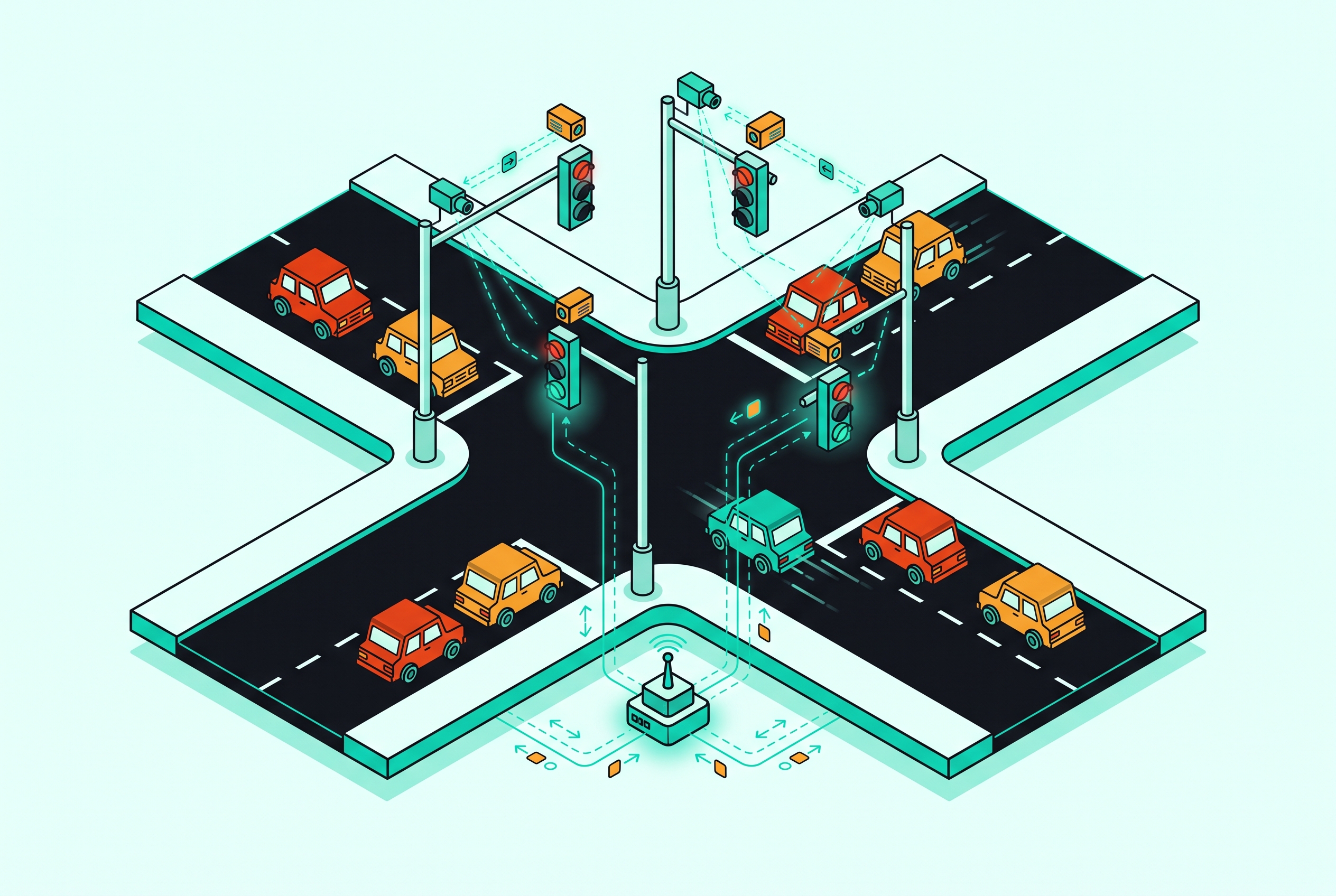
Smart Waste Collection Routing in Cities
IoT sensors and AI routing cut waste collection trips by 30 to 50 percent.
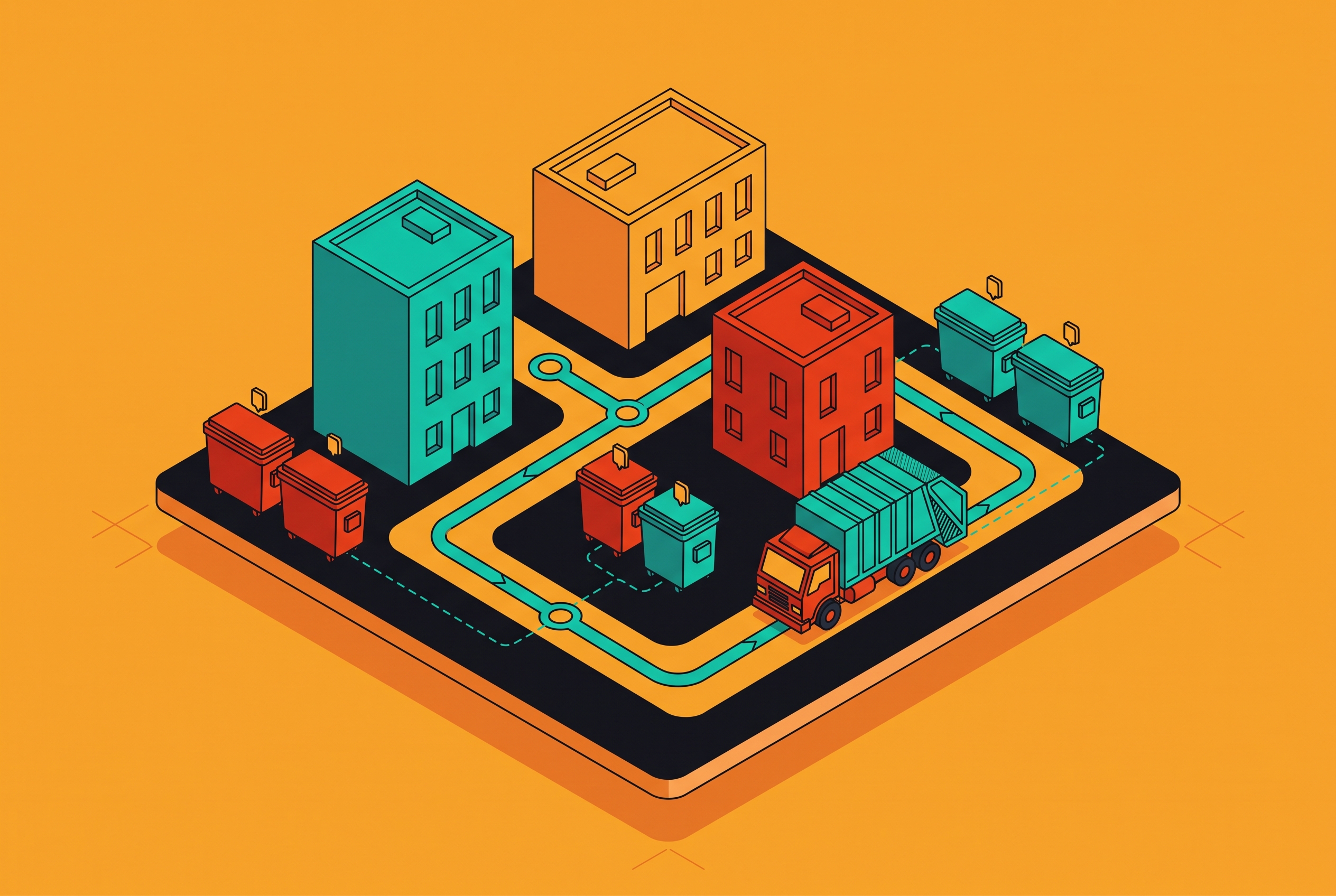
Waste collection eats up somewhere between 20 and 30% of a city's operating budget, historically speaking. That's not a rounding error, it's one of the biggest line items most residents never think about. And the reason it costs so much hasn't changed in decades: trucks run on a calendar, not on what's actually in the bins.
Since 2020, driver wages, fuel, and maintenance have jumped 25 to 40%. Diesel crossed $4 a gallon in early 2026. Meanwhile, fixed routes waste 15 to 25% of their fuel just driving to bins that didn't need to be touched that day. Fixed schedules make the system expensive by design, because it was built to follow a schedule, not a signal. So what does it look like when a city dispatches trucks based on demand instead of dates? That's the whole story here, and it starts with a sensor stuck inside a dumpster.
IoT sensors as the data foundation replacing manual bin-checking
The most common setup is an ultrasonic sensor bolted to the inside lid of a bin. It fires a pulse straight down, times how long it takes to bounce off the trash, and converts that into a fill percentage. Accuracy runs plus or minus 3 to 5%, the batteries last three to seven years, and each unit costs somewhere between $50 and $150. Cheap enough to scale, accurate enough to trust.
Ultrasonic isn't the only option on the table in 2026. Time-of-flight and infrared sensors show up in tighter or oddly shaped bins. Weight-based sensors work well for compactors. Camera and vision systems are creeping in where operators want to see contamination, not just volume. Each one fits a different bin type or waste stream, and most large deployments end up mixing two or three kinds rather than picking one and forcing it everywhere.
The smarter systems don't just report what's in the bin right now, they predict what's coming. By tracking fill patterns over weeks, a sensor network learns that a particular commercial block fills twice as fast on one high-traffic day of the week compared to a quieter one, and starts forecasting when a bin will cross its threshold before it actually does. A smoke detector tells you something's already wrong; a weather forecast tells you to bring an umbrella before the storm hits.
Getting that data off the bin and into a system that can act on it is its own puzzle. LoRaWAN, which runs on unlicensed spectrum, covers 2 to 15 kilometers per gateway and has become the default in US metros. Its coverage grew twentyfold since 2020. NB-IoT, which piggybacks on cellular networks, tends to fill in suburban and rural gaps where LoRaWAN gateways don't reach. Either way, the sensor sips power so lightly that the same battery lasting years also means nobody drives a truck out just to check if a bin happens to be empty.
None of this, on its own, saves a single gallon of diesel. A fill-level reading is just a number sitting on a server until something decides what to do with it. That's where the routing engine comes in.
The AI routing layer's use of real-time fill data
The routing engine pulls in more than fill levels. It factors in traffic, historical waste volumes, weather, and how much capacity the fleet has that day, then spits out a single output: a collection sequence containing only the bins that actually crossed threshold. Bins that haven't get skipped automatically, no dispatcher has to sit there deciding.
It doesn't stop at the start of the shift, either. If a bin crosses threshold mid-route, the system slots it into the nearest truck's path in real time, recalculating continuously rather than running one static plan for the whole day. A 2025 machine-learning routing study found dynamic routing cut total travel distance by 34% and fuel use by 30% compared to static, fixed routes. That is not a marginal improvement, for a third of the driving disappears.
A separate peer-reviewed study out of Vellore Institute of Technology (Anitha and Parthiban, published in Frontiers in Sustainability in 2025) trained an XGBoost classifier on 500 simulated bins across five zones. It hit 94.1% predictive accuracy and 95.8% recall for catching overflow before it happened. Against the static comparison model, the smart system cut overflow events in half, cut missed pickups by 72.7%, and dropped fuel use by 15.5%.
None of this replaces the dispatcher. It removes the boring, repeatable bulk of the job (should truck 12 visit a given bin today, yes or no) so a human is left to handle the parts that actually need judgment, like a broken truck or a blocked alley. The AI runs the routine. The person runs the exceptions.
What cities and fleets measure when they deploy these systems
Cities running sensor-based scheduling typically see collection trips drop 30 to 50%. That's the headline number, and it makes sense once you picture it: they're only sending trucks where trucks are actually needed.
Route optimization on its own cuts total miles driven by 10 to 30%, with fuel savings landing around 15 to 20%. AI and machine-learning platforms tend to shave 10 to 25% off vehicle kilometers within the first few months of going live, not years down the road. The overflow and missed-pickup numbers from the academic research (that 50% drop in overflow, that 72.7% drop in missed pickups) line up with what shows up in actual field deployments, which is a rare and reassuring thing when lab results and real life agree.
Fewer trips also means less diesel burned. That produces a smaller number to report on an ESG dashboard, and an increasing share of municipal contracts in 2026 require exactly that kind of reporting. Dispatchers benefit too: instead of spending 60 to 90 minutes a day manually building routes, they're looking at a plan the system already built, and correcting the exceptions. That's not a one-time fix, but a saving that repeats every single shift.
The system also gets sharper over time. It learns fill patterns week over week, so a bin network with six months of history routes better than one with six days. The data compounds, which is exactly the point that matters later when talking about pilots that never graduate into full deployments.
The ROI structure for a mid-sized fleet deploying sensors and AI routing together
Take a fleet of 20 trucks running roughly 600 sensors, a reasonable stand-in for a mid-sized city. Year one, all in (sensors, gateways, the software platform, installation labor) runs $65,000 to $90,000. Annual savings from fewer trips, less fuel, less overtime, and lighter maintenance typically run between $75,000 and $105,000.
Payback takes 9 to 14 months. That's fast for anything called infrastructure, and it happens because the savings start on day one of optimized routing, not after some multi-year ramp-up. Stretch that out five years and the cumulative return runs 3 to 5 times the initial spend, with total collection costs dropping 40 to 50% against a traditional fixed-schedule fleet.
Fuel is the first line item to move, since skipping an empty bin means skipping the diesel to reach it. Overtime shrinks because routes finish sooner. And there's a capital-avoidance angle too: Columbus, Ohio, postponed buying two additional refuse trucks after putting routing software in place, a savings that never appears as a "saving" on paper; instead, it appears as a truck purchase order that never got filed.
Because payback lands inside a single fiscal year, the financial case doesn't need a multi-year budget commitment to clear a city council. It can get approved on operational savings alone, which is a much easier sell than "trust us, this pays off eventually."
Barcelona, Columbus, and Houston: how three cities implemented demand-driven routing differently
Barcelona went big on hardware. More than 18,000 IoT sensors sit across the city, feeding a central system that dispatches crews based on real-time fill data. The result: €555,000 in annual operational savings and a 15% cut in overall waste management costs. This is the scale-first model, instrument everything, then route on what the sensors say.
Columbus took a different road entirely, no sensor hardware required. By integrating Rubicon's routing software with its existing 311 call system and GIS maps, the city cut bulk-item stops from roughly 12,000 a month down to about 10,000, a drop of more than 15%. Resident wait times for bulk pickups fell from three weeks to one. Staff clawed back about four hours a week by no longer manually updating requests, and the city put off buying two more refuse trucks. Columbus proves the same demand-driven logic works even without a single sensor in the ground, just by making the dispatch software smarter about the requests it already receives.
Houston, also working with Rubicon, took a third path: digitize first, optimize later. The city digitized more than 1,000 routes and over 1.3 million stops across trash, recycling, and yard waste. That's a data-foundation project, not a completed optimization story, and it's worth being upfront about that. Public reporting on what happened after the digitization step isn't available, so Houston reads as the groundwork phase rather than the finished product.
Lining these three up shows that there's no single correct entry point. Barcelona bought sensors. Columbus rewired its dispatch logic. Houston's digital map became the foundation the whole system runs on. Different starting lines, same finish line.
Enterprise waste operators' early adoption of AI routing ahead of municipalities
Private waste haulers got here first, and the reason is simple: they answer to a profit-and-loss statement, not a city council calendar. Waste Management Inc. and Republic Services both poured investment into AI route optimization and recycling automation through 2025 and 2026. Their fleets now run on AI-driven dynamic scheduling as part of ongoing investment in route optimization and recycling automation.
Casella Waste Systems, a regional operator rather than a national giant, deployed the same kind of AI for route efficiency, targeting overtime and maintenance costs. That matters for a specific reason: it shows the model doesn't only work at Waste Management's scale, it works for an operator running a fraction of the fleet.
For municipalities watching from the sidelines, the message is straightforward. Enterprise fleets faced the same fuel, labor, and compliance pressures cities do, they just moved faster because procurement wasn't stuck behind a public bidding process. By the time a city gets around to running its own pilot, the technology has already been proven at commercial scale, which lowers the risk of adopting it considerably. On the sorting side, enterprise material recovery facilities now hit plastics purity above 92% using AI vision systems to catch contamination, a reminder that this same logic (sensor plus algorithm plus automated decision) is spreading past routing and into the sorting line too.
The regulatory environment pushing cities toward demand-driven systems in 2026
Regulation is closing the gap fast. The EU's Waste Framework Directive now requires separate collection of textiles and organics. Under the updated rules, even a small amount of contamination can get an entire load rejected, stacking fines and landfill fees on top of each other.
Governments across Europe, North America, and the Middle East rolled out aggressive recycling mandates for 2026. Cities aren't just judged on whether they collect the waste anymore, they're judged on how clean that waste is when it gets sorted. In the US, a growing number of cities have active smart city programs that include connected waste management, and federal infrastructure funding increasingly covers exactly this kind of IoT rollout.
The ESG reporting requirement mentioned earlier does double duty here. Fewer trips means less measurable emissions, and that number isn't just nice to have on a dashboard anymore, an increasing number of municipal contracts in 2026 actually require it. Once the compliance pressure and the reporting requirement combine, the question for a city stops being "should this get funded?" It becomes "what happens if it doesn't?" Compliance sets the floor. Optimization is just the upside sitting on top of it.
Requirements for a city to move from pilot to full deployment
Barcelona and Columbus show two legitimate ways in. Buy sensors first and route on fill data, or fix the routing software first and add sensors later. Neither is wrong. They're just different doors into the same room.
Connectivity isn't the bottleneck it used to be. LoRaWAN coverage across most US metros grew twentyfold since 2020, so a city in a major market is looking at close to zero infrastructure cost for signal coverage. The real barrier sits in procurement and integration, wherever the network reaches, including the alley behind city hall.
That integration point actually matters more than it sounds like it should. A sensor that reports fill levels to a dashboard nobody checks isn't a routing system, it's a very expensive thermometer. The fill data has to plug directly into the dispatch platform for any of this to translate into fewer miles driven.
The biggest trap is the pilot that never ends. A 50-bin pilot running for two years generates a trickle of data, and a trickle of data produces a trickle of savings, because the AI needs volume and time to learn fill patterns well enough to route confidently. Cities that stall out in pilot mode are stuck exactly where fixed schedules left them, just with better dashboards to look at while they wait.
None of this runs on autopilot, and it shouldn't. The AI handles the routine skip-or-include calls, but restructuring a service area, changing collection thresholds, or deciding a neighborhood needs twice-weekly pickup instead of once is a human call every time. The model that works is human-governed and AI-executed, not some driverless fantasy where nobody's watching the wheel.
The sequencing that tends to work: digitize the existing routes first so there's a clean, timestamped record of what's actually happening on the ground. Layer sensors onto the zones with the worst overflow or highest volume next. Then let AI routing expand citywide as the data pile grows thick enough to trust. Skipping a step gives the system less to learn from, so cities wait longer before the savings appear.
Sources
- Smart Waste Management with IoT Sensors 2026 | Fill-Level Tracking
Provided the figures on rising driver wages and fuel costs since 2020, sensor cost ranges, and the year-one ROI estimates for a mid-sized fleet.
- Frontiers | AI-IoT-graph synergy for smart waste management: a scalable framework for predictive, resilient, and sustainable urban systems
Supplied the XGBoost classifier study from Vellore Institute of Technology, including the 94.1% predictive accuracy, 95.8% recall, 72.7% drop in missed pickups, and 15.5% fuel reduction figures.
- Why Smart Waste Management for cities is essential in 2026
Provided the statistic that waste collection consumes 20 to 30% of a city's operating budget.
- https://ifactoryapp.com/industries/infrastructure-management/ai-powered-waste-management-smart-city
Provided Barcelona's deployment figures: 18,000 IoT sensors, €555,000 in annual savings, and 15% cut in waste management costs.
- https://www.engineermd.com/2026/09/ai-in-waste-management.html
Provided the figure that fixed routes waste 15 to 25% of fuel on unnecessary trips, and the 92% plastics purity figure for AI-equipped sorting facilities.