Adaptive Traffic Signal Control Systems
Real-time systems outperform fixed schedules, but deployment lags far behind the science.
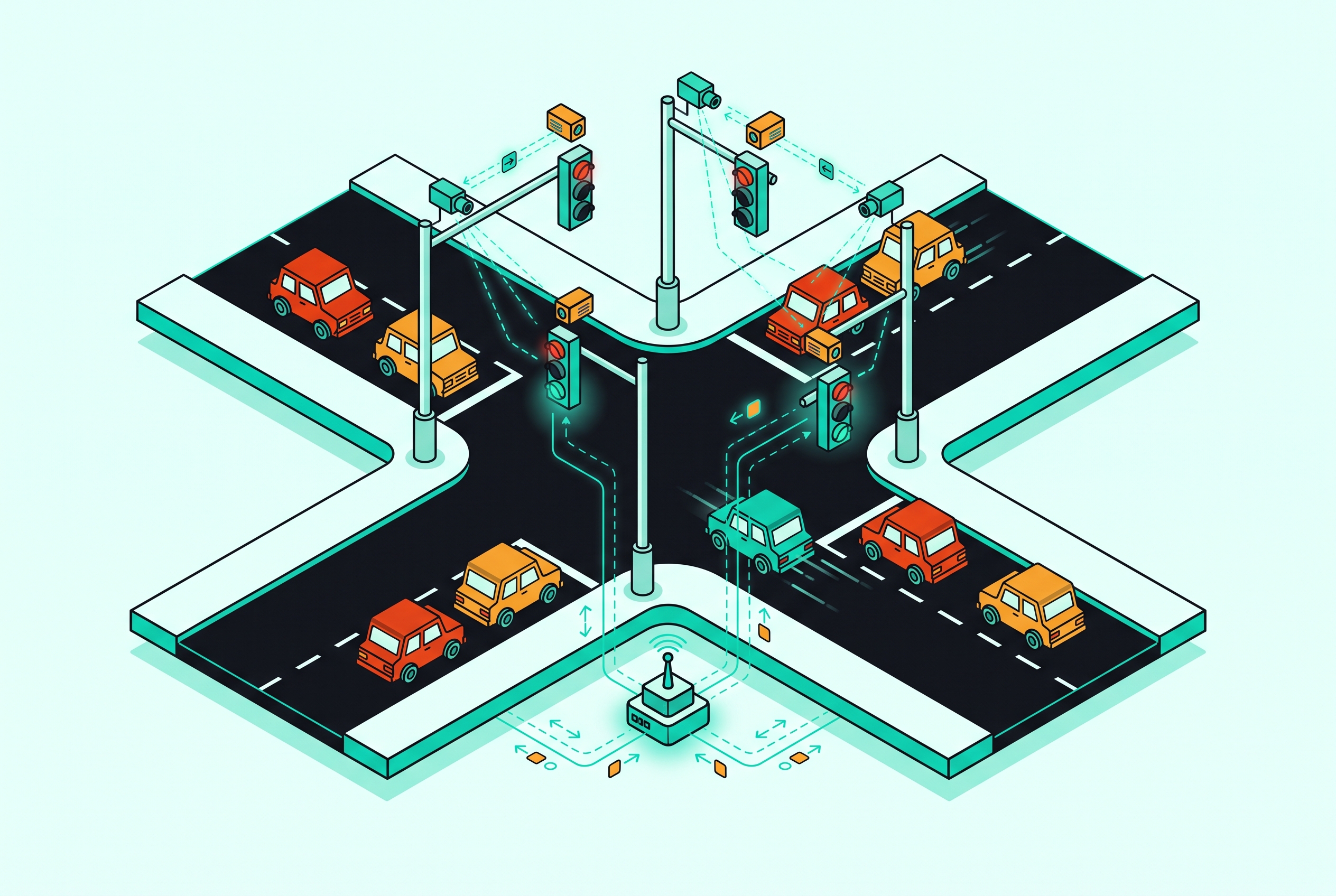
Fixed-time signals operate on preset schedules: cycle lengths, splits, and offsets set in advance and updated only periodically. They cannot respond to sudden demand shifts, whether a crash upstream, a stadium emptying, or a transit delay flooding one corridor. The result is inefficient vehicle flow, longer queues, and higher congestion. As S2 (PLoS One, 2026) notes, these systems "cannot analyze dynamic signal timing changes, especially at multiple intersections."
The Federal Highway Administration (FHWA) has observed that real-time management technologies are proven but deployed on less than 1% of existing signals, establishing the scale of the gap rather than the solution. Per the INRIX 2025 report, traffic congestion costs urban economies over $1 trillion annually in lost productivity and fuel consumption. The core problem is a structural mismatch: urban traffic is dynamic by nature, while fixed-time systems are static by design.
What adaptive signals actually do at the intersection level
Adaptive traffic signal control (ATSC) dynamically adjusts three signal parameters in real time: cycle length, phase splits, and offsets between adjacent signals. Data inputs include inductive loop detectors embedded in pavement, cameras, radar and microwave sensors, and pedestrian push-buttons, with different systems weighting these inputs differently. The local controller processes incoming detector data and extends, terminates early, or skips demand-dependent phases, allowing a single intersection to effectively breathe with traffic. A key distinction from vehicle-actuated systems is that ATSC doesn't simply react to the presence or absence of a vehicle. It models flow rates and projects downstream impact. It is worth noting that vehicle-actuated systems remain the largest technology segment, accounting for USD 3.306 billion or 40.1% of 2025 revenue per GM Insights, providing useful context for where the market currently sits versus where it is heading. Single-intersection optimization, however, is only part of the story. The network coordination layer is where the most significant coordinated gains emerge.
How networked signals become a corridor-wide system
Offset optimization times signals along a corridor so that vehicles released by one green encounter the next signal already green, which is the so-called green wave concept. Centralized systems such as SCOOT aggregate network-wide data at a regional controller, while decentralized systems such as SURTRAC let each intersection negotiate with its neighbors. SCOOT, the Split Cycle Offset Optimization Technique, uses real-time loop detector data to adjust timing network-wide and demonstrates performance enhancements of approximately 15% relative to fixed-time systems per an arxiv review. SCATS, the Sydney Coordinated Adaptive Traffic System, operates on a two-level architecture: local tactical control at each cabinet, and a regional strategic MASTER controller that sets cycle length, split, and offset targets. It is installed at more than 63,000 intersections across 216 cities in 33 countries, and its marriage and divorce logic automatically reconfigures subsystems based on predefined criteria. The economic evidence for SCATS is compelling. Smart traffic signal operation is estimated to deliver around $3.6 billion per year in travel time savings to Sydney compared to simpler signal control.
SURTRAC, developed at Carnegie Mellon's Robotics Institute, takes a fully decentralized approach in which each signal independently determines phasing based on incoming flows and projected outflows from neighbors. Its pilot achieved greater than 25% average reductions in travel time, vehicle speed, number of stops, and wait time across twelve routes, with an expected benefit-cost ratio of almost 20:1 after five years. The architecture choice between centralized and decentralized approaches carries real infrastructure consequences: centralized systems require robust communication back-haul, while decentralized systems are more resilient to node failures but harder to coordinate at scale.
What AI and deep reinforcement learning add
Classical ATSC systems like SCOOT and SCATS select timing from a pre-built plan library in response to detector data. They remain fundamentally rule-based and plan-library-driven. Deep reinforcement learning (DRL) approaches work differently: the controller learns a timing policy by simulating millions of scenarios and updating based on reward signals such as reduced delay, shorter queues, and fewer stops, with no pre-built plan library required. A PLoS One 2026 study by Alanazi et al. introduced the TD3P-ITC framework, Twin Delayed Deep Deterministic Policy Gradient with prioritization-based Intelligent Traffic Control, which achieved queue length reductions of up to 22 vehicles at transport hub intersections and up to 25 at highway intersections, along with a 17.9% decrease in simulated accident rates compared to baseline approaches. A 2025 multi-agent reinforcement learning approach using federated learning and parameter sharing optimized delay time by 12.7%, with enhanced adaptability during traffic surges exceeding 50% above baseline.
Graph neural network approaches such as X-Light and CoLight capture spatial correlations across road network topology and achieve up to 15.2% reduction in average travel time in unstructured road networks per a 2025 to 2026 review. Google's Project Green Light takes a different path, using AI and Google Maps data rather than embedded sensors. From 2022 through 2025, it shared recommendations for roughly 540 signalized intersections globally, with approximately 420 added in 2025 alone, and reports up to 30% fewer stops and 10% lower emissions across more than 20 cities. The City of Vancouver joined Project Green Light in a pilot officially beginning July 17, 2026 and running until the end of 2027, at zero cost to the municipal government. AI-based signal systems currently represent the smallest named revenue segment at USD 854.9 million in 2025, substantial in absolute terms but still well behind legacy deployment. The trajectory matters more than the snapshot. The performance numbers above, however, come almost entirely from simulation, which raises an important question about what happens when these systems meet real cities.
Why simulation results rarely survive real deployment
A 2026 survey synthesizing 211 peer-reviewed publications from January 2017 to early March 2026 establishes a unified taxonomy and finds that the inverse relationship between algorithmic sophistication and deployment readiness is a structural feature of the field. More complex systems are harder to deploy reliably, not easier. The same survey concludes that real-world operational success reflects graceful degradation and conservative adaptation rather than algorithmic sophistication, a direct rebuttal to the assumption that more AI automatically produces better outcomes in practice.
Google Project Green Light's real-world record illustrates the point. Seattle's transportation department reverted a Green Light-recommended signal timing shift because it "did not result in a net benefit." In Manchester, England, Transport for Greater Manchester engineers often opted to ignore Google's recommendations entirely, demonstrating that AI recommendations are not automatically superior to experienced engineer judgment. Sensor dependency compounds the challenge: DRL and GNN models trained on one road topology may perform poorly when deployed on a different network, and the coupling between road network topology and traffic flow dynamics is a fundamental constraint, not an engineering footnote. Centralized systems also require reliable data back-haul across every intersection, and gaps or latency degrade coordination quality across the entire corridor. FHWA evidence establishes that adaptive signal control can improve travel time, delay, emissions, and fuel consumption by at least 10%, a floor, not a ceiling, and one achievable with well-configured classical systems rather than necessarily AI-driven ones. The implication is that cities don't need the most sophisticated system. They need the most appropriately matched system, maintained well and monitored by engineers who can override bad recommendations.
Quantified performance gains across deployment contexts
A Nature Communications study published in February 2025 examined China's 100 most congested cities and found that adaptive signals reduced peak-hour trip times by 11% and off-peak trip times by 8% compared to pre-timed signals, with an estimated annual CO₂ reduction of 31.73 million tonnes. At the intersection level, reductions in idle time at traffic junctions are associated with an 8 to 15% decrease in CO₂ emissions per ATSC environmental research cited by eastgate-software.com. In favorable conditions, optimizing signal timing can cut travel times by up to 30% per Miovision analysis, though this represents a best-case rather than a typical deployment figure. The SURTRAC pilot across 12 routes in Pittsburgh achieved greater than 25% improvements across average travel time, vehicle speed, stops, and wait time, with a benefit-cost ratio of almost 20:1 after five years, a figure that makes the procurement case for cities weighing upfront infrastructure costs.
Performance gains are not evenly distributed. Outdated fixed-time plans in high-congestion corridors show the largest uplift, while already-well-tuned arterials in low-congestion areas show smaller gains. The environmental return on investment is increasingly central to municipal procurement decisions: adaptive systems don't just move vehicles faster, they reduce the cumulative idling that drives emissions, which is directly relevant given urban air quality mandates.
The market structure driving ATSC growth
The Business Research Company, writing in March 2026, puts the adaptive traffic control system market at $7.07 billion in 2025, growing to $8.3 billion in 2026 at a CAGR of 17.4% and projected to reach $14.37 billion in 2030 at a CAGR of 14.7%. Persistence Market Research values the market at US$8.4 billion in 2026 and projects US$25.8 billion by 2033. Figures vary across research firms due to differing scope definitions, and these are best understood as a range rather than a single authoritative number. North America was the largest regional market in 2025, while Asia-Pacific is expected to be the fastest-growing region through the forecast period.
Connected vehicle-based signal systems currently represent the smallest segment at USD 496.6 million in 2025, but are projected to reach USD 1.834 billion in 2035, signaling that infrastructure investment is increasingly designed around vehicle-to-infrastructure readiness rather than today's sensor mix alone. Import tariffs are increasing costs for traffic sensors, controllers, cameras, and communication modules, with municipalities in North America and Europe particularly exposed. The counter-effect is accelerating local manufacturing and cloud-based software alternatives. The key demand drivers are urban congestion growth, smart city programs, emissions-reduction mandates, and government capital programs, reflecting policy-pull as much as technology-push. AI-based signal systems at USD 854.9 million in 2025 remain a small but fast-growing slice and are the segment most likely to reshape the competitive landscape as DRL approaches continue to close the simulation-to-reality gap.
What cities must get right before & after deployment
No adaptive algorithm outperforms the quality of its input data, which makes sensor infrastructure the first priority. Loop detector maintenance, camera coverage gaps, and communication reliability are prerequisites, not afterthoughts. Architecture matching matters equally: centralized systems like SCOOT and SCATS suit dense, well-connected networks with reliable back-haul, while decentralized systems like SURTRAC suit variable-flow urban grids where dominant flows shift by time of day. The choice should follow the network topology rather than vendor preference.
The Green Light cases in Seattle and Manchester underscore that human override capability is not optional. Engineers must be able to audit, reject, and revert AI-generated timing recommendations with authority. Ongoing calibration is equally essential. ATSC systems are not set-and-forget. Traffic patterns shift seasonally, land use changes, and detector drift degrades model inputs. Cities that treat deployment as a one-time capital project rather than an ongoing operational program consistently underperform. FHWA's baseline floor of at least 10% improvement in travel time, delay, emissions, and fuel consumption gives procurement teams a defensible minimum threshold. Deployments that fail to clear this after calibration warrant investigation, not just acceptance.
Equity and access considerations deserve attention in procurement as well. Signal priority for emergency vehicles and transit is a well-established ATSC feature. SCATS supports three levels of bus and tram priority, and extending pedestrian detection and accommodating cyclists are active areas of system development. The honest conclusion is that the performance ceiling is real but context-dependent. Cities that match system architecture to their network, maintain sensor quality, and keep engineers in the loop consistently outperform those chasing the most algorithmically sophisticated option available.
Sources
- Adaptive traffic signal control using deep reinforcement learning: Toward smarter and safer urban mobility
Provided details on the TD3P-ITC deep reinforcement learning framework and its results on queue length reductions and simulated accident rate decreases.
- Sydney Coordinated Adaptive Traffic System - Wikipedia
Provided details on SCATS architecture, global deployment figures, and the marriage and divorce logic for subsystem reconfiguration.
- Traffic signal operation in New South Wales - Wikipedia
Supported the claim about SCATS delivering approximately $3.6 billion per year in travel time savings to Sydney.
- EDC-1: Adaptive Signal Control Technology | Federal Highway Administration
Provided the FHWA baseline floor of at least 10% improvement in travel time, delay, emissions, and fuel consumption from adaptive signal control.
- https://www.nature.com/articles/s41467-025-56701-4
Provided the China congestion study data on adaptive signals reducing peak-hour trip times by 11%, off-peak by 8%, and cutting 31.73 million tonnes of CO₂ annually.
- https://journals.plos.org/plosone/article?id=10.1371%2Fjournal.pone.0339207
Supplied the PLoS One citation on fixed-time systems being unable to analyze dynamic signal timing changes at multiple intersections.
- https://link.springer.com/article/10.1007/s11831-026-10574-y
Provided the 2026 survey synthesizing 211 peer-reviewed publications that found an inverse relationship between algorithmic sophistication and deployment readiness.
- https://www.gminsights.com/industry-analysis/intelligent-traffic-signal-system-market
Provided the market share figure for vehicle-actuated systems at USD 3.306 billion or 40.1% of 2025 revenue, and the connected vehicle segment projections.