Electric Bike Share Companies and Fleet Models
Fleet design determines whether e-bike sharing thrives or struggles.
What makes one electric bike share service different from another is the fleet model: where the bikes park, how they charge, and who's responsible for putting them back where riders need them. Docked, dockless, and hybrid are trade-offs operators actively move between depending on city conditions. Public bike-sharing schemes, mostly docked, racked up roughly 238 million trips across Europe in 2025, while private dockless fleets piled on volume of their own. Both models are running at scale, at the same time, in the same cities.
How docked systems work
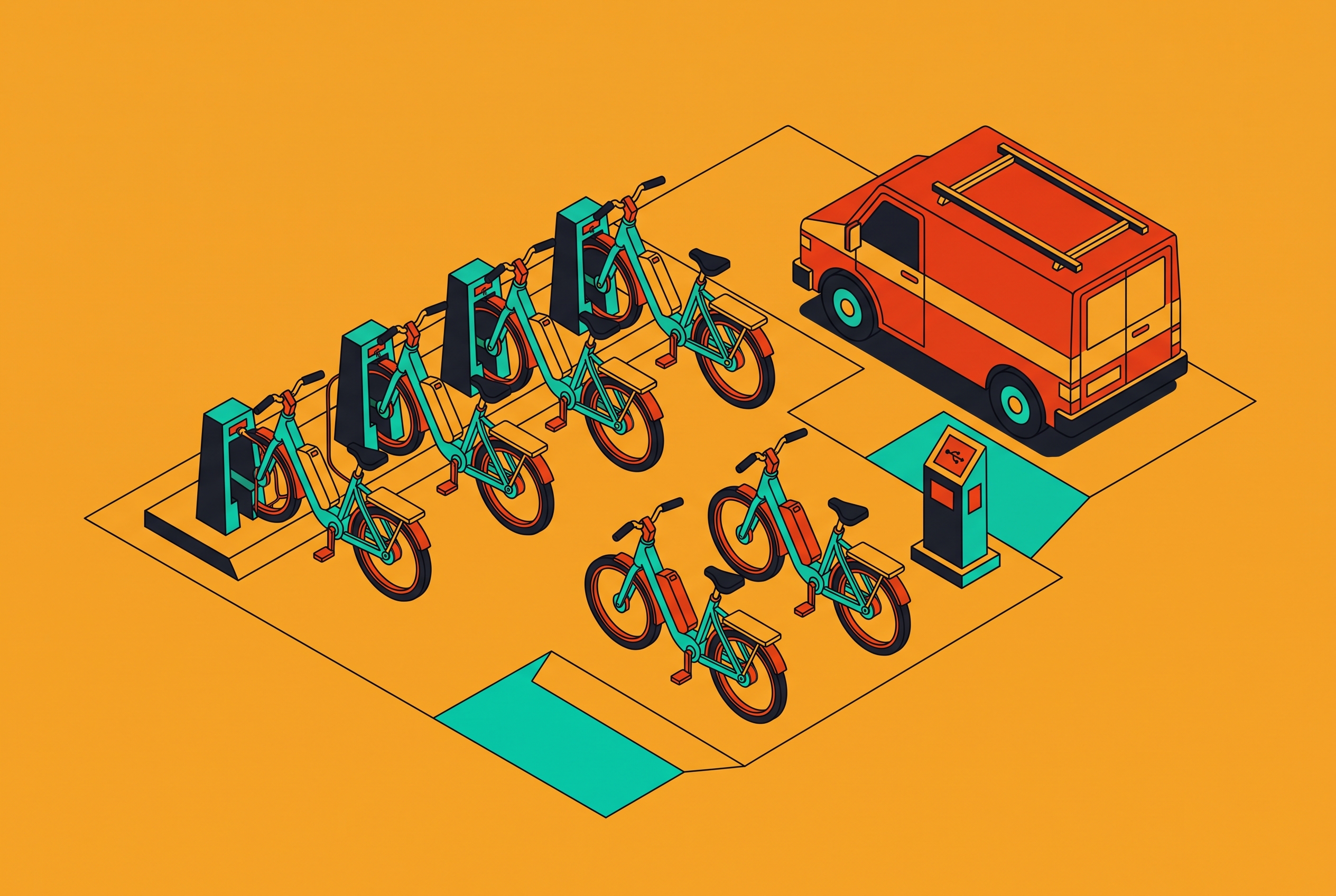
Docked systems bolt the bike to a station. That sounds restrictive, and it is, but it also quietly solves the two hardest problems in electric bike share: keeping batteries charged and keeping bikes from ending up parked across a wheelchair ramp. The charging part happens for free, in a sense. A bike plugs in the moment it's docked, so there's no separate battery run, no van full of spare packs circling the city. Lyft Urban Solutions built its Pillar Charging Dock around exactly that idea, with the Astro ebike tuned to charge in-station rather than needing a swap.
That predictability is why cities tend to treat docked systems less like a permitted business and more like infrastructure, the same category as a subway line or a bus shelter. Santander Cycles in London, BIXI in Montreal, and Citi Bike in New York have all been running for more than a decade without a serious interruption to the model itself. BIXI crossed 100 million total rides in 2025 and picked up a spot on TIME's list of the 25 most iconic inventions of the last century. Barcelona's Bicing reached the same milestone in just six years, though Bicing is managed by BSM (Barcelona de Serveis Municipals) while BIXI is operated by Lyft Urban Solutions.
And docked doesn't mean stuck in the past, either. Zaragoza launched in 2025 as fully electric from day one, thousands of ebikes across hundreds of stations, with Bilbao and Rivas rolling out their own all-electric, station-based networks that same year. The usage numbers back up the design: Zaragoza averaged 13.3 trips per bike per day in September 2025, Barcelona logged 7.1, and Rivas came in at 7.7. Get the station density right, and a docked system moves a lot of people.
The catch hasn't gone anywhere, though. If there's no dock near where a rider actually wants to go, the trip just doesn't happen. That gap means a trip just doesn't happen, the exact problem dockless systems were built to fill.
Why dockless systems are operationally harder than they appear
Dockless systems remove the need for riders to find an open docking slot at the end of a trip. Park anywhere in the zone, no hunting for an open slot three blocks from your actual destination. For the rider, the last stretch of a trip is faster, since a docked system forces a walk that defeats half the point of biking.
But that freedom has to come from somewhere, and where it comes from is the operator's back office. Without a dock forcing bikes into predictable spots, someone has to physically go find them, sort them, and move them to where demand actually is. That's rebalancing, a continuous task that doesn't shrink with scale, needs people and vehicles, and costs real money every single day a fleet is on the street.
Electrification adds vandalism, theft, and damage on top of that, all of which push replacement costs higher in dockless deployments. Batteries need swapping or charging by roving crews instead of the free, passive charging a dock provides. None of this fades once an operator matures past some early startup phase; it's structural, baked into what dockless is.
Lime, the most visible Western dockless operator, posted revenue growth in 2025 and filed its S-1 to go public in 2026, and still reported a net loss for the year. Growth and red ink, sitting side by side in the same set of books. Lyft's own SEC filings tell a similar story from a different angle: a pattern of exits from shared bike and scooter programs, blamed on institutionalized theft, contractual terms that didn't pencil out, and cities that wanted the service without funding the infrastructure to support it. Docked systems tend to dodge the worst of that because the municipal partnership already assumes shared cost. Dockless operators are out there alone.
London is a good place to watch dockless mature. Forest (started as HumanForest back in 2020) now runs across 20 boroughs with a sizable e-bike fleet and more than a million registered riders, going head-to-head with Santander Cycles' docked network and with Lime. In 2025, Forest updated its pricing to hand out free minutes to riders who park in an overcrowded bay or move a bike that's been sitting idle, an attempt to get riders doing rebalancing work for free. It's a clever fix, but it exists because the underlying problem is expensive enough to be worth bribing customers to solve.
London also carries a warning from recent memory. Ofo and Mobike (now folded into Meituan Bike) both launched dockless fleets in the city and both left. Their exit is what opened the door Forest walked through. City regulators still weigh that history whenever a new dockless entrant shows up asking for a permit.
The battery problem specific to electric dockless fleets
Bolt a battery onto a dockless bike and the sticker price isn't the only thing that goes up. Every single bike now needs someone managing its charge level, one at a time, with no dock to do it automatically. Docked electric systems dodge this almost entirely: park the bike, it charges, the operator's whole job is keeping the stations running. Dockless electric operators get none of that. Each battery has to be swapped in the field or the bike itself has to be hauled to a charger, and neither option is cheap or easy at fleet scale.
Two answers have taken shape. Plug-in charging keeps the hardware simple but takes the bike off the street and onto a truck while it charges, which is downtime the bike isn't earning anything during. Battery swapping keeps the bike on the road but demands its own network of swap stations and a steady supply of pre-charged batteries sitting ready.
Chinese operators HelloBike and Geek have conducted pilot battery-swapping implementations in Hangzhou and Changsha, and the economics justify the investment because average daily revenue per shared electric bike is meaningfully higher there than for conventional shared bikes, with shared e-bikes reportedly recouping their cost within a year. When the payback period is that short, building out swap infrastructure stops being a gamble.
Gogoro has taken the idea furthest, turning swapping into its own standalone business rather than a feature bolted onto bike sharing. Its Gogoro Network already serves hundreds of thousands of riders, has processed hundreds of millions of swaps, and runs thousands of GoStation locations.
None of that unit economics translates cleanly to Western markets. Western operators face a harder calculation because per-ride revenue is lower and theft and vandalism costs are higher. Operators there face a tougher spreadsheet, plain and simple.
How hybrid systems combine docked reliability and dockless flexibility
Hybrid systems let bikes dock and charge at fixed stations, but also allow them to lock and park outside those stations when it makes sense. What used to be a nice idea on paper is turning into an actual deployment pattern, mostly because the hardware finally caught up to the ambition.
Lyft Urban Solutions' newer fleet, the Astro ebike, the Metro pedal bike, and the existing Cosmo, all use rear-wheel immobilization that locks automatically the moment a bike is parked outside a dock. (The standard Metro is the one exception; it's dock-only and skips this feature.) That removes the need for a cable lock and gives the operator a GPS-confirmed read on exactly where every bike sits, without needing a physical station on that spot. The Astro takes it a step further: it's built to charge in-station through the Pillar docks, but it also supports parking outside the station for overflow, mid-trip pauses, or inside a "virtual station," a geofenced zone the operator sets up where the bike's own hardware enforces where it can and can't be left.
Forest's London fleet is chasing the same outcome from the opposite direction, using software instead of steel. Each bike has GPS baked in that enforces boundaries, speed limits, and parking rules, which amounts to a dockless system behaving like it has stations, minus the actual stations. Different hardware, same underlying logic: use location data and physical or digital constraints to get dockless flexibility without dockless chaos.
Moscow's Velobike ran the experiment in reverse and landed somewhere else entirely. It operated a docked system, watched riders gravitate hard toward its dockless "2.0" e-bikes over the standard station-based fleet, and by 2025 had fully committed: every Smoove dock was decommissioned, and the dockless fleet grew to nine thousand bikes. Velobike's move shows cities really can shift along this spectrum based on what riders actually do, not what a planning document assumed they'd do, and that the shift can run in either direction. Hybrid is one live option among several, and which option wins depends on the city.
How AI-driven rebalancing changes what dockless and hybrid operators can afford
Rebalancing has always been the line item that made dockless expensive. That's starting to shift as predictive, AI-driven redistribution takes over from the older model of dispatching a crew after a zone already ran empty, and the change is opening up dockless and hybrid deployment in cities that couldn't have supported it a few years back.
A 2026 study on the subject frames fleet management as something that directly shapes rider satisfaction, operator profit, and how useful the whole system is as actual transportation. Reinforcement learning is where a lot of the current research is aimed: build a system that predicts where demand is about to pile up and routes crews there ahead of time, instead of reacting once the damage (empty racks, stranded riders) is already done.
Forest's 2025 pricing tweaks, the free minutes for parking in a crowded bay or moving a bike that's been sitting too long, are really an early, low-tech version of this same idea. Use real-time location data to nudge the fleet back toward balance without sending out a van. Bosch is building toward the more automated version from the hardware side. Its Connected Biking platform gives each bike a digital twin that feeds fleet management, service tracking, and other data services across the bike's whole working life, positioning Bosch as shared infrastructure for the industry rather than just the company that makes the motor.
The stakes come down to a fairly blunt number. NACTO's member city data for September 2025 put dockless e-bikes at an average of 3 trips per bike per day, with shared e-scooters close behind at 2.9, the benchmark the industry measures itself against. A bike sitting idle below that line is losing money every hour it's parked instead of ridden, and the margin between a fleet that works and one that doesn't is thin enough that rebalancing efficiency can be the whole difference.
Cargo e-bike fleets as a distinct fleet model question
Cargo e-bikes raise the same docked-versus-dockless choice, but the bikes, the customers, and the money behind them are all different animals, so the answer looks nothing like passenger bike share.
Start with growth. The cargo e-bike segment is on track to be the fastest-growing part of the e-bike market through 2025 and 2026, and the European e-cargo bike market alone is expected to top a billion dollars in 2026, with commercial delivery already making up most of the 2025 market. Inside that market, service providers, the sharing operators and cargo-bike-as-a-service businesses, are growing faster than the individual businesses just buying their own bikes outright. Fleets, in other words, are outpacing one-off ownership.
The money behind cargo also runs on a different track. Germany's federal BAFA grant covers a chunk of a commercial e-cargo bike purchase up to a set cap, and regional programs, North Rhine-Westphalia's among them, fund municipalities for up to roughly 60% of the cost. Subsidies at that scale change what the spreadsheet needs to prove. A fleet can pencil out at utilization rates that would sink an unsubsidized passenger bike share program.
The hardware pushes cargo toward hybrid or depot-based setups almost by default. These bikes are heavier, need sturdier charging setups, and usually run fixed routes for a commercial client rather than getting picked up by whoever happens to be walking past. Free-floating dockless, the model that already strains under rebalancing costs in passenger bike share, rarely fits a fleet built around scheduled deliveries and dedicated depots.
What the fleet model choice means for a city or operator deciding between systems
None of the three models wins outright. A city with dense, well-funded transit corridors and the political will to build permanent stations gets the most out of docked, the model that's already proven it can run for over a decade without falling apart. A market with an established rider base, decent enforcement, and appetite for continuous rebalancing costs can make dockless work, the way Forest has in London, though the theft and turnover costs that pushed Ofo and Mobike out never fully disappear.
Hybrid systems split the difference for cities: docked reliability where it's affordable, dockless flexibility where riders need it, backed by hardware like automatic rear-wheel immobilization that activates when a bike is parked outside a dock or, as with Forest's London system, GPS embedded in each bike enforcing boundary, speed, and parking restrictions to create station-like behavioral controls without physical docks. Whether that combination beats a full commitment to one model or the other is still an open question. Velobike answered it by scrapping docked entirely once the data made the rider preference obvious.
The software is changing fastest across all three models. Predictive rebalancing is starting to close the cost gap that used to make dockless a hard sell in smaller or lower-density cities, and that alone is going to keep reshuffling which model makes sense where. Cargo fleets are running their own version of this decision, shaped by heavier hardware and subsidy programs that don't map onto passenger bike share at all. The fleet model is central to the bike share story. It's the story, and it's still being written city by city.
Sources
- Forest (bicycle-sharing system)
Provided details on Velobike's transition from docked to fully dockless operations and the nine thousand bike fleet figure.
- Lyft Urban Solutions introduces the next generation of bikeshare with new electric and pedal bikes | Lyft Urban Solutions
Provided details on Lyft Urban Solutions' Astro ebike, Metro pedal bike, Pillar Charging Dock, and rear-wheel immobilization features.
- 2025 in motion: global growth and innovation in bikeshare & micromobility | Lyft Urban Solutions
Provided BIXI's 100 million total rides milestone, Barcelona's Bicing milestone, and per-bike daily trip statistics for Zaragoza, Barcelona, and Rivas.
- Cargo Bike Fleet For Sharing Programs: 2026 Hardware Sourcing Guide For Operators
Provided information on European e-cargo bike market size, subsidy programs including Germany's BAFA grant and North Rhine-Westphalia's municipal funding covering up to 60% of costs.