Bike Share Advantages and Disadvantages for Urban Planners
Emissions and congestion gains are real, but they only materialize with smart design choices.

Bike share systems give urban planners a rare thing: a transportation intervention that's cheap to deploy, fast to scale, and easy to measure. That's the subject here. The gains (emissions, health, congestion relief) are real and documented, but they appear only when planners get the harder decisions right: system architecture, station siting, pricing, and the streets the bikes actually ride on.
Bike share systems as a planning instrument
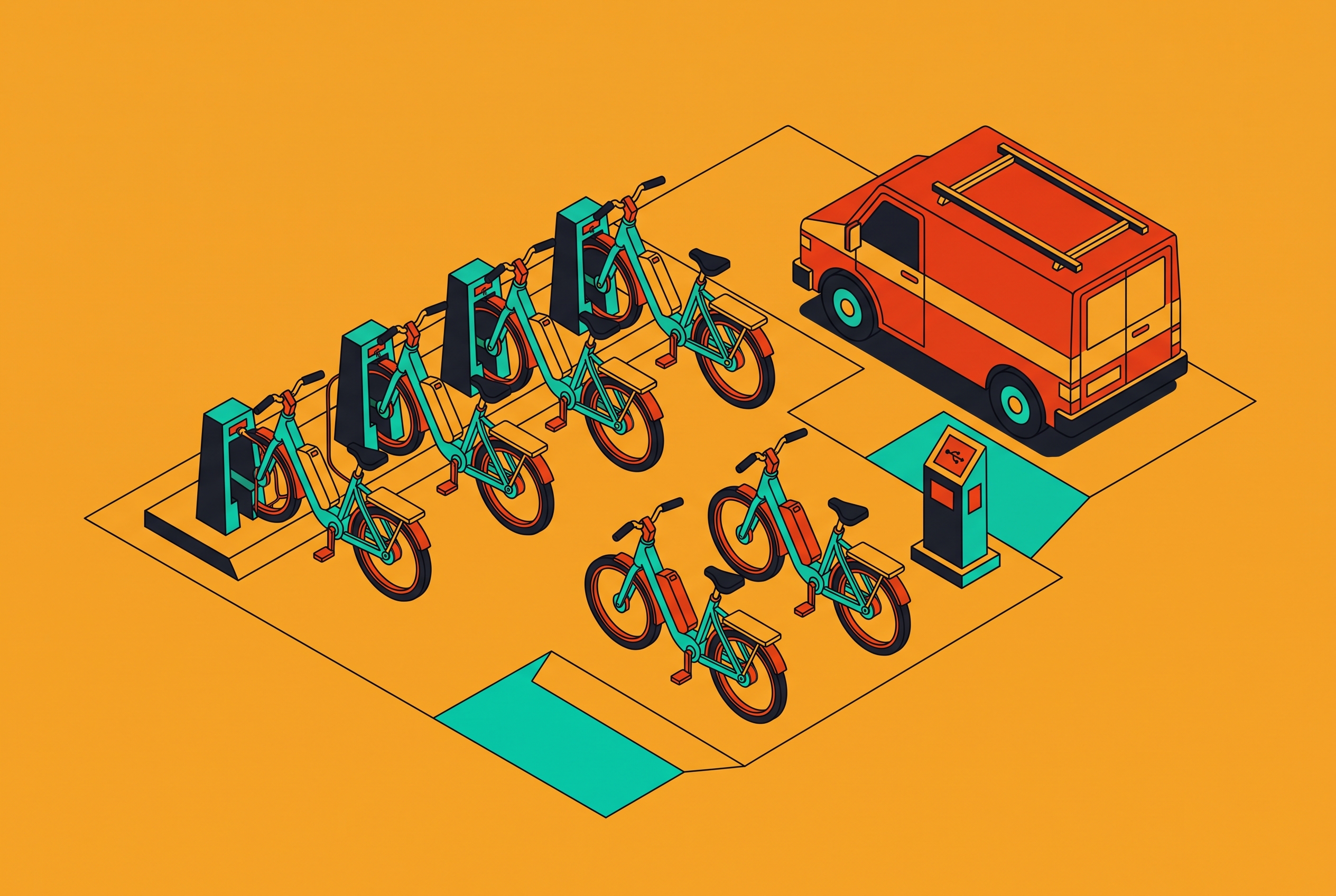
Every bike share program starts with one decision that shapes everything downstream: docked or dockless. Station-based systems rely on fixed docking infrastructure. Bikes live in specific slots, at specific locations, and riders check them out and return them to a dock, any dock in the network, but a dock all the same. Free-floating systems skip the hardware. GPS tracks the bikes, a phone app unlocks them, and riders can leave them wherever the ride ends, within whatever boundaries the city sets.
That single choice determines a long list of downstream problems. Docked systems need capital for station construction, but they give planners precise control over where bikes start and end up. Dockless systems need far less upfront concrete and steel, but they hand control of "where bikes end up" over to riders, which turns out to create its own headaches (sidewalks included, more on that later). Neither architecture is right or wrong. They're just different bets on where the cost and the complexity will land.
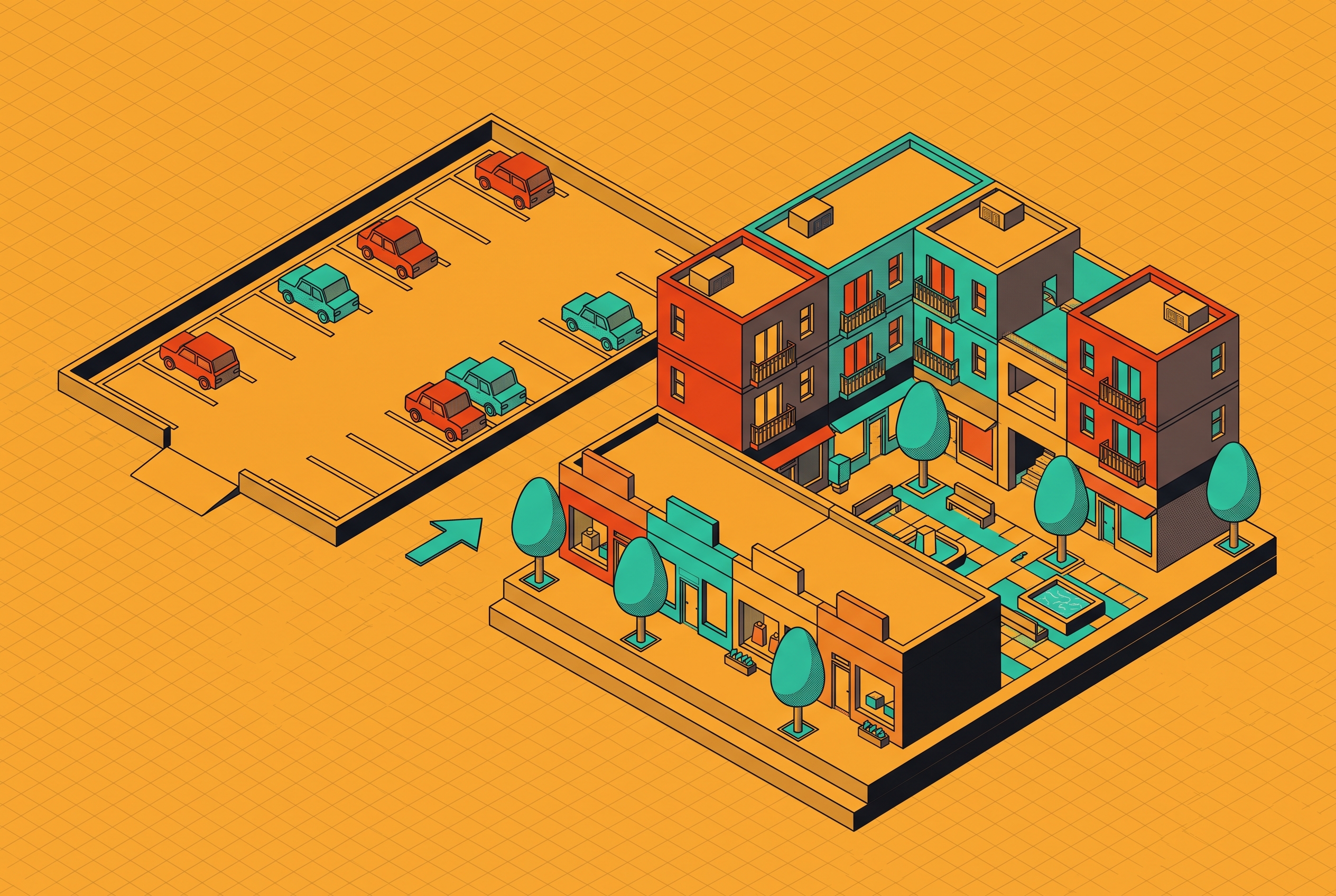
A 2025 study in Networks and Spatial Economics applied to Vienna frames the planning logic behind all this using the "15-minute city" concept: the idea that residents should reach daily needs, like groceries, work, school, within a short trip from home. Under that framework, bike share stations function as connective tissue. They link neighborhoods to amenities within that short travel window and plug into transit stops to cover the first and last mile of longer trips. A station is a deliberate node placed to close a gap in how people move through a city.
The measurable gains planners can point to: emissions, health, and congestion
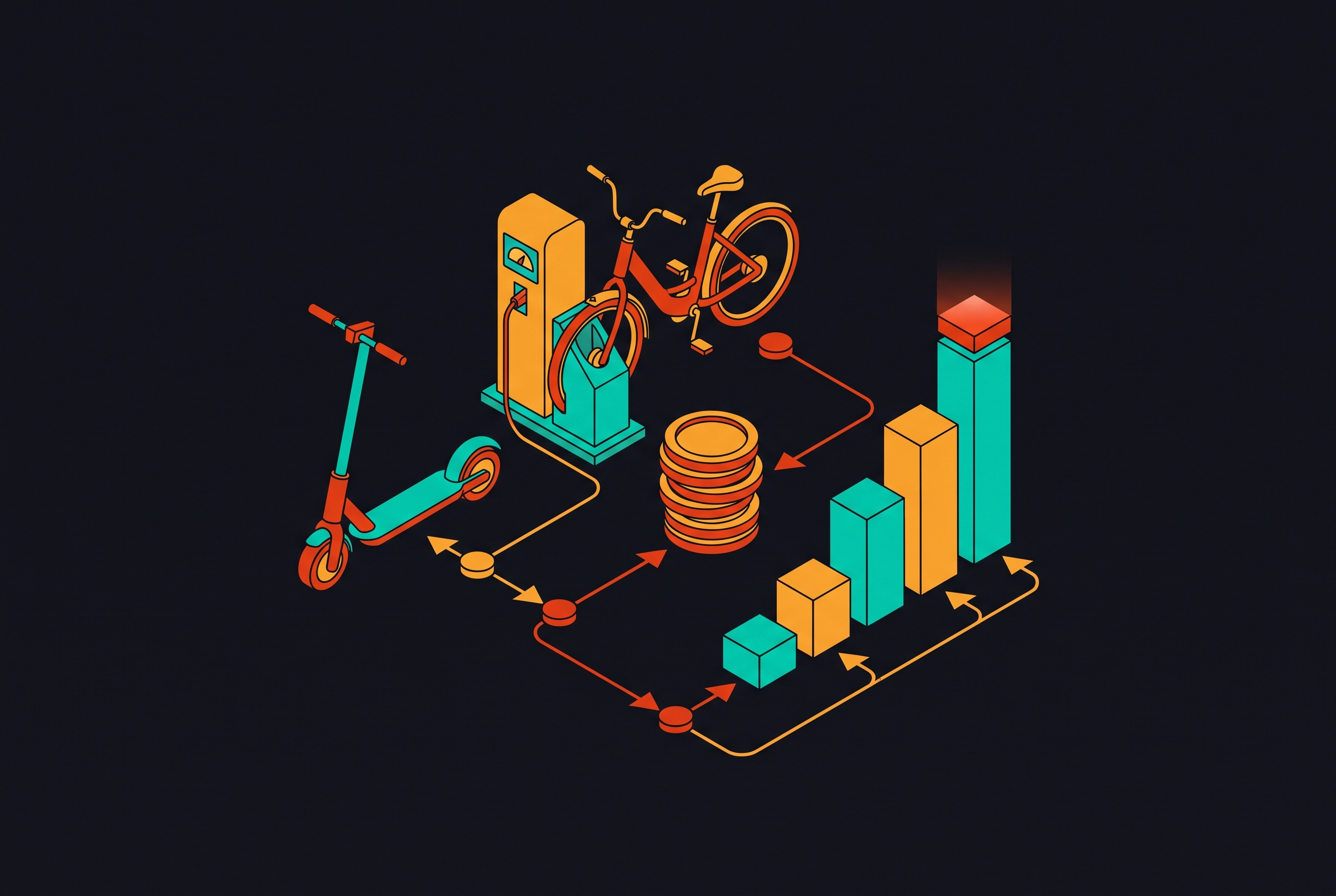
The case for public investment in bike share rests on numbers that hold up, not just vibes about healthier cities. Start with emissions. A 2026 machine-learning mode-choice study of Vancouver's system found that shared bikes substitute for car travel in 54% of trips in the current system, and that share climbs higher in a more heavily used network. The same research translates that into a planning-usable ratio: about 18 shared bikes deliver the same annual tailpipe CO₂ reduction as taking one gas-powered car off the road. That's a number planners can plug directly into an impact model when they're asked to justify a budget line.
Health and productivity gains appear at a bigger scale. A 2025 study from EIT Urban Mobility and Cycling Industries Europe, covering 150 European cities, found that active mobility through bike share prevents chronic disease cases every year, and the hours riders don't lose sitting in traffic convert into real productivity gains for the local economy. Those are the kinds of figures that turn a transportation line item into a public health line item too, which matters when budgets get fought over department by department.
Timing adds one more layer. A 2025 IoT-driven study of Madrid's system, published in Sensors, found that emission savings concentrate during peak bike usage hours, the same hours when car and transit demand also peaks. If a city gets more riders onto bikes during rush hour, it captures a disproportionate share of the environmental benefit, compared to the same number of rides spread across a quiet Tuesday afternoon. None of this happens automatically, though. These gains scale with ridership, and ridership scales with how well the system is designed, sited, and run, which is the rest of this article.
The complications in the modal substitution story
The question of whether bike share adds trips to a city's transportation network or just steals riders from the bus and train gets messier the closer you look, and the real answer is: it depends.
Research on dockless systems gives the optimistic version. Bike share complements rail transit best when the gap between a bike-share station and the nearest transit stop is longer than 1.5 kilometers. At that distance walking takes too long, so a bike becomes the thing that gets someone to the train who otherwise would have just driven the whole way. Solve that gap, and bike share isn't competing with transit, it's feeding it riders.
But a 2025 U.S. multi-city study, using difference-in-differences data from 2014 through 2019, complicates that story. Scooter share pulled riders away from buses and trains, and that substitution effect on transit ridership was statistically significant. Bike share showed a negative effect too, but it was smaller, and it wasn't statistically significant. So the clean story, "bike share always helps transit", doesn't hold up uniformly across cities.
That means the bike share/transit relationship is something to design for, not something to assume will sort itself out. Putting stations within 1.5 km of rail stops makes the system far more likely to pull its weight as a transit partner.
How system architecture drives operational costs, especially rebalancing
Once a system is running, the single biggest recurring cost tends to be rebalancing, moving bikes from where riders left them to where other riders need them. Downtown stations empty out during the morning commute while residential stations fill up with bikes nobody's riding. Someone (usually a van, sometimes a truck fleet) has to go physically move bikes around to keep the system usable, and that process eats hours and staff time every single cycle.
It's tempting to assume better software fixes this. A 2026 study applying reinforcement learning, a more sophisticated form of machine-learning optimization, to Warsaw's 310-station network put that assumption to the test. The algorithm-driven rebalancing cut unfulfilled bike departures (riders showing up to an empty station) by only a modest margin. More strikingly, none of the three active rebalancing policies tested produced a positive modeled net financial benefit, under any of the three economic scenarios researchers ran. In plain terms: smarter software moved the needle a little on service, but didn't pay for itself in any of the scenarios modeled.
Rebalancing gains aren't spread evenly across a network. Of the 310 stations studied, 64 improved under the rebalancing policy, 33 got worse, and 213 saw no change. That's a lopsided result, and it tells planners something practical: dumping money into rebalancing technology across an entire system doesn't help uniformly. The smarter move is identifying which specific stations are the actual bottlenecks and targeting resources there, rather than buying a system-wide fix for a problem that's really concentrated in a handful of locations.
Switching from docked to dockless doesn't make this cost disappear; it just changes its shape. Dockless systems trade "moving bikes between fixed docks" for "collecting bikes scattered across sidewalks, driveways, and the occasional bush," which comes with its own labor and logistics bill. The cost of keeping a system usable doesn't vanish with a different architecture. It relocates.
Who stations serve: the equity problem in siting
Where a city puts its stations ends up determining who actually gets to use the system, and left to pure market logic, that placement tends to favor people who already have plenty of transportation options. Research on spatial access to bike share consistently finds that neighborhoods with lower socioeconomic status and greater racial diversity have worse access to stations. That pattern isn't an accident of geography. It comes from market-driven siting that clusters stations near downtown cores and tourist corridors, the places where ridership (and revenue) looks easiest to capture early.
Some cities have built against that pattern on purpose. Philadelphia's Indego system committed, from its very launch, to putting at least 30 percent of its stations in low-income neighborhoods, the DC Policy Center reports. That's a structural target baked into the plan from day one, not a correction bolted on after a few years of complaints about access.
The 2025 Vienna study offers planners a repeatable method for doing this kind of work elsewhere: run a multicriteria analysis to flag underserved neighborhoods, then apply 15-minute city accessibility modeling to pick station locations at actual points of interest within those neighborhoods, grocery stores, clinics, transit stops, schools. That turns equitable siting from a vague goal into a process with steps a planning department can actually follow.
Vancouver's Downtown Eastside shows what that kind of deliberate siting produces on the ground. Research on the city's system found that bike share helped connect adults living, working, or accessing services in the DTES, a neighborhood marked by high concentrations of poverty and inadequate housing, to opportunities and resources they'd otherwise struggle to reach. Equitable siting is a measurable mobility gain for people who need it most, and the Vienna methodology shows how to replicate it.
Pricing, technology barriers, and the gap between station access and actual use
A station sitting on the right corner doesn't guarantee the right person ever uses it. Two things stand between "station nearby" and "person riding": the technology required to unlock a bike, and the price charged to ride it<sup>1</sup><sup>2</sup><sup>3</sup>.
Research from the Safe Routes Partnership found that a lot of would-be riders see the smartphone requirement itself as the barrier. No smartphone, no app, no bike, regardless of how close the station sits to someone's front door. The same research found that personal outreach, an actual human from the bike share program talking to people at a community center, moved the needle on usage and diversified the rider base more effectively than digital marketing campaigns ever did. Sometimes the fix for a tech problem is a conversation, not an app update.
Pricing adds a second barrier on top of the first. Many systems charge an added per-minute fee for e-bikes, the bikes with pedal-assist motors that make longer trips or hilly routes actually manageable. That surcharge prices out the lower-income riders who'd benefit most from the easier ride, turning the e-bike option into a feature for people who can already afford convenience.
Cities have tried different structural fixes here. Some programs build in income-qualified discount tiers charged trip by trip. Others have leaned on annual membership models, which spread the cost of access over a year, giving lower-income riders a predictable cost for using the system. Both approaches are real options, not just slogans about "affordability."
None of this holds up without sustained funding, though. Grist's reporting notes that some systems have kept their equity programs running while others have cut equity funding and community engagement staff as city budgets tighten, even as ridership numbers from federal data stay low in a lot of these systems. Equity features built into a program's launch don't survive on good intentions alone. They need a budget line that still exists in year five, not just year one.
Sidewalk management, safety infrastructure, and the street-level planning requirements that determine rider experience
A station can sit in exactly the right neighborhood, priced exactly right, and the whole thing still falls apart if the street outside that station doesn't make riding feel safe. Bike share success depends as much on the pavement around the dock as on the dock itself.
Dockless systems bring a specific version of this problem into sharp focus. Without a fixed place to return a bike, riders leave them wherever the trip ends, and that routinely means blocking a sidewalk, a curb ramp, or an accessible path for people with disabilities. An overview of the industry on Wikipedia identifies this as a recurring regulatory headache, one that generates real complaints about urban clutter and draws municipal crackdowns in response. A sidewalk blocked by an abandoned bike is a core planning problem for the city, whether or not the rider who left it there ever thinks about it again.
The planning fixes here sit squarely in a city's own toolbox: protected bike lanes connecting stations to the destinations people actually want to reach, clear rules (and enforcement) around where dockless bikes can and can't be left, and designated return zones that give dockless systems some of the predictability of a docked one without the construction cost. These are the specific, concrete decisions that determine whether a system planners spent years siting and funding correctly actually gets ridden, or just sits there looking good on a map.
Structuring decisions to capture the gains while managing the trade-offs
Every piece of evidence here points toward the same operating principle: bike share rewards planners who treat it as a system of interlocking decisions, not a single purchase. Architecture (docked versus dockless) sets the cost structure before a single bike hits the street. Station placement decides whether the system complements transit or quietly competes with it, with the 1.5 km distance threshold as a working target. Rebalancing investment needs to go where the Warsaw-style data says the bottlenecks actually are, not spread evenly across a network where most stations don't need the help. Siting needs a deliberate method, like the Vienna multicriteria approach, not default placement near downtown cores. Pricing and technology access need their own line items, separate from siting, because a station nearby means nothing to a rider without a smartphone or the cash for a surcharge. And none of it survives contact with real ridership if the streets around the stations don't give riders a safe, unobstructed way to get where they're going.
Planners who treat these as six separate fights can win some and lose others. Planners who treat them as one connected system, where each decision either reinforces or undercuts the rest, give bike share its best shot at delivering the emissions cuts, health gains, and congestion relief the research says are possible. The bikes are the easy part. The planning around them is the job.
Sources
- Implementing Bike-Sharing Stations in Urban Areas: An Integrated Multi Criteria-Accessibility Approach
Provided the 2025 Vienna study framing bike share stations through 15-minute city accessibility modeling and multicriteria analysis for equitable station siting.
- Emission reduction factor (ERF) of urban bike sharing - ScienceDirect
Provided the Vancouver mode-choice study finding that shared bikes substitute for car travel in 54% of trips and the ratio of 18 shared bikes equaling the CO₂ reduction of removing one car.
- Quantifying and Forecasting Emission Reductions in Urban Mobility: An IoT-Driven Bike-Sharing Analysis - PMC
Provided the 2025 IoT-driven Madrid study showing emission savings concentrate during peak bike usage hours.
- Assessing Potential of Bike Share Networks and Active ...
Sourced details on technology and pricing barriers preventing low-income residents from using bike share despite station proximity.
- Effect of shared micromobility on public transit ridership in metro and medium-sized urban areas in the United States: complementary or substitutionary?: Transportation Planning and Technology: Vol 49 , No 3 - Get Access
Provided the 2025 U.S. multi-city difference-in-differences study showing bike share's effect on transit ridership was negative but not statistically significant.
- Bike sharing systems: The impact of precise trip demand forecasting on operational efficiency in different city structures - ScienceDirect
Provided the Warsaw 310-station reinforcement learning rebalancing study showing modest service gains and no positive net financial benefit across any economic scenario.