Evolution of Urbanism in the US and Major Trends
Industrial boom, suburban sprawl, and Sun Belt migration have reshaped American cities.
There is no single story of the American city. There never has been.
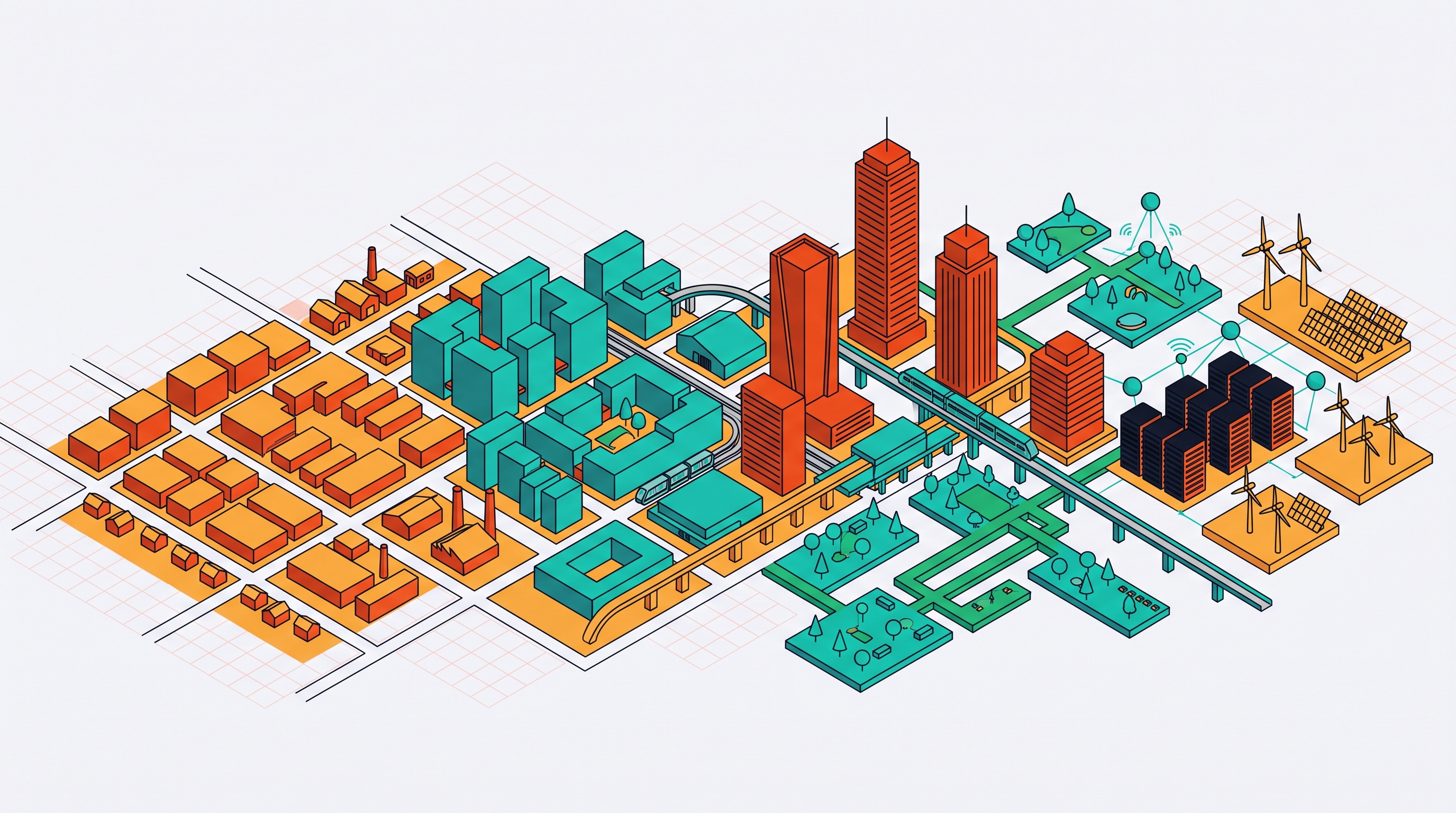
Every few decades, the whole map reshuffles. People chase jobs, space, warmth, affordability, or just something new. Cities that looked unstoppable plateau. Regions that seemed like afterthoughts explode. Understanding those cycles, where they came from and where they're pointing now, gives you a real framework for making sense of what U.S. cities look like today.
From Farm to Factory
Before the twentieth century, most Americans lived in rural areas. Then industrialization changed the math almost overnight.
Factories needed workers. Workers needed to live near factories. Cities like Chicago, Pittsburgh, Detroit, and New York ballooned. Immigration from Europe layered on top of internal rural-to-urban migration, and suddenly the dense, walkable, mixed-use industrial city was the dominant model of American life.
This era produced a certain kind of urbanism, often called the streetcar suburb model in its residential form:
Tight street grids
Transit built around streetcars and rail
Neighborhoods stacked on top of each other by ethnicity, trade, and income
Downtown as the unquestioned center of commerce, culture, and civic life
It worked because it had to. The city existed to serve the factory. The factory demanded density. That was the deal.
The Great Suburban Turn
Then came the car. And the highway. And the GI Bill. And the ranch house.
After World War II, the logic of density stopped being self-evident. The federal government subsidized mortgages, built the Interstate Highway System, and made it financially rational for millions of middle-class families to leave the city for the suburb. White flight accelerated the process. Redlining, the federally sanctioned practice of denying mortgage access by neighborhood, locked Black families out of the wealth-building that came with homeownership.
What followed was a hollowing out of American urban cores that lasted for decades. Like a tree that looks solid from the outside but has been quietly eaten from within. Downtown stopped being a destination. In many cities it became a place people drove through on their way somewhere else.
Here's the thing people miss about suburbanization: it wasn't a planning failure. It was a policy outcome. The choices were deliberate, even when the consequences weren't fully anticipated.
What the Suburbs Actually Delivered
The suburbs gave working-class families a backyard. They gave kids space. They gave families a financial foothold that previous generations never had. That's real, and dismissing all of it as a mistake is too simple.
But the costs compounded:
Car dependency became structural, not optional
Urban tax bases eroded as wealthier residents left, a fiscal impact that compounded with every departing household
Infrastructure sprawled out faster than it could be maintained, driven in part by induced demand from the roads themselves
Social segregation calcified into geographic segregation
The suburb wasn't the death of the city. It was a massive diversion of resources, attention, and population away from it. The city didn't die. It just got starved for a few decades.
The Urban Renaissance (and Its Ceiling)
By the 1990s and into the 2000s, something started reversing. Young professionals moved back into city centers. Crime had fallen dramatically in most major metros. Walkability became a selling point again, one that eventually got quantified into metrics buyers actively searched for. Neighborhoods that had been written off for a generation started attracting restaurants, galleries, and eventually tech offices.
New York, San Francisco, Boston, Washington D.C., Seattle. These cities looked like they had figured something out. Urban living was desirable again. Density was cool again.
This era had real energy. It also had a real ceiling.
The cost of living in revitalized cores rose fast. Often faster than wages. The very desirability that drove the renaissance made it unaffordable for most people. Gentrification displaced longtime residents, a process researchers now track as involuntary displacement. The story of urban revival was, for a lot of families, a story of being priced out of a neighborhood they'd lived in for thirty years. The city finally got its groove back, then promptly charged everyone too much to enjoy it.
And then the pandemic hit and stress-tested the whole thing.
Remote Work and the Great Re-Sorting
COVID-19 didn't invent new trends in American urbanism. It just stomped on the accelerator.
The high-cost, high-density coastal cities had already been losing working and middle-class residents before 2020. Remote work removed the last reason many people stayed. If you didn't need to commute, the calculus of paying enormous rent in a small apartment near an office you never visited stopped making any sense at all.
The re-sorting that followed is still playing out:
Sun Belt metros like Austin, Phoenix, Nashville, Raleigh, and Tampa saw population growth accelerate sharply
Coastal gateway cities like San Francisco and New York, long the default destinations for high-skilled workers, saw net population losses in the early pandemic years
Mid-sized interior cities like Boise, Spokane, and Knoxville saw demand they had simply never experienced before
Remote workers brought coastal salaries to local housing markets, which was great for sellers and genuinely complicated for everyone else
This wasn't just people chasing warmth. It was people chasing a better trade-off between cost, space, and quality of life. For the first time in a long time, geography felt negotiable.
Sun Belt Growth Is Real, But the Story Is Messier Than "It's Sunny and Cheap"
Sun Belt cities deserve a closer look. The growth is real. The reasons behind it are more layered.
A few forces working together:
Lower cost of living. Housing is the headline, but it's also taxes, utilities, and day-to-day expenses. Families stretching a dollar go further in Charlotte than in Chicago.
Business-friendly policy. Several Sun Belt states have attracted corporate relocations with lower regulatory burdens and favorable tax structures. Jobs bring people. People bring more jobs.
Population momentum. Younger demographic profiles in many Sun Belt metros mean higher birth rates and more household formation. Growth begets growth, and the numbers compound.
Infrastructure investment. Cities like Austin and Phoenix have invested heavily in roads, utilities, and amenities that support rapid expansion. The model is still largely car-dependent, but the pipes and roads are newer.
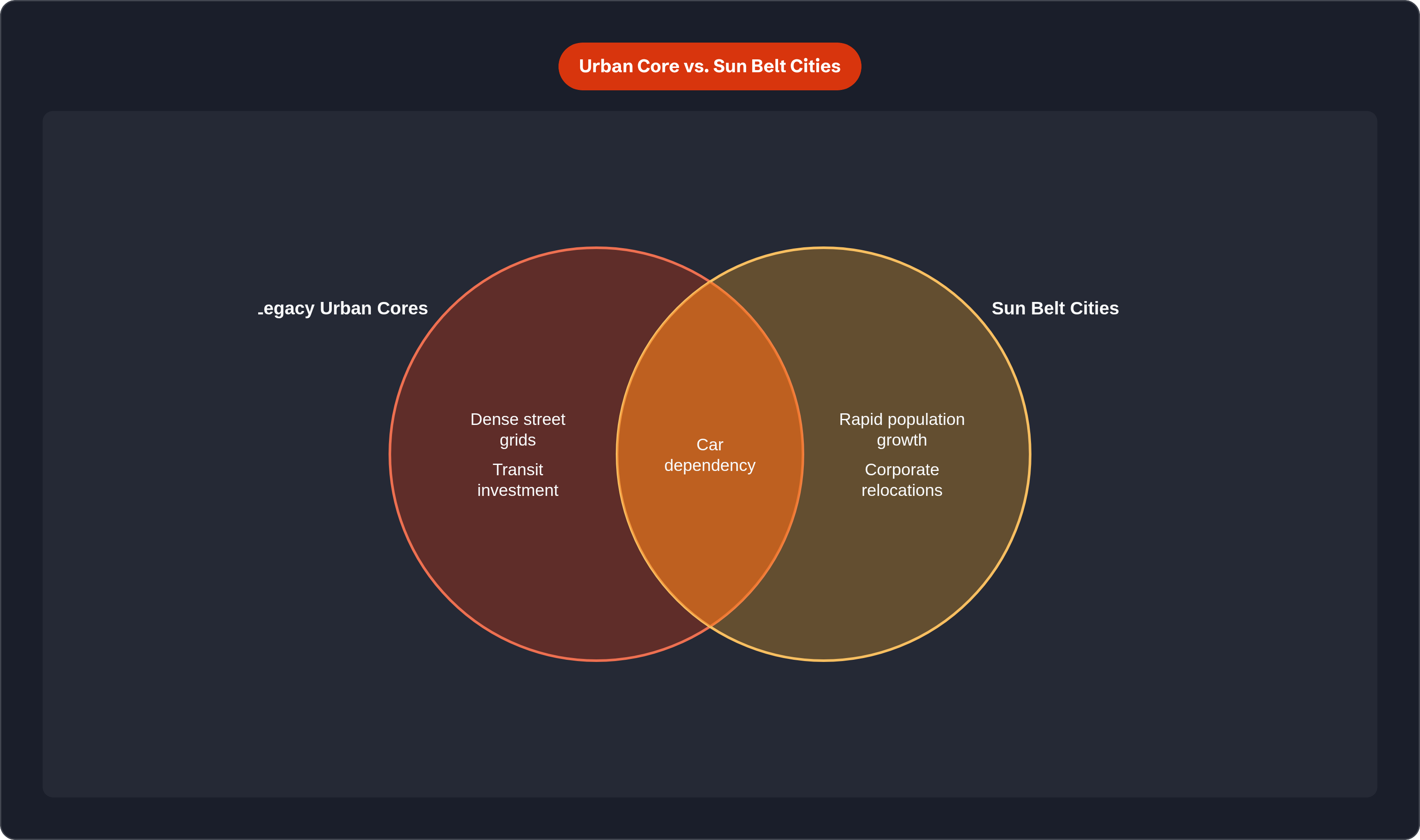
The catch is that Sun Belt growth has largely just replicated the suburban model in a new geography. Sprawl, car dependency, and affordability pressures are following the growth exactly as they did in the postwar suburbs. Different zip codes, same blueprint.
Urban Core Stagnation Isn't Universal
It would be easy to read the Sun Belt story as proof that the traditional American city is finished. That reading is too clean.
Some legacy urban cores are adapting. Minneapolis, Denver, and Washington D.C. have invested in transit, mixed-use zoning, and housing density in ways that are quietly keeping them competitive. They aren't growing at Sun Belt rates. But they aren't hollowing out either. There's a real difference between slow growth and decline, and it matters.
The cities struggling most are the ones that depended on a single industry, a single era, or a single employer base that no longer exists at scale. Detroit is the most cited example, but it's not alone. Smaller industrial cities across the Rust Belt face the same structural problem: the economic rationale that built them is gone, and building a new one is genuinely hard work with no guarantee of payoff. The factory isn't coming back. The question is what comes next, and not every city has a good answer to that yet.
The Zoning Conversation Nobody Wants to Have
Here's the uncomfortable throughline across almost every urban challenge in America: land use policy.
Zoning laws, often written decades ago to enforce suburban development patterns and limit density, have made it legally impossible to build the kind of housing and mixed-use neighborhoods that people actually want in most American cities. The market wants more housing. Policy often prevents it. That gap is where a lot of the affordability crisis lives.
This is changing. Slowly. Several states have passed legislation to allow more density near transit, eliminate single-family-only zoning through upzoning, or streamline permitting. It's not fast, and it's not universal, but the conversation has shifted in a way it genuinely hadn't in a generation.
The cities that figure out how to build more housing in the right places, near jobs, transit, and amenities, will be better positioned for the next wave of growth. The ones that don't will keep exporting residents to places that will. That's not a prediction. It's already happening.
What the Next Era Looks Like
Predicting the future of American cities has a poor track record. Plenty of smart people looked at the postwar boom and thought density was dead forever. Plenty of smart people looked at the urban renaissance of the 2000s and treated the Sun Belt as a footnote. Everyone has been wrong before. Everyone will be wrong again.
A few forces will matter a lot regardless of how things shake out:
Climate. Heat, water scarcity, and wildfire risk are already shaping migration patterns. Phoenix faces long-term water questions that are not abstract, and urban heat island effects are already measurable in its expanded footprint. Parts of the Southeast face increasing flood risk. When those costs start showing up in utility bills and insurance premiums, the calculus of living there changes.
Remote work staying power. Even if hybrid becomes the norm, the geographic flexibility that untethered workers gained won't fully disappear. Location decisions will stay more negotiable than they were before 2020.
Affordability pressure moving inland. The Sun Belt's cost advantage is already narrowing in the most popular metros. Austin and Nashville are catching up to coastal prices faster than most people expected. The next wave of migration will push into less obvious cities as a result.
Infrastructure age. Legacy cities have aging infrastructure. Growing cities are building fast and sometimes not well. Both create long-term liabilities that will eventually come due.
American urbanism has always been a story of people voting with their feet. The forces driving those votes keep shifting. What doesn't shift is the underlying logic: people go where opportunity and livability intersect. Every era has just redefined where that intersection sits.
The current era hasn't finished reshuffling yet. The next chapter is already being written. It just hasn't announced itself.
Sources
- https://www.citygov.com/article/where-the-nation-is-growing-the-new-power-map-of-us-cities
Provided context on Sun Belt metro growth patterns and the shifting geographic power map of U.S. cities.
- https://www.census.gov/newsroom/press-releases/2025/vintage-2024-popest.html
Supplied population estimate data underlying claims about coastal city losses and Sun Belt gains.
- https://www.census.gov/library/stories/2026/05/major-city-outer-edge-growth.html
Informed the discussion of outer-edge suburban sprawl replicating in Sun Belt growth areas.
- https://thephiladelphiacitizen.org/new-urban-order-cities-census-population-decline/
Informed the section on legacy urban cores experiencing population stagnation or decline.
- https://thephiladelphiacitizen.org/the-new-urban-order-six-trends-transforming-cities-2025/
Provided framing for several major trends reshaping U.S. cities including remote work, zoning reform, and affordability pressures.
- https://www.nber.org/system/files/working_papers/w13543/revisions/w13543.rev0.pdf
Informed the historical discussion of suburbanization, white flight, and the fiscal erosion of urban tax bases.
- https://www.ebsco.com/research-starters/history/white-flight
Provided background on white flight and redlining as drivers of postwar urban hollowing.