What is the "Smart City" and why aren't there more around?
Technology alone cannot fix broken cities without strong fundamentals first.
Cities are growing faster than the pipes, roads, and power grids built to handle them. As of 2024, 57.5% of the global population lived in urban areas. That number hits 60% by 2050. The pressure to make cities work better shows up in packed buses, gridlocked intersections, and water systems running past capacity. It is a structural problem, and planning oversight alone cannot resolve it.
The case for smart cities rests on real outcomes from real places.
- Singapore's machine-learning models predicted bus crowding with 92% accuracy in 2025, cutting average commute times by 11 minutes.
- Predictive maintenance in Singapore's public housing cut service costs by 15%.
- Munich's open-source urban digital twin processed 2.3 billion sensor readings to improve snow-removal routes, cutting fuel use by 18% and saving EUR 4.2 million in overtime.
These are running cities with numbers you can check, which is why investor and government interest has held. Market estimates for 2025 range from roughly $700 billion to nearly $800 billion, depending on what you count. That range mostly reflects disagreement about definitions.
The momentum is real. The following sections examine why it has produced fewer cities that actually work this way than expected, given the scale of investment involved.
What Top-Ranked Smart Cities Share
The IMD Smart City Index 2023 put Zürich, Oslo, Canberra, Copenhagen, and Lausanne at the top. Before looking at what technology they use, it is worth noting what else they share.
All five are mid-sized. All five are wealthy. All five were already running well before any smart technology was layered on. The technology made good things better, but it did not fix broken fundamentals. Adding technology on top of poorly functioning systems does not repair them.
Zürich has topped the IMD index four years running. Residents there report a life expectancy of 84, against a global average of 70. 80% rate public transport as satisfactory. 71% say finding information about local government decisions is easy. Those are quality-of-life numbers, and they reflect conditions that existed before smart city initiatives were introduced.
Singapore is the clearest example of a smart city operating at real scale. More than 100,000 IoT (Internet of Things) sensors are deployed across the city, reading air quality, traffic, noise, and energy use, all tied together under a national strategy that launched in 2014.
Barcelona took a more targeted approach. Rather than trying to rebuild everything, it focused on specific pain points: parking and street lighting. Smart lighting adjusts based on whether people are nearby, and a parking app reduces the time drivers spend searching for a spot. The outcomes are citizen-facing and straightforward to measure.
The 2025 CIMI rankings put Hong Kong, Dubai, Singapore, Abu Dhabi, and Seoul at the top for raw technology use. But when the index measured human capital, social cohesion, and governance quality, most of those cities ranked lower. Technological capability and genuine urban quality are related but not the same thing.
Why Greenfield Smart Cities Keep Failing
The greenfield approach made sense on paper. Start with an empty site, wire everything from the ground up, and avoid the difficulty of retrofitting. In practice, the results have been consistently disappointing.
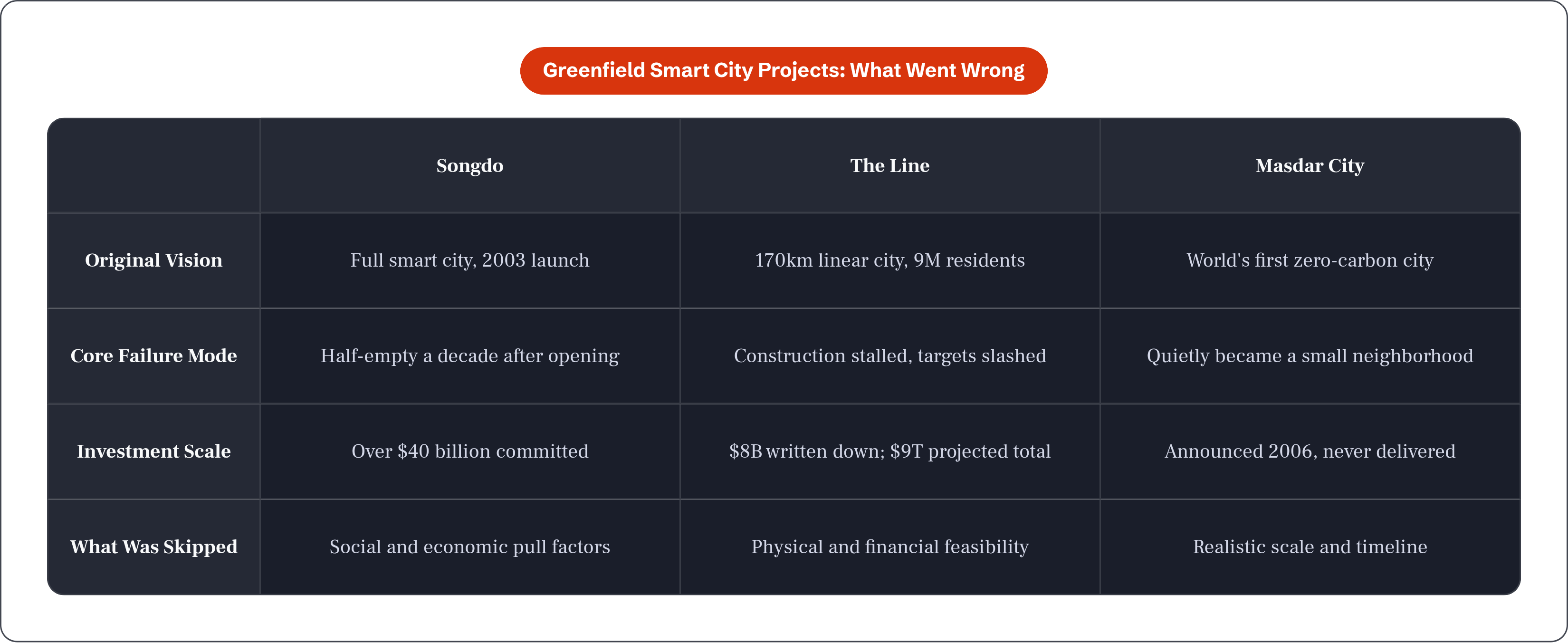
Songdo, South Korea is the longest-running example. Construction started in 2003, and full completion is not expected until 2030. More than $40 billion has gone in. The integrated digital systems and renewable energy infrastructure built from day one represent genuine advantages that cannot easily be added to an existing city later.
And yet Songdo was roughly half-occupied a decade after it opened. People did not move there in the numbers the plans assumed. Smart infrastructure alone does not create urban life. People move to cities for jobs, culture, and existing social connections, and sensor density cannot substitute for any of those things.
The Line in Saudi Arabia scales this problem considerably further. Announced as a 170-kilometer linear city for 9 million people with zero cars and zero carbon emissions, by late 2025 only a 2.4-kilometer section had been built, with no residents. The target population was revised from 1.5 million by 2030, down to 300,000, then to 100,000. The sovereign wealth fund wrote down $8 billion, and internal evaluations put the full project cost near $9 trillion, roughly nine times Saudi Arabia's annual GDP. The project also involved forced displacement of the Howeitat tribe and reported poor working conditions for construction laborers.
Masdar City in the UAE was announced in 2006 as the world's first zero-carbon city. It has since become a small neighborhood.
Greenfield projects that have succeeded tend to be modest in scope and designed to adapt over time. Those that launched with sweeping visions have generally produced costly and instructive failures.
The Retrofitting Problem Holding Cities Back
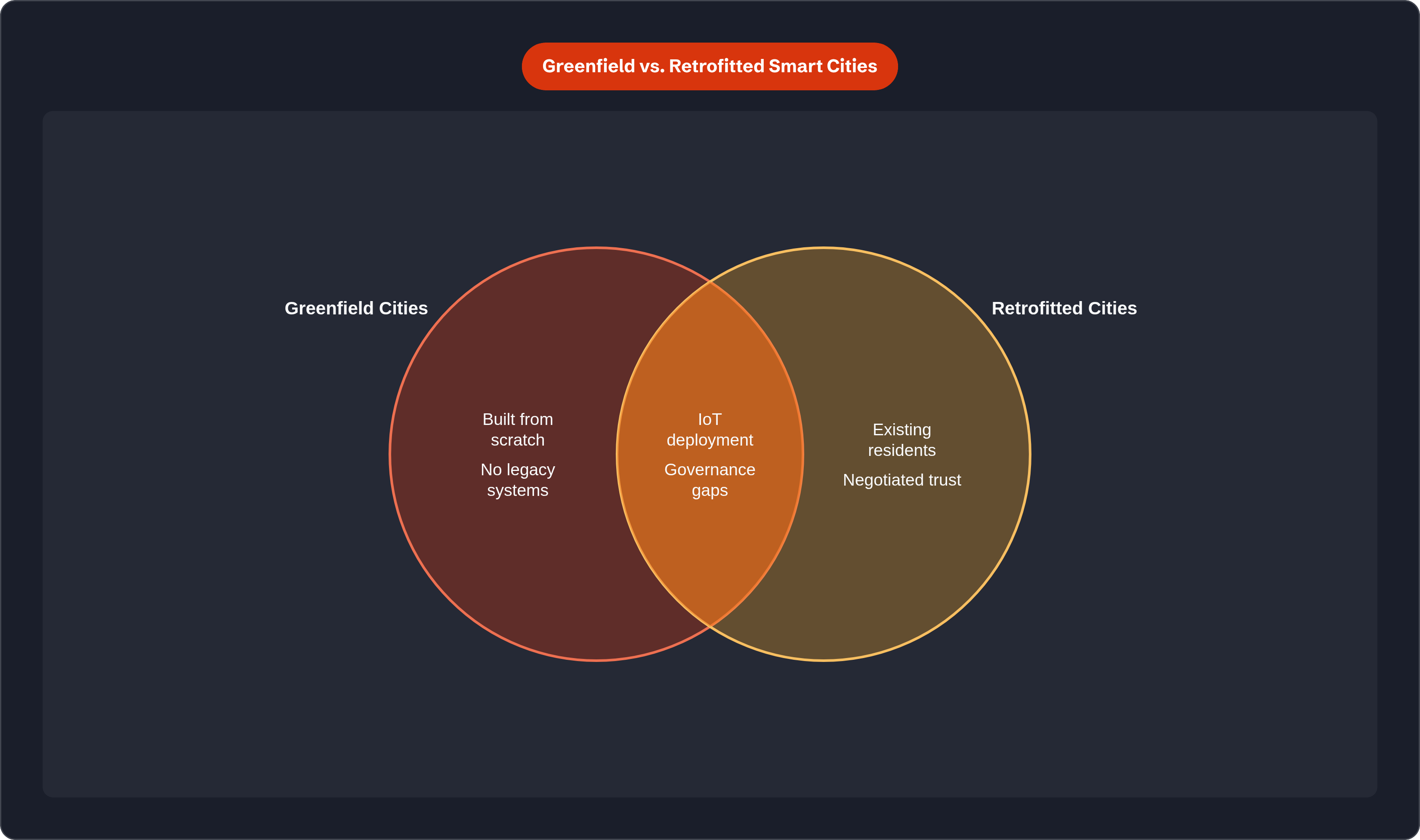
What Songdo built in from the start is precisely what most cities cannot obtain. Installing fiber, sensors, and connected systems into a city already full of people, buildings, zoning constraints, and competing priorities is categorically harder than building on cleared land. It requires working around residents, businesses, and existing infrastructure that cannot simply be paused or relocated.
The physical requirements are significant: cameras, poles, terminals, and connected utilities, each requiring installation, power, ongoing maintenance, and acceptance from the communities they affect.
The IT side presents equal challenges. City-wide data collection requires systems capable of handling information at a scale most legacy municipal software was never designed to manage.
The problem compounds across sectors.
- Transportation, energy grids, water networks, and waste management each run on their own legacy architecture.
- A city that modernizes one sector while leaving others disconnected captures only a fraction of what the investment was intended to deliver.
- Systems built by different vendors at different times rarely communicate without significant integration work, and interoperability standards are rarely established before contracts are signed.
Vendor lock-in compounds these difficulties. When a city builds on one vendor's proprietary platform, it becomes dependent on that vendor's pricing, product roadmap, and continued operation. That limits a city's ability to adapt as technology changes.
A 2024 review in the journal Smart Cities found that progress directly tied to smart city work is limited, and that the concept's reputation rests on a small number of highly successful pilots rather than broad or repeatable rollout.
Surveillance Concerns That Have Derailed Projects
The clearest example is Sidewalk Toronto. Alphabet's Sidewalk Labs proposed a smart development on Toronto's waterfront. Privacy concerns about data collection in public urban space grew quickly. The project was cancelled in 2020. Sidewalk Labs cited economic uncertainty, but the political conditions had shifted well before that decision.
A Harvard Kennedy School analysis identified three factors that contributed to the project's failure: insufficient public engagement early on, no clear data governance framework establishing who owned and controlled the data, and a widespread perception that a private company was setting the terms for the use of public space. None of those are technology problems.
The underlying tension is straightforward. Smart cities generate efficiency gains by collecting continuous, detailed data about how people move through and use the city. The same data that improves bus routing also enables surveillance. Those are the same dataset applied to different purposes, and distinguishing between them depends entirely on who controls the data and under what rules.
Citizens and advocates increasingly distinguish between city-controlled data infrastructure and privately run platforms that profit from urban data. That distinction sits at the center of most public-private partnerships in this space, and projects that do not address it clearly tend to face the kind of opposition that ended Sidewalk Toronto.
Regulation varies considerably by location. GDPR in Europe sets strict data-protection requirements that shape system design from the outset. Other regions have far fewer constraints. What is technically possible and what is legally permitted differs enough by geography that scaling any city-wide data approach across borders is complicated.
Public trust, once lost on a project, takes time to rebuild. Sidewalk Toronto made other city governments more cautious about similar arrangements.
The Governance Gap Technology Cannot Fix
A smart city requires coordinated decisions across transportation, utilities, public safety, and social services. In most cities, those are separate departments with separate budgets, separate vendors, and separate lines of political accountability. Reaching agreement across those divisions takes time, and agreeing on a shared data platform takes considerably more.
Investments that cross departmental lines also require political alignment that is difficult to sustain across election cycles. A project that made sense under one administration may not survive the next. The technology is indifferent to that reality; municipal politics are not.
Procurement systems in most city governments were not designed for the iterative, software-style development that smart city projects actually require. Cities commit to long contracts before they fully understand what they need, then find themselves locked into systems that no longer fit their circumstances. That is a governance problem that is often misidentified as a technology problem.
The 2024 Smart Cities literature review noted that the pace of innovation in this space is slower than in other technology sectors. Urban governance moves at the pace of public institutions, and that is not going to change.
Zürich and Singapore function well partly because their governance structures are unusually coherent by global standards. That coherence is a precondition for the technology to be effective, not something that technology can produce.
Cities in the Global South face the same challenges with less margin for error. Governance fragmentation, tighter budgets, and more significant infrastructure gaps all present simultaneously. Africa is projected to see the highest smart city investment growth rate globally through 2031, at 18.09% CAGR per Mordor Intelligence. The governance capacity to absorb and coordinate that investment is the variable most market projections do not adequately address.
Why the Investment Gap Still Persists
The market is large and growing. The ambition behind it is genuine. The results in cities that have implemented smart systems well are real and measurable. The concept works. It is simply harder to execute than early promotional framing suggested. The technology has not failed; the surrounding conditions have proved more demanding than expected.
The greenfield failures share a common pattern. Songdo's occupancy gap, The Line's stalled construction and repeatedly revised targets, and Masdar's scaled-back ambitions all reflect a tendency to optimize for technical design over the social and economic realities that determine whether people actually choose to live somewhere.
The cities getting retrofitting right, including Singapore, Zürich, and Barcelona, share something the greenfield projects lacked: an existing relationship with residents. That relationship is what allows data collection to be negotiated and trusted rather than imposed.
The most durable gains come from targeted work with clear, visible outcomes for the people who live there. City-wide platform deployments justified primarily by efficiency projections that residents cannot observe in their daily lives tend to underdeliver.
The real question for any city considering this kind of investment is whether the governance, trust, and cross-department coordination are already in place to support it. Those conditions take longer to build than any sensor network and cannot be purchased in a procurement cycle or recovered quickly after public trust breaks down. Truly smart cities remain rare for this reason. The technology was never the primary obstacle.
Sources
- https://www.ube.ac.uk/whats-happening/articles/smart-cities/
Provided the Zürich resident satisfaction figures for public transport and government transparency used in the top-ranked cities section.
- https://datasmart.hks.harvard.edu/news/2025/05/lessons-failed-tech-urbanist-dream
Provided the Harvard Kennedy School analysis identifying the three factors behind Sidewalk Toronto's failure: poor public engagement, absent data governance, and private-company control of public space.