Distributed Energy Resources Management Systems
Software coordinates thousands of rooftop solar panels and batteries as one grid resource.
The grid used to be simple: a few big power plants pushed electricity one direction, out to homes and businesses. Solar panels, home batteries, EVs, and wind farms broke that model entirely. Power now moves in every direction, ownership is split across millions of individual behind-the-meter rooftops and garages, and no single utility can see all of it at once. Distributed Energy Resources Management Systems, DERMS for short, are the software layer built to solve that mess, and understanding how they work is the first step to evaluating any vendor in this space.
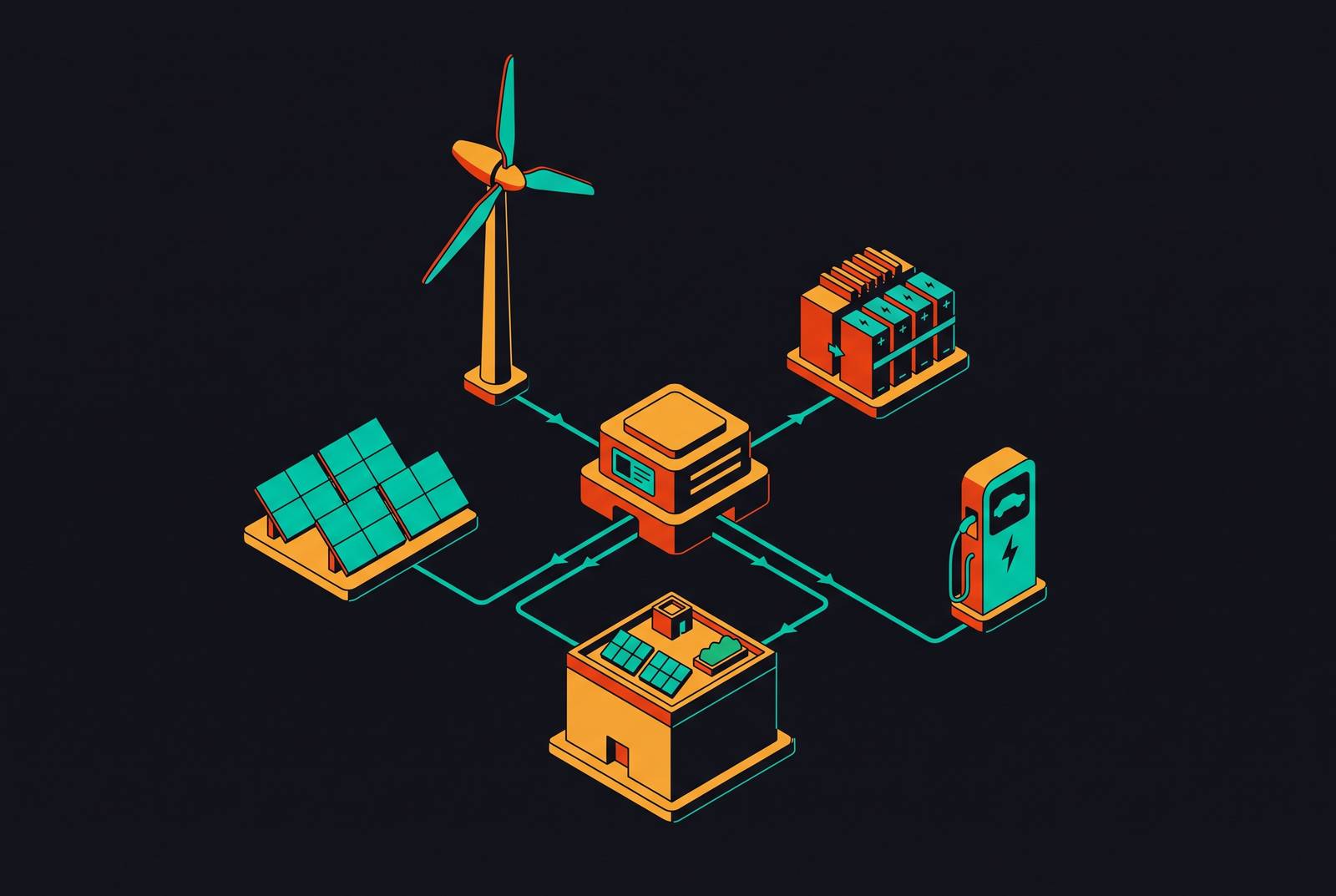
Here's the friction in plain terms: grid operators need supply and demand to match, second by second, or the lights flicker and equipment fails. That's always been true. What's new is that thousands of small, intermittent, non-utility-owned devices are now part of the supply picture, and none of them called ahead to say when they'd be generating or drawing power. A DERMS platform manages, controls, and optimizes those assets: solar arrays, wind turbines, batteries, EV chargers, so the network sees one coordinated resource instead of a few thousand unpredictable ones. It smooths peaks and valleys, helps predict prices, and keeps distribution reliable. It doesn't replace the grid. It makes the grid's messiest new residents behave.
One wrinkle worth flagging before going further: nobody in the industry fully agrees on what "DERMS" even means. Alignment around definitions matters because a lot of the terms are still fluid. DERMS gets conflated with **Advanced Distribution Management Systems** (ADMS) constantly, and that confusion has real consequences when you're trying to compare vendors or write an RFP.
The two distinct product types most discussions collapse into one
Most conversations about DERMS lump two very different products into one bucket. They shouldn't.
**Grid DERMS** is what utilities use to manage assets they actually own: utility-scale solar farms, grid-connected battery installations, that sort of thing. **Grid-Edge DERMS** handles the opposite problem: behind-the-meter assets in homes, offices, and factories that the utility doesn't own and can't directly command. Different buyer, different regulatory trigger, different integration headache, different vendor list. Treating them as one product category is like treating a school bus and a rideshare app as the same transportation solution because they both move people.
The Guidehouse Insights Leaderboard on DERMS Providers defines the category as "a software platform capable of intelligently managing, controlling, and optimizing DER aggregations to provide grid services," and it splits the two types out explicitly, for good reason. Grid-Edge platforms tend to be device-agnostic and API-first, orchestrating dozens of hardware brands, thermostats, inverters, EV chargers, batteries, through one interface, since nobody's going to build a custom integration for every smart thermostat on the market.
Then there's the ADMS overlap. Hitachi Energy, for instance, builds DERMS functionality directly into its Network Manager ADMS rather than selling it as a separate product. That's a legitimate design choice, but it means the line between "DERMS" and "ADMS" gets blurrier every year, not clearer.
How DERMS works under the hood: forecasting, optimization, and real-time control
Strip away the marketing decks and DERMS does three things: watch, predict, and act.
Real-time visibility comes first, seeing what every connected asset is doing right now. Forecasting comes second, predicting what generation and demand will look like in the next hour, day, or week. Dispatch comes third, either automatically or with an operator's sign-off, telling flexible resources when to charge, discharge, or throttle back.
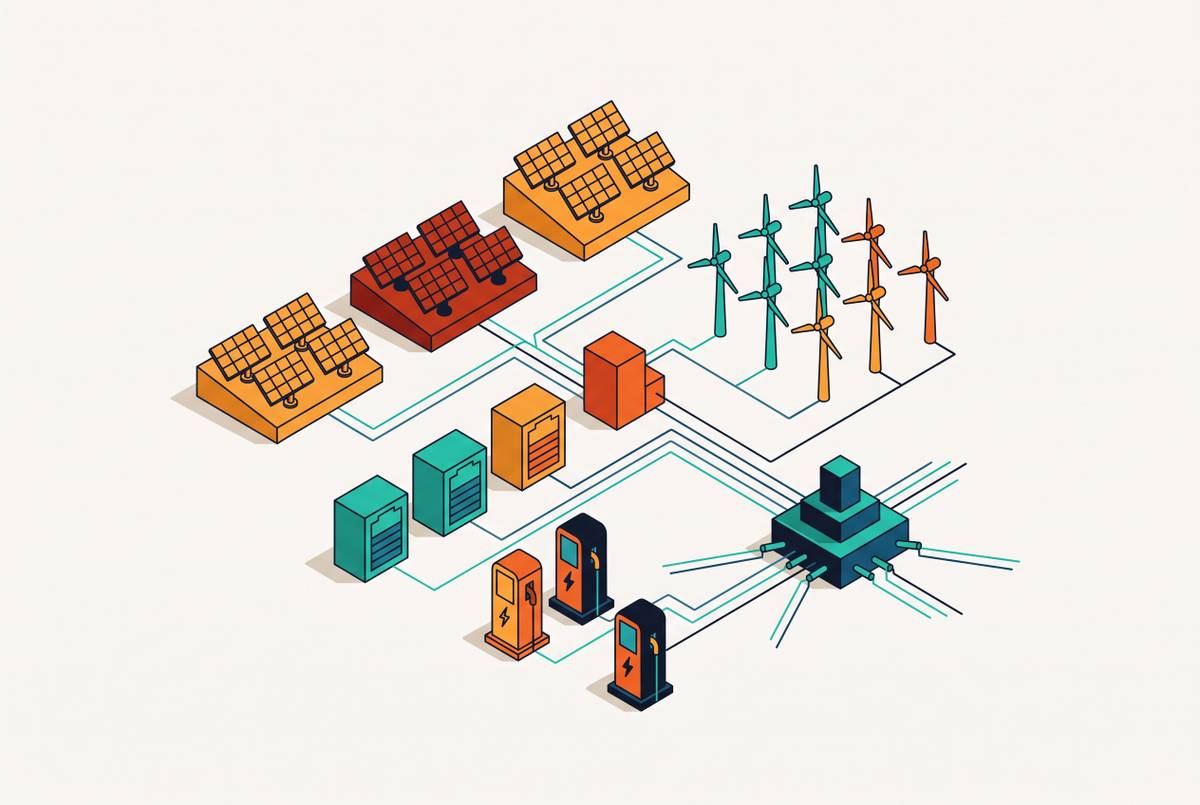
None of that happens in isolation. DERMS platforms plug upward into ADMS, SCADA, and EMS systems, the tools grid operators already rely on, and downward into inverters, thermostats, EV chargers, and batteries through open communication protocols, coordinating DER aggregation across all of them. AI and predictive algorithms do the heavy lifting in between: optimizing performance, squeezing more solar onto a circuit without overloading it, and supporting microgrids that need to keep running when the main grid doesn't.
Siemens launched its Gridscale X Flexibility Manager in November 2025, and it's a decent snapshot of where this is headed. It lets distribution operators forecast congestion before it happens and activate EVs, heat pumps, and batteries to head it off. Siemens claims that can lift usable grid capacity by up to 20% and cut infrastructure reinforcement spending by up to 40%. Whether every deployment hits those numbers is a separate question, but the direction, avoid the concrete pour if software can do the job instead, is the whole point of the category.
The end state a lot of this is building toward is the Virtual Power Plant: thousands of small assets acting like one big power plant. AutoGrid's platform currently manages more than 6,000 MW of flexible capacity worldwide, up 34% from its 2024 baseline. And this isn't just theory. Itron and Xcel Energy have been working with Tesla in Colorado, using Itron's IntelliFLEX DERMS to balance grid load with solar power stored in Tesla Powerwall home batteries. That's Grid-Edge DERMS running in production, not in a slide deck.
The scale of the DER buildout that makes DERMS a necessary infrastructure layer
The numbers behind this buildout are the real reason DERMS stopped being optional. Between 2024 and 2028, DER capacity in the US alone is expected to grow by 217 GW, compared to 310 GW of new bulk generation over the same stretch. Distributed resources are catching up to traditional power plants in raw capacity added, which is a genuinely strange thing to type out and have it be true.
Globally, renewable capacity additions are projected to hit nearly 4,600 GW between 2025 and 2030, with distributed solar leading a big share of that growth. Solar PV is already the dominant application inside the DERMS market itself: MarkNtel Advisors puts the solar PV segment at roughly 42% of the global market in 2026.
More solar and batteries on a distribution circuit eventually runs into a hard physical wall: **hosting capacity**, the limit hosting capacity analysis is specifically designed to push outward. Circuits weren't built for two-way power flow at this density, and without software coordination, utilities hit that wall and have to pay for costly upgrades, new transformers, new lines, the expensive stuff. The pitch from vendors is that software coordination can unlock meaningful additional distribution capacity and eliminate the need for some of that spending entirely. That's the pitch in one sentence: DERMS isn't just software, it's a capex deferral tool, a way to defer capital expenditure that would otherwise show up on a rate case.
Industrial manufacturers are leaning into this too, adopting DERMS to integrate on-site solar and combined heat and power systems, partly to manage energy costs and partly because their share of total DER assets keeps climbing.
The regulatory environment that is forcing utility action, particularly FERC Order 2222
If demand for DERMS has a single regulatory parent, it's FERC Order 2222. Approved in 2020 and effective February 2022, it lets distributed energy resources get organized by aggregators and participate directly in wholesale energy markets. Before this order, a home battery had basically no path into a wholesale market. After it, aggregators can bundle thousands of them and bid that capacity in.
Rollout has been slow and uneven, which tracks for anything involving multiple regional grid operators. CAISO finished its compliance work in November 2024. NYISO's full implementation is slated for the end of 2026. ISO New England's energy and ancillary services markets are set to bring Order 2222 online on November 1, 2026. PJM, NYISO, and SPP are all still working through compliance filings. Meanwhile states including Ohio, Pennsylvania, Colorado, Illinois, and Oregon are separately pushing interconnection reforms, virtual power plant programs, and microgrid frameworks, as of early 2026.
Underneath all of it sits a quieter problem: data doesn't talk to itself. The Common Information Model, or CIM, is one framework for DER data exchange, but interoperability standards are still being hashed out across the industry.
Europe has its own version of this pressure. EU network codes require distribution operators to keep the grid reliable even as renewable penetration climbs, and the European Grids Package published in December 2025 and under negotiation through 2026 is speeding up permitting and digitalization on that side of the Atlantic. In the US, the Department of Energy published its Distributed Energy Resource Interconnection Roadmap in January 2025, addressing how the US approaches DER integration going forward.
For utilities, this regulatory calendar is the sales calendar. Utilities across affected regions deploy DERMS for wholesale market aggregation specifically because FERC Order 2222 requires it. Texas, running under ERCOT, sits outside FERC jurisdiction entirely and follows its own state-level DER framework instead. Procurement cycles at major utilities tend to be long, with compliance checkpoints built into the process. Vendors selling into this space aren't just selling software. They're selling into a regulatory clock.
Where adoption is concentrated today and which regions are building fastest
North America currently holds the largest share of the DERMS market, 39.40% in 2025 according to Polaris Market Research, and 39% in 2026 per MarkNtel Advisors. Smart grid investment, supportive state programs, and FERC Order 2222 compliance pressure all point in the same direction here.
Asia-Pacific is growing faster than anywhere else. Kaiser Research put the region's 2025 revenue share at 34.29%, driven by rapid solar and wind buildout, rising electricity demand, and government-backed smart grid investment across China, India, Japan, and Australia. DataM Intelligence projects Asia-Pacific growing at a 16.9% compound annual rate through 2033. China is doing much of the heavy lifting in that regional growth story, through renewable expansion and state-supported smart grid rollouts.
Inside the market itself, software is winning decisively over hardware and services. Grand View Research put the software segment at roughly 68% of global DERMS revenue in 2025, and cloud or SaaS-based DERMS platforms are the fastest-growing deployment model, expected to grow around 21% annually between 2025 and 2034. Grid optimization and stability is the leading use case, accounting for roughly 30% of 2025 revenue per the same firm.
Worth a flag here: market size estimates vary a lot depending on who's counting. Polaris puts 2025 at $1.48 billion, growing to $6.62 billion by 2034 at an 18.14% annual rate. DataM Intelligence puts 2025 at $546.10 million, reaching $1,484.00 million by 2033 at 15.0% annually. MarkNtel has 2025 at $0.78 billion, climbing to $3.6 billion by 2032 at 26.23% annually. None of these firms are measuring the exact same thing the exact same way, so treat any single number as directional, not gospel, and always check which source it came from.
The vendors building this market and how their approaches differ
Gartner published its Market Guide for Distributed Energy Resource Management Systems in June 2025, written by Lloyd Jones and Jo-Ann Clynch, with Itron and CGI named as Representative Vendors.
The independent, pure-play vendor tier has shrunk considerably through acquisition. Schneider Electric bought AutoGrid in May 2022. Generac picked up Enbala back in October 2020. GE Vernova acquired Opus One Solutions in February 2023. Emerson bought OSI in October 2020, which later fed into AspenTech in May 2022. Four acquisitions, four fewer standalone options on a buyer's shortlist.
Among the vendors still standing on their own or folded into bigger platforms, the approaches diverge quite a bit. Siemens leads with its Gridscale X portfolio, combining DERMS, ADMS, digital twin modeling, and AI-driven planning under one roof, with the Flexibility Manager module targeting operators managing EVs, heat pumps, and batteries. Schneider Electric, through its AutoGrid acquisition, has positioned itself as a dominant force in Virtual Power Plants and flexibility management, with that 6,000-plus MW footprint mentioned earlier. Hitachi Energy takes the opposite architectural bet from Siemens' modular approach, folding DERMS directly into its Network Manager ADMS so real-time optimization and control run through a single interface rather than a bolted-on layer.
Itron built its name with IntelliFLEX, a Grid-Edge DERMS product giving utilities visibility and control over behind-the-meter assets, proven out in that Xcel Energy and Tesla Powerwall deployment in Colorado. CGI, named in the 2025 Gartner guide, sells CGI OpenGrid DERMS as part of its broader OpenGrid360 portfolio. ABB has carved out a niche as the leader in what's called "Hard-Asset" DERMS, hardware-integrated systems that tie physical battery storage tightly to digital control.
Other names showing up regularly in analyst coverage include General Electric, Oracle, Mitsubishi Electric, Emerson, Enel, Doosan, and EnergyHub. When comparing any of these, four questions cut through the noise fast: is it pure software or hardware-embedded, does it serve Grid or Grid-Edge use cases, does it stand alone or live inside an ADMS, and how deep does the AI forecasting actually go versus how deep does the marketing say it goes. Ask all four before you shortlist.
The real barriers slowing deployments despite strong demand
Demand for DERMS is strong. Deployment is still slow. Here's why those two facts coexist.
Legacy system integration is the big one. DERMS platforms have to talk to grid infrastructure built up over decades, using protocols that were never designed to be compatible with each other, let alone with a new cloud-based platform. That integration burden rarely shows up in a vendor demo, which is exactly the problem: buyers see the clean interface, then discover the real work during implementation.
Definitional fluidity doesn't help either. DERMS and ADMS overlap in features, and definitions shift from utility to utility, which makes vendor comparisons genuinely hard and turns RFPs into guesswork. Cybersecurity adds its own drag: major US utilities build cyber-certification gates into procurement, and the 18-to-24-month timelines seen in states like Texas and Arizona are partly just security review taking the time it takes.
Regulatory fragmentation compounds all of it. Grid codes and interconnection standards differ country to country, and sometimes state to state within the same country, so compliance cost and timeline risk scare off new entrants more than the technology ever would. Add a workforce gap, running these systems takes trained operators, and the training and change management costs are routinely underestimated, plus high upfront implementation costs that hit smaller utilities hardest, and it's clear why "strong demand" hasn't translated into fast, uniform rollout. Standardized communication protocols remain unresolved industry-wide; CIM is the leading candidate, but it isn't universally adopted yet.
Who the buyers are and what they are actually trying to accomplish
Strip away the acronyms and there are four groups actually writing checks here, each chasing something a little different.
Utilities and grid operators buy Grid DERMS to manage congestion, keep the lights on reliably, comply with FERC Order 2222 market rules, and put off expensive infrastructure spending for as long as physics allows. Commercial and industrial customers buy DERMS to integrate their own solar and combined heat and power systems, manage peak demand charges, and get a foot in the door on flexibility service and ancillary services markets, with industrial manufacturing standing out as a leading end-user by revenue. Residential aggregators and virtual power plant operators use Grid-Edge DERMS to turn scattered rooftop solar, home batteries, and EV chargers into dispatchable capacity through demand response programs that can actually be sold. And energy retailers operating across multiple markets use DERMS to bid aggregated DER capacity into wholesale markets, something FERC Order 2222 now technically allows, though it still requires separate compliance work in each ISO territory.
None of these buyers move fast. Procurement at a large utility runs 18 to 24 months, folding in cyber-certification, regulatory alignment, and integration scoping before a contract ever gets signed. That timeline matters for anyone producing content or sales material in this space: a buyer six months into evaluation needs something very different from one who just learned the acronym last week.
One more thing worth remembering: the Grid DERMS buyer and the Grid-Edge DERMS buyer are frequently two different people inside the same utility, sitting in different departments, judging vendors against different scorecards. Selling to one doesn't mean selling to the other. Sometimes it doesn't even mean they're in the same building.
Sources
- Distributed Energy Resources Management System Market Report 2026-2033
- Distributed Energy Resource Management System Market 2026-2034
- Distributed Energy Resources Management Systems Market Share, Size 2032
- Distributed Energy Resource Management System (DERMS) Market Size, Growth Industry Report, 2026 - 2035
- Distributed Energy Resource Management Systems Market Size to Hit USD 3,655.46 Million by 2034
- Distributed Energy Resource Management System Market, 2033
- eta-publications.lbl.gov
- ferc.gov