Distributed Energy Resources in Commercial Buildings
Solar and batteries are becoming how commercial buildings cut energy costs and support the grid.
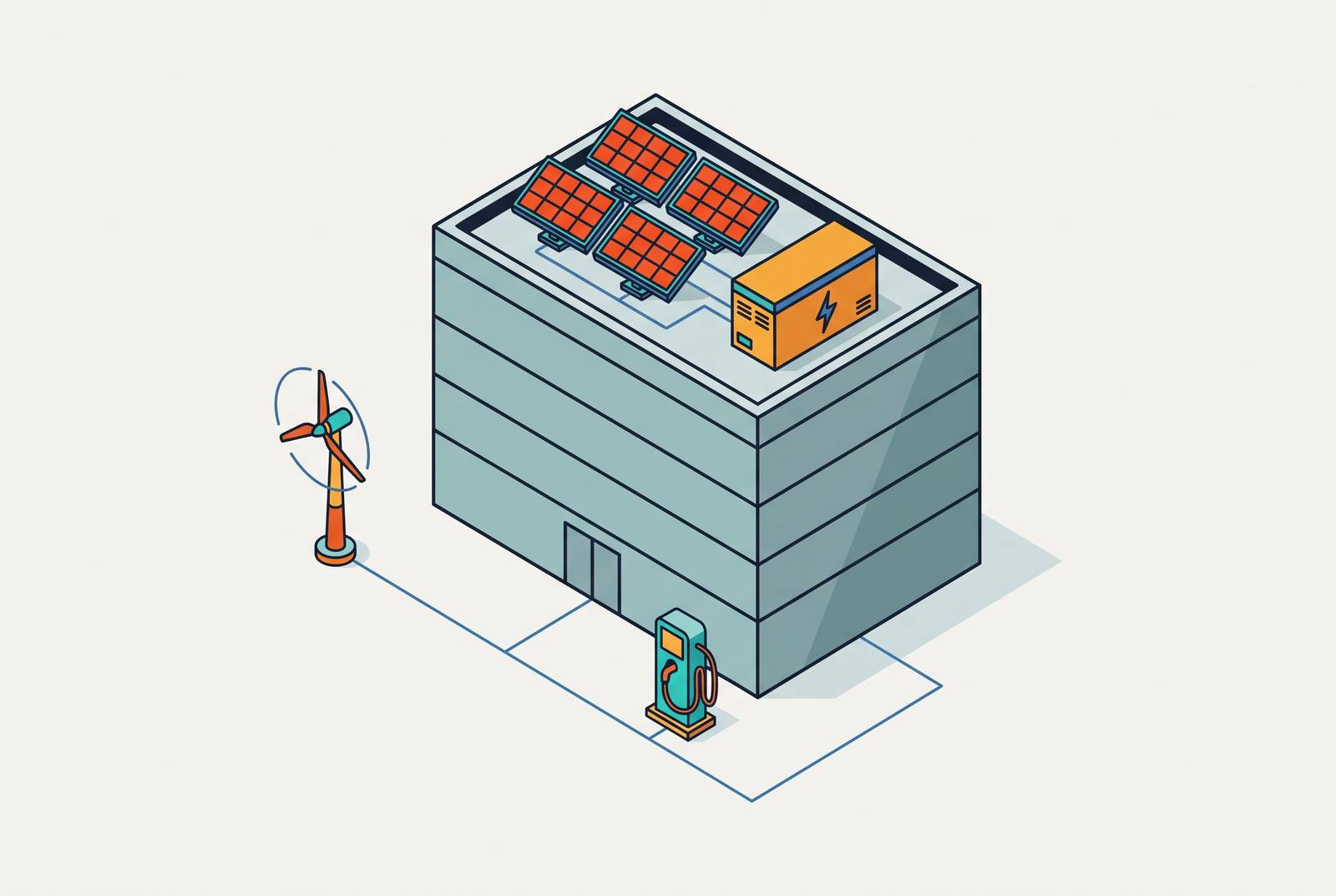
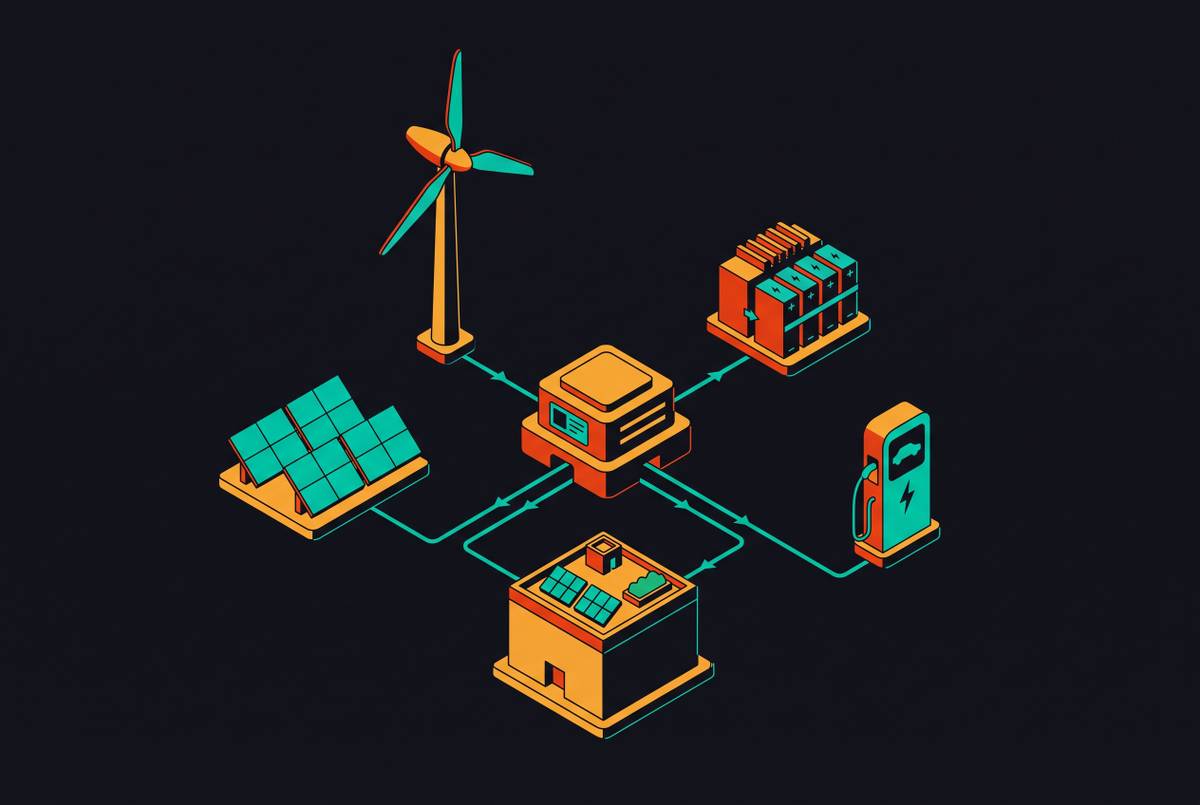
Distributed energy resources, or DERs, are small power systems sited right where the energy gets used, instead of miles away at some centralized plant. In commercial buildings, that means solar panels, batteries, combined heat and power units, EV chargers, and demand response programs working as a set. The building stops being a place that just eats electricity and starts being one that manages it.
A commercial building isn't a bigger version of a house with panels bolted on. The scale is different, the load is messier, and the building often carries direct grid obligations a homeowner never sees, like seeking access to wholesale energy markets. A single commercial site can carry hundreds of kilowatt-hours of battery storage. Multiple buildings on a campus, a hospital complex, or an industrial park can link their DERs into a microgrid, a small self-sufficient grid that runs connected to the utility or cuts itself loose during an outage.
Most of this happens "behind the meter," meaning the building's own generation and use never show up on the utility's ledger until it crosses that meter. That line matters: it decides what the building uses for itself versus what it sends back out, and it determines how the whole thing gets billed and credited. The end goal for a lot of owners has a name, Grid-Interactive Efficient Building (GEB): a building that's efficient on its own terms but also adjusts itself to help the grid, not just draw from it.
How each major DER technology functions inside a commercial building
Solar PV is the familiar piece. Panels go on the roof or the facade, and they generate power only when the sun cooperates. That intermittency is the whole reason storage or a strong grid connection has to sit alongside it. No sun, no output.
Battery storage picks up the slack. It stores extra solar generated at midday, or cheap grid power pulled overnight, and releases it later. Commercial and industrial sites increasingly pair rooftop solar with lithium-ion or LFP systems running past 250 kWh per site. Storage does two jobs that matter: peak shaving (cutting the highest, priciest demand spikes) and backup power when the grid drops.
Combined heat and power (CHP) generates electricity and captures the waste heat at the same time, using it for space heating or industrial process loads instead of letting it escape into the air. That double duty is what makes it efficient, and it's arguably the most underrated DER on this list, because it doesn't depend on sun or wind, just on a building already needing both power and heat.
EV charging used to be treated like any other plug load, something the building just absorbed. Now it's managed as a controllable asset, dispatched up or down with grid conditions, instead of left to draw power whenever a car happens to plug in.
Fuel cells run steady. No weather dependency, no time-of-day swings, which is why facilities needing constant low-emission backup (data centers, hospitals) tend to favor them.
Demand response isn't a generation technology at all. It's a contract: a promise that a building will cut or shift its power use when the grid is under stress, in exchange for payment or rate credit. It's not about making power. It's about not using it at the worst possible moment.
Each of these behaves differently. Some are steady, some are wildly variable, some can be commanded on demand and some can't be commanded at all. That mismatch is exactly why none of this works without software tying it together.
Why solar PV and battery storage have become the commercial DER anchor pair
Solar dominates the DERMS conversation for one blunt reason: its unpredictability creates most of the coordination headache that utilities and building operators have to solve. Every other DER problem is, in some sense, downstream of "the sun doesn't always shine."
The U.S. installed more than 32 GW of distributed solar in 2024, and residential and commercial projects together made up close to 60% of that. Storage is what makes the solar useful outside daylight hours: it soaks up the midday surplus and lets it out during the evening peak, when demand and prices both climb. That pairing turns solar from an intermittent, somewhat unreliable resource into something a building can actually plan a budget around.
The results show up on the bill. A 2025 public infrastructure energy program found commercial buildings using storage for peak shaving cut monthly peak demand by 18%. Separately, a large U.S. commercial real estate portfolio landed a 14% reduction in demand charges in 2025 by pairing AI-based load forecasting with storage dispatch. None of this makes CHP or demand response irrelevant. But solar-plus-storage is the foundation everything else gets stacked on top of, and any building skipping straight to fuel cells or demand response contracts without nailing this pair first is building the roof before the walls.
How DERs connect and coordinate: the role of DERMS and building energy management platforms
Left alone, these systems fight each other. A battery might charge from the grid during a peak-price window because nobody told it not to. EV chargers might all fire up at 6 p.m., right when demand is already maxed out. A CHP unit might keep running while solar output gets curtailed for lack of anywhere to put it. None of that is a hardware failure. It's a coordination failure, and it's the reason DERMS exists at all.
DERMS, short for Distributed Energy Resource Management Systems, handles real-time monitoring and dispatch control across every asset in the building, all at once. In 2024, software made up roughly 58% of the DERMS market.
The platform landscape now includes offerings from major vendors such as Siemens, Honeywell, Johnson Controls, Schneider Electric, and BrainBox AI. Schneider Electric's EcoStruxure DERMS, deployed with PG&E in July 2023 and running on Microsoft Azure, optimizes solar, EVs, and battery storage together.
Budderfly bought the Sunverge Energy DERMS platform in August 2024, expanding its capabilities for small and mid-sized commercial buildings, groups of scattered assets that act like one big flexible resource for the grid. Cloud deployment and microgrid interoperability are the two things vendors keep pointing to as defining the next round of these platforms, and the buildings that wait for a "mature" version of this software are the ones that will still be running spreadsheets in five years.
How aggregated DERs let commercial buildings participate in wholesale energy markets
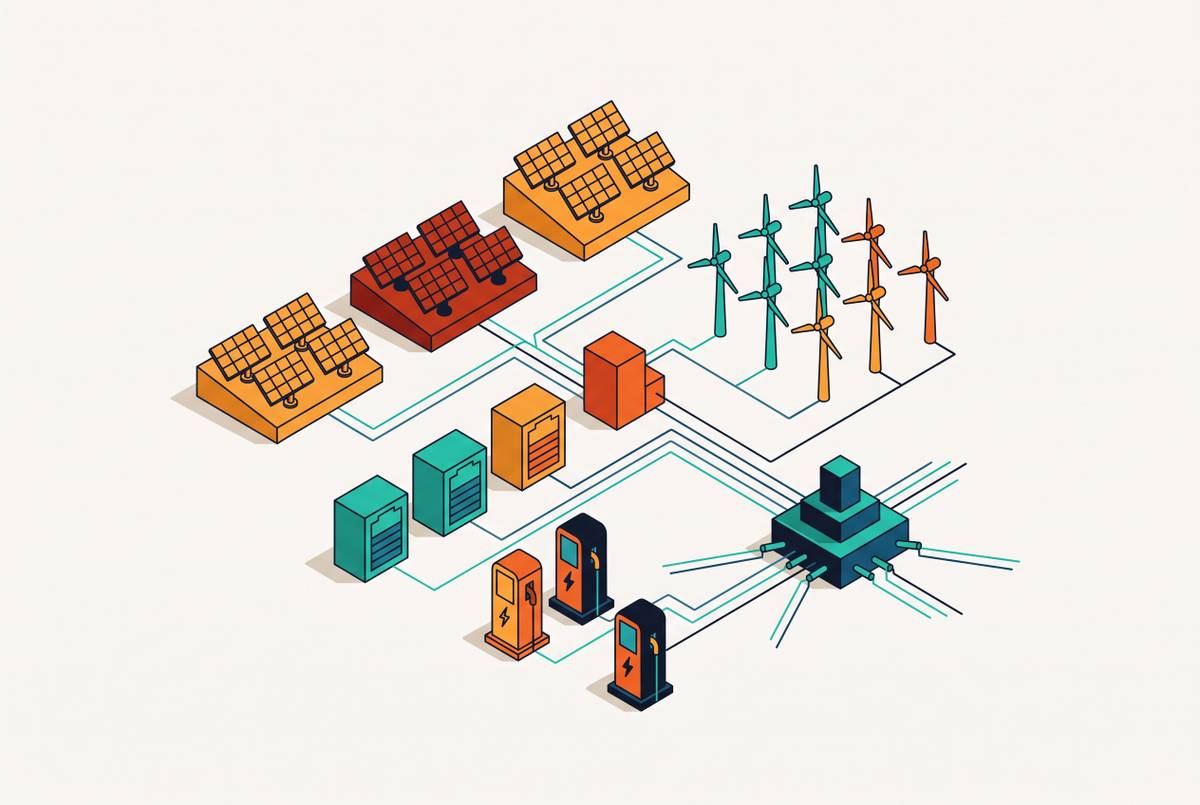
Bundle enough small DERs together and, from the grid's point of view, they start looking like one conventional power plant that can be turned up or down on command. That's a virtual power plant, or VPP: EV chargers, behind-the-meter batteries, and rooftop solar, aggregated and responding to grid signals as a single unit.
FERC Order 2222, issued in 2020, made this legal at scale. It requires regional grid operators (RTOs and ISOs) to let mixed DER aggregations bid into wholesale markets, and it caps the minimum size those operators can demand at 100 kW. As of early 2026, most Independent System Operators were still working through implementation, with completion dates spread from late 2026 out to 2029. PJM, NYISO, and SPP have moved compliance filings forward, and states including Ohio, Pennsylvania, Colorado, Illinois, and Oregon have advanced their own interconnection reforms, VPP programs, and microgrid frameworks.
This created something worth naming on its own: VPP yield. Order 2222 lets a building sell power it isn't using directly into the wholesale market, and dispatching stored energy has become a revenue line, not just a way to dodge costs. Large commercial customers, including data centers, are increasingly co-locating facilities behind the meter alongside their own generators, which has pushed regulators to keep sorting out how those arrangements should be classified and paid for. It's no accident the commercial and industrial segment led the DERMS market in 2024. These are the buildings big enough to chase grid-participation revenue on top of the usual cost savings, and treating VPP yield as a nice-to-have rather than the main event misses where the actual money sits.
The financial case: where DERs actually save or generate money in commercial buildings
A SERI analysis from April 2026 modeled microgrid deployment across 65 use cases, 13 regions, and five commercial building types. Simple payback landed between 5 and 10 years in 55% of cases. In 25% of cases, payback came in under 5 years, with the U.S. West, Canada, and the UK among the leading regions.
The savings stack in layers: lower demand charges, less wasted energy, VPP yield from wholesale participation, and resilience value (what a building avoids losing when the power stays on during an outage everyone else is sitting through in the dark). Energy waste reduction alone, just from better monitoring and dispatch, tends to deliver 10 to 30% savings, among the faster returns building infrastructure typically offers.
Facility managers often file decarbonization spending under "compliance cost" and stop thinking about it there, missing that the same investment can wipe out $30,000 to $150,000 a year in wasted energy. That's not a rounding error on an operating budget, that's a line item worth fighting for. More than 35 U.S. states now run active energy storage incentives or resilience programs to help owners get there.
For buildings that can't front the capital, Energy as a Service (EaaS) offers a subscription or performance-based path instead, no big upfront check required. Providers in that space include Johnson Controls, ENGIE, Veolia, Schneider Electric, Ameresco, Siemens, Centrica, Ørsted, and Enel X. The pitch is simple: pay for the outcome, not the hardware, and let someone else own the equipment risk.
The regulatory pressure building owners cannot ignore
Building Performance Standards (BPS laws) are spreading across cities and states, and they come with real financial teeth attached to real thresholds. Sit still and the bill comes due whether the building changed anything or not.
New York City's Local Law 97 charges $268 per metric ton of carbon over the annual limit, and the first compliance reports were filed in 2025. Boston's BERDO 2.0 hits non-compliant buildings over 35,000 square feet with $1,000-a-day fines (buildings between 20,000 and 35,000 square feet face $300 a day instead). Washington, D.C.'s BEPS penalties can reach $10 per square foot of gross floor area, which adds up fast on anything bigger than a corner store.
Penalties across major BPS cities are set to rise an average of 82% between the first and second compliance periods. Waiting doesn't just fail to help, it actively costs more the longer it drags on. States are stacking their own layers too: California now requires annual energy reporting for commercial buildings over 50,000 square feet, Colorado has advanced building decarbonization policy efforts, and Maryland's Building Energy Performance Standard is aiming for net-zero by 2040.
There's a fuel cost angle underneath all this too. In 2025, gas bills rose 60% faster than electric bills and four times faster than inflation, with gas utilities requesting $3.83 billion in rate increases that year. Every point that gap widens, DERs built around electrification look less like a virtue project and more like the financially obvious move. The same investments that keep a building out of penalty territory are the ones generating the demand charge savings and VPP yield covered earlier. Compliance and economics aren't separate arguments here. They're the same argument, told twice.
What the DERMS market's growth trajectory signals about where commercial building energy management is heading
The DERMS market grew from $0.64 billion in 2025 to $0.74 billion in 2026, a 16.9% jump, and Research and Markets projects it reaches $1.37 billion by 2030 at 16.5% annual growth. Demand response, one of the more mature DER use cases, was valued at $11.1 billion in 2025 and is projected to hit $26.6 billion by 2035, per GM Insights.
North America currently leads the DERMS market by size, though Asia-Pacific is growing faster over the forecast window. The pattern across every one of these numbers points the same direction: wider VPP participation, real-time optimization, better forecasting, and tighter ties into microgrids. Higher tariffs on imported software infrastructure and grid control hardware have stretched some project timelines, though they've also pushed more domestic software development into the mix.
None of these figures move in a direction that rewards sitting still. Buildings without DER infrastructure, and active management sitting on top of it, are going to face a widening gap against buildings that already made the investment, on cost, on compliance, on competitive footing. Going from passive consumer to active grid participant isn't a trend worth watching from a distance. It's the baseline now, and the buildings still treating it as optional are the ones that'll spend the next decade catching up.