Distributed Energy Generation Technologies Compared
Seven technologies power generation close to where it's used, each with distinct trade-offs.
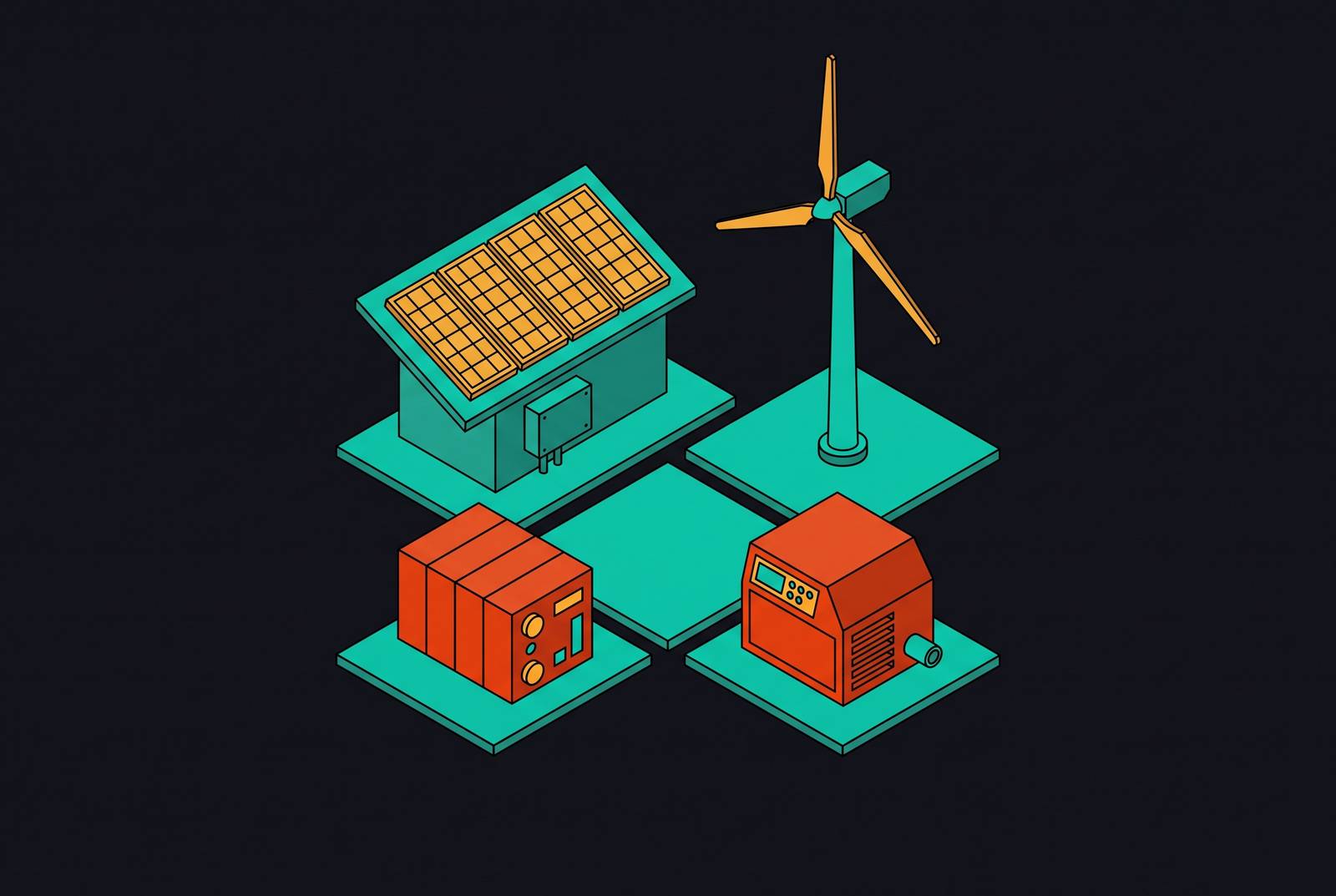
Distributed energy generation means small power sources built close to where the power actually gets used, wired into the local low-voltage grid instead of the high-voltage transmission lines that carry electricity hundreds of miles. That's the whole idea. No long hauls, no giant substations, no watching a meaningful chunk of your electricity turn into heat somewhere between the power plant and your living room, which is what long-distance transmission inevitably does.
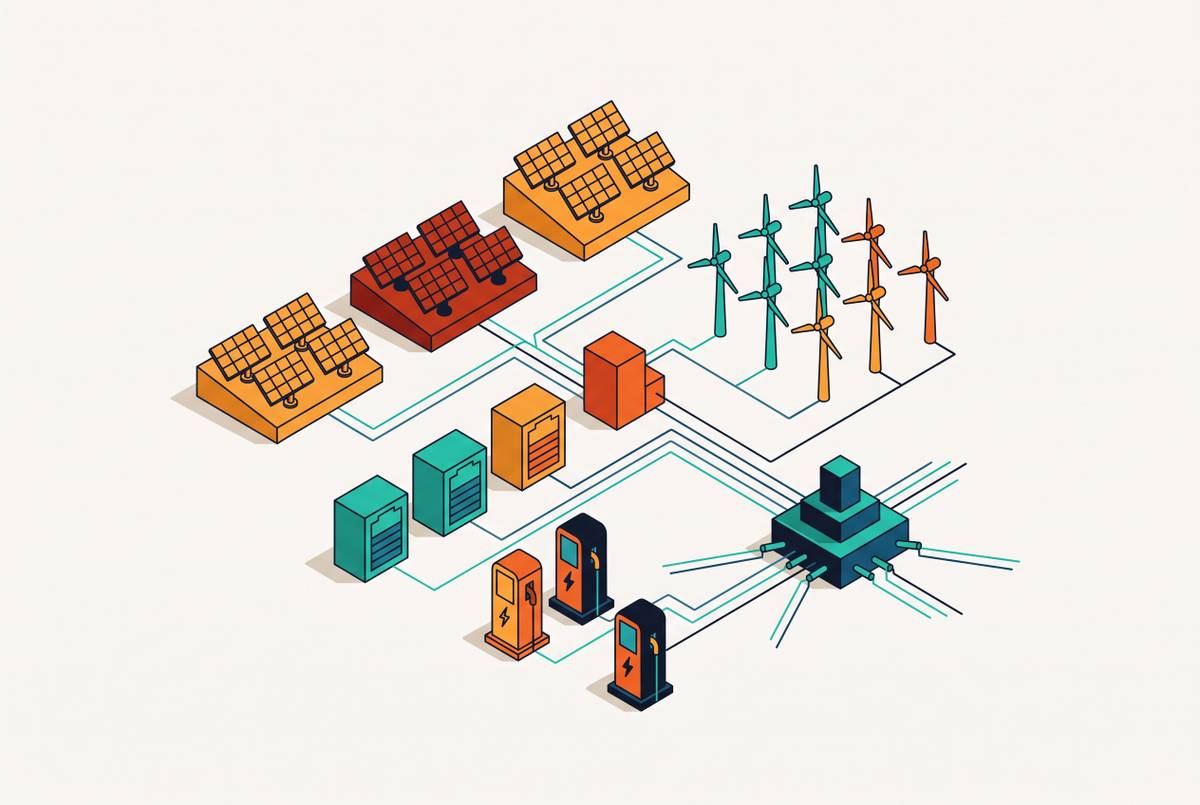
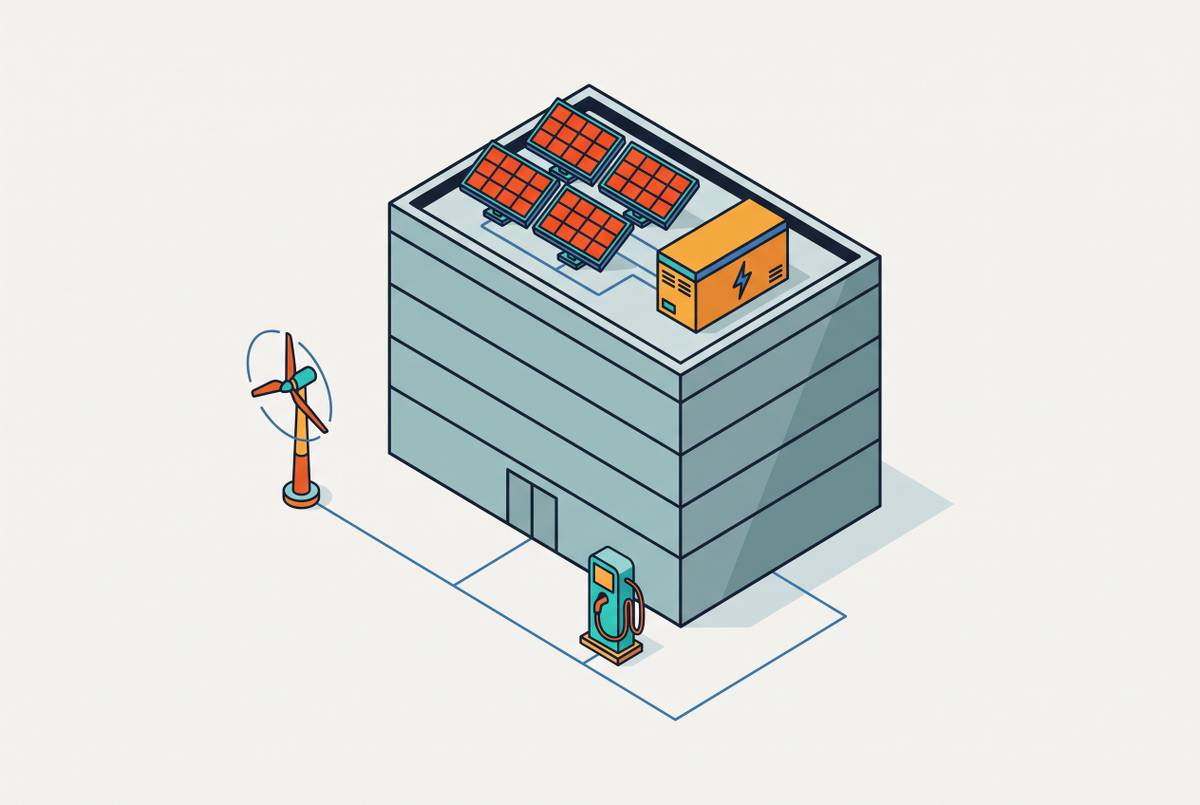
This piece compares the technologies doing the work: solar PV, wind turbines, fuel cells, combined heat and power (CHP), microturbines, reciprocating engines, and micro-hydropower, plus battery storage, which isn't really a generation technology so much as the thing that makes all the others behave better. Two splits matter before getting into specifics. First, dispatchable versus intermittent: engines, microturbines, and fuel cells run when you tell them to; solar and wind run when the weather tells them to. Second, behind-the-meter versus grid-connected, which decides whether the power serves one building or gets sold back out. The same box of equipment can sit on a single house, a commercial rooftop, an industrial campus, a military base, or a wastewater treatment plant, and the economics change completely depending on which of those it is. Every section below tracks the same four things: cost, use case, scalability ceiling, and the operational trade-off that comes bundled in.
Why the market for these technologies is growing fast enough to make the comparison urgent
Nobody agrees on the exact size of this market, and that disagreement itself says something. Allied Market Research pegs it at $360.4 billion in 2023, heading toward $1,403.5 billion by 2033. Fortune Business Insights, using different assumptions, has 2025 at $509.83 billion climbing to $854.22 billion by 2034, less than half that growth rate. Same market, wildly different math. Treat both numbers as directional, not gospel, and stop citing either one like it's carved in stone.
What's not in dispute is the demand side. SEPA projects US electricity demand rising 25% by 2030, and as much as 78% by 2050. That's not a sustainability talking point anymore. It's a resource adequacy problem: the grid needs more supply, fast, and building new transmission lines takes years nobody has. Distributed generation skips that line by making power where it gets used instead of shipping it in from somewhere else.
Asia-Pacific already holds the largest share of global DER revenue, while North America is catching up from a smaller base. Behind all of it: decarbonization rules, falling equipment costs, resilience anxiety after grid failures made headlines, and a growing appetite for energy independence at the site level. None of that tells you which technology to buy. It just explains why so many more options exist now, and why the trade-offs between them are worth mapping instead of guessing at.
Solar PV: the dominant technology and what that dominance actually costs
Solar holds the largest single slice of the DER technology market, well ahead of anything else on this list. But it's not the fastest grower anymore, and that gap tells you something worth sitting with: the easy wins are mostly already installed. The remaining growth comes from harder sites, tighter roofs, and slower interconnection queues, not from more of the same low-hanging fruit.
On efficiency, a typical residential system today runs 400-watt panels around 20.4% efficiency, while commercial rooftops (think school buildings) use 500-watt panels closer to 21.1%. Newer TOPCon and HJT panel designs push past 23%, meaning more electricity off the same square footage of roof. That matters a lot when roof space is the actual constraint, not money.
Cost-wise, residential installs run $2.80 to $3.80 per watt, commercial runs $1.80 to $2.60. The 30% federal tax credit, in place through 2032, brings residential payback down to 6 to 10 years. The cost floor isn't stable, though: a 50% tariff hit crystalline silicon panels from one exporting country in early 2025, with anti-dumping duties stacking on top. Timing a purchase around that kind of policy noise is now part of the job, not a footnote to it.
Rooftop residential, commercial rooftop, ground-mount community solar, and pairing with storage to manage demand charges: that's the use case list. The catch is obvious but worth saying plainly: no sun, no power. Output is predictable across a full year, but on any given cloudy Tuesday, solar can't run on command by itself. That gap is exactly what batteries exist to fill, which is the next section. Scalability is close to unlimited at the grid level, though any single rooftop is capped by its own square footage and by how long the interconnection queue takes to clear.
Battery energy storage: why it is less a standalone technology than a multiplier for everything else
Here's the fact that explains this whole category: IRENA reports global weighted-average battery storage costs have dropped 95% since 2010. That's not a gradual slide, it's a category getting cheap fast enough to change what every other technology on this list can justify.
China manufactures battery packs at a noticeably lower cost than Europe, and that gap shows up directly in project math depending on where the equipment comes from. Levelized cost for a four-hour battery project has fallen to the lowest number on record since tracking started in 2009. Pair storage with solar and the number gets more interesting: solar-plus-storage projects now deliver power cheap enough to compete directly with standalone gas peaker plants in a lot of markets, not as a moral choice but as the cheaper option, full stop.
Lithium iron phosphate, or LFP, dominates stationary storage now because it's cheaper and more thermally stable than older chemistries, and round-trip efficiency is high relative to older storage technologies. Batteries firm up solar and wind output, cut demand charges, provide backup, and sell grid services like frequency regulation. The limit is duration: a four-hour battery covers many typical commercial needs but can't stand in for multi-day backup, and degradation over the battery's cycle life chips away at the economics year over year.
Battery storage is among the most rapidly expanding DER categories by forecast, and that's exactly why solar-plus-storage has become the default comparison point every other technology on this list gets measured against. Pricing out any other option here without pricing storage alongside it isn't really doing the comparison, it's just guessing.
Microturbines: the dispatchable middle ground between large gas turbines and reciprocating engines
Microturbines run from around 15 kW up to roughly 300 kW, with the smallest units about the size of a large refrigerator. The technology descends from aircraft auxiliary power units and turbocharger design, which explains why these things spin so fast and weigh so little for what they put out.
Fuel flexibility is a real strength here: natural gas, biogas, propane, and increasingly hydrogen. Caterpillar started a three-year hydrogen-hybrid commercialization program on its C13D engine line, which signals where the fuel mix is headed. Compared to reciprocating engines, microturbines use air bearings that eliminate the need for lubricating oil, running at much higher speeds. Less stuff to maintain is the main pitch here, full stop.
Units stack, too. A wastewater treatment plant can run a whole facility off multiple microturbines rather than one oversized unit, so scaling means adding boxes, not building bigger ones. Tightening emissions rules are widely cited as a key reason buyers are moving off older diesel reciprocating units toward microturbines instead.
Here's the trade-off nobody markets loudly enough: electrical efficiency lags behind large gas turbines, and the economics barely work unless the waste heat gets captured too. Power-only, standalone, no heat recovery? That's a hard case to make on cost alone, and most buyers who try it end up disappointed. The use cases follow from that logic: CHP at hospitals and campuses, biogas power at landfills and wastewater sites, backup or peak shaving anywhere diesel is off the table on emissions grounds. Capstone Turbine and Caterpillar are among the recognized suppliers active in this category.
Fuel cells and CHP: where efficiency is highest and the cost case is most context-dependent
Fuel cells convert hydrogen electrochemically into electricity, with heat as a side effect and no combustion involved. That matters because it means minimal emissions right at the point where the power gets made. Where things get murkier is upstream: green hydrogen from electrolysis powered by renewables costs more than conventionally produced hydrogen, and the feedstock choice is what actually decides whether the system is clean or just clean-looking on a brochure.
Fuel cells hold the largest single share of the distributed energy generation market by technology, which surprises most people who picture rooftop panels when they hear "distributed energy." That's not because your neighbor has one bolted to the garage. It's because industrial and large commercial buyers deploy fuel cells at a scale residential markets never touch.
CHP is the efficiency argument in its purest form. Capture the waste heat from generation, use it for space heating or industrial process heat, and total system efficiency jumps well past anything power-only generation can hit. That efficiency gain, not the electricity price on its own, is what makes the financial case work. Use cases cluster around data centers and hospitals that need continuous reliable power, industrial sites that need both electricity and process heat, buildings where grid power runs expensive or unreliable, and remote sites where fuel can still get delivered even if wires can't reach.
The catch is capital cost and payback period, both of which run long. The whole case rests on the gap between fuel cost and local grid electricity price. Narrow that gap even a little, and the financial argument for a fuel cell falls apart fast. Scalability runs the full range, residential up through large industrial, but the cost premium over solar and storage means buyers pick fuel cells for reliability and low emissions, not because they're chasing the cheapest kilowatt-hour. Commercial and industrial buyers increasingly reach for fuel cells specifically for backup power, precisely because of the zero-emission operation at that scale.
Wind at the distributed scale: where the technology works and where it doesn't
Wind is among the faster-growing segments in distributed energy generation forecasts, riding better turbine tech and rising investment in onshore and offshore projects alike. But distributed wind is its own animal, distinct from utility-scale wind farms: smaller units sited on farms, coastal industrial land, and remote communities where the economics and permitting look nothing like a giant wind farm project.
Wind and solar complement each other nicely, since wind tends to blow harder at night or in winter, exactly when solar output drops off. Hybrid solar-wind systems are increasingly the pairing of choice for that reason. Rural and agricultural land with steady wind, coastal and island communities, remote industrial sites too costly to connect to the grid, and community microgrids pairing wind with solar and batteries: that's where distributed wind earns its place.
A site needs a minimum average wind speed to make any of this pencil out at all, a brutal and non-negotiable requirement that rules out most urban and suburban locations before the conversation even starts. Noise complaints, visual objections, and permitting headaches pile on top of that. Scaling works by adding units, same as microturbines, but the binding constraint here is the site itself, not the capital budget. Throwing more turbines at a weak wind site doesn't fix a weak wind site, it just multiplies the underperformance. Vestas Wind Systems shows up in market reports as a key supplier in this space.
How the technologies compare across cost, use case, scalability, and operational fit
Solar paired with batteries wins on cost for most behind-the-meter setups on a decent site, and it's not close. Anyone weighing that pairing against fuel cells or standalone CHP on price alone is comparing the wrong things: fuel cells and CHP earn their keep on reliability and heat recovery, not on cents per kilowatt-hour. Microturbines land in the middle. Wind's cost is almost entirely a function of how good the site is, and nothing else moves that number much.
Dispatchability draws the sharpest line in this whole comparison. Fuel cells, CHP, microturbines, and reciprocating engines run on command. Solar and wind run on the weather's schedule and need storage or a grid connection behind them to firm things up. For anyone buying power for critical infrastructure, that single distinction decides the shortlist before cost even enters the conversation.
Matching technology to use case looks like this: solar for any site with decent sun exposure and a low-cost priority, batteries for firming renewables or cutting demand charges, microturbines for biogas sites or CHP under emissions limits, fuel cells for high-reliability low-emission continuous power at commercial or industrial scale, distributed wind for rural or coastal sites with the wind data to back up the pitch.
Scalability differs in shape more than degree. Solar and batteries both scale smoothly from a single panel or pack up to multi-megawatt installs. Microturbines and fuel cells scale by adding modular units. Wind is the most boxed-in of the group, limited by physical siting long before capital becomes the constraint.
Every technology also carries costs that don't show up on the initial quote. Solar needs inverter swaps and ongoing maintenance over its operational lifeoses output over its 25-year life. Batteries degrade with every cycle and eventually need disposal. Microturbines need scheduled maintenance and locked-in fuel contracts. Fuel cells carry their own scheduled maintenance requirements. Wind turbines require maintenance work done at height, which is exactly as expensive and annoying as it sounds.
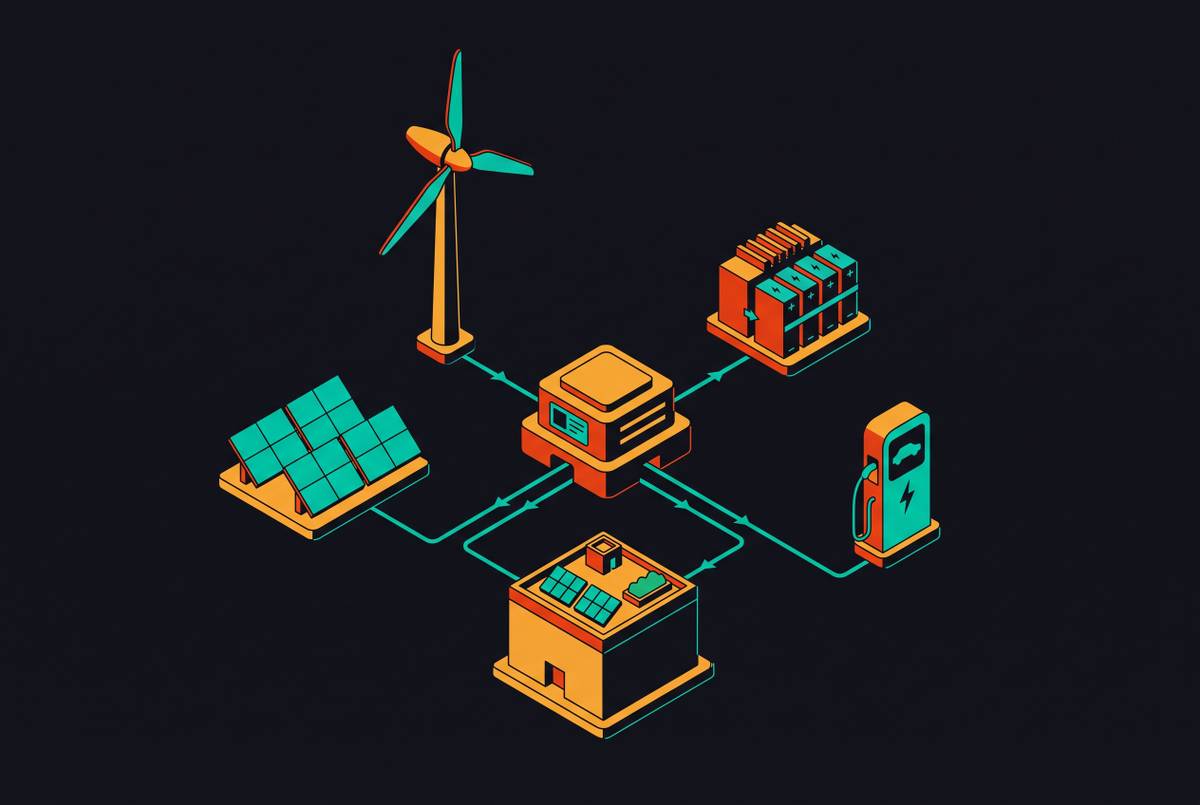
The pattern showing up across real deployments: nobody's really picking one technology anymore. Solar plus batteries has become the default pairing. Solar, wind, and batteries together show up in microgrids that need serious reliability. Microturbines or fuel cells paired with renewables cover the critical loads. Running on a single technology alone is turning into the exception, not the rule, and any buyer still shopping for a single silver bullet is asking the wrong question.
What the comparison does not resolve and what a buyer still needs to determine locally
None of this settles the interconnection question. Wiring a distributed system into the existing grid is still technically messy and administratively slow in most markets, and queue delays can tack years onto a project regardless of which technology got picked.
Regulation varies enough by jurisdiction to flip a project's economics entirely. Net metering rules, export tariffs, permitting requirements: none of it is consistent, and a technology that looks great against a national benchmark can look mediocre once local rules get applied. What pencils out in one state or country might not travel at all to the next one over.
Supply chains carry their own risk. That tariff action is a clean example of how fast a cost benchmark can move. Fuel and feedstock prices swing the economics for microturbines, CHP, and fuel cells in ways that solar and wind, running on sunlight and air, never have to think about. None of the numbers in this comparison are fixed points. They're a snapshot, and the buyer's actual job is figuring out what the local version of that snapshot looks like before signing anything.