AI-Powered Traffic Management Systems in Cities
Cities locked traffic signals decades ago—AI rewires them to predict congestion before it happens.
Traffic signals in most American cities run on math from a handful of days someone measured years ago. Engineers watched traffic, calculated an average, and locked the timings into a controller box that hasn't been touched since. AI traffic systems flip the entire premise: instead of reacting to a jam once it's already formed, the system predicts it and adjusts before a single extra car sits at a red light. That shift, from responding after the fact to acting ahead of it, explains basically every number in this piece.
Here's the part that should bother you more than it probably does. Many cities only retime their signals once every three to five years. Meanwhile the city itself changes every single day: new apartment building goes up, a school changes its start time, a stadium adds a Tuesday concert. The signal doesn't know any of that happened. It's still running on an average from 2021, confidently directing traffic based on a version of the city that no longer exists.
And averages were always a strange thing to design around, because rush hour isn't average. A parade isn't average. A thunderstorm, a fender-bender, a spike from a major celebrity event nearby, none of that is average. Average conditions are actually the rare case. A report from a transportation analytics firm found congestion in most major metros in one country. metros is now worse than before the pandemic, despite years of predictions that remote work would thin it out. The system wasn't built to absorb change, so it didn't.
The bill for that comes due in hours and dollars: American drivers lose 97 hours and $1,350 a year to congestion, not as some abstract inconvenience but as the direct output of a fixed-schedule system meeting a world that refuses to hold still. Transportation makes up 15% of global greenhouse gas emissions, and pollution at city intersections runs 29 times higher than on open roads. A significant share of that intersection pollution comes from cars accelerating after stopping at a red light they didn't need to stop at. That's not traffic being traffic. That's a design flaw with a tailpipe.
What AI does differently at the signal, the corridor, and the network level
AI traffic control operates on three levels, and each one moves faster than any human retiming cycle ever could.
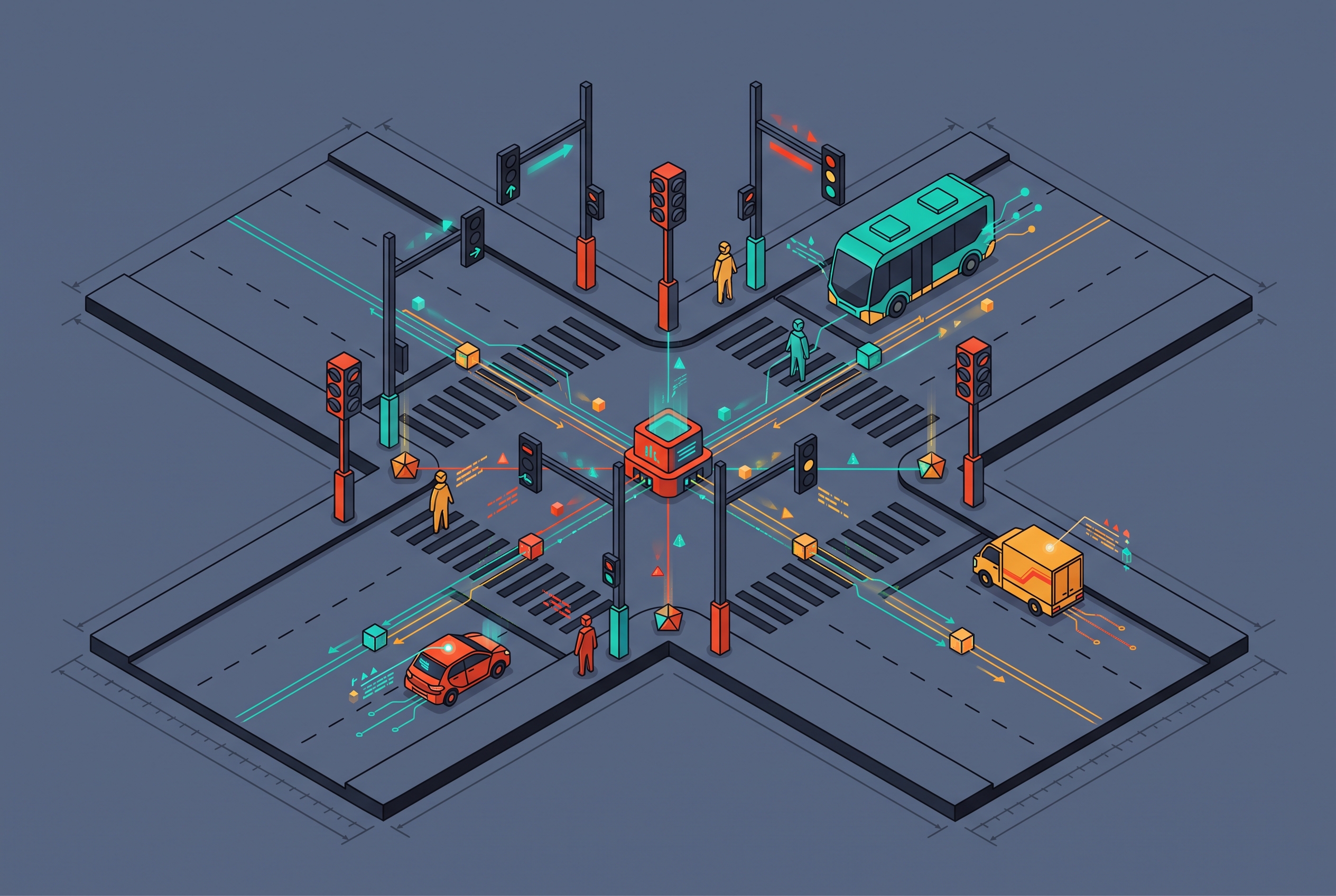
At the signal level, individual intersections pull in constant feeds from cameras, GPS data, inductive loops, and IoT sensors. Convolutional neural networks and LSTM models (the kind of machine learning built to handle sequences over time) combine to produce short-term forecasts, and neighboring intersections coordinate rather than acting alone. Some systems use reinforcement learning, where the software gets rewarded for results, fewer stops, better throughput, rather than being handed a rulebook. UC Berkeley's HumanLight project takes this further: it weights green time by how many people are moving through an intersection, not how many cars, giving higher-occupancy vehicles an advantage over lower-occupancy ones.
At the corridor level, this becomes green waves, that satisfying stretch where every light turns green right as you arrive, plus transit signal priority that holds a green a few seconds longer for an oncoming bus.
At the network level, the system forecasts demand across the whole city and reroutes traffic before backups spread.
Incident detection shows the payoff clearly. AI can watch dozens of camera feeds at once and flag a stalled car or a strange traffic pattern that a human monitor, however alert, would likely miss on a slow Tuesday shift. TRL Software's SCOOT 8 AI, launched in late September 2025, claims anomaly detection up to 40% faster than older systems. More striking is its forecasting window: it predicts network demand and adjusts signal timing up to 30 minutes ahead of time. That 30-minute gap between "something's about to go wrong" and "the system already fixed it" is the whole ballgame.
Vivacity Labs pushes the idea past cars. Its sensors are designed to classify pedestrians, cyclists, and vehicles all at once, so signal timing can account for the full mix of people using a street, not just the ones inside metal boxes.
AI-assisted retiming still has humans review and approve changes but do it far more frequently than the old multi-year cycles, while fully adaptive systems have the signal learn and adjust on its own, removing the human retiming step. Both are real upgrades. They are not the same thing.
Pittsburgh and Los Angeles's real-world deployment at scale
Pittsburgh runs Surtrac, a system built by Carnegie Mellon's Robotics Institute and commercialized through Rapid Flow Technologies. Early pilots cut travel time by 26%, idling time by 41%, stops by 31%, and emissions by 21%, according to the SURTRAC final report. Those aren't small numbers, and the city didn't just nod and move on: Pittsburgh has since pulled in $20 million in federal and state funding to grow Surtrac from 50 intersections to 200. That expansion is itself the evidence. Nobody scales a system that didn't work.
Los Angeles built ATSAC (Automated Traffic Surveillance and Control) back for the 1984 Olympics, starting with just 118 signals. It now covers more than 4,850 adaptive signals across the city, which makes it one of the longest-running large-scale deployments anywhere. Intersection delays dropped 32%, and citywide emissions fell 3%. That 3% sounds modest until you remember it's spread across a city the size of Los Angeles, where even small percentage gains touch a huge number of trips. ATSAC also gives priority to buses, Metro trains, and emergency vehicles, and folds in real-time data from connected vehicles and crowd-sourced apps like Waze.
Both cities tell the same story: nobody flipped a switch overnight. Gains got verified over years, then the systems expanded. What neither case proves, and this matters, is how much of the improvement came from AI specifically versus simply retiming signals more often than once a decade. There's no side-by-side control group running the old system next to the new one. The comparison is against the old fixed-schedule baseline, which is the fair comparison to make, but it leaves a real question mark on the table.
Boston and the Green Light rollout's lessons on where AI recommendations succeed and where they don't
Google's Project Green Light started pilot testing in 2021 and now processes traffic recommendations touching up to 30 million car rides a month, across cities including Rio de Janeiro, Seattle, Bengaluru, Boston, Haifa, Hamburg, and Kolkata, according to AI Magazine's coverage.
Boston is the clean success story here. Since April 2024, the city has used Green Light to analyze hundreds of signalized intersections and put recommendations into action at 114 intersections across 20 neighborhoods. Some congested spots saw unnecessary stops drop by up to 33%, per Boston.gov's update. That's a genuinely good result.
But a real caveat has been noted: Google's headline numbers come from an assessment of 70 intersections, and most of those weren't running any adaptive system beforehand. Comparing "before" to "after" is easy when "before" is a signal untouched since a decades-old administration. It's a fair result, just not proof that AI beats other forms of optimization, only that AI beats doing nothing.
Seattle actually reversed one of Green Light's recommended signal changes because, in the department's own assessment, it didn't produce a net benefit. And in Manchester, traffic engineers declined to follow the tool's suggestions because certain signals were deliberately timed to serve priorities the AI wasn't accounting for, such as favoring bus routes or managing cut-through traffic. Green Light's goal was minimizing stops. The city's goal was something else entirely, and when those two goals collided, the city's judgment won.
An AI system chasing one number (throughput, or stops avoided) can quietly work against a city's actual priorities, which usually include safety, transit access, and keeping cut-through traffic off residential blocks. None of this is an argument against AI traffic tools. It's an argument that the system needs to be told, explicitly, what a city actually wants, and that a human engineer needs to stay close enough to catch it when the software optimizes for the wrong thing.
Applying the predictive model across transit, enforcement, and maintenance in other cities
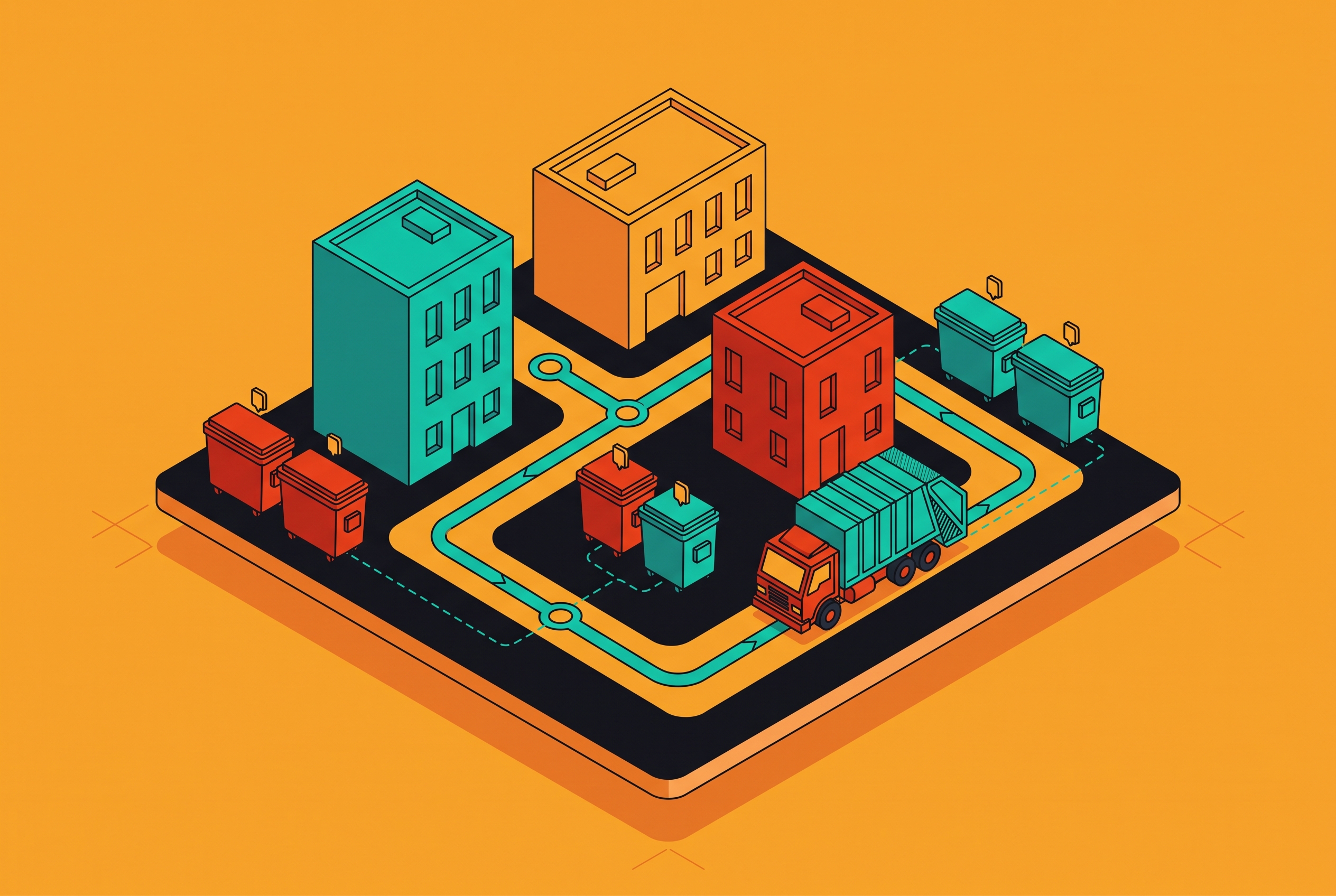
San Jose equipped key transit corridors to detect an approaching bus and hold the green or shorten the red accordingly. Bus travel times on those priority routes improved by more than 50%, and VTA ridership rose 15% in early 2024, according to IoT For All.
Lisbon deployed AI traffic management across 260 intersections. Travel times improved somewhere between 20% and 70% depending on the corridor, per Numalis.
New York combined congestion pricing with AI-assisted transit tools. In early 2025, congestion pricing took effect in Manhattan, and initial reports indicated meaningful reductions in vehicle volumes in the busiest zones, along with some improvement in travel times on key crossings. Predictive maintenance approaches, which flag mechanical issues before they cause a breakdown, have become a broader feature of transit AI deployments.
Oakland's AC Transit put AI cameras on buses in August 2024 to catch bus-lane violations. The system flagged a substantially higher number of violations and citations than the previous enforcement method had managed over a comparable period. Enforcement, in this case, is really a form of prevention: a clear bus lane means delay never gets the chance to build up.
One vendor's platform now runs in more than 400 cities, including two major metros, and is used by a notable share of traffic agencies in that country. The sheer range of agencies using the platform, from big metros to small towns, says something about how portable this approach has become.
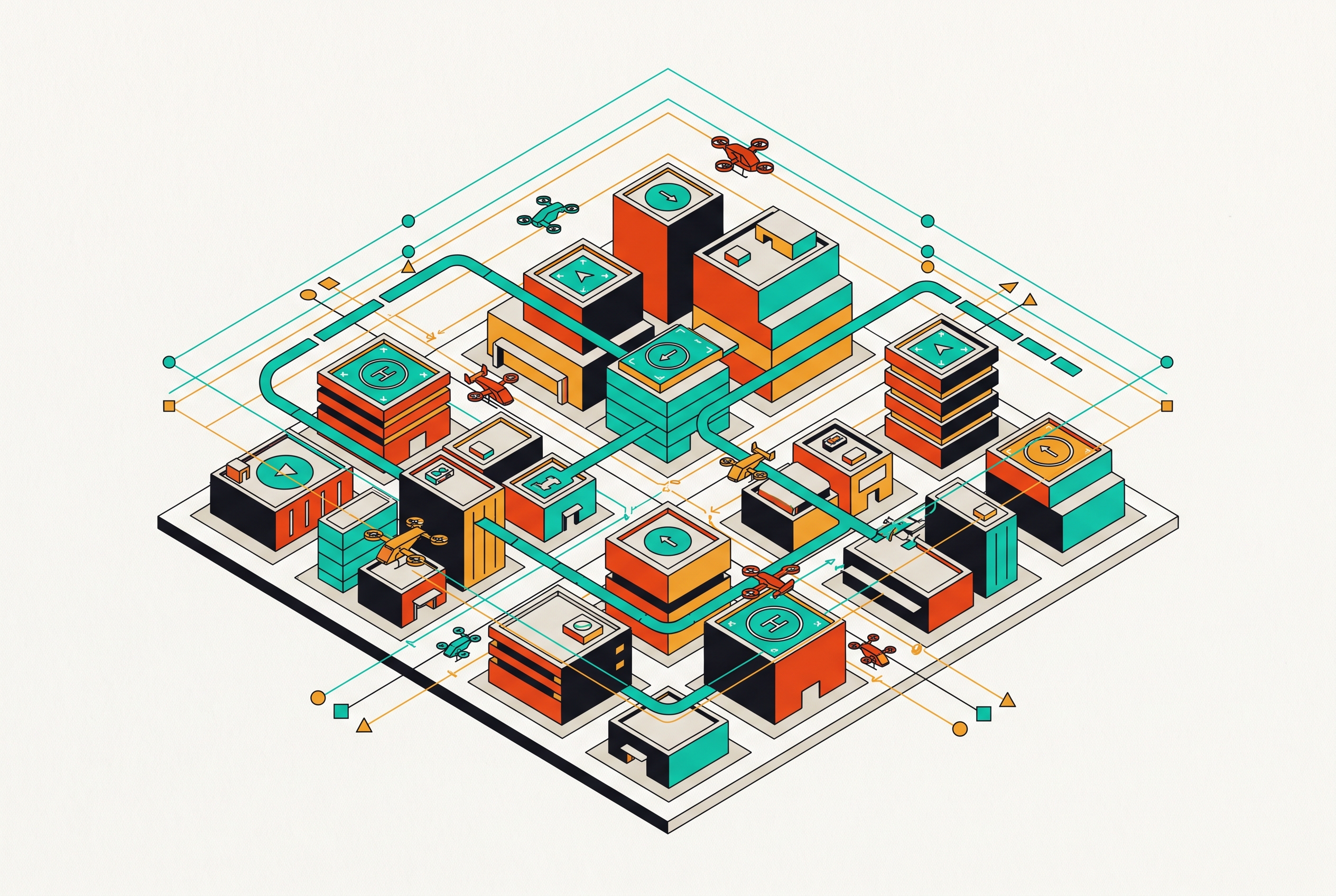
Dubai's RTA runs an Integrated Mobility Platform that pulls data from multiple sources to suggest routes in real time, predict transit maintenance needs, and test autonomous vehicles, part of the city's stated goal of making a quarter of all trips autonomous by 2030, per Trends Group's coverage.
Different cities, different problems, same underlying pattern: pull in live data, run a model that looks slightly ahead of the present moment, and act before the problem grows visible in traffic counts or delay measurements. Signals, buses, tickets, maintenance schedules, it's the same logic wearing different clothes.
The vendors and platforms cities are deploying in 2025–2026
TRL Software's SCOOT 8 AI, launched September 24, 2025, bills itself as the first AI-powered urban traffic control system that predicts and prevents congestion up to 30 minutes ahead. It claims journey-time cuts of up to 15% over the previous generation of the software and runs in more than 350 cities worldwide.
Surtrac, the Carnegie Mellon spinout run by Rapid Flow Technologies, uses decentralized signal optimization, and Pittsburgh's results (26% less travel time, 41% less idling) remain among the most cited outcomes in the field.
One vendor covers more than 400 cities and close to one in ten traffic agencies in that country. traffic agencies, with an architecture built to work across different sensor types and connected-vehicle data.
Miovision is, per Traction Technology's report, the most heavily funded pure-play AI traffic company anywhere. Its Scout platform turns raw video feeds into structured intersection data used for signal timing, safety review, and long-term planning, and a 2025 partnership with HARMAN puts it inside the connected-vehicle data pipeline.
Vivacity Labs leads much of Europe's AI traffic sensing market, with its all-in-one classification of cyclists, pedestrians, and vehicles now running across dozens of UK local authorities and expanding onto the continent.
Iteris launched VantagePriority in late 2025, aimed at connected-vehicle management, giving priority at signals to emergency vehicles, transit buses, and connected cars. It already holds contracts with dozens of state transportation departments, including one signed with Texas in 2025.
StreetLight Data, now under Jacobs Solutions, works differently: it's aggregated mobility data used for modeling and infrastructure decisions, not real-time signal control.
Siemens Mobility landed a $150 million contract from Miami-Dade County back in June 2020 to build an Advanced Traffic Management System across 2,900 intersections. Together, Siemens Mobility, IBM, and Kapsch TrafficCom hold roughly a third of the entire AI traffic management market, according to Market Report Analytics' figures.
Huawei introduced its Urban Transportation Model Solution in September 2025, aimed at city-wide optimization: prediction, congestion analysis, signal timing, and incident response bundled together.
Google's Project Green Light sits apart from all of these. Manchester and Seattle show why that distinction isn't just semantics.
And on the academic side, a peer-reviewed study out of Casablanca, published in the Journal of Urban Management in 2025, applied a Random Forest model to 9,847 accident-related data points pulled from Waze and hit an AUC of 0.997 for predicting traffic jams (AUC measures how well a model separates true cases from false ones, and 0.997 is close to a perfect score). Academic machine learning research is keeping pace with what the commercial vendors are shipping, not trailing behind it.
The market forces and government investment driving deployment beyond early adopters
Money is pouring into this space from every direction, and the size of the market swings wildly depending on how broadly each number defines "traffic management."
The broadest measure, the global traffic management market overall, was valued at $55.24 billion in 2026 and is projected to hit $106.13 billion by 2032, growing at 11.5% a year, according to MarketsandMarkets. Narrow it down to intelligent, AI-forward systems specifically, and Precedence Research puts that segment at $14.69 billion in 2025, climbing to $52.35 billion by 2035. Narrow it further, to AI-specific traffic control alone, and Data Insights Market estimates $5 billion in 2025 growing to $15 billion by 2033. Smaller base, faster growth, same underlying trend.
Government buys almost all of it: the public sector makes up over 79% of the traffic management market in 2026, according to MarketsandMarkets, because roads and signals are public infrastructure. That single fact shapes everything about how vendors sell, since budget cycles, procurement rules, and compatibility with decades-old legacy hardware matter as much as the technology itself.
North America holds the largest regional share at 39% in 2025, while Asia-Pacific is growing fastest, a trend Singapore's $150 million Siemens contract helps explain. On the federal side, a national transportation department has put over $500 million toward smart mobility programs. Department of Transportation has put over $500 million toward smart mobility programs, money that's letting cities upgrade who otherwise couldn't have paid for it out of their own budgets.
None of this comes cheap, and Route Fifty's reporting doesn't sugarcoat that: cash-strapped local governments face steep software costs, integration headaches with old systems, staff retraining, and ongoing cybersecurity spending. The return on investment has to be spelled out to city councils in plain terms, not waved at as an assumption. Pittsburgh's $20 million federal and state grant to add 150 more Surtrac intersections is probably the template most mid-size cities will end up following, because few can fund a rollout like this alone.
Considerations for cities before treating AI as a drop-in upgrade
Manchester's experience with Green Light points to the biggest risk here: an AI system chasing the wrong goal can actively work against what a city actually wants. Minimizing stops sounds good until it conflicts with protecting a residential street or keeping buses moving. Cities need to decide what they're optimizing for before deployment, not discover the mismatch afterward.
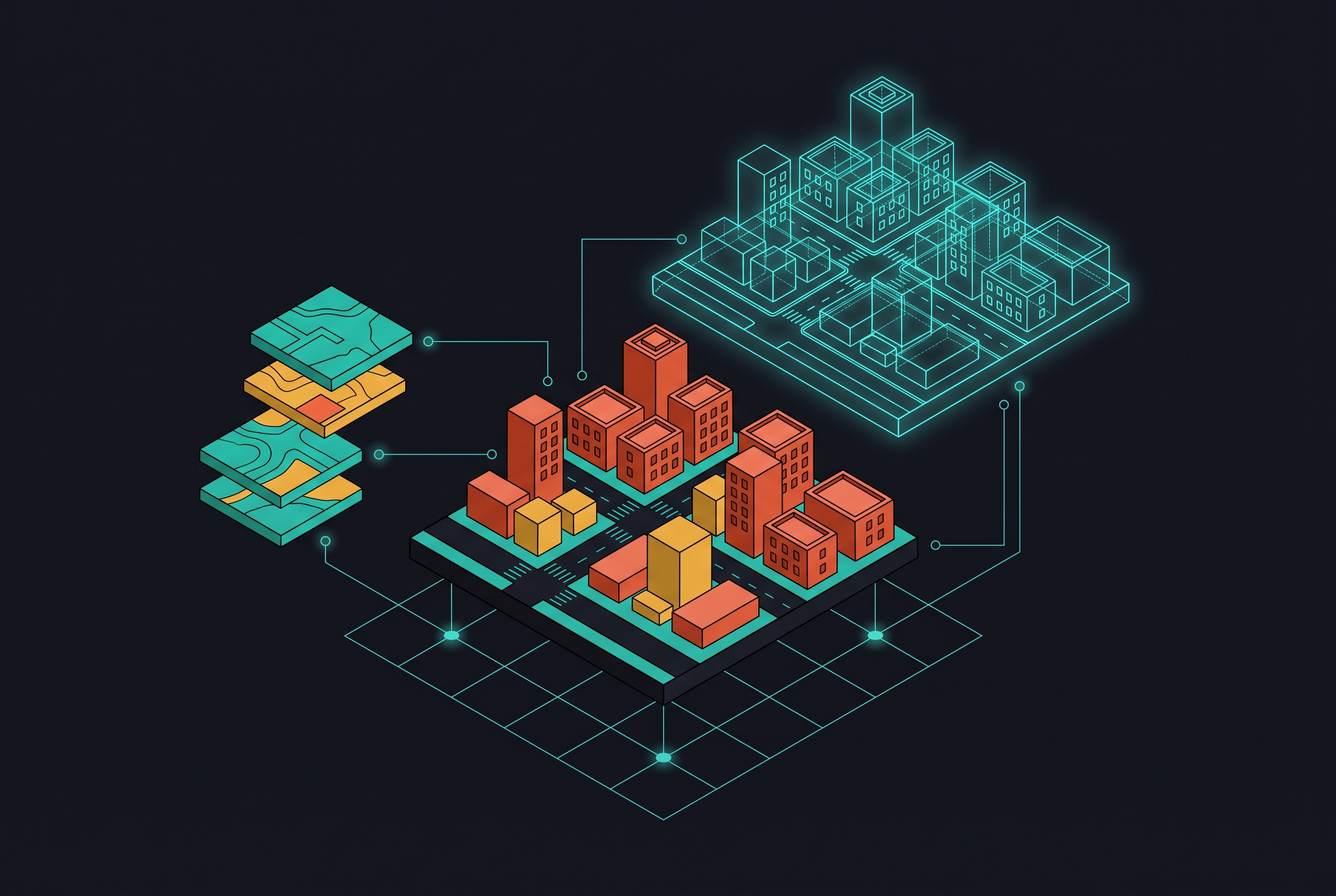
Data quality affects prediction accuracy just as much, even though it's less glamorous to talk about. A predictive system is only as sharp as what it's fed, and a city running on sparse sensors or aging loop detectors from decades past will get worse predictions no matter how good the algorithm is. Sensor infrastructure isn't an optional add-on here, it's the foundation everything else sits on.
Cybersecurity closes the list, and it deserves more than an afterthought. A traffic system wired into cameras, GPS feeds, and connected vehicles across an entire city is also a wide-open target, and any city weighing this upgrade has to weigh that exposure honestly, alongside the very real gains sitting on the other side of the ledger.
Sources
- AI-Integrated Smart Traffic Systems for Carbon-Neutral Cities
Provided the figures on transportation's share of global greenhouse gas emissions and intersection pollution levels compared to open roads, as well as details on Dubai's RTA autonomous vehicle goals.
- AI-driven traffic management is already having a big impact
Provided the figures on annual congestion costs to American drivers in hours and dollars, and the candid assessment of financial and operational barriers facing cash-strapped local governments.
- Smarter Streets: How California Is Using AI and IoT to Reinvent Traffic | IoT For All
Provided details on Los Angeles's ATSAC system including its scale, delay reductions, and emissions figures, as well as San Jose's transit signal priority results and VTA ridership gains.
- TRL unveils world’s first AI-powered urban traffic control system | Traffic Technology Today
Provided details on TRL Software's SCOOT 8 AI launch, including its anomaly detection speed improvement, 30-minute forecasting window, journey-time reduction claims, and deployment across 350 cities.
- AI-Powered Traffic Management - Numalis
Provided figures on Lisbon's AI traffic management deployment across 260 intersections and the range of travel time improvements achieved.
- How AI Is Revolutionizing Traffic Management: Top Startups in 2026 | Traction Technology | Traction Technology
Provided market size figures from MarketsandMarkets and Precedence Research, as well as details on Miovision's funding status and its 2025 HARMAN partnership.
- https://aimagazine.com/articles/project-green-light-google-using-ai-for-sustainability
Provided details on Google's Project Green Light pilot start date, monthly car rides processed, and the cities where it operates.
- https://www.smartcitiesdive.com/news/this-ai-traffic-system-in-pittsburgh-has-reduced-travel-time-by-25/447494/
Provided the Pittsburgh Surtrac deployment outcomes including travel time, idling, stops, and emissions reductions, along with the federal and state funding expansion details.