What Micromobility Means for Urban Transport

Micromobility is a weird word. It sounds like a buzzword someone invented in a WeWork conference room around 2018, slapped on a deck, and sent to investors. And honestly, that's not entirely wrong. But here's the thing: underneath the jargon, something real is happening. Small, lightweight vehicles, bikes, e-bikes, e-scooters, cargo e-bikes, and all their shared or privately owned cousins, are quietly becoming a structural layer of how cities actually move people. Not a gadget. Not a pilot program. Infrastructure. Think of micromobility as the connective tissue of urban transport — invisible when it's working, painful when it's missing. And understanding what that shift actually means, where it's working, where it isn't, and what friction remains, is what the term is really about.
How Big Micromobility Has Actually Gotten, and Why the Numbers Are Hard to Pin Down
Let's talk about market size, because the numbers are all over the place and that's worth explaining up front.
Depending on which research firm you ask, the global micromobility market in 2025 is either around USD 4.5 billion or closer to USD 46 billion. That's not a rounding error. That's a different definition of what's being counted. One approach captures only shared-mobility services. The other pulls in hardware manufacturing, which is dominated by enormous e-bike production in Asia. Neither number is wrong. They're just measuring different things.
Trip volume is actually more useful. In North America, shared micromobility grew from 42 million trips in 2017 to over 130 million in 2022. Citi Bike alone logged more than 44 million rides in 2024. Those are concrete, countable human trips.
A few things worth knowing about the shape of this market:
- E-bikes dominate. Electric bicycles hold an 89.1% share of the global micromobility market in 2025. Scooters get most of the media coverage, but they are not the main event.
- Asia-Pacific leads, with about 38% of the global market. Europe is growing fastest and is where the most interesting regulatory battles are playing out. What European cities are figuring out now, other cities will face later.
- The market is still finding its shape. Growth is real, but so are bankruptcies, consolidations, and regulatory reversals. This is not a mature industry. It's a messy, adolescent one.
The First/Last Mile Problem Micromobility Was Built to Solve
Here's the core issue that micromobility is actually trying to fix.
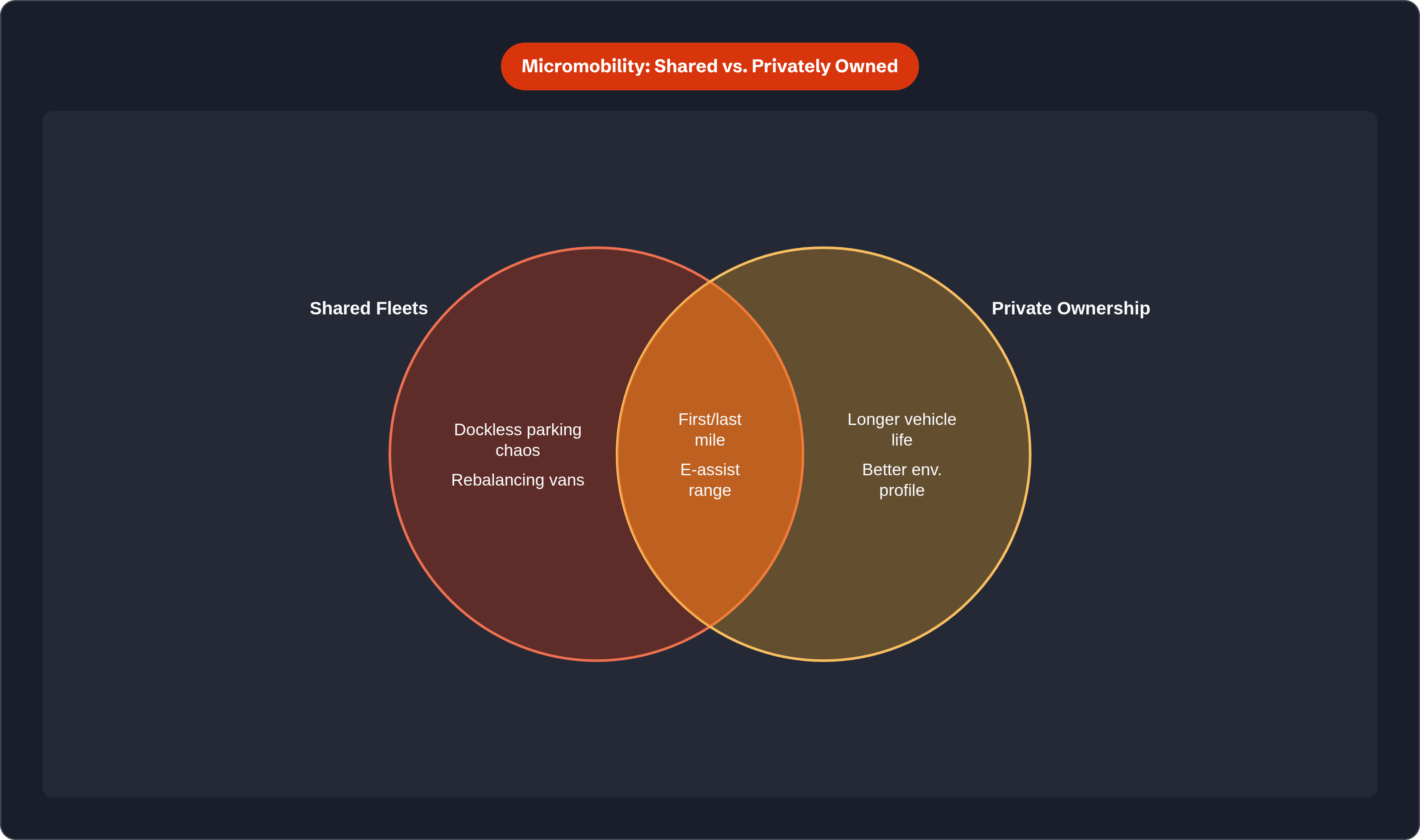
Transit systems are generally good at moving people over medium to long distances. A subway gets you across the city. A commuter rail gets you between cities. But the moment you get off the train, you're on your own. That last stretch, from the station to your actual destination, is where the whole system falls apart. It's too far to walk comfortably, too short to justify a car, and too inconvenient or expensive for a taxi. That gap, what transit planners call the **first/last mile connectivity problem**, is like a missing stair in an otherwise solid staircase — everything works until suddenly it doesn't. That's the "awkward distance" that urban transport has historically just... ignored.
Micromobility's pitch is simple: cover that gap without a car.
Electric assist is the piece that changes the math significantly. It extends the range of who can actually make that trip. Older riders, people on hilly terrain, people who don't want to show up to work sweaty. E-assist opens the door wider.
Some cities have taken this seriously as a design principle. Divvy in Chicago deliberately places many of its stations near public transit hubs. That's not an accident. That's the transit-complement model working as intended.
The integration gap in the US, though, is real. The infrastructure logic exists. The behavioral pattern hasn't followed everywhere. In contrast, Berlin's BVG Jelbi platform combines public transport and multiple micromobility operators in a single app. Helsinki showed that users of a **mobility-as-a-service (MaaS)** platform became more likely to combine rail and bike-share or transit and scooter when the option was surfaced clearly.
One more thing worth knowing: GPS data from over 14,000 e-scooter trips in Germany found that dedicated bike infrastructure reduces perceived travel distance by more than 51%. The physical infrastructure isn't just a safety feature. It changes how usable the whole network feels.
Whether Micromobility Actually Reduces Car Use, and Where It Doesn't
This is the question everyone wants to say yes to. The honest answer is: sometimes.
A 2022 NABSA study found that 37% of shared micromobility trips replaced vehicle trips. That's meaningful. It's also worth sitting with the flip side: 63% did not.
Paris is the useful counter-case here. E-scooters were genuinely popular, logging around 10 million rides in 2021. But studies found those rides mostly replaced walking or public transit, not car trips. Popularity and **modal shift** are not the same thing. A product can be well-used and still not solve the problem it was supposed to solve.
This matters because micromobility that replaces walking or transit may add complexity to the urban system without reducing congestion or emissions. That's a very different outcome from the pitch.
Where car displacement does happen, the effect is real and measurable. Research has shown that bikeshare can lower daily **vehicle miles traveled (VMT)** per capita in meaningful ways. Electric assist is again the variable that shifts the calculus, because it makes car substitution plausible for trips that would have been too far or too demanding on a conventional bike.
The honest summary:
- Micromobility reduces car use in some contexts, for some users.
- It is not automatically a car replacement.
- The outcome depends on trip type, available infrastructure, and what alternatives exist.
The Environmental Case for Micromobility, and the Lifecycle Caveat That Complicates It
NABSA reported that micromobility options offset approximately 101 million pounds of carbon emissions in 2024. That's a headline number worth stating. It's also worth interrogating.
Research from Fraunhofer ISI gives the mechanism. Shared e-scooters and e-bikes can meaningfully reduce net carbon emissions, with some of the largest effects measured in cities like Melbourne and Seattle, but only when they replace motorized trips. That "only when" is doing a lot of work in that sentence.
The lifecycle caveat is real and underreported. Three things complicate the clean environmental story:
- Short vehicle life cycles. Shared scooters, especially early-generation ones, had a brutal lifespan. Manufacturing a vehicle that lasts eight months is not environmentally neutral, and **lifecycle emissions accounting** makes that cost visible.
- Rebalancing operations. Those vans driving around at night picking up and redistributing scooters? They run on diesel. That's a carbon cost that doesn't show up in the tailpipe comparison.
- Manufacturing emissions. The battery supply chain, especially, carries a significant carbon footprint that full lifecycle accounting has to include.
Privately owned e-bikes likely have better environmental profiles than high-turnover shared fleets, precisely because the vehicle gets used longer. U.S. e-bike sales grew from under 300,000 annually in 2018 to over 1 million by 2021, and unlike a lot of pandemic-era product categories, that growth held. That's a sign of genuine demand, not a blip.
The environmental benefit of micromobility is real. It is just not automatic. It's a function of what it replaces, how the fleet is operated, and how long the vehicles last.
Safety: Where the Injuries Are Concentrated and Why the Picture Is More Complicated Than the Headlines
Between 2017 and 2021, micromobility-related injuries in the U.S. rose 127%, reaching over 77,000 reported cases, with e-scooters accounting for the sharpest rise, per U.S. CPSC data. That number sounds alarming. The context matters.
Risk is concentrated in specific places and populations:
- Safety risks are most acute for riders themselves, not bystanders.
- In New York City data from 2020 to 2023, micromobility accounted for a small share of pedestrian fatalities and injuries. Small, but rising from near-zero. Worth watching.
- Conflict points tend to cluster around scooter riders and cyclists on sidewalks, creating real risk for older adults and children.
- Dockless vehicles abandoned in the middle of sidewalks create serious access problems for people with physical, visual, or cognitive disabilities.
The regulatory implication is that this is not a uniform problem. It differs by vehicle type, rider age, infrastructure quality, and whether vehicles are privately owned or part of a shared fleet. A blunt ban is a blunt tool for a differentiated problem.
Paris is instructive here. When 89% of participants in a 2023 referendum voted to ban shared e-scooters, the decision was driven significantly by what the city's own Shared Mobility Manager described as a "feeling of insecurity," not statistical injury rates. Perception and data diverged. Perception won.
That's not a bug in the democratic process. It's a signal that operators and cities failed to build sufficient public trust.
What Happened When Paris Banned Shared E-Scooters, and What Other Cities Took From It
The Paris vote in 2023 is one of the most referenced data points in the micromobility world, so it's worth being precise about what actually happened.
89% of participants voted to ban shared e-scooters. But only 7.5% of registered voters showed up. So a small, motivated group ended a service that 1.2 million people had used the previous year. Whether that reflects the will of the city or a specific, dissatisfied slice of it is a fair question.
What happened next is actually more interesting than the vote itself.
Paris did not retreat from micromobility. The city is simultaneously investing €250 million to make itself entirely bikeable by 2026. Shared bikes filled much of the gap left by scooters. The mode changed; the direction of travel did not.
The ripple effect hit other European cities quickly. Rome, Brussels, Helsinki, and Riga all tightened e-scooter regulations in the aftermath. Speed caps. Designated parking. Stricter enforcement.
The lesson is not that micromobility failed in Paris. The lesson is that shared scooters, specifically, failed to build enough public legitimacy. Cycling infrastructure investment kept accelerating regardless.
That distinction, between the mode and the specific deployment model, is what cities and operators need to carry forward. A scooter left blocking a curb cut is not an argument against the category. It's an argument against bad operations and weak enforcement.
How Cities Are Rethinking Streets, Regulation, and Infrastructure to Accommodate Micromobility
The cities where micromobility is actually working tend to share a few things in common. They didn't just permit micromobility. They designed for it.
The German GPS study mentioned earlier makes the point clearly: dedicated bike infrastructure reduces perceived travel distance for e-scooter riders by more than 51%. Separated infrastructure doesn't just improve safety. It changes how connected the whole network feels. People will use a mode differently when the physical environment supports it.
Regulatory tools that have become common across European cities:
- Speed capsenforced via geofencing, especially near pedestrian zones
- Geofenced slow zones that kick in automatically near high-foot-traffic areas
- Mandatory designated parking, enforced via operator licensing
- Operator licenses tied to compliance, not just presence
In May 2025, the EU passed regulation mandating that all new micromobility vehicles meet safety standards including speed limits and required safety equipment. That's a shift from city-by-city patchwork toward a baseline. It's not the end of variation, but it's a floor.
The **dockless** bike-share model still dominates the market. Dockless means no fixed station, which reduces infrastructure costs and increases flexibility. It also creates the parking chaos that erodes public support. Cities are increasingly conditioning operating licenses on parking compliance, which is the correct lever.
Infrastructure investment and regulatory clarity tend to move together. The cities where micromobility has stabilized are generally those that stopped treating it as a pilot and started treating it as a permanent layer of the transport network.
The Equity Gap Between Who Micromobility Serves and Who It Should
This one is uncomfortable and important.
Historically, bikeshare users have skewed White, male, and wealthier. The default deployment pattern, stations placed in dense, high-income, high-visibility areas, has reinforced urban mobility inequality rather than corrected it.
The barriers are layered and compounding:
- Physical. Stations often aren't located in lower-income neighborhoods.
- Financial. Pricing can be prohibitive for daily users without subsidies.
- Logistical. Most systems require a smartphone, a bank account, and a data plan. Not everyone has all three.
Progress is real but incomplete. Research examining hundreds of shared micromobility programs in the U.S. found that 70% now include at least one equity requirement, things like discount rides, cash payment options, or smartphone alternatives. That's meaningfully better than where things were.
Here's the catch: fewer than one-third of those programs included process-equity requirements, meaning active, targeted outreach to underserved communities. Having a discount program is not the same as deploying vehicles where people need them and making sure those people know the discount exists.
Equity requirements exist mostly on paper in too many cases. The test is not whether a policy document mentions equity. The test is whether vehicles are actually distributed in underserved areas and whether pricing makes them genuinely usable.
Where Micromobility Fits in the Urban Transport Stack as Cities Plan for the Next Decade
Here's where things get interesting.
One projection suggests the U.S. could see 540 million annual micromobility trips by 2035 if cities invest significantly in infrastructure. The conditional matters as much as the number. Infrastructure investment is the variable. Without it, the category plateaus.
A few signals worth watching:
- Cargo e-bikes. Projected to grow at a strong rate through the next decade, with operators reporting meaningfully higher daily revenue per vehicle than standard bikes. That's not recreational use. That's logistics. That's a mature, functional use case finding sustainable unit economics.
- Industry consolidation. TIER and Dott merging into a single operator across hundreds of cities. Bird's 2023 bankruptcy. The era of venture-subsidized growth and land-grab expansion is over. What's left needs to work at real prices with real regulation.
- The cities getting it right. They share a pattern: transit integration by design, dedicated physical infrastructure, clear operator rules, and equity requirements with actual enforcement teeth.
The word "micromobility" will matter less over time than the question it forces cities to answer. How do you connect people to transit? How do you reduce car dependency for short trips? How do you distribute that access fairly? And what physical and policy infrastructure does all of that actually require?
Those are not small questions. They're the ones cities are working through right now, whether they're using the word or not.