Types of Micromobility Devices Explained
Pedal, electric, standing, or cargo—here's what defines each type.
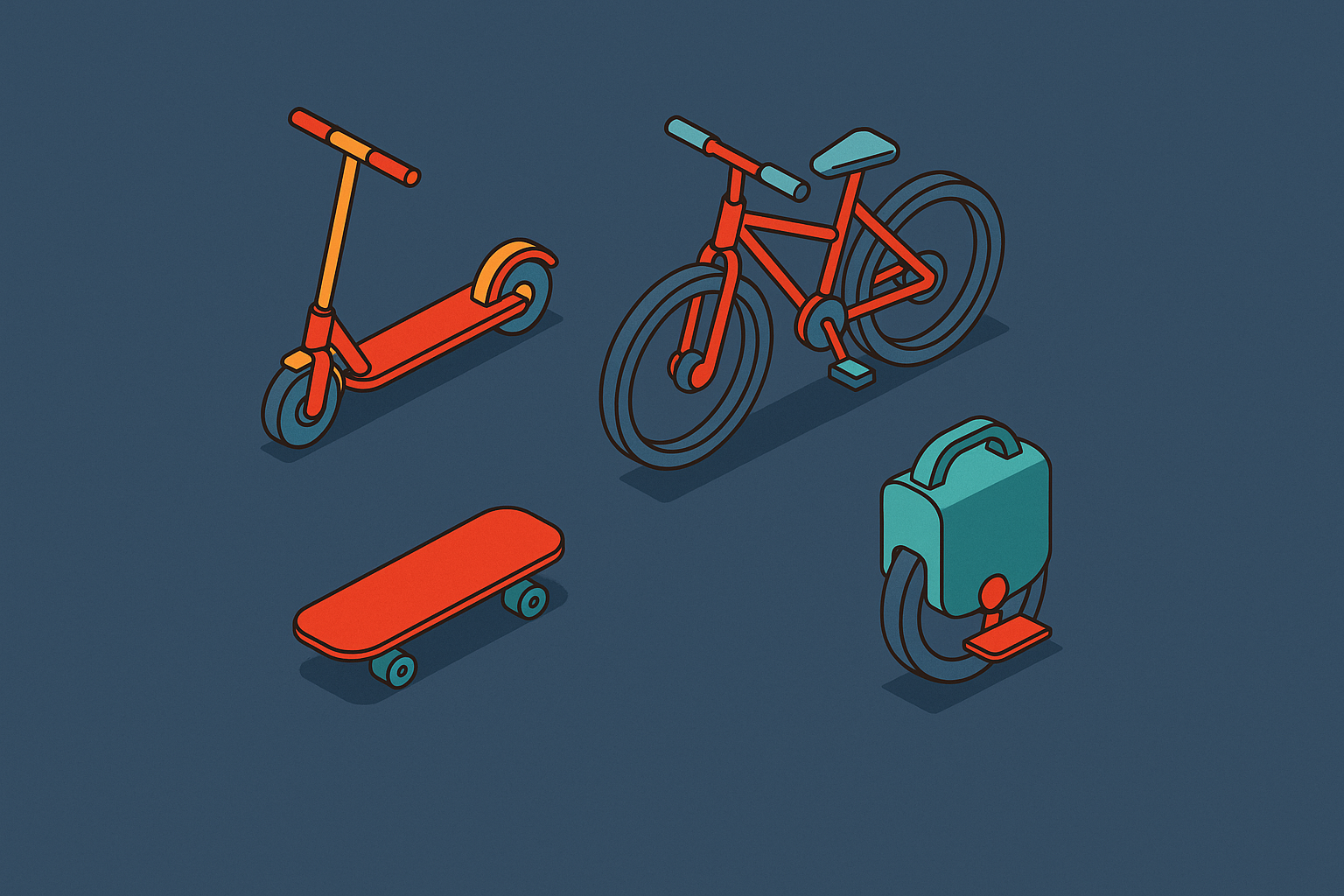
Micromobility is a genuinely confusing category, and that confusion is not your fault. The word was reportedly coined by analyst Horace Dediu in 2017, which means the entire category is younger than some of the smartphones people use to unlock its vehicles. In that short time, it has expanded to cover everything from a standard pedal bike to a cargo e-bike hauling parcels across Manhattan to a self-balancing unicycle.
The working definition most U.S. planners use comes from the Federal Highway Administration: small, low-speed, human or electric-powered devices. SAE International's standard puts harder numbers on it: under 500 pounds, under 30 mph, no wider than five feet. The International Transport Forum uses similar but not identical limits. Even official bodies have not fully agreed on what this category is, and the same device can be regulated differently depending on which state, city, or country you are in.
Two Splits That Define the Category
The first: human-powered versus electric-assisted. This one matters because the regulatory consequences are real. Pedal a bike, no problem almost anywhere. Add a motor, and you are navigating class definitions, trail access rules, and in some places, license requirements.
The second split is less obvious but equally useful: standing versus seated versus cargo-carrying. This cuts across the powered and unpowered divide and explains why devices that share a battery and a motor can feel like completely different tools. A standing e-scooter and a Class 3 e-bike might both be electric and reach similar speeds, but one you stand on and the other you sit on and pedal. They serve different riders, different trips, different cities.
The real problem in this category is marketing, which loves to blur these lines. The term "e-scooter" gets applied to both standing kick scooters and sit-down moped-style vehicles. "E-bike" covers everything from a gentle assist commuter to something that rides more like a motorcycle. When the vocabulary is this loose, understanding breaks down fast.
Pedal Bikes
Traditional, unpowered bicycles fit the micromobility definition squarely: human-powered, lightweight, low-speed. In cycling-mature cities like Amsterdam and Copenhagen, they still dominate short urban trips alongside, not instead of, electric alternatives.
In shared systems, pedal bikes have held up well. Docked bikeshare systems anchor bikes to fixed stations. Dockless systems removed the fixed station requirement entirely — you find a bike through an app and leave it wherever the operator's geofencing zone permits. Dockless trips are shorter on average, closer to true last-mile distances, and research shows they distribute access more equitably than docked systems, which historically clustered stations in wealthier, higher-density neighborhoods.
NACTO's 2024 report found that 2023 was a record year for shared bike and scooter trips in the U.S. and Canada, hitting 157 million total trips — beating the previous record of 136 million set in 2019. Projections put shared bikes as the dominant shared micromobility form in urban areas through at least the mid-2030s.
The Three-Class E-Bike System
The U.S. three-class e-bike framework was not created by a federal agency. It was developed in the early 2010s by manufacturers and advocacy groups, with PeopleForBikes leading the effort, to give states a ready-made standard that kept e-bikes out of the licensing, registration, and insurance requirements that apply to mopeds and motorcycles. More than 40 states now use it.
All three classes are capped at 750 watts under federal consumer product rules. The differences are about speed and how the motor engages.
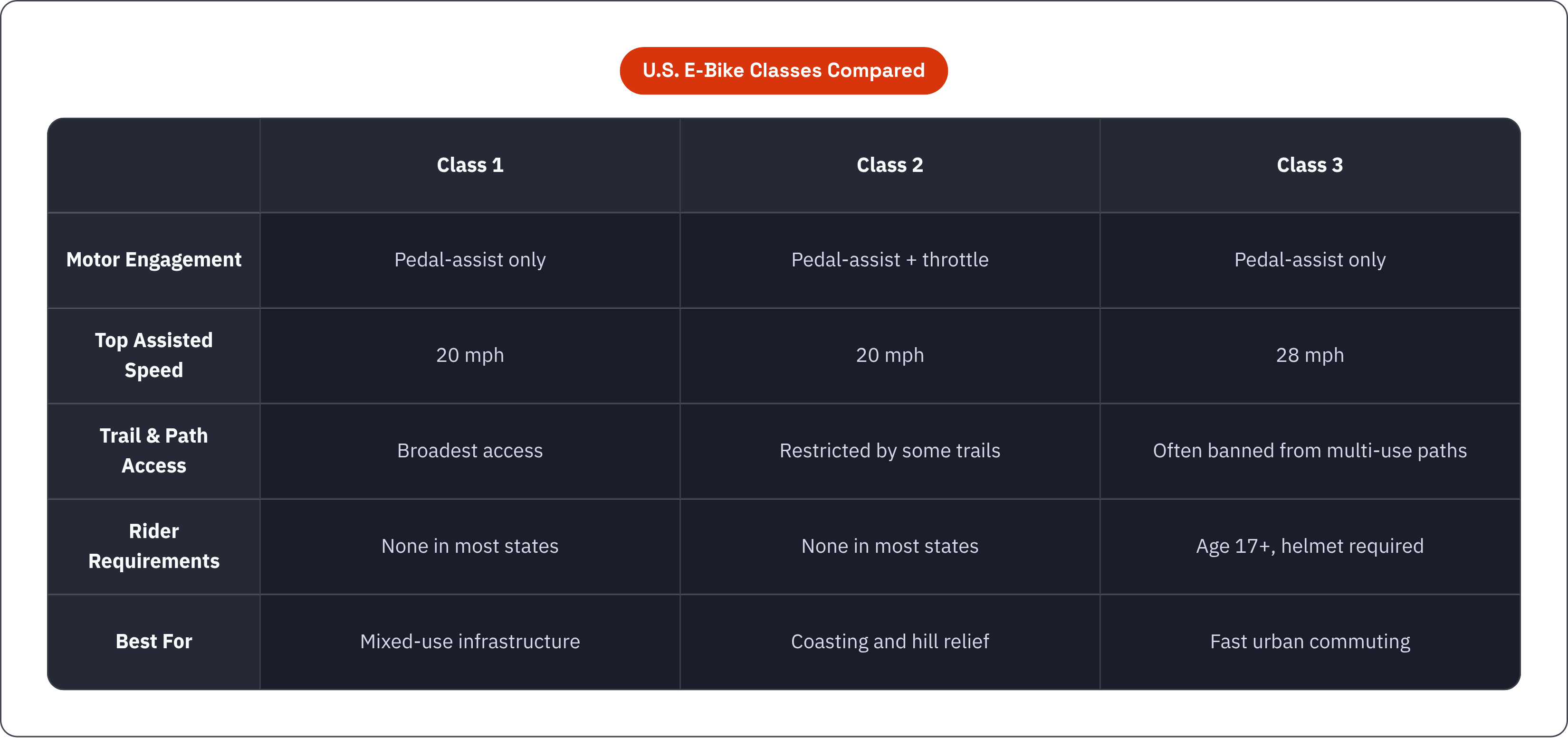
Class 1 is pedal-assist only, no throttle, with a 20 mph top speed. Because the speed profile is closest to a conventional bicycle, Class 1 bikes get the broadest access to bike paths and trails.
Class 2 adds a throttle to the pedal-assist setup, still capped at 20 mph. The throttle lets you engage the motor without pedaling — useful on long flat stretches or hills — but it is why some trail managers restrict it.
Class 3 is pedal-assist only but the assist goes up to 28 mph. In most states, riders must be at least 17 and wear a helmet. Multi-use paths shared with pedestrians often restrict Class 3 entirely.
Battery packs on modern e-bikes typically run 400 to 800 watt-hours, giving a well-specced commuter a range of 50 to 200 kilometers depending on conditions. E-bikes dominated the global micromobility market in 2025 with a nearly 90% share.
Cargo E-Bikes
A cargo e-bike is not a regular e-bike with a bigger basket. It is a different vehicle built around a different job: extended frame, front-loading cargo box, or heavy-duty rear platform. Two use cases are worth keeping separate.
Personal use: groceries, kids, gear — a minivan replacement for urban households.
Commercial last-mile delivery: In 2022, cargo bikes in New York City made more than 130,000 trips and delivered over five million packages. NYC's Department of Transportation authorized cargo bikes and finalized usage standards in 2024. European cities including Vienna and Copenhagen have run cargo bike delivery programs for years, and U.S. cities including Madison, Portland, and Boston have their own programs now.
Cities care about cargo e-bikes not just for emissions reasons but for geometry: a cargo e-bike displacing a delivery van removes a much larger vehicle from a congested street.
Standing Electric Scooters
A standing scooter is a deck, a stem, handlebars, a rear hub motor, and brakes. They typically weigh 25 to 50 pounds, top out around 15 to 20 mph for standard consumer models, and carry enough battery for 15 to 30 miles per charge.
The shared market launched fast. Bird launched in Santa Monica in 2017. By 2019, 109 U.S. cities had scootershare programs and e-scooters had surpassed bikeshare as the most-ridden shared mode with over 85 million trips. The pandemic hit the market hard, but NACTO's 2024 data showed a 15% bounce-back in 2023, reaching 65 million e-scooter trips.
The performance range is expanding. Consumer commuter models stay in the 15 to 20 mph range. At CES 2025, Segway demonstrated a model that hit nearly 50 mph — technically outside standard micromobility speed limits entirely. Operators are also rethinking the form factor: Lime's 2025 lineup includes a sit-down model and a pedal-assist option, aimed at women and older riders who find standing models uncomfortable.
E-Mopeds
E-mopeds are electric, lightweight, and built for urban streets. In spirit they belong in the micromobility conversation; in technical specs, they often do not. Most e-mopeds exceed the weight or speed thresholds that SAE and FHWA use to define the category, and in most U.S. states they require registration, insurance, and a valid driver's license.
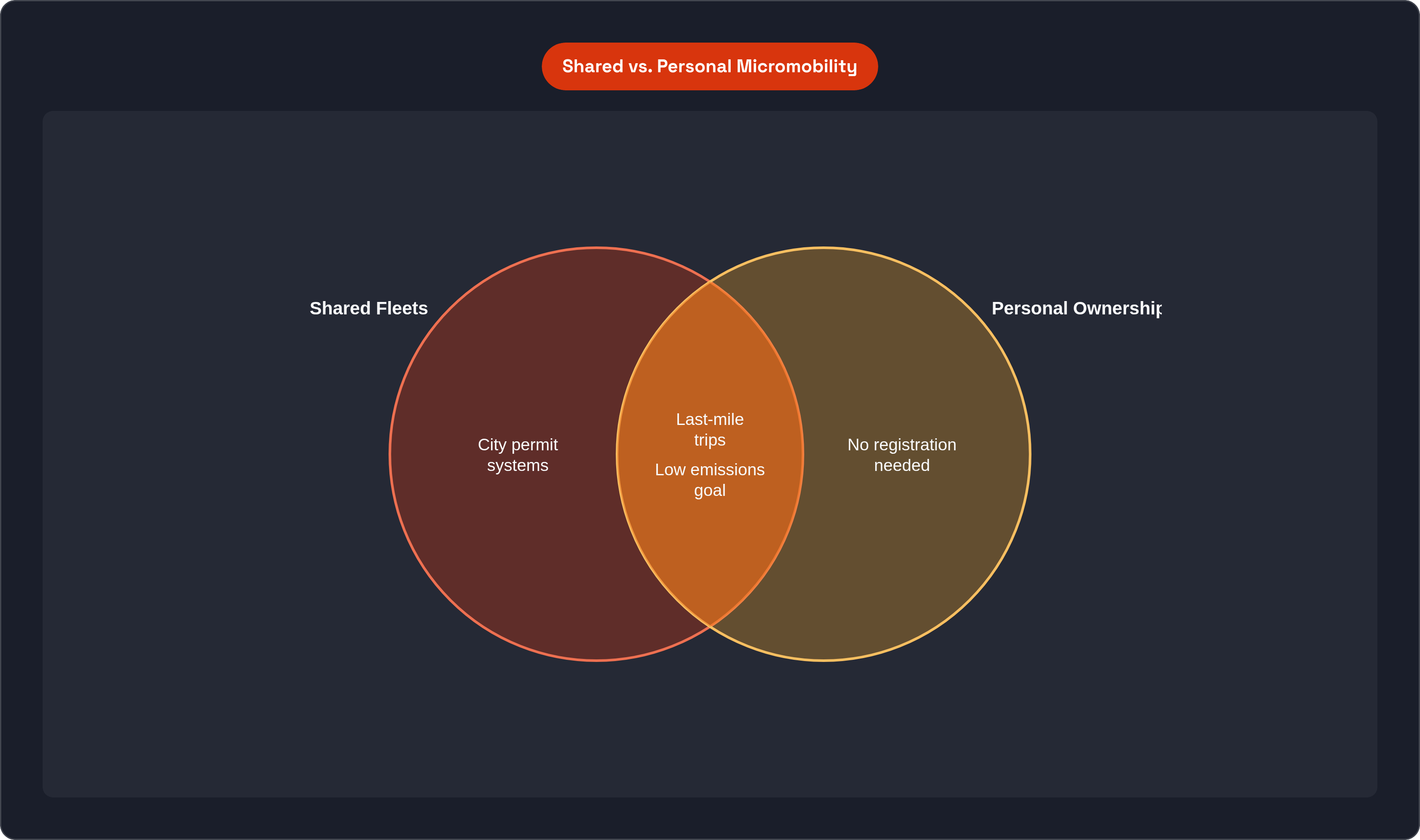
Sit-down shared scooters like Lime's newer models occupy a gray zone: moped form factor, but operating inside a shared fleet governed by city permits rather than individual vehicle registration. Which rules apply depends on the city, and the lack of harmonized definitions creates real friction for operators and riders.
Electric Skateboards, Hoverboards, and Unicycles
These devices technically meet the micromobility definition but have no meaningful shared-fleet presence. They are personal-ownership vehicles with limited urban utility — included here because they shaped how regulators think about the broader category, mostly because of what went wrong early on.
Self-balancing scooters (hoverboards) saw battery management failures cause fires. More than 500,000 units were recalled in the U.S. in 2016 across eight manufacturers. Standards improved after that, including UL 2272 certification, but the episode put regulators on alert about small electric devices. Some of the scrutiny e-scooters faced at launch traces back to the hoverboard fires.
Electric unicycles — single-wheeled, self-balancing, harder to learn than anything else on this list — offer longer range and better all-terrain performance than hoverboards. The people who ride them tend to be dedicated enthusiasts.
The Honest Environmental Picture
The environmental case for micromobility is real but more complicated than the marketing suggests.
A California shared micromobility pilot found that 49% of e-bike and e-scooter trips displaced car trips. More than half did not — they replaced walks, transit rides, or were trips that would not have happened otherwise, a pattern researchers call trip generation rather than mode substitution.
Lifecycle emissions for shared e-scooters range from 55 to 213 grams of CO2 equivalent per passenger-kilometer depending on city, fleet management practices, and vehicle lifespan. That wide range reflects manufacturing, international shipping, electricity source, and nightly redistribution van miles. A scooter charged on renewable energy and ridden for two years has a very different footprint from one charged on coal and replaced after six months.
Personally owned e-bikes and cargo bikes have a better lifecycle profile than shared scooters for a straightforward reason: no redistribution van. The ownership model matters as much as the device type.
Micromobility's environmental value depends on what it replaces and how it is operated. "Electric" is necessary but not sufficient.