Micromobility Safety Regulations by City
Injury rates doubled in two years, forcing cities to enforce rules that riders largely ignore.

Cities aren't tightening rules because they hate fun. People are getting hurt, and the numbers are hard to ignore.
E-bike emergency room visits roughly doubled between 2022 and 2024, from around 26,800 to 59,200, according to CPSC (Consumer Product Safety Commission) data. E-scooter emergency visits hit 79,300 in 2024. Between 2023 and 2024 alone, reported e-scooter injuries jumped 80%, from 64,312 to 115,713. Those are not rounding errors.
A few patterns in the injury data are worth understanding, because they're shaping which rules are actually getting written:
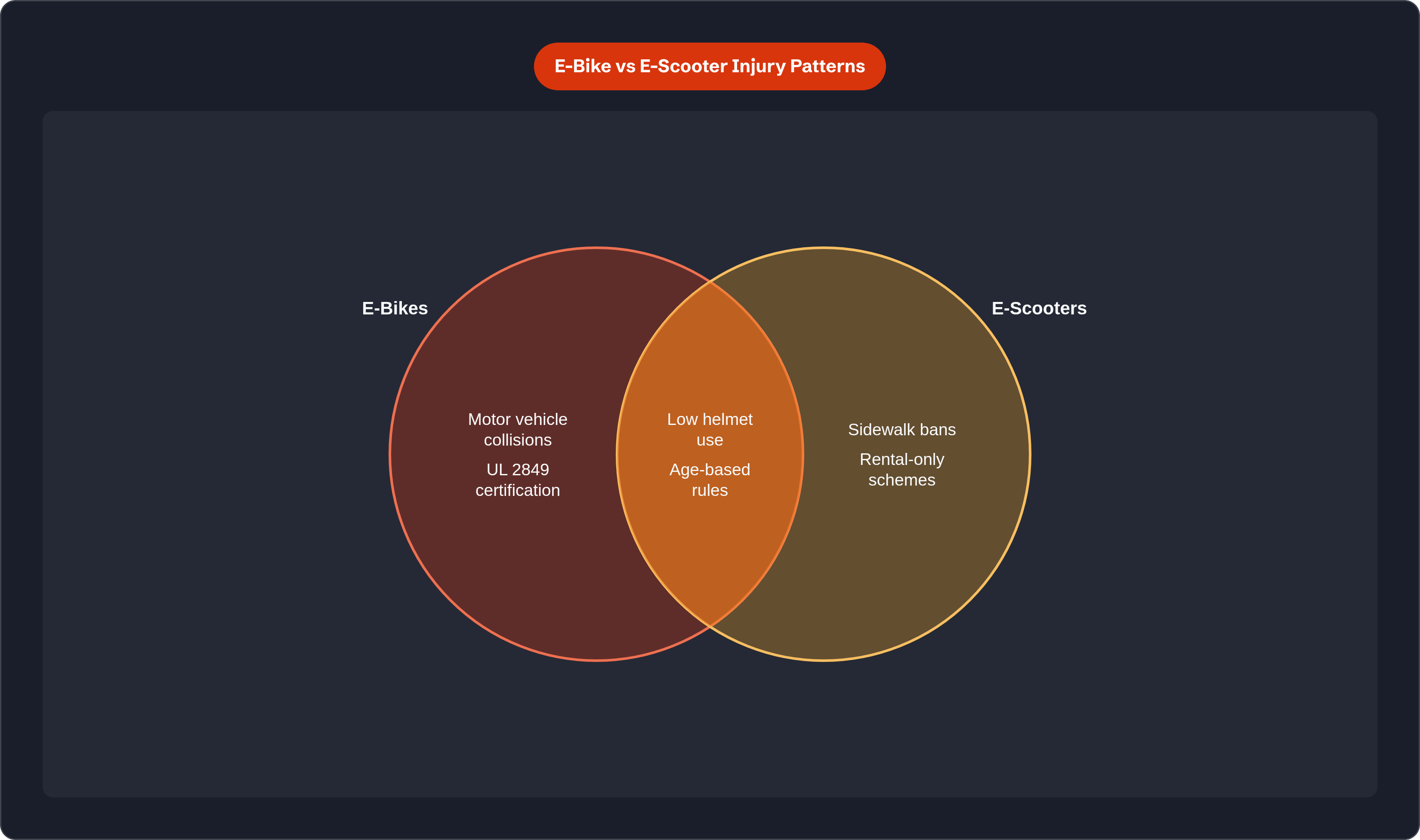
Falls dominate e-scooter crashes. A 2024 Illinois study of more than 34,000 hospital patients found that 78% of e-scooter injuries came from falls, not collisions. The biggest enemy of an e-scooter rider is not a car. It's pavement.
E-bike crashes look different. Nearly half of e-bike injuries in that same study involved motor vehicle collisions. Different crash type means a different policy response.
Kids are disproportionately exposed. Children 14 and under made up 36% of micromobility injuries between 2017 and 2022, despite being roughly 18% of the U.S. population. Regulators noticed.
Helmets aren't being worn. Helmet compliance among injured riders has hovered around 19% per CPSC data. Laws exist in many places. People are largely ignoring them.
That last one matters most. Johns Hopkins research suggests helmet laws, when actually enforced, can cut traumatic brain injury rates by more than half. The problem isn't a lack of rules. It's the gap between what's written and what riders actually do. A rule that nobody enforces is just text on a webpage. More cities are treating enforcement as the real lever, not just adding another line to a safety pamphlet nobody reads.
How the U.S. regulatory structure produces city-level variation
Here's the structural reason this is so messy: the federal government sets manufacturing standards and has largely stepped back from everything else. Recent NHTSA reports on micromobility are advisory. No binding force. So states and cities fill the void, and they fill it very differently.
As of 2024 and 2025, 28 states and D.C. have updated their e-scooter laws. No state has enacted a universal adult helmet mandate. Seventeen states have statewide sidewalk bans. Only four states require a driver's license to ride an e-scooter. Even the most basic rules are unevenly distributed across the country.
The e-bike classification system shows how this plays out on the ground. Most U.S. states have adopted some version of the three-class e-bike classification framework, but the access rules attached to those classes vary by city and sometimes by trail. A Class 2 e-bike is trail-legal in one county and prohibited in the next one over. Same bike, same day, different rules, no warning sign.
Don't assume the rules from your home city apply everywhere else. They don't. The patchwork is real, it's intentional in some cases, and navigating it is genuinely its own skill set.
New York City's layered approach: pilots, geofencing, and battery law
New York has built one of the most layered regulatory frameworks in the country. It's not a model anyone would design from scratch, but it's instructive precisely because you can see what each layer was responding to.
The shared scooter program runs through three providers, geographically limited to the East Bronx and parts of Eastern Queens. Manhattan and Brooklyn are excluded. Rental scooters are capped at 15 mph. Geofencing restricts operation to approved zones, with 2026 legislation adding speed reductions near schools and parks. Ridership in the Queens pilot nearly doubled between 2024 and 2025, reaching 648,000 total rides. Expansion requests are already pending.
Helmet rules in NYC are asymmetric. Adults are not legally required to wear helmets on e-scooters. Riders under 18 are. This split is common across U.S. cities, and it tracks with the injury data on kids.
The battery fire legislation is where NYC has done something genuinely consequential. After e-mobility fires peaked at 18 deaths in 2023, the city passed two laws. Local Law 42 banned reconditioning of used lithium-ion battery cells. Local Law 38 mandated a public information campaign on fire risks. UL 2849 certification for batteries became a legal requirement. By 2025, annual deaths from e-bike fires fell to one. The FDNY commissioner attributed that drop directly to the certification mandate. One death versus eighteen is a result, and other cities are paying attention.
The 2026 updates also shifted accountability in a meaningful way. New permit-bond requirements and parking-citation authority now point more liability toward operators rather than individual riders. That's a deliberate policy choice about where enforcement pressure actually lands, and it's a direction several other cities are moving.
How other major U.S. cities structure their rules differently
Not every city has NYC's resources or appetite for layered policy. What you find across the U.S. is a wide range of approaches, from conservative bans to fairly permissive frameworks, with most cities landing somewhere in the middle and adjusting as they go.
The ban-and-reverse pattern is common. Nashville enacted a scooter ban in 2023 following concentrated safety incidents. San Francisco issued an early moratorium. In most of these cases, bans eventually give way to permit systems once operators demonstrate they can meet compliance requirements. Bans are rarely permanent. They're what cities reach for when things feel out of control and nobody has a better idea yet.
Zone-based speed limits are becoming more standard. Rather than one citywide cap, some cities now use geofencing to enforce slower speeds near schools, parks, and transit hubs. A decade ago, this would have been administratively unworkable. GPS makes it feasible now. It's a more targeted tool than a blanket restriction.
Helmet mandates vary enormously. Some cities have full adult mandates. Many have under-18 requirements only. Some have nothing on the books. The gap between what's required and what's actually enforced is real everywhere.
Smaller cities are dealing with this too. Durham, NC runs a shared active transportation program with a permit-based operator framework. This isn't a problem reserved for cities with millions of people. If your city has scooters, it has some version of this regulatory question sitting on someone's desk.
When you're comparing cities, four variables matter most:
Where you can ride: bike lane only, road, or sidewalk.
Speed caps: single citywide limit or zone-based variation.
Helmet scope: under-18 only, or all riders.
Operator permits: insurance requirements, fleet size limits, equity mandates.
No city has solved enforcement. Rules on paper and actual rider behavior are far apart everywhere.
How cities outside the U.S. regulate micromobility
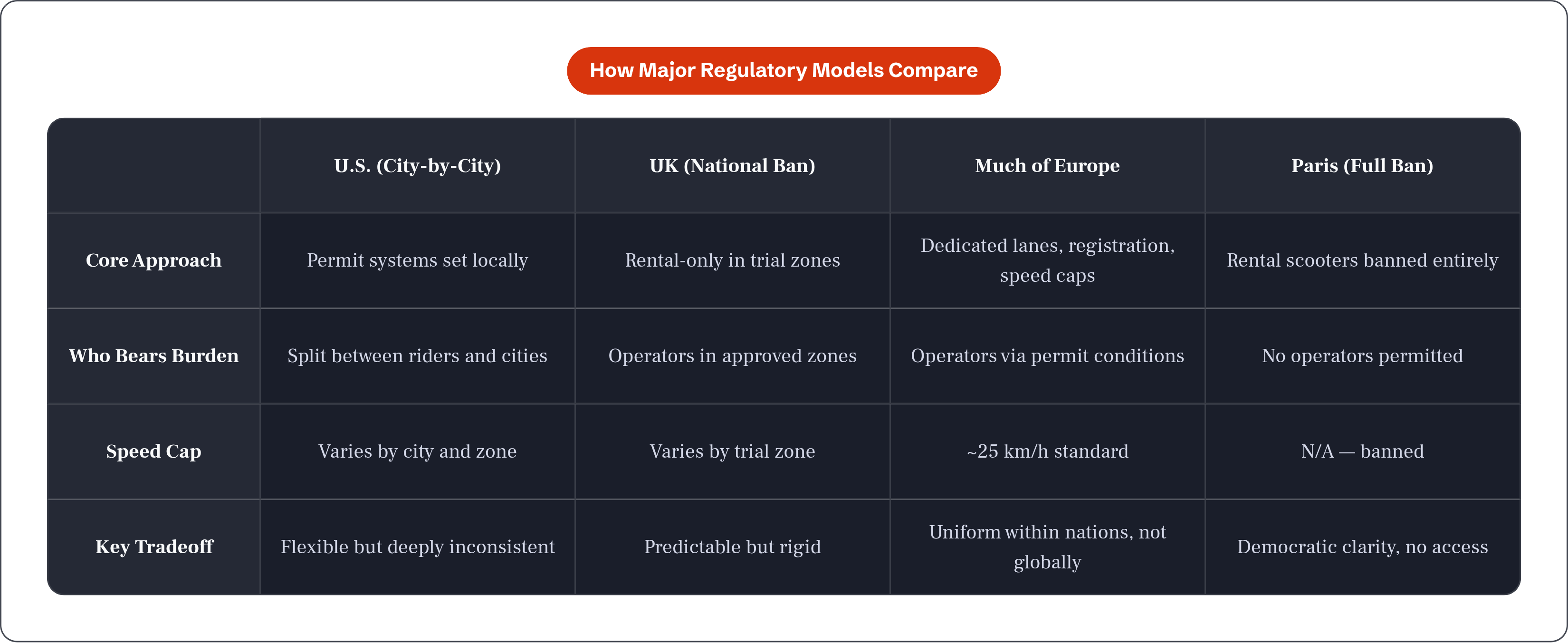
Looking abroad clarifies what the alternatives actually look like, which is useful when U.S. cities are debating their options.
The UK has seen e-bike and e-scooter lithium-ion battery fires rise sharply, from 26 incidents in 2020 to 211 in 2024, resulting in 86 injuries and 8 fatalities. Nationally, privately owned e-scooters remain illegal on public roads. Only rental schemes in designated trial zones are permitted. One national rule, applied consistently. The tradeoff is rigidity. The benefit is that nobody has to guess.
Much of Europe has moved toward dedicated lane requirements, mandatory registration, and speed caps around 25 km/h as conditions of operating permits. The burden sits more on operators than on individual riders, which mirrors where NYC is moving with its 2026 changes.
Paris banned rental scooters entirely in 2023 following a public referendum. Residents voted on it directly. That's the clearest example in the world of democratic backlash against permissive micromobility policy, and both advocates and skeptics in the U.S. cite it regularly, for opposite reasons.
The underlying tension is straightforward. Nationally uniform rules create predictability. They reduce confusion for anyone crossing city or country lines. But they don't fit the infrastructure, density, or culture of every locality. City-by-city rules allow experimentation and local adaptation. But they also create exactly the patchwork problem this article is about. There's no clean answer. Every approach just comes with its own specific set of costs.
What operators must navigate across multiple jurisdictions
If you're a rider, the regulatory patchwork is annoying. If you're an operator, it's a full-time compliance job with no finish line.
An operator running scooters across a dozen U.S. cities faces a dozen different permit structures, insurance thresholds, fleet caps, and geofencing specifications. Each one requires separate work to implement and maintain. When a city updates its rules, which can happen with short lead times and minimal notice, the operator's technical and legal teams have to respond fast or face permit consequences.
A few things operators are dealing with that riders rarely think about:
Equity requirements are now standard. Seventy percent of U.S. shared systems include at least one equity requirement, per 2024 data from NABSA (the North American Bikeshare and Scootershare Association). That means low-income pricing tiers, adaptive vehicles, or coverage in underserved neighborhoods. Operators aren't just selling rides. They're being asked to serve as social infrastructure, and cities are putting that in the permit language.
Geofencing maintenance is ongoing work. Slow zones, hard stop boundaries, parking corrals. These aren't set-once configurations. City rules change, sometimes quietly, and operators who rely on manual update processes spend a lot of time playing catch-up.
Federal movement on batteries is happening. A bill targeting battery safety passed the House in 2025 and would introduce some national uniformity on product certification. That matters for fire safety. Operating rules remain a city-by-city question for the foreseeable future.
Regulatory monitoring and compliance infrastructure are operationally as important as fleet management. Not more, not less. The operators who treat those as separate concerns eventually find out why they shouldn't.
What riders actually need to know before they ride in an unfamiliar city
Most riders don't research local rules before hopping on a scooter in a city they're visiting. That's understandable. It's also how people end up with tickets, or worse, in an ER.
Before you ride somewhere new, check these four things.
Is a helmet legally required here? In 2024, tens of thousands of e-scooter injuries involved the head. That's about 18% of all e-scooter injuries that year. The rule exists in some places and not in others. Check before you assume. "I didn't know" is not useful to say at the hospital.
Where am I allowed to ride? Sidewalk riding, which puts e-scooters in pedestrian right-of-way, is a ticketable offense in 17 states. In others, it's unrestricted. Riders who don't know this find out the hard way, usually from a cop or an annoyed pedestrian.
What is the speed limit, and does it change by zone? Many cities now use zone-based speed caps enforced through geofencing. If you're renting from a shared fleet, the app often handles this automatically. If you own your vehicle, there's no equivalent nudge. You're responsible for knowing what applies where.
Do I need a license, and is there a minimum age? Only four states require a driver's license to operate an e-scooter. Minimum age rules vary. If you're traveling with kids, check the local helmet and age rules specifically, because children are disproportionately represented in injury data and more cities have written rules around that.
One practical note on private versus rental vehicles: shared fleet apps with geofencing built in provide a layer of automatic compliance that privately owned e-bikes and scooters simply don't have. If you own your vehicle and you're riding in a new city, check the rules before you leave the hotel.
No single source aggregates current rules for every U.S. city cleanly. Regulatory databases lag behind municipal updates. Check the city transportation department's website and the operator's app before you ride somewhere unfamiliar. It takes a few minutes. The alternative is learning the rules by breaking them.