Micromobility Vehicles Compared by Use Case
Pick the right micromobility vehicle for your trip, not just the closest one.
Every micromobility vehicle on the market right now is solving a specific problem. The trouble is that most people pick a vehicle the same way they pick a restaurant on vacation: they go with whatever is closest. That works fine until you're standing at a scooter dock wondering why your legs hurt, you're sweating through your work shirt, and you still have two miles to go. The right vehicle isn't the one you can see. It's the one that actually fits your trip. NACTO recorded 157 million shared micromobility trips in the U.S. and Canada in 2023, a record that beat even the pre-pandemic 2019 peak of 136 million. More trips mean more options on the street. But more options on the street doesn't mean any option works equally well for any trip. This piece maps the real use cases so you can stop defaulting to whatever's most visible and start picking whatever actually works, which is what modal shift looks like at the individual level.
The Four Main Vehicle Types, and Why the Differences Actually Matter
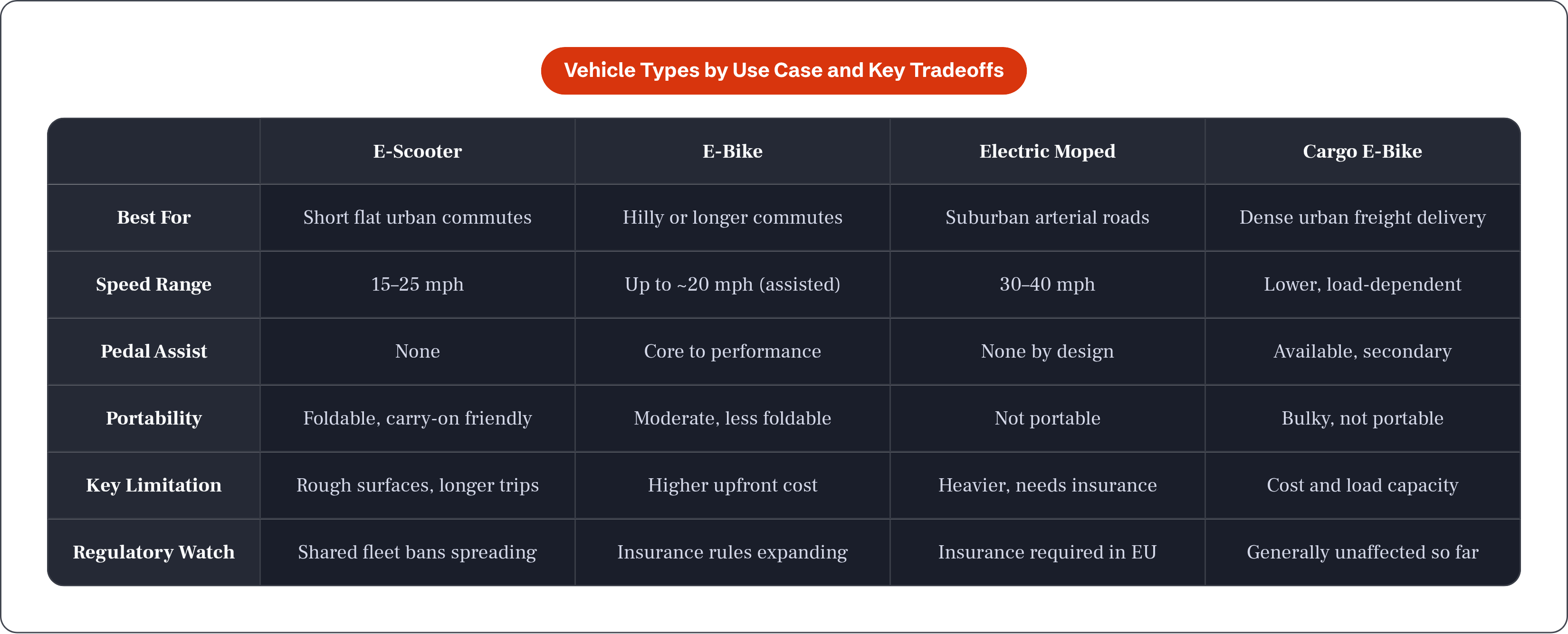
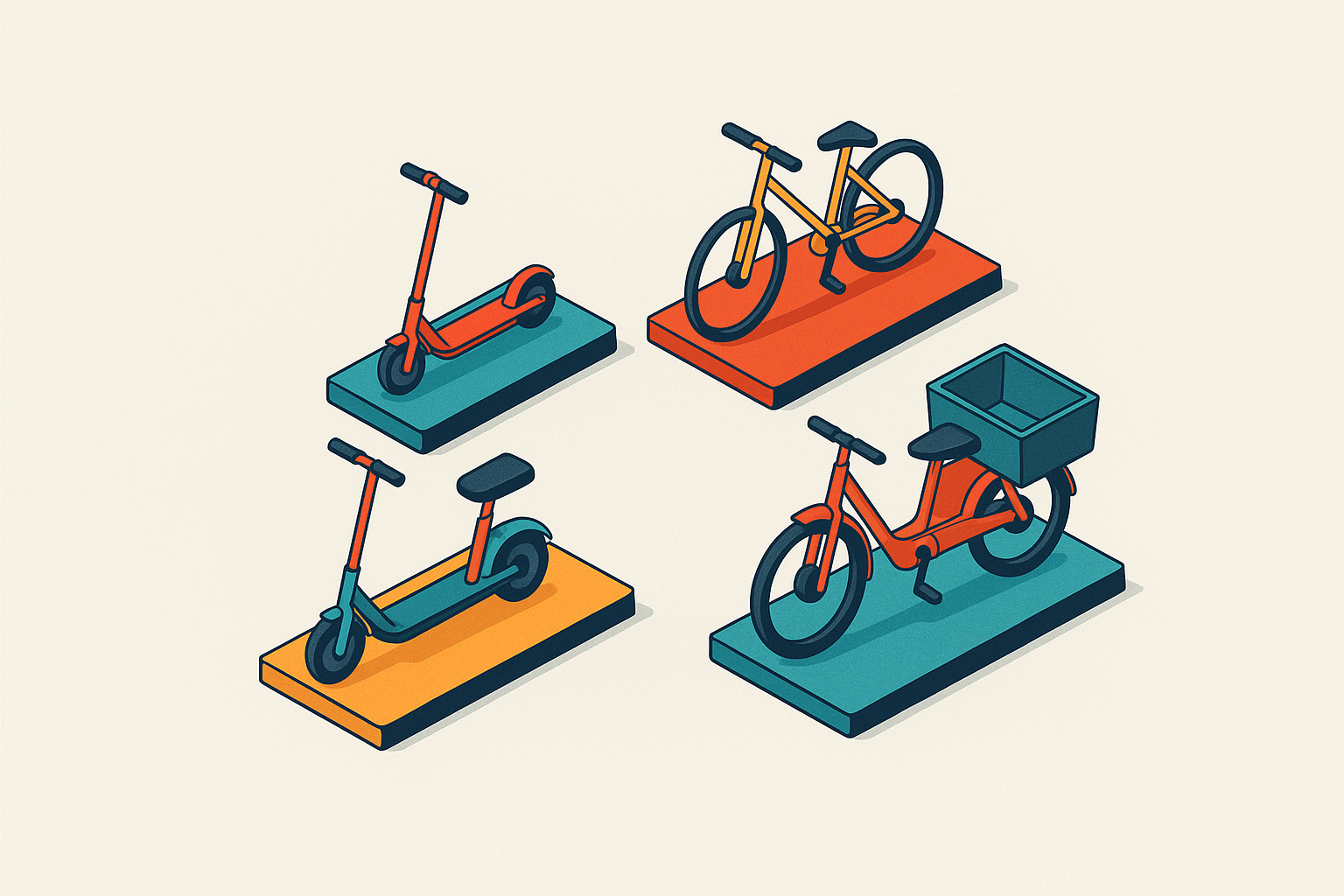
Before we get into use cases, let's level-set on what these four vehicle types actually are. Not the marketing version. The technical reality.
Stand-up e-scooters. You know these. Small wheels, no seat, you stand. They typically top out somewhere between 15 and 25 mph and get between 10 and 30 miles per charge depending on weight, terrain, and how aggressively you're riding. The form factor is the whole story here. Foldable, lightweight, easy to carry. That same form factor is also why they fall apart on longer trips or rough surfaces.
E-bikes. Seated, pedal-assist, and significantly more capable by almost every range metric. A typical motor runs around 250 watts in European markets (regulations vary elsewhere), and real-world range of 25 to 50 miles per charge is achievable on a **pedelec** because you're contributing pedal power alongside the battery. That's the key distinction. The rider is part of the drivetrain. That matters enormously on hills and long distances.
Electric mopeds (sit-down scooters). These are closer to a motorcycle in behavior than to a bicycle. Motors in the 750 to 2,000 watt range, speeds of 30 to 40 mph, street-legal alongside cars. No pedal option. That's not a flaw. It's a design choice that reflects a different set of use conditions entirely.
Electric cargo bikes. Purpose-built to carry things. Wider, heavier, and slower than a standard e-bike. They run anywhere from $2,500 to $8,000 at purchase. They are not stylish. They are not meant to be. They are built to move volume through dense urban space without a van.
One technical dividing line cuts across all four of these and will come up again and again: whether the vehicle lets you contribute pedal power or not. That single factor shapes range, terrain capability, and how forgiving the vehicle is when conditions aren't ideal. Keep it in mind.
Short Urban Commutes Under Five to Seven Miles, Where E-Scooters Actually Earn Their Dominance
Here's where I'll defend the humble e-scooter, because it genuinely deserves it in the right conditions.
If your commute is flat, short, and in a dense city, the scooter is not a consolation prize. It's the right answer. The advantages stack up cleanly:
- Foldable. You carry it onto a subway or bus without hassle.
- No locking infrastructure needed. Park it under your desk. Lock it to a pole. Whatever.
- Fast to maneuver. Stop-and-go urban traffic doesn't punish you.
- No helmet hair. (Look, this is a real consideration for commuters.)
Commuters, including riders using scooters for first- and last-mile connectivity, represent 56.4% of the micromobility market by end-user as of 2024. And within that segment, short urban commutes are the dominant trip type. The scooter didn't accidentally end up at 48.6% of the shared and rental market. It got there because a lot of people in dense cities have flat, short trips.
The liabilities show up fast once you leave that sweet spot. The stand-up position starts to strain your legs around the 30-minute mark. Small wheels lose stability on uneven pavement, gravel, or anything that isn't freshly poured city concrete. And past a certain distance, you start wondering why you didn't just take the train.
But on a flat, sub-seven-mile city route with transit in the mix? A heavier vehicle doesn't give you anything the scooter doesn't already provide.
Longer or Hillier Commutes Where E-Bikes Outperform Everything Else in This Category
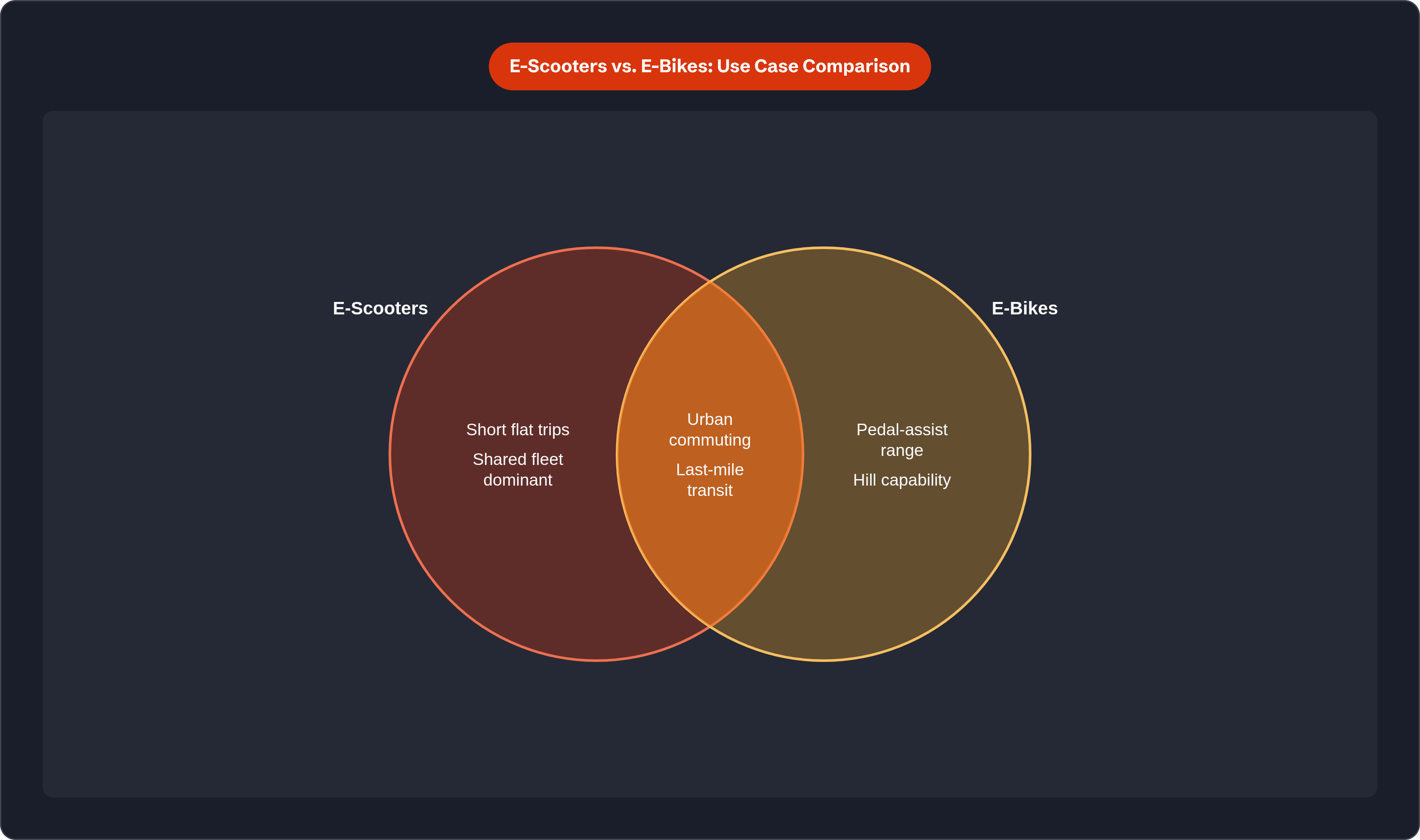
The moment your commute involves a real hill, or you're covering more than seven or eight miles each way, the math changes. Completely.
The pedal-assist difference is not cosmetic. You are part of the drivetrain. When a hill gets steep, you contribute more effort, the motor compensates, and you don't grind to a crawl. An e-scooter's fixed motor has no equivalent fallback. It just slows down. That's the inflection point.
Germany sold 2.05 million e-bikes in 2024, representing 53% of all domestic bicycle sales. That is not a country with flat terrain and mild weather. That's a market of serious, year-round commuters who did the math and decided the e-bike is the right daily vehicle. That figure is a demand signal worth taking seriously.
In the U.S., dockless e-bike trips rose 50% to 6.7 million in 2023, the steepest growth rate among shared vehicle types that year. Longer-range utility is pulling more riders in, and the data reflects it.
A few other reasons e-bikes win this use case:
- Physical comfort. You sit. You control your effort level. You can arrive without soaking through your clothes, which matters if you're heading into an office.
- Multi-gear setup. Not every e-bike has it, but the ones that do let you manage output intelligently across varied terrain.
- Economics over time. Higher upfront cost, but genuinely useful across a wider range of conditions. States like Massachusetts were covering up to 90% of e-bike purchase cost for income-qualified buyers through voucher programs in 2024, with over $50 million distributed nationally that year. The access calculus is shifting.
If your commute has hills, or length, or both, the e-bike is not the premium option. It's just the right one.
Suburban Roads with No Bike Lanes, Where Mopeds Solve a Problem E-Bikes and Scooters Can't
This one is underappreciated. Suburban road design creates a specific problem that neither an e-scooter nor an e-bike actually solves.
Picture a four-lane arterial road, the kind of stroad that suburban commuters navigate daily. No protected bike lane. Traffic moving at 35 to 45 mph. Destinations spaced a mile or two apart. An e-bike doing 20 mph on that road isn't just slow. It's a hazard. A scooter doing 18 mph is worse.
A moped doing 35 to 40 mph moves with traffic instead of obstructing it. That's not a performance feature. That's the condition for using the road safely.
The no-pedal design isn't a limitation here. The use case doesn't benefit from pedaling. You want consistent speed, stability at sustained higher speeds, and a sit-down form factor that keeps you composed over longer stretches of open road. The moped delivers all three.
On price, moped-style e-bikes tend to run $900 to $2,500, undercutting gas scooters ($1,500 to $4,000) while matching their road presence. That's a reasonable value proposition if you've looked at the road outside your neighborhood and decided a regular bike isn't the answer.
A caveat worth knowing: the EU's motor insurance directive, effective January 2024, requires third-party liability insurance for motor vehicles exceeding 25 km/h or 25 kilograms. Mopeds fall squarely in scope. That means registration and insurance requirements that simply don't apply to slower, lighter vehicles. If you're in this use case, understand the regulatory layer before you buy.
Also worth noting: once roads return to lower speeds with protected infrastructure, the moped's advantages thin. It's heavier, less maneuverable, and you're not folding it onto a train anytime soon.
The Last-Mile Transit Gap, Where the Right Vehicle Depends on What You Can Carry
The last-mile problem is specific and worth naming clearly. It's the one-to-two mile gap between a transit stop and wherever you're actually going. It doesn't sound like much. It is, in practice, where a lot of commutes fall apart. It's also where the environmental math is sharpest. Short car trips in this range emit a disproportionate amount of CO₂ per mile because cold starts and low speeds are inefficient. Micromobility's environmental case is strongest exactly here.
Two solutions, two different tradeoffs:
Option A: A folding e-scooter you own and carry. You control the whole journey. No availability risk, no wondering if there's a working bike at the dock. You fold it, you board, you unfold at the other end. The downside is that some transit systems restrict wheeled vehicles during peak hours. That policy layer matters as much as the vehicle specs.
Option B: Docked e-bike share at the station. No carrying required. You park and walk. The downside is dependency on dock availability and working bikes, which is not always a given in high-traffic stations.
Berlin's Jelbi platform integrates public transit with multiple micromobility operators in a single app, making it one of the clearest examples of **Mobility as a Service (MaaS)** in practice. It's a working example of a city designing for this use case at the infrastructure level, rather than leaving riders to piece it together themselves. That's the direction things are moving in cities that take the problem seriously.
The right answer is partly a function of your local transit policy, not just vehicle preference. Find that out before you buy anything.
Urban Freight and Delivery, Where Cargo E-Bikes Are Displacing Vans on Specific Route Profiles
Let's be clear about what's happening here. Cargo e-bikes are not a feel-good experiment. The cargo e-bike logistics market sits at approximately $3.24 billion in 2025 and is projected to reach $8.46 billion by 2032. That's a 14.72% compound annual growth rate (CAGR). That is not novelty. That's a sector being validated at commercial scale.
The displacement case is straightforward in the right conditions. A 2019 New York City pilot found that each cargo bike replacing a van or box truck produced roughly 7 fewer tons of CO₂ annually. A Bogotá pilot operating cargo e-bikes within a five-kilometer radius from micro-fulfillment centers showed similar emissions reductions per vehicle. Amazon opened a micromobility hub near Berlin's Alexanderplatz in July 2024 as part of a €400 million investment to electrify its German transport network, with plans to add over 250 e-cargo bikes to its New York City fleet in 2025. When Amazon is running the numbers and choosing cargo bikes, the business case is no longer theoretical.
The operational condition that makes cargo bikes viable is dense urban geography with congested roads. A narrower vehicle that can filter through traffic outperforms a van on time, not just emissions. That's the legitimate competitive advantage.
The condition that keeps vans in the picture: delivery density below a threshold where multiple stops per route don't amortize the cargo bike's limited load capacity. Dispersed suburban delivery without hub infrastructure doesn't work. The bike needs the density to earn its keep.
Upfront cost ($2,500 to $8,000) is the real barrier for smaller operators. Larger logistics companies can absorb that capital cost against fuel savings and congestion charge reductions. Smaller couriers and local delivery businesses are the ones who get squeezed.
Campus, Tourism, and Recreational Riding, Where Shared Fleets Solve a Problem Ownership Doesn't Need To
This is the one category where buying a vehicle is probably the wrong frame entirely.
The defining condition is low frequency. If you're visiting a city for a weekend, spending a semester on a college campus, or going for a recreational ride on a Saturday, you don't need to own anything. You need access.
As of mid-2024, the U.S. had 60 dockless bikeshare systems and 194 e-scooter systems operational outside restricted areas, per the Bureau of Transportation Statistics. That scale makes spontaneous access realistic in most mid-to-large cities. Lime reported nearly 156 million global trips in 2023. A meaningful portion of those trips were tourists, campus users, and recreational riders. Shared services led the service-type segment with 62.3% of the market in 2024.
For this use case, the vehicle selection is essentially made by the operator. A tourist opens an app and takes what's available. What matters for a reader thinking about this context is knowing that ownership is the wrong solution to a problem shared services already solve well. Don't buy something that spends 355 days a year in a garage because you used it during a trip to Barcelona.
Safety Profiles Vary by Vehicle Type, and the Injury Data Maps Directly onto Use-Case Fit
The safety picture is not comfortable, so let's look at it honestly.
E-scooter injuries in the U.S. rose from 29,344 in 2020 to 115,713 in 2024, per American College of Surgeons data. That's a real increase in absolute harm. The injury profile is specific: 87.6% of e-scooter injuries are falls, not collisions. Most affect extremities (57.1%) and the head or neck (46.8%). At least 41.1% of injured riders wore no helmet. A UCLA study found e-scooter injuries more likely than bike injuries to involve bone fractures, paralysis, or major surgery. That's a meaningful distinction if you're weighing a scooter against an e-bike for a similar route.
Here's the part that should be contextualized, though. Shared fleet operators have moved the needle. There was a 29.8% drop in injuries per kilometer on shared e-scooters between 2021 and 2024. Speed limiters, geofencing, and mandatory rider education programs make a measurable difference. The risk is not fixed.
E-bike fatalities rose from 57 in 2022 to 97 in 2024, per CPSC data. Lower absolute numbers than scooters, but a steady upward trend that reflects increased exposure as e-bike use scales. Worth tracking.
Here's the thing that ties this back to use case. The scooter's injury profile, falls on uneven surfaces, no helmet, often inexperienced riders, maps almost exactly onto the conditions where scooters are used outside their genuine sweet spot. Off smooth urban pavement. By riders who grabbed one impulsively. Without protective gear.
Use the right vehicle for the right conditions, and the risk profile changes. That's not a coincidence.
Regulatory Status Affects Which Vehicles Are Actually Usable in Your City
This is the part people skip until it's too late.
Paris held a referendum in September 2023 and voted to remove shared e-scooters from the city. Tier, Dott, and Lime pulled 15,000 scooters. Melbourne followed by the end of September 2024. Madrid banned shared e-scooter operations in October 2024 after operators failed to implement required control measures. These are not small markets. These are some of Europe's largest cities.
The distinction that matters for the purchase decision: these bans targeted shared fleets, not necessarily personally owned vehicles. If you own your scooter and your city bans the shared operator, you may still be fine. But if your multimodal commute depends on shared availability at a specific station, that's a meaningful exposure.
The EU motor insurance directive, effective January 2024, requires third-party liability insurance for any motor vehicle exceeding 25 km/h or 25 kilograms. That brings most high-speed e-scooters and heavier e-bikes into the same insurance framework as mopeds across member states. Registration and insurance aren't just a moped problem anymore.
The practical takeaway is simple. Regulatory status is not stable and varies at the city level. A vehicle that is legal and insurable in one metro may be restricted or banned in another. Checking local rules before buying or renting is not optional. It is also worth thinking about what the regulatory trajectory looks like in your city over the next two years, especially if you're building a commute around shared-service availability. Those services are not guaranteed to be there.
Pick the right vehicle. Then confirm it's actually allowed where you're going to use it.