Construction Technology Platforms for Carbon Tracking
Most construction teams lack the tools and data to track carbon emissions effectively.
Most construction project teams are not tracking carbon. The tools are fragmented, the data is patchy, and nobody is making them do it yet. That is the honest starting point for any conversation about carbon tracking platforms in construction. It's why choosing the right tool, for the right workflow, matters more than most teams realize.
Think of the construction sector as a ship with a slow leak: you can keep bailing water, or you can find the hole. Buildings and construction account for 34% of global CO₂ emissions. Global building CO₂ hit 10 gigatonnes in 2023, up 5% since 2015. The sector added 5 billion square metres of new floorspace that same year, much of it built without any applicable energy code. The tracking gap is structural.
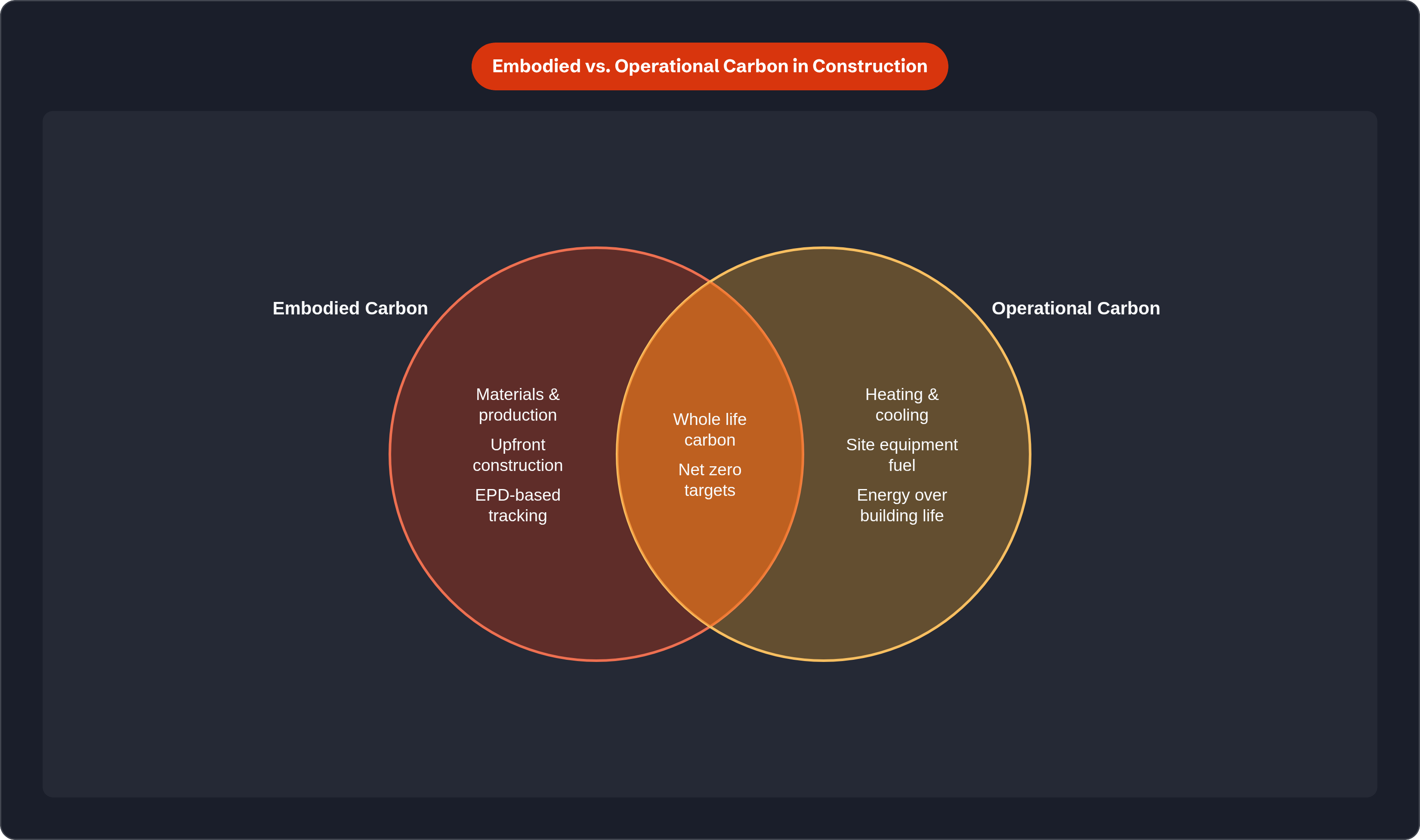
There are also two very different types of carbon at play, and whole life carbon accounting covers both. Operational carbon covers energy used to heat, cool, and run a building over its life. Embodied carbon covers everything locked into the materials and construction process itself, roughly 10 to 11% of global emissions. Most platforms were built for one or the other. Very few do both well. And upfront embodied carbon alone represents roughly half of total lifecycle emissions for new buildings through 2050, which makes early-stage tracking hard to ignore if you're serious about net zero carbon commitments.
Most Project Teams Still Aren't Tracking. Here Are the Numbers.
RIB Software's 2025 Sustainable Construction Report surveyed roughly 440 respondents across 40+ countries. Only 31% of organizations are actively tracking embodied carbon. That number has barely moved across three consecutive annual surveys. 74% aren't tracking it at all. Only 6% track it on most projects.
The most common reason given? 57% of non-trackers say their clients aren't asking for it. Others point to cost, time, and not knowing which tool to use or how. That last one is telling, because RIB's own survey found participants named over 45 distinct tools, ranging from spreadsheets to full 6D BIM platforms. When the market is that scattered, "which tool do I use?" is a genuinely hard question.
There is one bright spot worth noting. NBS research of roughly 550 UK construction professionals found that three-fifths now use digital tools for embodied carbon reporting, up from two-fifths in 2023. The UK has regulatory pressure and higher adoption. That connection is not a coincidence. 69% of respondents globally expect embodied carbon tracking to become a standard project requirement within five years, which means platforms are being built and bought for rules that don't fully exist yet.
The Three Platform Categories and What Each One Actually Does
Before picking a tool, you need to know what kind of tool you actually need. There are three broad categories, and they solve different problems.
**Life Cycle Assessment (LCA)** tools model the full environmental impact of materials across a building's lifecycle (from raw material extraction through end of life). These are the most common type of carbon tracking platform in architecture and engineering. They rely heavily on **EPDs** (Environmental Product Declarations), standardized, third-party verified documents that measure a material's environmental impact, typically expressed as **global warming potential (GWP)** in kg CO₂ equivalent. The quality of EPD data is the single biggest factor in how accurate your results are.
**Emissions-management platforms** aggregate operational data. Think fuel burned by site machinery, transport emissions, supplier-reported carbon. These tools are more common in large general contracting and infrastructure contexts where site operations generate significant direct emissions.
**Project-level tracking systems** connect carbon figures to schedules and costs. They're built for project managers who need carbon as a line item alongside budget and program, rather than a separate sustainability report produced at the end.
The best sustainability programs pull from all three. In practice, most platforms are built for one category and try to graft the others on. Knowing which category your team actually needs is step one. The second question is where in your workflow the tool needs to live, because whether a platform reads directly from your BIM model or requires a manual data export is often the difference between an assessment that gets done and one that doesn't.
One Click LCA: Breadth of Standards Coverage and Database Depth
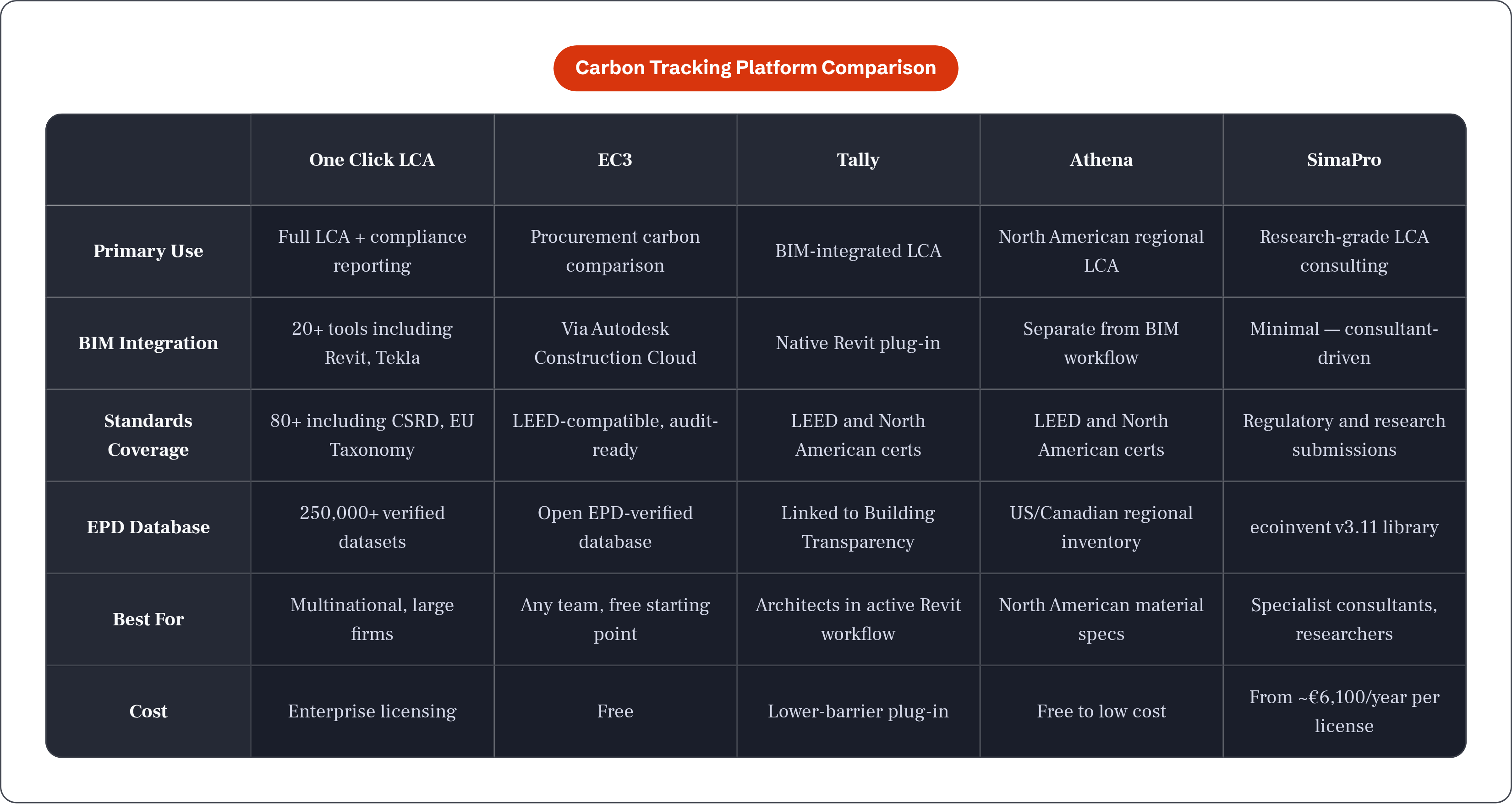
One Click LCA is the most widely used dedicated LCA platform in construction, and its main advantage is coverage. It integrates with 20+ BIM tools including Revit, Tekla, Archicad, Rhino, Grasshopper, Procore, and Autodesk Takeoff. It holds the world's largest construction-focused LCA database: 250,000+ verified datasets. It supports compliance with 80+ global standards and certifications including EN 15978, LEED, BREEAM, DGNB, CSRD, and EU Taxonomy.
That last part matters enormously if you work across borders. If your project needs to satisfy both a US green building certification and European regulatory reporting, One Click LCA is the tool that doesn't require you to start over. It received a 9.2 Features rating and 9.1 Overall score in independent rankings, noted specifically for traceable, dataset-backed material mapping that keeps calculation inputs auditable.
Carbon Designer 3D lets teams run early-stage carbon optimization before a full BIM model exists. That's a real workflow advantage. Most design decisions that affect embodied carbon happen at concept stage, long before anyone has drawn a wall assembly in Revit.
The honest caveat: the scale and licensing structure skew toward larger firms and multinational projects. If you run a 10-person architecture practice doing mostly local residential work, One Click LCA may be more tool than you need.
EC3: The Free, Open Tool Built Around EPD Transparency
EC3, built by Building Transparency, is free to use. That alone makes it worth knowing about. The real cost is setup time and the quality of EPD data available for your specific materials, which is true of every LCA tool, just more visible here.
EC3 is purpose-built for one thing: making it easy to compare materials by their cradle-to-gate embodied carbon at the procurement stage. You can benchmark options, filter by EPD-verified data, and find lower-carbon alternatives before you commit to a spec. It doesn't try to be a full LCA platform. It's a procurement decision tool with a strong data layer underneath.
It integrates with Autodesk Construction Cloud, Bentley's iTwin platform, cove.tool, and One Click LCA. RIB Software has also partnered with Building Transparency, making EC3's EPD database accessible within RIB CostX's carbon tracking workflow. That's the trend across the market right now: platforms bundling and connecting rather than competing on every feature.
Through the Bentley iTwin integration, engineering firms can quantify embodied carbon directly from infrastructure models at design stage and compare low-carbon options in an auditable workflow. If you need a credible, audit-ready embodied carbon number at procurement without paying for an enterprise LCA license, EC3 is the right starting point. Start there.
Tally and Athena: Tools Built Into the Design Workflow
Tally is a Revit plug-in. LCA runs inside the CAD environment. That sounds like a small thing. It isn't. The export-import friction between a BIM model and a separate LCA platform is where most assessments die — like a relay race where the baton gets dropped every time it changes hands. Tally removes that step entirely, which means architects can test structural and material alternatives mid-design without context-switching to a different tool.
Tally has been updated for Revit 2025 and 2026. C.Scale is developing Tally 2.0 in collaboration with Building Transparency, connecting early-stage carbon modeling with BIM-integrated analysis so the workflow runs from concept through construction rather than requiring a fresh start at each phase.
Athena Impact Estimator takes a different approach. It uses its own life cycle inventory database calibrated specifically for US and Canadian regional products. If your project is in North America and you're specifying North American materials, Athena's regional data fidelity is a genuine advantage over tools built on European EPD databases.
Per WoodWorks research, Athena, Tally, and One Click LCA are the three most common whole-building LCA tools in North America. The choice between them usually comes down to how much you need regulatory standards coverage versus how much you need BIM integration speed versus how much regional data accuracy matters for your supply chain.
The shared limitation is clear: both Tally and Athena are viable for LEED and North American certifications, but they're not built for CSRD or EU Taxonomy reporting. If that's on your compliance list, you need a different tool. Check your jurisdiction before you commit.
SimaPro and the Consulting-Grade End of the Market
SimaPro is the tool academic researchers and specialist LCA consultants use when methodological rigor is more important than speed. Craft 10.2 includes ecoinvent v3.11, uncertainty analysis, and a deep library of life cycle impact assessment methods. The depth of options exceeds what most construction project teams need or could make use of in a normal design workflow.
It's priced from €6,100 per year per license. That positions it outside the workflow of most general contractors and design practices. Its natural home is specialist consultants and researchers who are building methodologies, publishing findings, or producing third-party verified assessments for regulatory submissions.
The existence of SimaPro at one end of the market and EC3 (free) at the other tells you something important: "carbon tracking platform" covers an enormous range of sophistication and price. The middle of that range (LCA tools with solid BIM integration, reasonable EPD databases, and compliance coverage for major certifications) is where most project teams actually operate.
How BIM, IoT, and Blockchain Are Changing What Platforms Can Measure
A December 2025 systematic literature review published in MDPI Buildings identified 16 technology-based embodied carbon tracking systems and found that most are integrated with IoT and BIM. It catalogued 6 benefits, 7 key limitations, and 17 adoption challenges. The barriers are known. They are specific. The industry is working on them.
IoT sensors embedded across construction sites capture real-time data on material use, energy consumption, and equipment emissions. When that data feeds into a BIM model or digital twin, you stop doing retrospective carbon accounting and start doing live, predictive accounting. That's a meaningful shift: you can catch problems before concrete gets poured rather than calculating regret afterward.
**Blockchain** adds a different layer. Frameworks using tools like Hyperledger Fabric for modular construction add immutability to carbon records. Once a supply chain claim is logged, it can't be quietly edited. That matters when your regulatory reporting requires verified, traceable data across a multi-tier supply chain, including scope 3 emissions from upstream material production.
The direction of travel is toward carbon embedded directly in construction management systems, rather than housed in separate platforms. BIM-LCA integration has the potential to replace dedicated LCA software for many standard use cases. AI is accelerating this: carbon management tools increasingly use AI to automate EPD-to-material matching, flag data anomalies, and cut the manual effort that currently eats most of an assessment's time.
The primary barrier remains fragmented supply chains and inconsistent data management. A 2026 study in Engineering, Construction and Architectural Management identifies these as the core reason BIM-IoT-blockchain frameworks are being developed in the first place. The technology exists. The data pipelines are the problem.
Why EPD Availability Determines How Accurate Any Platform Output Can Be
You can have the best LCA platform in the world and still produce a bad result if the EPD data isn't there. One Click LCA's 2025 Carbon Experts Report surveyed roughly 150 qualified experts across two global surveys. A large majority said EPDs influence their material choices. Nearly nine in ten cited lack of manufacturer EPDs as a major barrier.
That gap is the core problem. A platform with 250,000+ datasets still can't produce accurate results for materials that lack verified EPDs. When that happens, platforms fall back on generic material data. Generic data introduces uncertainty that compounds across a full building assessment. The gap between a generic-data result and an EPD-backed result can be wide enough to change the carbon intensity of your specification and which material you choose.
The same report found that over 60% of AEC respondents achieved at least a 10% embodied carbon reduction using LCA, with roughly a third achieving up to 20%. The reductions are real. They happen when the data exists.
Your EPD coverage will vary by material type, region, and manufacturer. North American regional coverage and European EPD depth are genuinely different databases with genuinely different gaps. Evaluate which platform's database covers the materials you actually specify, in the markets you actually build in, before you commit to a license.
What Actually Drives Platform Choice for a Given Project Team
Here's the short version of how to think about this.
Workflow integration beats feature count. A tool that lives inside Revit gets used. A separate platform that requires a data export often doesn't. Start with where your team actually spends their time.
Regulatory jurisdiction sets your standards requirements. Teams reporting under CSRD or EU Taxonomy need the breadth One Click LCA provides. North American teams focused on LEED have more options and more flexibility.
Carbon type shapes category choice. Embodied carbon across the full lifecycle points toward LCA tools. Operational and site emissions from equipment and transport point toward emissions-management platforms. Compliance reporting for investors may require both, and that's worth knowing before you pick one and discover the gap.
Budget and team size are real constraints. EC3 is free. Tally is a Revit plug-in with a lower barrier to entry. One Click LCA and SimaPro serve larger organizations with dedicated sustainability staff. Knowing your budget before you evaluate features saves time.
Check EPD coverage for your actual material supply chain. Before you commit to any platform, ask whether it has verified EPD data for the materials you specify in the markets you build in. This is the most commonly skipped step and the one that causes the most post-purchase disappointment.
The regional adoption numbers say everything. 31% globally. 60% in the UK. The difference is regulatory pressure. Where mandates exist, teams choose tools. Where they don't, the decision gets deferred. That's about to change in a lot of markets, which means the platform decision a team defers today will feel more urgent in two or three years. The teams that figure it out now will have a head start that's worth more than the cost of the license.