Mass Timber Construction as a Low-Carbon Alternative
Studies find mass timber cuts embodied carbon 22 to 69 percent compared to concrete and steel.
Buildings and construction cause a large share of global greenhouse gas emissions, per a 2023 UN Environment Program report. Mass timber, engineered wood used to build mid-rise and even high-rise buildings, attacks that number two separate ways: it locks carbon inside the wood itself, and it replaces steel and concrete, both filthy to produce. This piece walks through both mechanisms, checks them against what the studies actually say, and points out exactly where the pitch falls apart if you stop nodding along.
One thing worth knowing up front: buildings keep getting better at insulation and electrification, so the energy burned once people move in keeps shrinking year over year. That means the embodied carbon baked in before a building opens its doors, mining, manufacturing, shipping, becomes a bigger slice of the pie every cycle. Steel and concrete carry most of that weight right now. So the real question isn't whether mass timber sounds nice; it's whether the math holds up once you stop reading the brochure.
What mass timber actually is and how it functions as a structural material
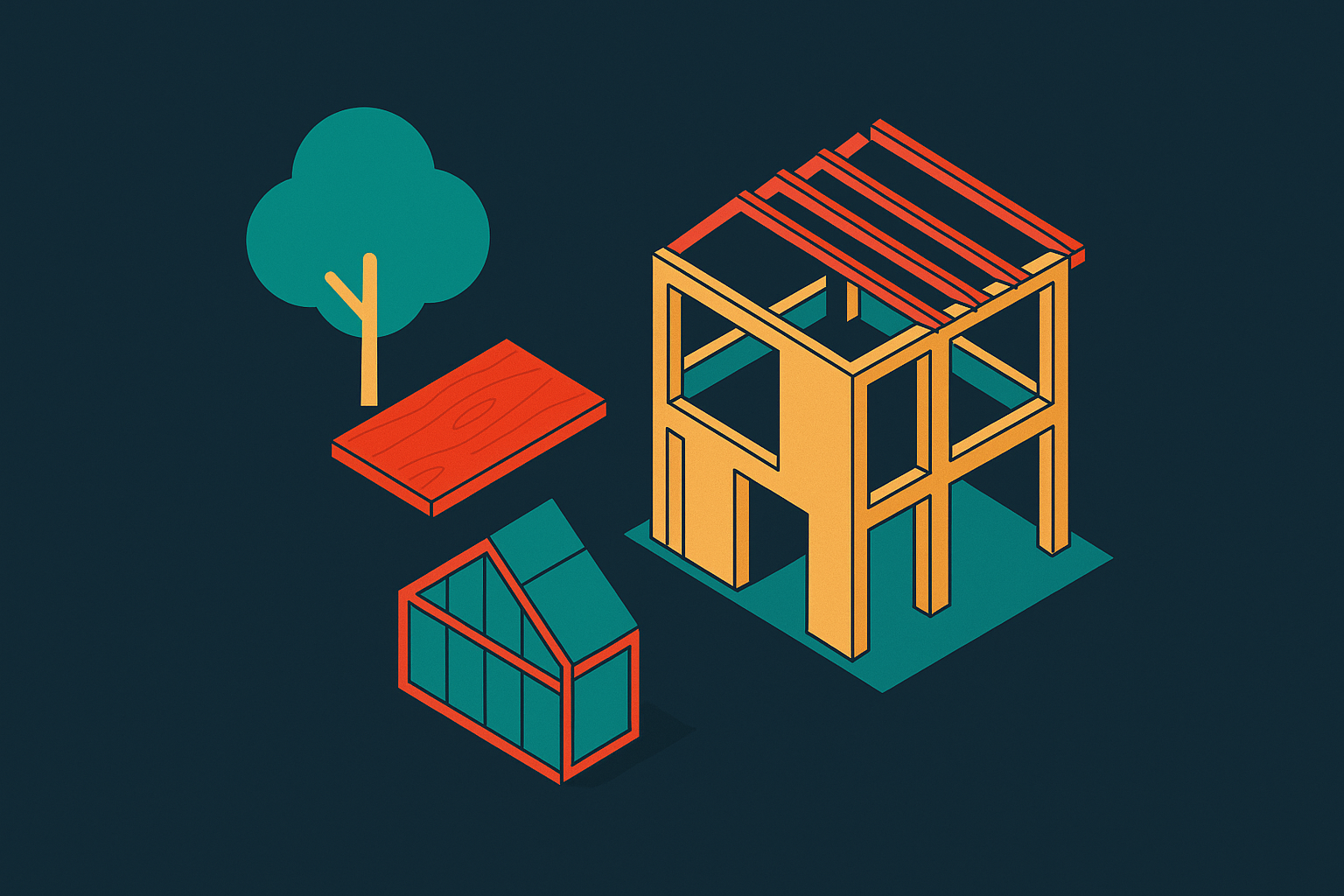
Mass timber isn't a single product; it's a family. Cross-laminated timber (CLT), glued laminated timber (glulam), nail-laminated timber (NLT), dowel-laminated timber (DLT): four names, one idea. Take wood, glue it in stacked layers, and turn it into something strong enough to stand in for steel or concrete.
CLT does most of the heavy lifting in this family. Picture layers of wood laid crosswise, glued into thick panels, then used as walls and floors, thick enough to match a concrete slab, structurally speaking. Glulam gets laminated into long beams that span distances the way a steel girder would, minus the steel.
Here's the engineering fact that actually matters: mass timber has a strong strength-to-weight ratio. Lighter than concrete means smaller foundations and often quicker builds, and that's the whole reason architects can now put up 10, 12, even 18-story buildings out of wood, something that would've gotten you laughed out of a permitting office twenty years ago.
CLT alone made up 62.68% of the mass timber market in 2024. The substitution logic is direct and almost boringly simple: CLT panels swap in for concrete walls and floors, glulam beams swap in for steel beams. That one-to-one trade is where the carbon conversation actually begins.
The two mechanisms through which mass timber reduces embodied carbon
Two separate things happen here, and people mash them together constantly.
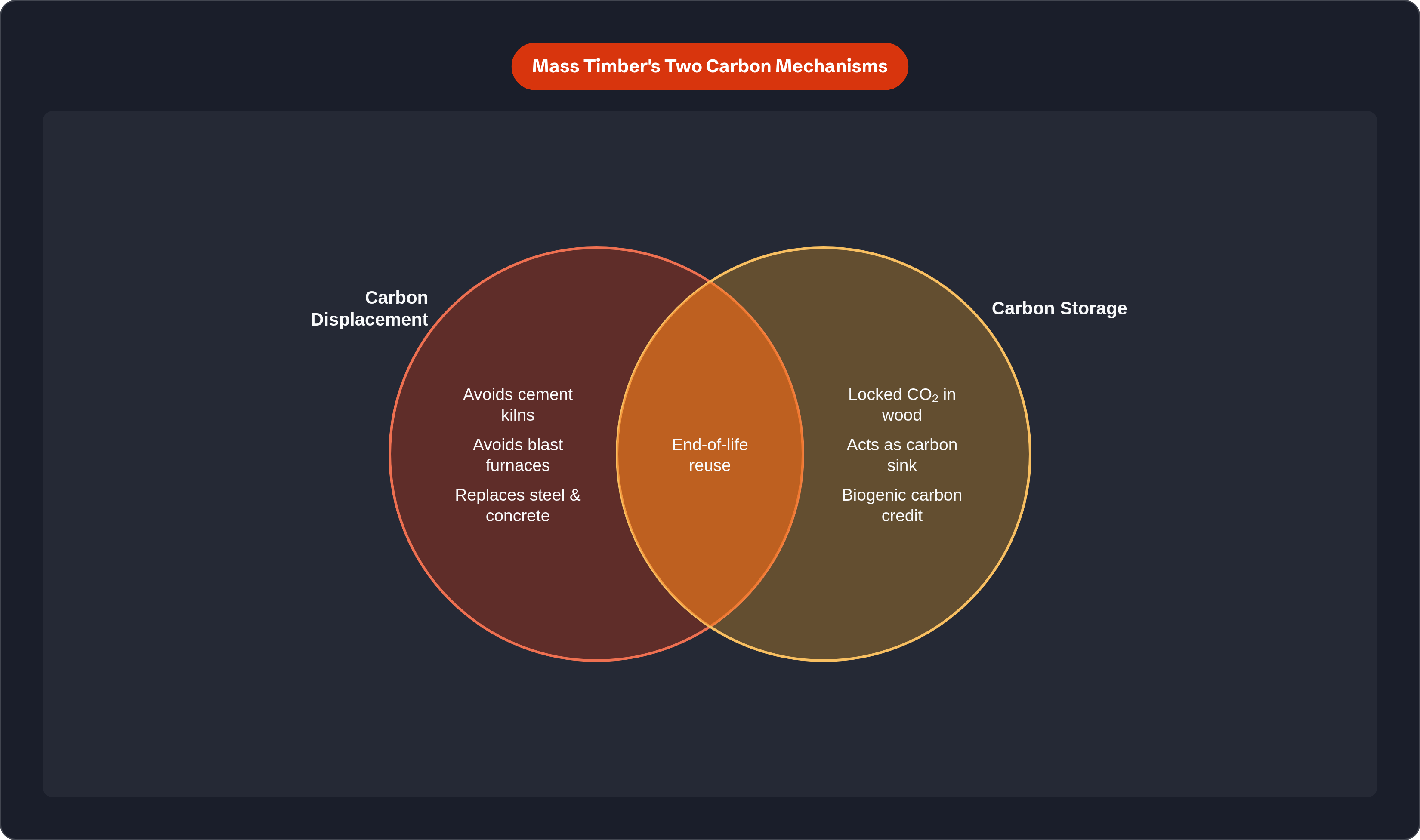
First, displacement, what LCA researchers call the material substitution effect. Making steel and concrete burns huge amounts of energy and dumps a lot of CO2 into the air, mostly from the chemical reactions and heat needed to produce them. Swap in mass timber, and you skip those emissions entirely at the source, no cement kiln running around the clock, no blast furnace, none of it.
Second, storage, or carbon sequestration, a completely different mechanism. Trees pull CO2 out of the air while they grow, and once that tree becomes lumber, a good chunk of that carbon stays locked inside the wood, going nowhere as long as the building stands.
Stack both together and you get a compounding effect: build with mass timber, avoid emissions, and store carbon at the same time. Neither mechanism runs on autopilot, though. Both depend on messy, real variables: where the timber came from and whether it carries FSC certification, how the building got designed, what happens to the wood once the wrecking ball shows up. Keep displacement and storage in your back pocket, because every section from here tests one or both against actual evidence.
What life cycle assessments show about mass timber's carbon savings versus steel and concrete
The numbers look genuinely good, even when they don't line up neatly across studies.
A 2021 CORRIM comparative **life cycle assessment** (LCA) found mass timber buildings carry 22% to 50% lower embodied carbon than equivalent concrete buildings. A 2024 review of 27 separate studies by Younis et al. found that swapping in CLT could cut carbon emissions in large buildings by around 40%. Allan and Phillips, working separately, found CLT buildings showed a 30% to 40% drop in global warming potential compared to structural steel across mid- and low-rise buildings in North America.
The USDA Forest Products Laboratory ran its own numbers and landed on 198 kg CO2eq per square meter of gross floor area for mass timber, against 243 kg CO2eq for steel structures.
There's an actual building behind these numbers, not just a spreadsheet somewhere. The Under Armour headquarters project in Baltimore swapped steel and concrete for mass timber and saved over 69% on embodied carbon, coming in far lighter than its conventional twin would have.
Why the range, 22% on the low end up past 69% on the high end? Different buildings, different structural systems, different lines drawn around what counts as "the building" in each study. Honest measurement looks like a range, not a single number pinned to a press release.
Why the carbon numbers vary so widely across studies and databases
Sit with this number for a second. A 2025 ScienceDirect study compared five separate LCA databases, including end-of-life treatment assumptions, and found mass timber construction ranging from negative 170.31 to positive 434.62 kgCO2eq per square meter. Concrete, in that same study, ranged from 69.79 to 485.95. Notice the overlap: in some accounting frameworks, timber comes out worse than concrete. In others, it's carbon-negative.
A negative number means the carbon stored in the wood outweighs everything spent producing it. A number above 400 means, under different assumptions, timber can land in the same range as concrete, or worse than it. Same material, wildly different verdicts, depending entirely on which ruler you grab.
What drives the spread? A handful of choices baked into the methodology: whether biogenic carbon (the CO2 physically stored in the wood) gets counted at all, whether the assessment stops at manufacturing (A1 through A3) or runs the full cradle-to-grave life cycle assessment, what lifespan gets assumed for the building, what happens to the material once demolition rolls around.
Then there's what people in the field call the slash problem. Cut a tree, and only about a third of it becomes usable lumber; the rest, branches, roots, mill scraps, gets left behind or burned, releasing carbon back into the air as it rots. Most standard LCAs don't count this at all, and leaving it out flatters the savings numbers more than it should. This isn't one sloppy study cutting corners; it's baked into how the industry usually measures things, across the board. If you're sizing up a specific project, that range isn't noise. It's a flag. Go find out exactly which assumptions the analysis leaned on before you trust the headline.
The carbon storage claim and the serious challenges to it
The pitch sounds clean: a mass timber building holds atmospheric carbon inside its walls and floors for decades, acting like a carbon sink the whole time it stands. There's a real hole in that story, though, and it's worth taking seriously.
The World Resources Institute published research estimating that global wood harvests add 3.5 to 4.2 billion metric tons of greenhouse gases to the atmosphere every year, something like 10% of recent annual global CO2 emissions. Their position doesn't soften anything: wood use is not carbon neutral, even under sustainable forest management, and cutting more trees for construction will likely raise atmospheric carbon for decades under most realistic scenarios.
Here's the mechanism at work. A living forest keeps carbon locked away for centuries if nobody touches it, while most mass timber buildings, by contrast, are expected to last somewhere between 60 and 100 years. Cut the tree, build with it, and that carbon comes back out into the atmosphere far sooner than it would have if the tree had just kept growing where it stood. That gap is called **carbon debt**, and it's not a fringe complaint from someone with a grudge against plywood. The WRI findings ran in Nature and set off a genuine reckoning among architects, builders, and the people who run these LCAs for a living.
Timber's defenders have a fair comeback, to be fair. The comparison shouldn't run timber against an untouched forest, they argue; it should run timber against steel or concrete, since that's the real choice on the table when someone designs a building. The question that actually matters is which material leaves less carbon in the air over the life of that specific structure.
Storage is real, but it comes with strings attached: certified-sustainable sourcing, buildings built to last well past the usual 60-to-100-year window, an end-of-life plan that reuses or stores the wood instead of burning it or hauling it to a landfill. Skip any one of those, and the storage argument gets shaky fast.
What large-scale modeling finds when both mechanisms are modeled together over time
Zoom out from individual buildings to the entire planet, and the picture shifts on you.
A Yale study published in Nature Communications in May 2025 modeled what happens if CLT gets used in 30% to 60% of new urban buildings worldwide between 2020 and 2100. The result: a potential reduction of 25.6 to 39 gigatons of CO2 equivalent over that span. For scale, total annual global energy-related CO2 emissions hit 37.8 gigatons in 2024 according to the IEA, so this is roughly a full year of global energy emissions, spread thin across eight decades.
There's a twist that caught a lot of people off guard here. The same study found that rising wood prices, driven by higher mass timber demand, would push landowners toward expanding forests rather than clearing them. The projection: 30.7 to 36.5 million hectares of new productive forestland by 2100, roughly the land area of Germany, grown back from bare ground.
A separate 2024 USDA Forest Products Laboratory study, published in PLOS ONE, found that using mass timber in new U.S. buildings taller than three stories could deliver combined carbon benefits of 9.9 to tens of millions of tonnes of CO2eq per year, sustained from 2020 through 2070.
These are scenarios, not guarantees, and it's worth saying that plainly. They hinge on forest management staying disciplined, sourcing standards holding up under pressure, and adoption sticking around for decades instead of stalling out after a good decade. What's interesting is that these big-picture models land more optimistic than the building-level LCAs from earlier, because they capture something a single-project assessment can't see: the feedback loop where timber demand pushes the market toward more forest, not less of it. You need both scales of analysis running side by side, because neither one alone tells you enough.
How U.S. building codes opened the door to mass timber at commercial scale
None of the numbers above matter much if the law won't let you build the thing. For decades, U.S. building codes capped timber construction at low-rise buildings, treating fire risk and structural concerns as automatic deal-breakers for anything taller.
That changed with the 2021 International Building Code, which introduced three new construction types built specifically around mass timber: IV-A, IV-B, and IV-C, allowing buildings up to 18, 12, and 9 stories respectively. Type IV-A alone permits buildings up to 18 stories and 270 feet tall in certain occupancy classes. That's a genuine shift in what's legally buildable out of wood in this country.
The 2024 IBC pushed further on the aesthetic side, too. Type IV-B construction now allows 100% exposed mass timber ceilings and beams, up from just 20% under the 2021 code. That matters more than it sounds like on paper, because exposed wood is a big part of why developers and architects want this material in the first place, biophilic design being the shorthand for that pull. Nobody's covering a $40 million glulam ceiling in drywall if the code doesn't force them to.
Adoption is patchy but spreading fast enough to notice. Texas, California, Georgia, Virginia, and Ohio have adopted the 2021 IBC. Illinois, Mississippi, Oregon, and Washington already moved to the 2024 version. Code reform is the hinge point in this entire story, the thing that turns tall wood buildings from an architect's pet project into something a developer can actually pencil out and build at scale.
Where the mass timber market stands and which sectors are driving adoption
The market is growing, though the exact size depends on who's doing the counting. Business Research Insights valued the global mass timber market at roughly $3.2 billion in 2024, with a projection to hit $9.5 billion by 2033, a compound annual growth rate of 12.60%.
On the ground, WoodWorks identified over 1,800 mass timber projects in the U.S. design and construction pipeline in 2024 alone, with more than 2,500 built or underway nationwide. Schools, apartment buildings, and public infrastructure make up most of that activity right now.
Europe still leads by a wide margin, holding 75% of the global market in 2024, powered by Austria, Germany, and Sweden, countries with decades of engineered wood experience and tight embodied carbon rules already written into law. Asia Pacific is growing the fastest of any region, projected at a 14% compound annual growth rate from 2025 to 2033.
Analysts describe the U.S. market as moving out of the pilot phase and into mainstream commercial territory. Code reform, corporate sustainability pledges, faster construction schedules, that's the usual list of reasons cited. Worth flagging, though: developer enthusiasm is running ahead of the science getting fully settled, which is exactly why the conditions behind the carbon claims matter more right now, not less.
The conditions under which mass timber's carbon case is strongest — and where it is weakest
So when does this actually work the way it gets advertised?
The strongest case looks like this: timber certified through FSC or an equivalent standard, sourced from regions with real forest-management enforcement, not just a stamp somebody paid for. Wood sourced locally to cut down on transport emissions. A building designed to last well past the standard 60-to-100-year window. An end-of-life plan built around reuse or long-term storage instead of a bonfire.
The weakest case flips every piece of that around: timber pulled from regions with no credible forest oversight whatsoever. LCAs that quietly skip slash emissions and mill waste because counting them makes the numbers worse. Buildings designed with short lifespans baked into the plan from day one. Wood that gets burned at demolition, releasing every bit of stored carbon in one shot instead of holding onto it for decades more.
The WRI critique and the Yale modeling aren't really arguing with each other, if you look closely; they're describing two different worlds. WRI is looking at what happens when uncertified, poorly managed sourcing scales up carelessly. Yale is modeling what happens when demand pressure pushes the market toward forest expansion instead of forest loss. Both outcomes are plausible, and which one you actually get depends entirely on the choices made along the way, not on the material itself.
For developers and project teams, the lesson is straightforward enough. Carbon savings have to be earned, project by project, through a full life cycle assessment with consistent boundaries, not assumed just because the material happens to be wood this time. Displacement and storage are real, and they do compound when the conditions line up right, but neither one comes free just because you picked timber over steel.
Mass timber carries real promise as a low-carbon strategy, and real limits on how far that promise stretches without deliberate sourcing, design, and end-of-life choices standing behind it. That distinction belongs at the center of every investment decision, every zoning debate, every corporate sustainability pledge built around this material. Treating it as automatically green is exactly the kind of shortcut that gets a serious climate strategy into real trouble down the road.