Embodied Carbon in Building Materials
Concrete and steel lock in most of a building's carbon before construction even begins.
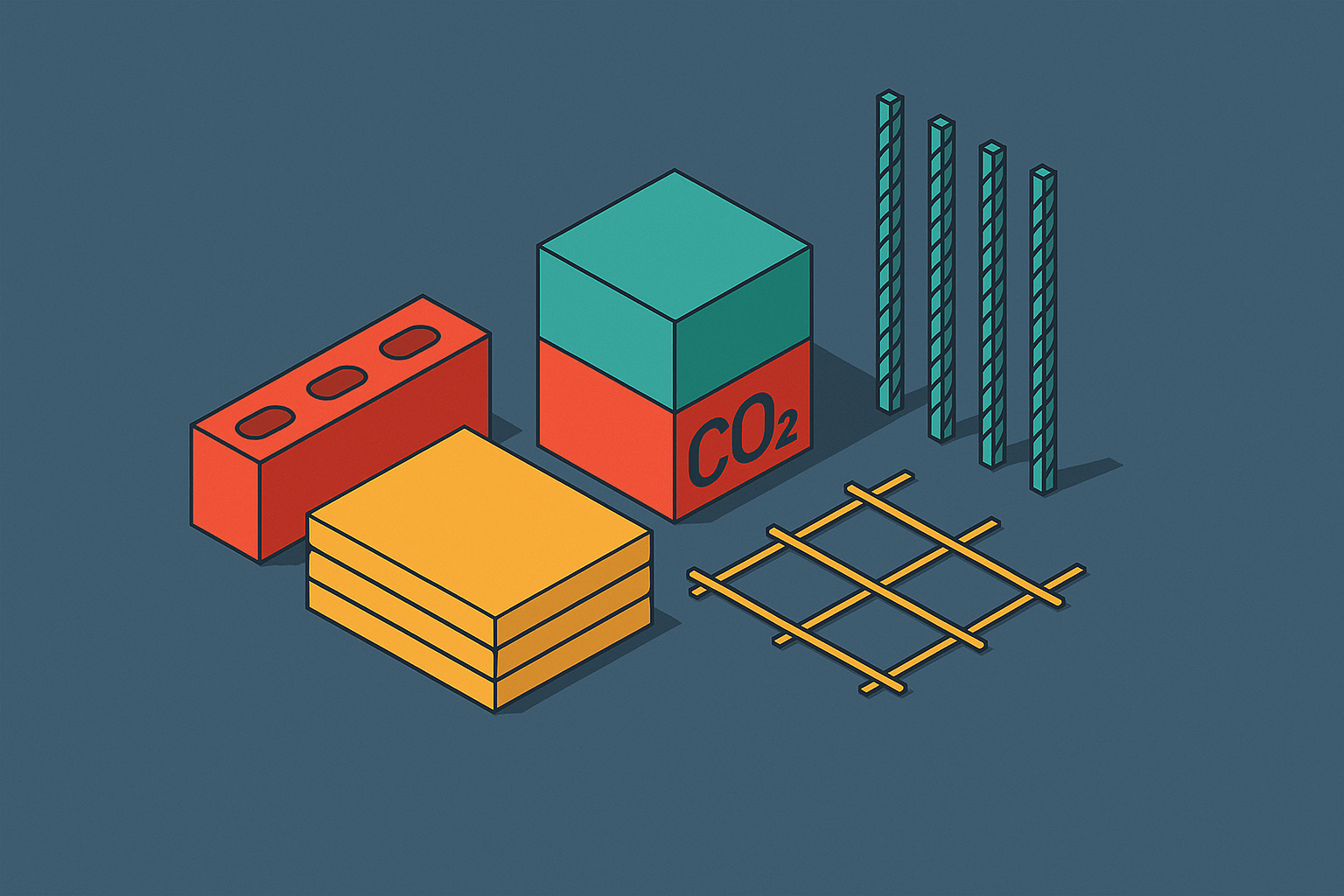
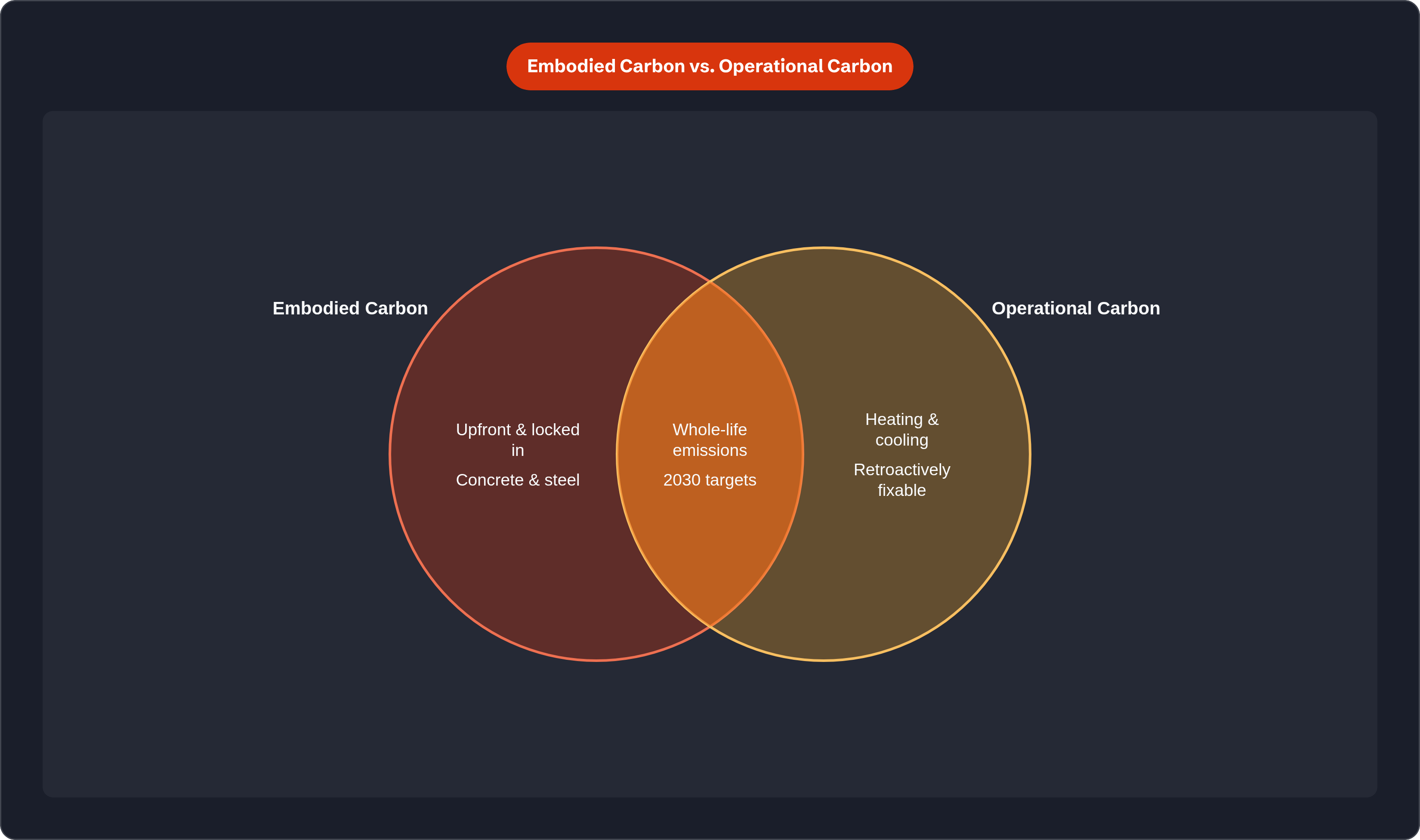
Embodied carbon is the emissions bill that comes due before a building ever opens its doors. It's everything baked into your materials: mining, manufacturing, trucking, pouring, and eventually tearing it all down and hauling it away. Operational carbon, by contrast, is what a building burns to heat, cool, and light itself once people move in. Mixing the two up is where most people's understanding falls apart, and honestly, that's an easy mistake to make, because for decades the industry only really talked about one of them.
Quick vocab lesson. You'll need it. Embodied carbon gets measured as global warming potential (GWP), in units of CO2 equivalent, so a ton of methane and a ton of CO2 can sit on the same scale and get compared fairly. The industry splits a building's life into lettered stages: A1 through A5 cover raw material extraction through construction, B covers years of use and repair, C covers demolition and disposal. You'll see this A/B/C stamp on Environmental Product Declarations (EPDs), which work basically like nutrition labels for building materials, and on regulatory filings too, and it's worth recognizing even if you never memorize it. The method behind all these numbers is called life cycle assessment (LCA), and it's about as close as this industry gets to a polygraph for building materials.
One number worth sitting with before we go further: a building's skeleton and foundation, the structure and substructure, can eat up to the vast majority of upfront embodied carbon depending on what's being built. That's why almost every conversation about cutting embodied carbon circles back to concrete and steel. Everything else is basically a rounding error.
Where embodied carbon sits in the global emissions picture
The construction materials sector accounts for a substantial share of global CO2 emissions, per the Global Cement and Concrete Association's 2025 figures, and cement and steel do most of the damage inside that number. Combined, they contribute a considerable share of global emissions, with steel alone responsible for a large share on its own.
Zoom out and buildings plus construction together account for a major portion of global energy-related carbon emissions. Split that apart: embodied carbon makes up 11 percentage points, operational carbon takes the other 28. Operational is still the bigger slice today, but don't get too comfortable with that ratio, since it's shifting, and the next section gets into why.
A tiny fraction of buildings worldwide have ever had their carbon footprint formally assessed. Sit with that for a second: we're debating how to fix a problem the industry has barely bothered to measure in the first place. Nobody's counting, and you can't manage what you refuse to count, same as arguing about your credit score without ever pulling your credit report.
Why embodied carbon is a sunk cost while operational carbon is not
Operational carbon is a work in progress, always. You can swap out a bad HVAC system, plug into a cleaner grid, add insulation next decade if you feel like it, and the building keeps handing you second chances for as long as it stands.
Embodied carbon works on a different timeline. Once the concrete's poured and the steel's welded into place, that upfront carbon is locked in for good, with no do-overs and no refunds. Every decision that actually matters happens before a shovel touches dirt, which means design and procurement carry far more weight than most teams give them credit for.
Here's the part that catches people off guard: embodied carbon's share of total building emissions is projected to climb toward nearly half of whole-life emissions by mid-century, according to 2019 OECD figures. Operational emissions are shrinking as power grids clean up, so the embodied slice looks bigger by comparison, standing still while everything around it improves. A building optimized purely for operational efficiency, while ignoring what went into its bones, is going to age badly on a whole-life carbon basis next to buildings built under tomorrow's standards. The World Green Building Council wants at least 40% less embodied carbon in all new buildings and renovations by 2030. That deadline should be shaping your decisions on the drafting table right now. Not five years from now.
How embodied carbon concentrates in concrete and steel
Concrete's carbon problem has a name: cement. Producing one tonne of cement emits roughly 900 kg of CO2. Cement makes up the overwhelming majority of a typical concrete mix's total emissions despite being a small fraction of the mix by weight. Concrete itself is mostly sand, gravel, and water; the cement gluing it together does all the climate damage, kind of like how the smallest ingredient in a recipe can wreck the whole dish.
Conventional blast furnace steel emits somewhere between 1.8 and 2.2 tonnes of CO2 per tonne of product, depending on the furnace and the ore going into it, and it isn't better news.
So what does all this add up to in a finished building? A Carbon Leadership Forum review of 30 whole-building life cycle studies found commercial buildings ranging from 290 to 460 kg CO2e per square meter. That's a wide spread, and it exists because design choices vary enormously even within the same building type. It's also the benchmark everyone measures improvement against.
Break it down by structural system, per square meter over a 50-year period: steel runs roughly 5.0 to 12.4 kgCO2-eq/m² a year, reinforced concrete sits at 4.4 to 8.7, and mass timber lands at 3.6 to 5.4. Those ranges overlap on purpose, because a well-designed steel building can beat a badly designed timber one without breaking a sweat. The structural system matters, but it's only part of the equation. Mix design, recycled content, and where you source materials all move the needle within each category.
What mass timber and low-carbon material substitutions actually deliver
Mass timber has one genuine trick: trees pull carbon out of the air as they grow, and that carbon stays locked in the wood once it's cut into a beam or a panel. A 2024 USDA review of 62 peer-reviewed studies found mass timber avoids an average of 43% of greenhouse gas emissions compared to reinforced concrete. On a per-square-meter basis, that same review put mass timber at 198 kg CO2e against 243 kg CO2e for steel across production and construction. That gap is real and worth having, though it's not the silver bullet some marketing decks make it out to be.
Timber's carbon benefit depends entirely on how the forest was managed and how you handle biogenic carbon accounting across the material's full life. Researchers are still arguing over the right way to do that math, so treat big reduction claims for mass timber as directionally right, not gospel truth carved in stone.
Concrete has its own upgrades available today, and none of them need some exotic new technology. Supplementary cementitious materials (SCMs) like fly ash and ground granulated blast-furnace slag can replace a chunk of the Portland cement in a mix, cutting embodied carbon meaningfully without weakening the structure. These are commercially available and already poured into buildings today.
Steel has a comparable move: green steel, made in an electric arc furnace (EAF) from recycled scrap instead of a blast furnace running on virgin ore, cuts embodied carbon dramatically compared to the conventional process. The technology already exists in full, and what's holding it back is clean electricity supply and having enough scrap metal to feed the furnaces at scale.
Then there's the option that beats everything above on principle alone: reuse. Reusing materials skips extraction and manufacturing almost entirely, and while it carries its own footprint from prep and transport, that footprint is usually a fraction of what making something brand new would cost the atmosphere.
How far current best practices can actually take the sector toward 2050 targets
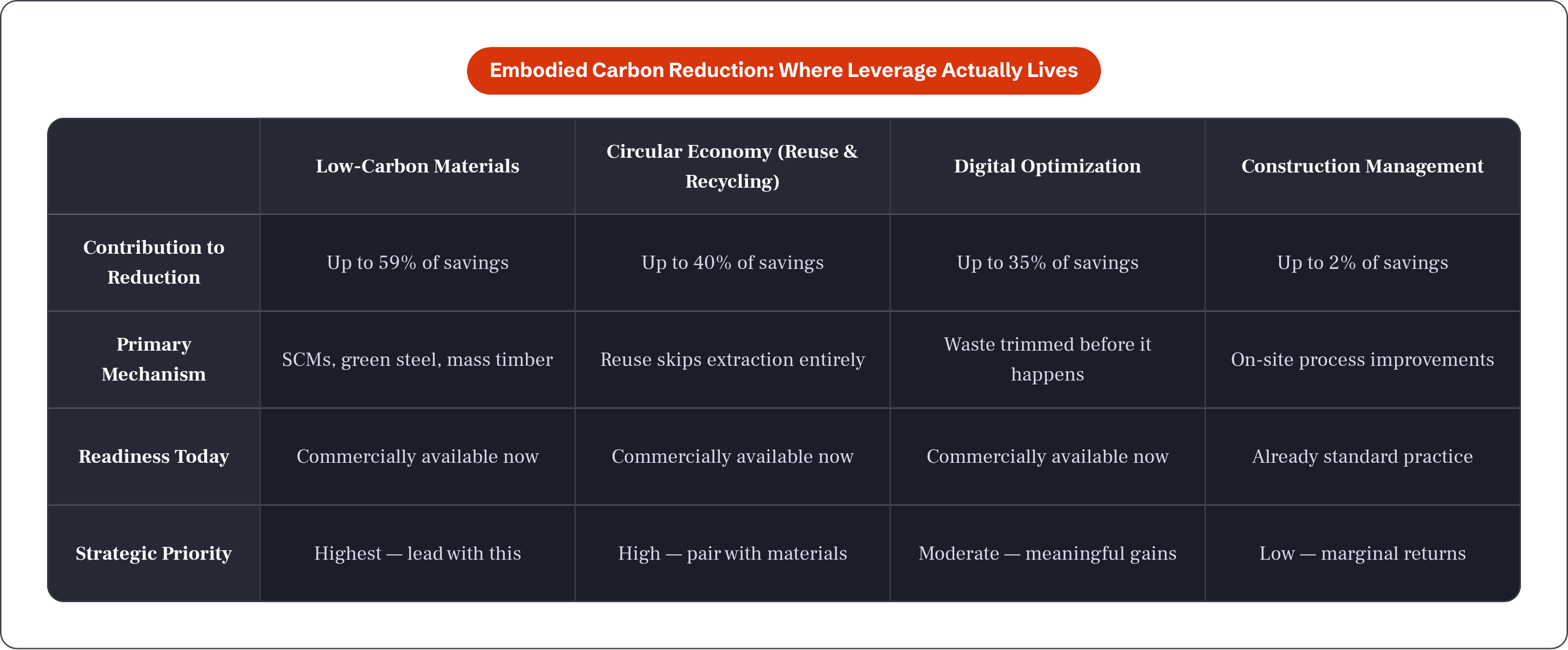
Run the numbers on a technology-optimized building against business as usual, and you get an average 45.7% reduction in upfront carbon. That works out to savings of 236.29 kgCO2e per square meter, based on the study behind these figures.
Where do those savings actually come from? Low-carbon materials do the heaviest lifting, contributing up to 59% of the reduction, while circular economy approaches, meaning reuse and recycling, contribute up to 40%. Digital optimization, better modeling and design software that trims waste before it happens, gets you up to 35%. Construction management practices barely register at up to 2%, which tells you exactly where not to spend your energy.
Compare that to what a 1.5°C-aligned climate budget actually demands: upfront carbon needs to drop 12.5% every single year from 2025 to 2050, converging on 17.5 kgCO2e per square meter by mid-century, inside a total carbon budget of 20.21 gigatonnes of CO2e for new construction worldwide. Stack that against the 45.7% reduction available through today's best practices, and the honest math says current tools get the sector most of the way there, but not the whole way. Past 2040 especially, the remaining gap depends on materials and processes that haven't hit commercial scale yet, and might not for a while.
What's the move this year, right now? Material-efficient structural design, cement substitution, and reuse are where the leverage sits today, using tools that already exist and don't require anyone to invent anything new. Novel cements, electrified manufacturing, and carbon capture are the bridge across what's left of the gap, and they're still under construction themselves. Don't wait for them. Use the tools you have now.
Where policy is turning embodied carbon measurement from voluntary to mandatory
California got there first, as it usually does with this stuff. CalGreen, Title 24, Part 11, took effect July 1, 2024, and it's the first mandatory U.S. green building code requiring embodied carbon documentation. Right now it applies to buildings over 100,000 square feet; that threshold drops to 50,000 square feet for nonresidential buildings starting January 2026. California's own target is a 20% cut in greenhouse gas emissions from building construction materials by the end of 2030, climbing to 40% by the end of 2035.
Caltrans moved the same direction on infrastructure. Since February 2025, it requires contractors to submit third-party-verified EPDs, following the ISO 14025 standard, for concrete, asphalt, and masonry on state-funded projects.
Other states are watching closely and taking notes. New York, Vermont, Massachusetts, and New Jersey are exploring or piloting embodied carbon disclosure tied to building permits, and New York has already passed Buy Clean standards for concrete used in public contracts.
Europe isn't waiting around either. The EU's revised Energy Performance of Buildings Directive, updated in 2024, requires whole-life carbon reporting for all new buildings by 2030, one regulatory line applied across every member state at once. That's going to reshape how construction gets bought and sold across the whole continent.
Meanwhile in the U.S., the Inflation Reduction Act pointed real federal money toward low-embodied-carbon material specs, including Buy Clean procurement criteria, and pushed the General Services Administration to buy low-carbon building materials directly. That turns federal purchasing power into a demand signal the entire supply chain has to answer to, whether it wants to or not.
Put it together and the direction is hard to miss: disclosure is shifting from a voluntary sustainability talking point toward a legal requirement with deadlines attached. Teams that haven't built basic LCA and EPD literacy into their process are running short on time to catch up. The window where any of this was optional is closing, and it's closing on a fixed schedule, not a whim.