Whole-Life Carbon Standards and Regulations for Buildings
Regulators are finally cracking down on the embodied carbon locked into buildings before they open.

Buildings produce 39% of global energy-related carbon emissions. Split that number in half and you'll see something odd: 28% comes from running buildings (heating, cooling, lights), and 11% comes from building them (materials, construction). Codes and standards have spent decades hammering away at the 28%, while the 11% has basically been getting a free pass. That's the whole story of whole-life carbon regulation right now: the world is finally turning its attention to the half of the problem nobody's been watching.
Here's why that matters more than it sounds. Cement alone accounts for 7% of global emissions, and steel adds another 7 to 9%. Both sit almost entirely outside traditional building codes, which have obsessed over insulation and boilers and appliance ratings while ignoring the concrete truck idling outside. And here's the kicker: operational carbon is fixable after the fact. You can retrofit insulation, swap a gas boiler for a heat pump, clean up the grid. Embodied carbon, once it's poured or welded into place, is locked in for good, with no do-overs — which is why lifecycle assessment, or LCA, is the only methodology that captures the full picture. With something like 230 billion square meters of new floor area expected worldwide by 2060, that's a lot of concrete setting in stone (pun very much intended) before anyone gets a second chance at it.
What whole-life carbon actually measures across a building's full lifespan
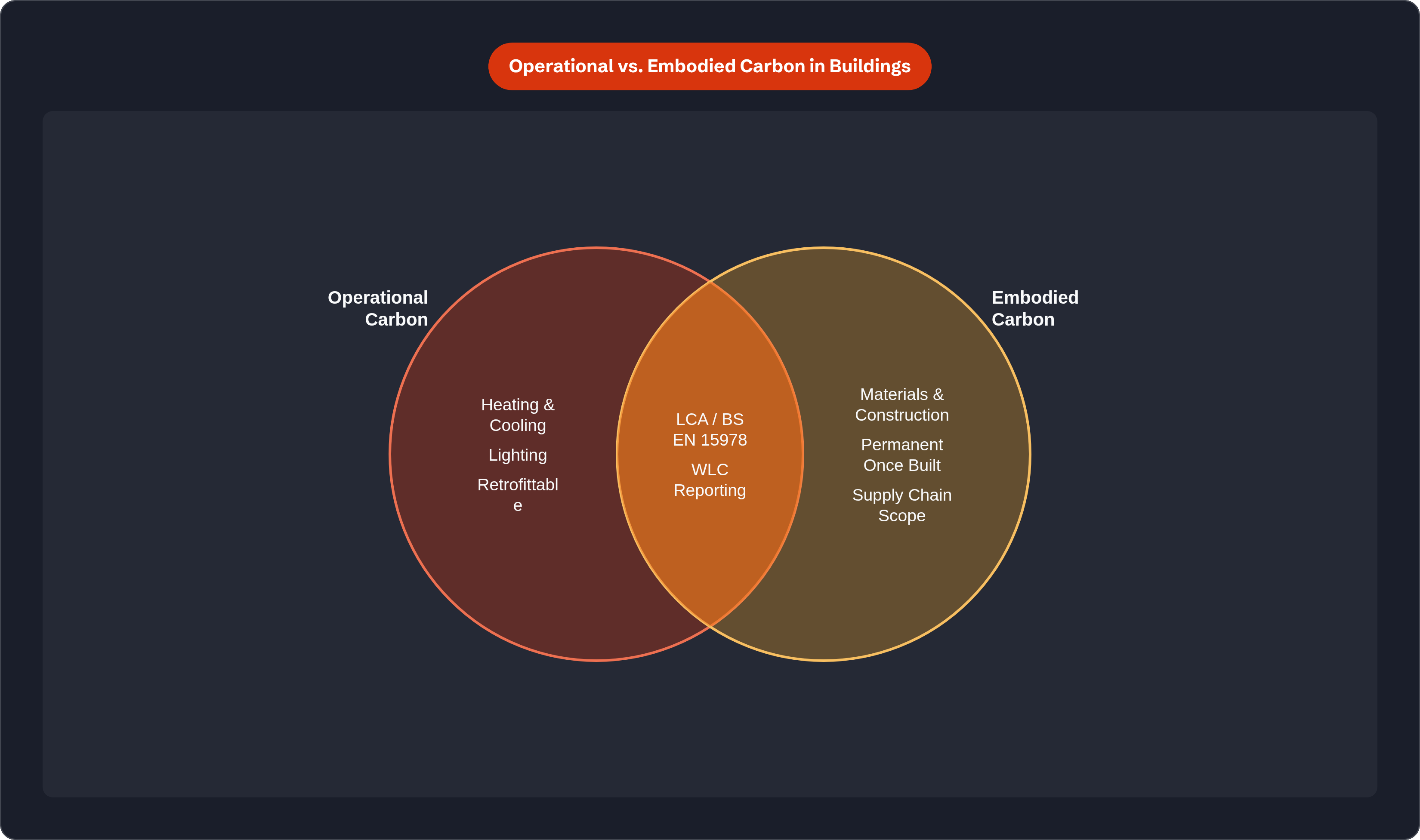
Whole-life carbon, or WLC, is operational carbon plus embodied carbon, tracked from the moment raw materials get pulled out of the ground to the day a wrecking ball shows up.
Operational carbon is the part everyone already knows: heating, cooling, lighting, running the building day to day. Embodied carbon is everything else: mining, manufacturing, shipping, actually building the thing, maintaining it, renovating it, and eventually tearing it down and hauling it away.
The industry standard for organizing all this is BS EN 15978, which splits the building lifecycle into modules. Module A covers production and construction, Module B covers use and maintenance, and Module C covers end-of-life. There's also Module D, which credits things like recycling benefits that happen beyond the building's own boundary. A revision expected in 2025 will add Module A0 for preconstruction activity and Module B8 for user activities that weren't captured before, and it'll split Module D into two parts. Basically, the accounting keeps getting more granular, because the current version leaves gaps.
RICS has its own standard, the WLCA (second edition, fully in effect since July 2024), and it adds something called "user carbon" as its own tracked category, separate from operational and embodied. No other major standard does that.
Why does any of this module-splitting matter to you? Because regulators can pick and choose which modules to require. A rule can mandate reporting on A1 through A5, the upfront construction phase, measuring global warming potential in kg CO2-equivalent, without touching B or C at all. And that's exactly what's happening almost everywhere. Regulators are starting with the front end of the lifecycle because that's where the emissions are locked in fastest and hardest.
Why upfront carbon — not lifetime emissions — is the most urgent regulatory target
For a high-performance new building designed to hit net-zero operational targets, embodied carbon can make up 50 to 80% of its total emissions over 60 years, according to the World Green Building Council's 2024 figures — a core finding driving the net zero buildings agenda. Read that again: the better a building gets at running efficiently, the more its embodied carbon dominates the picture. Tightening energy codes doesn't shrink the embodied carbon problem; it makes it loom larger by comparison.
Upfront carbon, meaning everything emitted in modules A1 through A5 before anyone even moves in, can't be walked back. It's a one-time hit with permanent consequences, the climate equivalent of a tattoo you got in college. According to the UN Environment Programme's 2024 Global Status Report for Buildings and Construction, embodied carbon from building materials hit 3.6 gigatons of CO2 in 2023, and that number has stayed flat even as operational efficiency keeps improving elsewhere.
So the regulatory logic writes itself: upfront carbon is irreversible, it's mostly unregulated, and it's sitting there as the single biggest gap in existing codes. That's why nearly every first-generation whole-life carbon regulation starts with disclosure and caps on modules A1 through A5, then works outward from there.
How the UK has built a layered whole-life carbon framework — standards, city policy, and proposed national law
The UK's approach comes in three layers, stacked like a badly organized filing cabinet: a professional standard, a city planning mandate, and a proposed national law.
The professional standard is RICS WLCA, second edition, effective July 2024. It sets the methodology for how assessments should be done. Worth noting, though: RICS doesn't verify the results or police anyone against them, so compliance here means following the method, not hitting a particular number. RICS also ties WLCA to cost planning through ICMS 3, so carbon and cost can get evaluated side by side at the design stage, which is a smart way to make carbon feel less like an afterthought and more like a line item.
There's also the Built Environment Carbon Database, or BECD, currently UK-only, which collects submitted WLCA data so the industry can benchmark itself. This matters more than it sounds like it should, because you can't set a sensible limit on something until you know what a normal range even looks like, and benchmarking at scale is the only way to establish that range.
At the city level, the London Plan (2022 guidance) requires WLC assessments for all major developments at the planning stage, aligned with BS EN 15978, aiming for a 40% cut in WLC emissions by 2030. Scotland's NPF4 takes a lighter touch, asking developments to minimize lifecycle emissions on a "proportionate" basis rather than hitting a hard number.
Then there's Part Z, the proposed national regulation for England and Wales, backed by industry groups rather than currently sitting on the books as law. It follows a two-step plan: first require reporting with a consistent methodology, then, once enough comparable data piles up, introduce actual enforceable limits. It's not law yet, but the sequencing tells you everything about where this is all heading.
And here's the uncomfortable part. UKGBC's 2025 Whole Life Carbon Roadmap Progress Report found embodied carbon has fallen 14% since 2018, against a target reduction of 24%. That's a shortfall of roughly 20 million tons of CO2-equivalent a year. Standards and city mandates alone clearly aren't closing that gap. They're helping, sure, but "helping" and "solving" are different zip codes.
What the UK Net Zero Carbon Buildings Standard requires in practice, and how its limits are structured to tighten over time
The UK Net Zero Carbon Buildings Standard, or UKNZCBS, had its pilot published in September 2024 and got tested on 216 projects over four months. Version 1 arrives in early 2026 with added technical evidence requirements and formal verification.
It's built by a genuine cross-industry coalition: RIBA, IStructE, CIBSE, and RICS all had a hand in it, pulling in architects, structural engineers, building services engineers, and quantity surveyors. That gives it professional weight even before it becomes anything close to statutory.
The standard sets numerical carbon limits by building type and by year, and those limits get tighter every year. Take an office building designed in 2025: its embodied carbon target sits at 580 kilograms of CO2-equivalent per square meter. That's a real, concrete number you can design against, not a vague aspiration.
About 90% of the expected carbon reductions under this standard come from tackling embodied carbon, not operational. That weighting isn't an accident; it reflects where the untapped savings actually sit. Looking ahead to 2030, operational energy limits tighten by 10 to 15%, while upfront carbon limits tighten by 25 to 30%. Embodied carbon is getting squeezed at nearly double the rate.
The clever bit of engineering here isn't the numbers themselves, it's the mechanism. Because the limits decline automatically over time, setting built-in carbon budgets by building type, the standard tightens itself without needing a fresh act of Parliament every few years. Regulatory escalation gets baked in at the source.
How the EU's EPBD and Construction Products Regulation extend WLC requirements across member states
Across the Channel, the EU's Energy Performance of Buildings Directive (EPBD 2024/1275) is the legislative spine for building carbon rules, and its recast now covers embodied carbon explicitly, not just operational.
The dates matter here. Zero-emission buildings become mandatory for public buildings in 2028 and for all new buildings in 2030. Whole-life carbon reporting becomes mandatory for all new buildings by 2030, and life cycle global warming potential measurement kicks off in 2028. Critically, the EPBD requires member states to publish an assessment framework and a roadmap for limit values by the end of 2027, meaning the methodology and benchmarking infrastructure get built first, before any enforcement shows up. Sound familiar? It's the same disclosure-before-limits sequencing as Part Z in the UK, just running on a continental scale.
The Construction Products Regulation, updated in November 2024, pushes the accountability further upstream, onto manufacturers rather than just designers. Under the updated regulation, declarations of performance must report multiple global warming potential indicators covering different carbon sources, including what would typically be classified as scope 3 emissions in a manufacturer's own reporting. Suddenly, the company making the rebar has skin in the game too.
There's also a quieter operational shift: from January 2025, member states have to stop subsidizing stand-alone fossil-fuel boilers. It's an operational carbon measure on paper, but it reshuffles the baseline that embodied carbon gets measured against.
Implementation across the bloc is patchy, as you'd expect from 27 countries moving at their own pace. Denmark has already set carbon caps by building type and tightened them again in 2025. Ireland and Spain are rolling out WLC assessments without enforceable limits yet. Same pattern, different speeds: disclose first, cap later.
France's RE2020 as a working example of how national limits are structured and sequenced
France's RE2020, in force since 2022, is one of the most advanced whole-building carbon regimes currently running.
It sets construction-stage carbon ceilings, called Ic construction, which tightened again on January 1, 2025 across residential building types. RE2020 doesn't stop there, either. It addresses both construction-stage and energy-related carbon within the same regulatory framework, enforcing both halves of the split at the same time, in the same law.
The 2025 tightening wasn't just about lower numbers. That combination — tightening the ceiling while continuing to refine the standard — is the template. Set limits by building type, publish a schedule for tightening them, and update the assessment method in step. It's the same DNA as the UKNZCBS's declining-limits design, just arrived at independently and a bit earlier.
What makes France genuinely instructive is that it brought embodied carbon into the same regulatory frame as operational performance through a single whole-life carbon assessment requirement, rather than treating it as an afterthought bolted on years later. That's the model the EPBD is now nudging the rest of the EU toward.
The consistent regulatory pattern running across every jurisdiction: report first, cap later
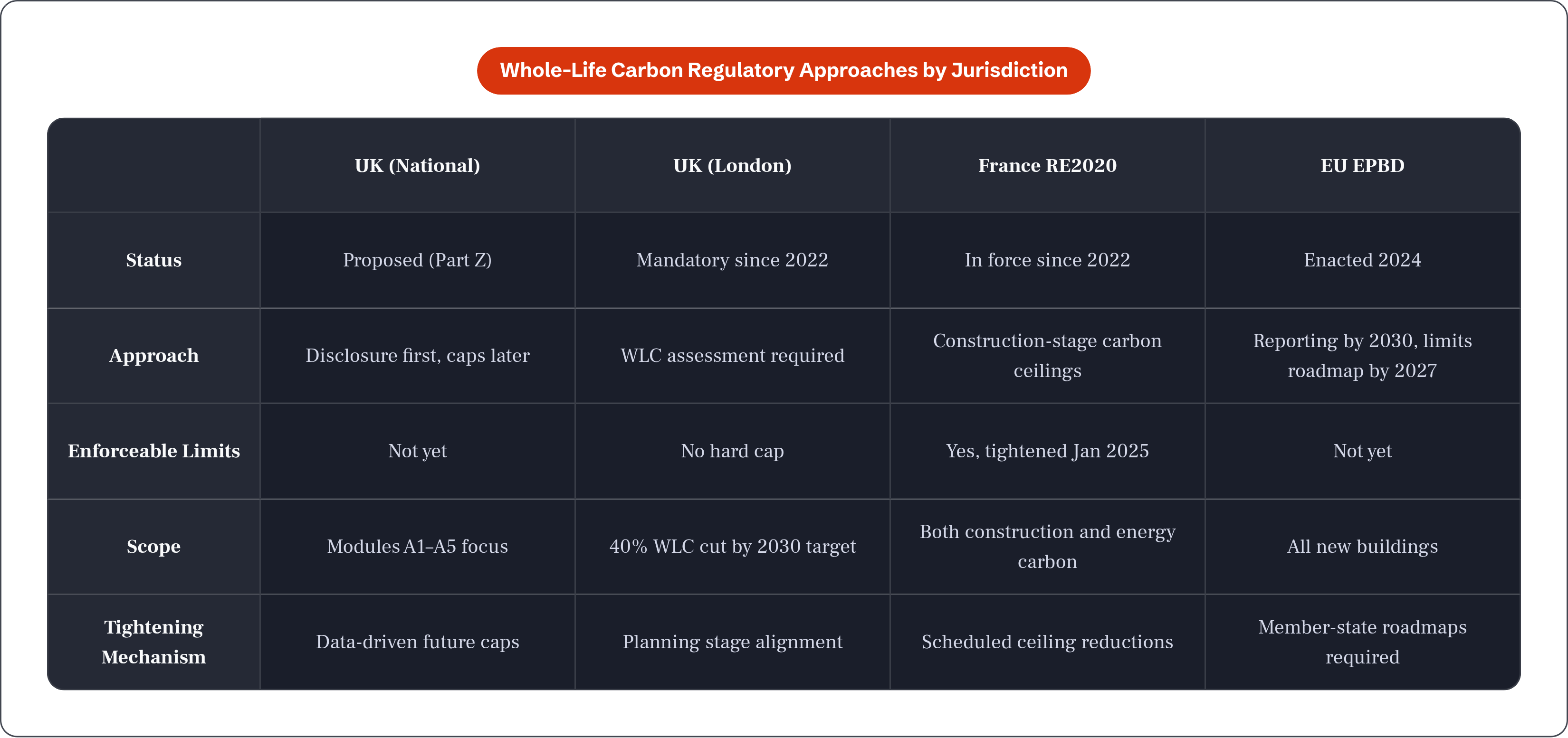
Look across the UK's Part Z proposal, the EU's EPBD roadmap, Denmark, Ireland, and Spain, and you'll find the exact same two-step choreography every time. Mandate disclosure and a consistent way of measuring things first, then introduce hard limits only once there's enough comparable data sitting in the system.
That sequencing isn't bureaucratic caution for its own sake. Without standardized data, something like the UK's BECD, regulators have no benchmark to work from, and they can't set a limit if they don't know what's actually achievable on the ground. The standard, the database, and the eventual limit-setting are three legs of the same stool, not separate decisions made in isolation.
The declining-limits trick, used by both the UKNZCBS and RE2020, solves a different problem: it means governments don't have to keep coming back to legislate again every few years. The tightening trajectory lives inside the standard from day one.
Meanwhile, the EU's product-level EPD rules extend the chain even further upstream. Manufacturers now have to declare global warming potential via environmental product declarations, or EPDs, before designers can assess it and before regulators can enforce anything at the building level. It's accountability creeping backward through the supply chain, one link at a time.
But here's the gap nobody's papering over: professional standards and city-level mandates, on their own, are not closing the embodied carbon shortfall. The UK's 20 million ton annual gap against its own roadmap makes that plain. Voluntary tools and sub-national rules help, but they don't finish the job.
For anyone actually designing and building right now, the practical takeaway is timing. The gap between "reporting only" and "enforced limits" is exactly as long as a typical planning horizon, and projects greenlit today under disclosure-only rules will be standing, fully occupied, once the caps show up. Design for the rules that are coming, not just the ones currently on the books.