Green Building Certifications Compared for Decarbonization Goals
LEED v5 and BREEAM V7 now require embodied carbon measurement, closing a three-decade oversight.

Buildings account for something like 37 to 40 percent of global greenhouse gas emissions, a figure that only makes sense when whole-life carbon is counted, not just operational output. That number belongs in a certification conversation before anything else, because most certification systems were designed to catch only half of it. Operational carbon (the energy a building burns once people move in) got all the attention for thirty years. Embodied carbon (the emissions locked into the concrete, steel, and glass before the building even opens its doors) mostly got a shrug.
The World Green Building Council states it plainly: upfront embodied carbon from new construction will make up roughly half of all new-building carbon between now and 2050. Most certification plaques you see on the wall today were earned under systems that treat that half as optional homework.
How certifications developed an embodied carbon blind spot
Rewind to the 1990s. Energy modeling was the tool everyone had lying around, so energy modeling became the whole game. Cut kilowatt-hours, cut emissions, done. No one was hiding embodied carbon on purpose; there just wasn't a standardized life cycle assessment (LCA) methodology yet, no agreed benchmarks, nothing for a rating system to grab onto. So it sat on the sidelines, or got dropped from the checklist entirely.
Then buildings got more efficient operationally, which is genuinely good news, except it had a side effect nobody planned for. As the operational slice shrank, embodied carbon's share of total lifetime emissions grew just by proportion. Research on high-performance buildings has found that embodied emissions can represent a substantial and growing share of total lifetime carbon, reaching the majority in the most efficient cases.
Measurement is catching up, at least. The 2025 GRESB Real Estate Assessment found 50 percent of development participants now measure embodied carbon, up from 31 percent in 2024 and 24 percent the year before that. But measuring something and requiring it inside a certification framework are two different jobs, and most of the frameworks are still figuring out how to do the second one.
LEED v5 makes carbon measurement mandatory
LEED v5 launched in April 2025 and opened for project certification that November, and it's the biggest rebuild of the system in over a decade. Decarbonization now makes up roughly half of all available credits. More importantly, none of it is optional anymore.
Two new prerequisites carry the weight. A Carbon Assessment requirement pulls life-cycle thinking into the earliest design phase, targeting upfront carbon before structural decisions get locked in. A separate Quantify and Assess Embodied Carbon requirement backs it up. Neither one existed as a mandatory item under LEED v4. You don't skip these and still walk away with your plaque.
Scope 1 and 2 reductions get direct credit, and Scope 3, the messier upstream emissions that used to get ignored because they fell outside a project's direct supply chain, now enters through a new Building Product Selection and Procurement credit. It bundles environmental product declarations, responsible sourcing, and material health into one scoring block instead of scattering them across the rulebook.
There's a hard deadline sitting under all of this. LEED v4 registrations close in early 2027, so anyone planning a project today is choosing between v5 and no LEED at all.
On the financial side: LEED-certified buildings have historically sold at a 21.4 percent premium and rented at 11 percent higher rates. Those numbers predate v5 and reflect decades of brand recognition rather than anything specific to the new carbon rules. LEED v5 does ship with alignment crosswalks to WELL and SITES, which reduces documentation overlap for teams pursuing more than one certification.
BREEAM V7 tightens tiers around whole-life carbon
BREEAM V7 landed for assessors in July 2025 and opened for public registration that September. V7 counts more than its predecessor ever did. It evaluates operational carbon, embodied carbon, refrigerant management impacts, and transport emissions, all together. Instead of one carbon snapshot taken at the start and never revisited, V7 requires life-cycle assessments at three stages: concept design, technical design, and as-built. That tracks a building's carbon story across the whole construction arc rather than producing a single early estimate.
The tiers have teeth now. Excellent requires mandatory life-cycle assessment and embodied carbon reporting. Outstanding demands a minimum of five credits tied specifically to embodied carbon performance, plus a flat ban on on-site fossil fuel consumption. Meanwhile the entry bar actually got easier; Pass dropped from 30 percent to 25 percent, Good dropped from 45 to 40 percent. The floor loosened while the ceiling got harder to reach. That tells you exactly where BREEAM wants ambition concentrated.
For the first time, UK and International BREEAM schemes largely line up, a real relief for multinational developers who used to run two rulebooks that never quite matched. V7 reporting also aligns with EU Taxonomy, TCFD, and GRI, useful for anyone already answering to investors on those fronts.
The new LCA stage gates and tighter third-party verification mean more specialist consultants on your project roster, and that shows up in your budget.
DGNB integrates circular economy into carbon neutrality
DGNB, short for Deutsche Gesellschaft für Nachhaltiges Bauen, is a prominent certification framework in Europe, and it has had life-cycle cost thinking integrated into its evaluation logic longer than most competitors. Its Framework for Carbon Neutral Buildings and Sites maps a path to 2050, with ongoing revisions aimed at keeping pace with evolving decarbonization targets.
What separates DGNB is its circular economy emphasis. Material reuse and design for disassembly aren't treated as an afterthought; they sit alongside carbon reduction as core considerations in the framework's evaluation logic.
That said, DGNB isn't exempt from a shared limitation. Analysts reviewing leading frameworks including LEED, BREEAM, and DGNB have noted that all three fail to weight embodied carbon in proportion to its actual share of whole-life emissions in high-performance buildings. For developers working in Europe, DGNB's regional roots give it a practical familiarity with local regulatory expectations that global frameworks can struggle to match.
LBC sets the performance verification ceiling
The Living Building Challenge, run by the International Living Future Institute, is widely regarded as one of the most demanding green building standards available. It certifies actual performance measured over a minimum operating period, not a model's prediction of what should happen once the lights come on. For projects with a narrower focus, ILFI offers pathways that target specific performance outcomes rather than requiring the full Living Building Challenge framework.
LBC sets demanding requirements around both material transparency and energy performance, verified through actual measured outcomes rather than modeled predictions.
The real gap between LBC and the mainstream frameworks isn't just how high the bar sits. It's a difference in what gets checked. Many mainstream frameworks certify design intent and process compliance, meaning a project can satisfy every requirement on paper while actual post-occupancy performance diverges from what was modeled. LBC's approach centers on verified outcomes, what the building demonstrably achieves over time, rather than what the design documents projected.
That distinction is worth holding onto regardless of which framework you ultimately pursue. It gives you a reference point for calibrating a mainstream certification against what measured performance actually looks like.
WELL addresses occupants, not carbon reduction
WELL is about people, not carbon. Its organizing logic centers on occupant health and comfort across multiple indoor environment dimensions, and carbon reduction was never part of the design brief.
That doesn't make WELL useless in a decarbonization strategy; it just means it plays a supporting role. Most prime commercial assets chasing both health and carbon credentials pursue WELL alongside LEED or BREEAM, not instead of them. Dual certification is quietly becoming what institutional tenants expect by default. A health-only credential won't answer the carbon half of that question for you.
USGBC has published formal alignment crosswalks between LEED v5 and WELL specifically to cut documentation overlap for teams pursuing both, which is the practical reason WELL keeps coming up in planning meetings even though its carbon contribution stays indirect.
To hold both frameworks in view at once: WELL addresses the indoor environment your occupants experience. LEED, BREEAM, DGNB, and LBC address whether the building is actually low-carbon.
How frameworks compare on two carbon questions
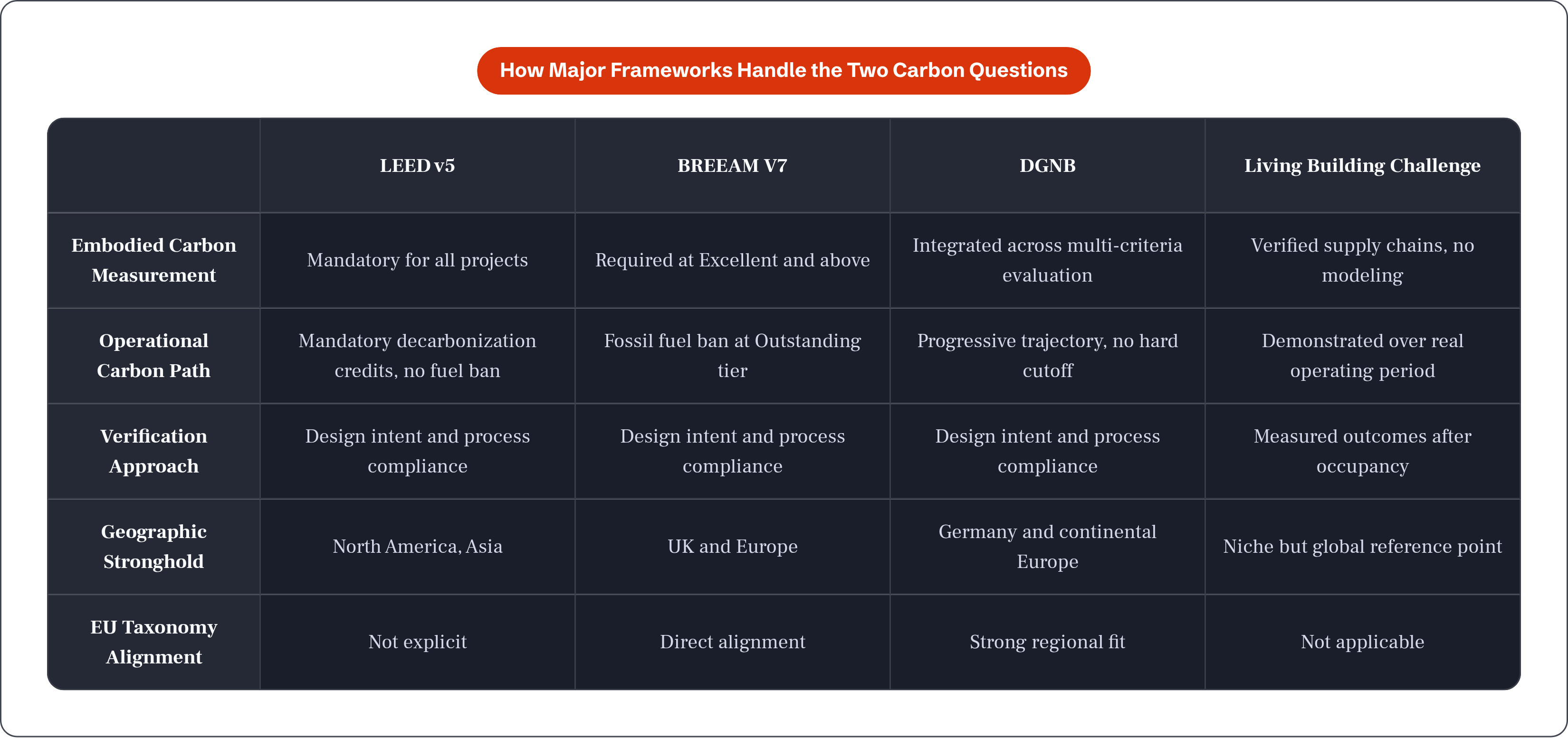
Every framework, once you strip the logos off, comes down to two questions. Does it require embodied carbon measurement against a real benchmark? And does it demand, or at least seriously reward, a path to zero operational carbon?
Here is how each framework handles embodied carbon measurement. LEED v5 makes life-cycle assessment mandatory for every project, no exceptions carved out. BREEAM V7 requires it only at Excellent and above, with five specific credits needed to reach Outstanding. DGNB integrates life-cycle thinking throughout its evaluation process within a broad multi-criteria framework. LBC skips modeling altogether and requires documented supply chains plus real performance data. Older versions of all four frameworks treated embodied carbon as optional, worth remembering the next time somebody presents an older certificate as evidence of climate ambition.
Operational carbon splits the group differently. BREEAM V7's Outstanding tier bans on-site fossil fuel consumption outright. LEED v5 makes decarbonization mandatory and rewards reductions in operational energy intensity, without banning specific fuel sources by name. DGNB takes a progressive approach toward lower-carbon operation, emphasizing long-term trajectory over immediate hard cutoffs. LBC requires demonstrated energy performance over an actual operating period, representing the most rigorous verification standard of the group.
Verification philosophy is the quietest variable and the one that changes the most in practice. LEED and BREEAM certify design intent and process compliance. LBC certifies outcomes that already happened. A project can walk away with LEED Platinum on a model that diverges significantly from how the building performs once tenants move in and start running the HVAC on their own terms.
Geography still decides plenty of this on the ground. LEED dominates North America and holds real share in Asian markets too, accounting for 36.5 percent of the certification consulting market in 2025. BREEAM has a strong presence in the UK and parts of Europe. DGNB is rooted in Germany and maintains a significant presence across the continent. LBC stays niche worldwide but functions as the reference point that other frameworks get measured against.
The practical trap to watch for: if your project earns LEED Certified or a BREEAM Pass today, it may have done next to nothing meaningful on embodied carbon. Which tier you land on matters just as much as which framework's name appears in your documentation.
Market signals show where certification is heading
The green building certification services market was worth $8.3 billion in 2025 and is projected to hit $21.8 billion by 2034, an 11.2 percent compound annual growth rate. Certification is growing faster than green building overall, which means demand for third-party proof is outrunning demand for sustainability itself.
Asia-Pacific is the fastest-growing region in this whole story. China's Three-Star system has already certified more than 3.5 billion square meters of built space. In Singapore and Japan, over 70 percent of new commercial developments now pursue green certification as a matter of routine. Embodied carbon requirements haven't fully arrived in these markets yet, but given the trajectory elsewhere, adoption is likely near-term.
The GRESB figure reinforces this: 50 percent of development participants measuring embodied carbon in 2025, up from 24 percent just two years earlier. Investor reporting pressure is moving faster than most certification bodies planned for. Certification is now responding to what investors already expect on paper.
The direction holds steady across LEED v5, BREEAM V7, and DGNB's 2025 revision: embodied carbon measurement is turning mandatory rather than staying optional, and thresholds keep tightening. LEED v4 shuts its doors to new registrations in early 2027. BREEAM's older schemes are getting phased out in favor of V7. If you register under a legacy version today, you are choosing a framework that will be outdated before your project completes.
If you are doing data-driven project planning, verifiable carbon performance requires different evidence, collected much earlier, than the old point-accumulation model ever asked for.
Choosing a framework when decarbonization is the goal
This section helps you match the right framework to your project's specific priorities. The right framework depends on where you are building, what kind of asset it is, who is reading your investor reports, and which specific carbon question your project needs to answer.
Building in North America with embodied carbon as the priority? LEED v5's mandatory life-cycle assessment prerequisites set a credible floor. The certification tier still decides how much real performance gets demanded versus simply reported.
Working in the UK or EU and need EU Taxonomy alignment for investors? BREEAM V7, especially at Excellent or Outstanding, now gives you a more granular embodied carbon obligation and reporting that lines up directly with what institutional investors already ask to see.
DGNB's carbon neutral framework handles whole-life carbon through a supply chain and material-reuse lens that neither LEED nor BREEAM quite replicates, which matters if circular economy thinking and European market fit are both priorities.
Want verified net-zero performance instead of certified design intent? The Living Building Challenge, or ILFI's standalone Zero Carbon Certification, is the only option on this list that confirms outcomes rather than modeled projections. It serves as a long-range target even if a mainstream certification is what your project is pursuing this year.
If your institutional tenants are asking for health credentials on top of carbon ones, WELL belongs in your mix, but only as an addition to the stack. It won't close the embodied carbon gap on its own, and it was never built to try.
The lesson sitting underneath all of this: the certification tier and the specific framework version now matter as much as the name on the badge. A BREEAM Outstanding under V7 and a BREEAM Pass under that same version share a logo and essentially nothing else in terms of carbon obligation. Treating them as interchangeable is the exact mistake you want to avoid.