Green Building Procurement Standards and Buy Clean Policies
How government purchasing power can cut building material emissions before construction begins.
Buildings and construction eat up 39% of global energy-related carbon emissions, and for years, nearly all the policy attention went to the 28% that comes from running buildings (heating, cooling, lighting). The other 11%, the embodied carbon baked into materials before a building ever opens its doors, got ignored. Buy Clean policy fixes that blind spot, and it works through government purchasing power instead of building codes. I've watched this space long enough to know the pitch sounds boring until you realize it's quietly reshaping how steel and concrete get made in this country.
What Buy Clean policies actually are and how their core mechanics work
Buy Clean is simple at its core: government agencies use their buying power to favor construction materials that produce less greenhouse gas over their full life cycle. Not just the emissions from running a finished building, but everything before it. Mining the ore. Firing the kiln. Hauling a steel beam across three states on a flatbed truck.
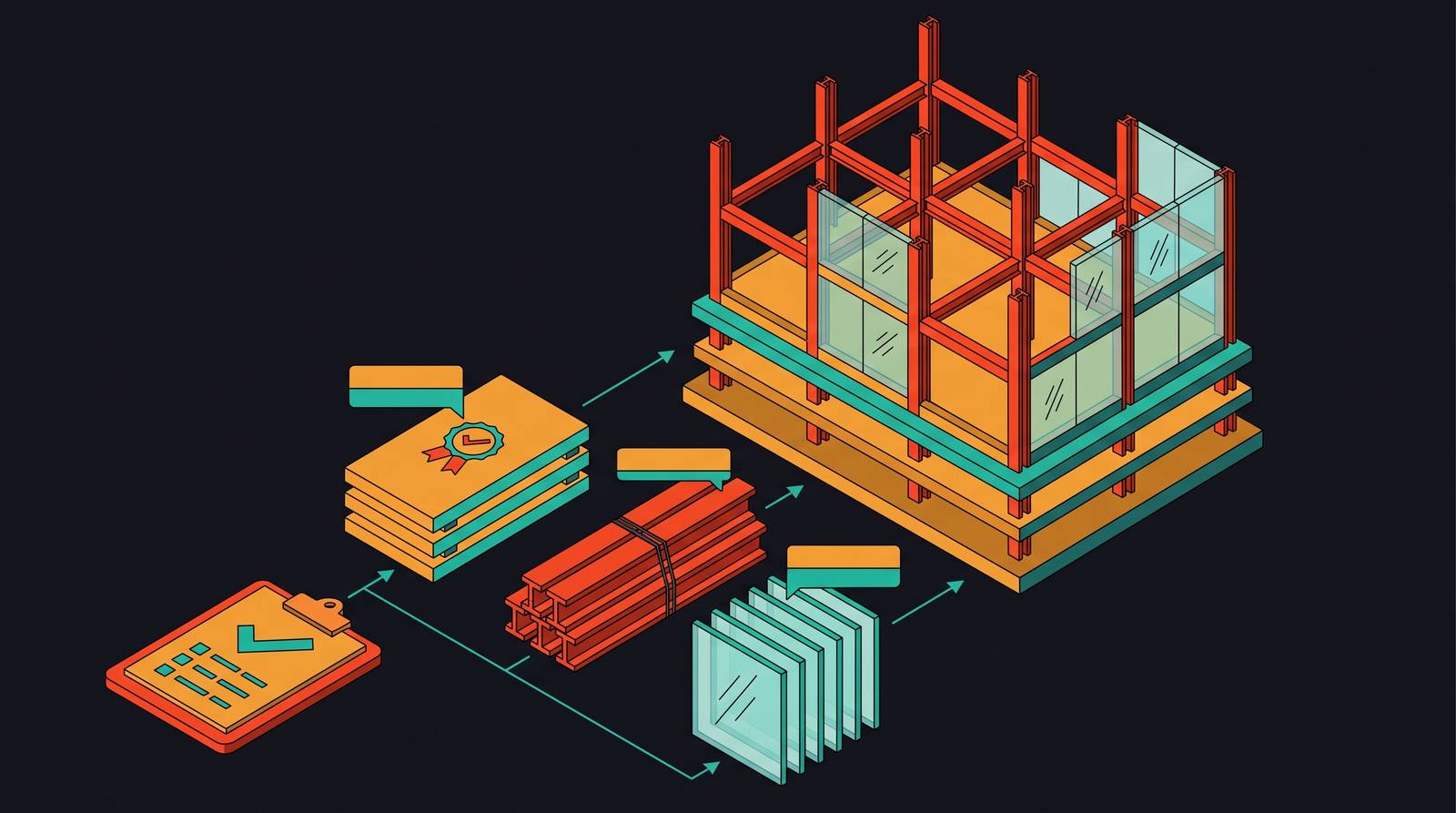
Life cycle assessment (LCA) is the method that tracks all of that, following a product from raw material extraction through manufacturing, transport, installation, and eventually disposal or reuse, capturing what practitioners call whole-life carbon. The way a buyer actually sees the results is through an Environmental Product Declaration, or EPD: a standardized document, verified by a third party, that reports a product's environmental impact, including its global warming potential (GWP). People call it a nutrition label for building materials. Fair enough, though a nutrition label doesn't usually come with a lawyer attached.
Programs mix three levers, usually in different ratios depending on the state or agency:
- Disclosure rules, where you just submit an EPD to bid
- Incentives, like bid preference or a bonus for lower-GWP products
- Hard limits, where a product above a certain GWP threshold gets shut out entirely
Buy Clean doesn't touch how a building performs once people move in; it targets upfront carbon, the emissions locked in before occupancy ever begins. That's what energy codes handle. Buy Clean reaches upstream, into the supply chain, before the concrete truck even shows up.
And the leverage is real. The federal government spends over $630 billion a year on procurement, making low-embodied-carbon procurement a lever with genuine scale. Add state and local governments on top of that, and you get a purchasing engine large enough that manufacturers start reshaping entire product lines, not just their government-contract offerings, to hit lower GWP numbers.
How the U.S. federal Buy Clean Initiative was structured and funded
The federal version started with Executive Order 14057 in December 2021, part of the Biden administration's Federal Sustainability Plan. It stood up a Buy Clean Task Force with one job: point the government's purchasing power at lower-carbon materials.
Money followed fast. The 2022 Inflation Reduction Act put $4.5 billion toward this, split across GSA, FHWA, and EPA, earmarked for materials with substantially lower embodied carbon. GSA got the biggest cut: $3.375 billion for federal buildings, with $2.15 billion of that going straight to procuring low-carbon materials. Another $250 million funded an EPD Assistance Program, grants that helped manufacturers produce EPDs in the first place. A missing EPD is usually the first wall anyone hits when trying to enforce a GWP limit, and no amount of enthusiasm fixes a document that doesn't exist.
Four materials got priority: steel, concrete, asphalt, and flat glass. Not arbitrary picks. They make up the bulk of what the federal government actually buys for construction, and the task force agencies together handle 90% of all federally financed and purchased construction materials, covering a federal building portfolio of 2.8 billion square feet. At that scale, even a modest per-material carbon cut adds up to something real.
Between 2023 and 2024, GSA and FHWA published low-emissions benchmarks off EPA's interim guidance. By late 2024, EPA had a draft Carbon Labeling Program in motion. The whole thing was mid-build when the administration changed. That timing, honestly, is the whole story.
Where the federal program stands after the 2025 rollback
The Trump administration told agencies to drop Buy Clean priorities. The Biden-era version of the initiative sits suspended at the federal level now. That's the short version, and it's not a happy one if you spent three years building the plumbing for it.
The longer version involves an April 2025 executive order called "Protecting American Energy from State Overreach," which told the Attorney General to go find state laws and policies that burden domestic energy production. Read between the lines and it's not subtle: this is federal pressure aimed squarely at state-level climate programs, Buy Clean included.
Legal observers have flagged this as a real operational risk, not just political noise. The reversal opens up new legal uncertainty and could widen the gap between what the federal government wants and what states are actually doing on the ground.
One argument survives the shift intact, though. Buy Clean standards tend to favor domestic manufacturers, who generally produce cleaner materials than a lot of foreign competitors, a dynamic that echoes the logic behind carbon border adjustment mechanisms. This competitiveness framing has appeal across party lines, since it's really an argument about American manufacturing jobs wearing a green hat.
What happens to the remaining IRA money is anyone's guess right now. Congress appropriated $4.5 billion; how much of it stays accessible, or gets spent at all under the current administration, has no clean answer yet. The EPD infrastructure hasn't disappeared, though, and neither has the benchmark data or the state laws already on the books. The federal purchasing mandate paused. The groundwork underneath it didn't go anywhere.
The state-level programs that are now carrying the policy forward
California got there first, back in 2017, with Buy Clean California setting GWP limits on structural steel, rebar, flat glass, and mineral wool insulation for state-funded projects. The targets aren't vague aspirations: a 40% cut in cement emissions by 2035, net-zero by 2045, both measured against 2019 levels. Caltrans started requiring EPDs for concrete, asphalt, and concrete masonry on new infrastructure contracts back in February 2025. California even folded the same logic into building code itself: the 2024 CALGreen update requires new commercial buildings over 100,000 square feet to show at least a 10% cut in embodied carbon, starting July 2024.
Other states are close behind, each on its own clock:
- Colorado passed HB21-1303 in July 2021; the state architect and DOT had to set GWP procurement policies by January 2024 and January 2025
- Minnesota signed its Buy Clean program in May 2023, with concrete thresholds due January 2026 and rebar/structural steel by January 2028
- Oregon's HB 4139, from March 2022, requires the transportation department to set up a GHG reduction program by the end of 2025
- New York's SB 25-182, passed in 2025, directs the Office of General Services to write guidelines for low embodied carbon concrete on public works projects
A Biden-era Federal-State Buy Clean Partnership had coordinated across 12 states. Federal co-leadership is gone, but those relationships and commitments haven't evaporated with it.
Here's what this means if you actually work in the field: if you're a contractor or supplier crossing state lines, you're not dealing with one rulebook. You're dealing with a patchwork. Different materials in scope, different deadlines, different agencies enforcing all of it, and nobody handing you a single spreadsheet to track it.
What compliance with a Buy Clean requirement actually demands from buyers and builders
Step one, every time: does an EPD exist for the product you want to spec? If the manufacturer never made one, that product might get disqualified no matter how clean it actually is. The paperwork gates the performance, full stop.
Not all EPDs carry equal weight, either, since they can be prepared under different **product category rules (PCR)** that govern what gets measured and how. A third-party-verified, product-specific EPD tells you a lot more than an industry-average EPD does, and different programs accept different types. Knowing which one your project's program requires matters as much as knowing the GWP number itself.
GWP limits are set relative to industry averages, not a fixed target of zero. The real question you have to answer is whether a specific product falls below the threshold for its category. That means knowing both the product's declared GWP and whatever benchmark applies to it. Two numbers, not one, from two different sources.
If you're a contractor, this pushes materials specification earlier in your timeline than you're used to. EPD availability and GWP performance have to factor into your subcontractor and supplier selection well before the traditional bidding workflow would normally consider them. For public procurement officers, the legal standard itself shifts, from lowest price that meets spec, to lowest price that meets spec and clears the GWP bar. New bid evaluation criteria, new documentation habits. Not just a mental adjustment.
Architects and spec writers sit upstream of all this. Embodied carbon targets need to get written into the project spec before a single bid goes out, not bolted on after the contract's awarded like an afterthought nobody budgeted for.
How Canada and early international programs extend the same logic
Canada has moved forward with a Standard on Embodied Carbon in Construction, and it's been getting tightened since launch. Subsequent amendments have added new requirements, continuing to tighten the standard over time. This isn't a policy that sat still after launch, which honestly puts it ahead of most.
The target: meaningful reductions in embodied carbon, pursued through recycled materials, lower-carbon alternatives, material efficiency, and performance-based design standards. Canada has also been building out repositories of reliable emissions data, basically the same problem the U.S. tried to solve with the EPD Assistance Program, just tackled from a different angle.
Subsequent revisions have continued expanding the scope of embodied carbon accounting, pushing requirements toward whole-building assessment and broader material coverage. The definition of "embodied carbon accounting" keeps getting wider, not narrower.
And this isn't just a North American story anymore. Ireland has moved toward green public procurement requirements for cement and concrete, with EPD submission becoming part of public construction bids as part of a longer sectoral decarbonization effort. Buy Clean logic keeps appearing in markets that would have surprised you just five years ago.
For global materials suppliers, there's a real upside buried in all this. Build a product line that clears California's or Canada's GWP limits, and you're increasingly set up for whatever new international requirement shows up next. The standards are converging around the same basic architecture, EPDs plus thresholds, even if the exact numbers differ from place to place.
Where the gaps and open questions in Buy Clean policy remain
EPD coverage is still thin in places. A GWP limit only works for products that actually have an EPD, and large chunks of the materials market, especially smaller manufacturers, haven't produced one yet. No EPD means no compliance path, no matter how clean the product actually is.
Jurisdictional fragmentation is the headache contractors deal with every single day. A company working projects in California, Minnesota, and New York at the same time juggles three different lists of materials in scope, three different timelines for when thresholds kick in, and nothing tying any of it together.
The federal-state tension from that April 2025 executive order hasn't resolved. Whether state Buy Clean programs touching federally funded infrastructure face preemption risk remains an open legal question, and nobody in Washington seems in a rush to answer it.
There's also a quieter, more technical gap. Programs that accept industry-average EPDs send a weaker market signal than ones requiring product-specific data. Tightening toward product-specific requirements is the obvious next step, but most programs haven't taken it.
The core market-signal argument, that steady public purchasing drives the green premium on low-carbon materials down over time by pulling supply up, depends on consistent volume. With federal purchasing paused, that signal runs thinner and more scattered than the Biden-era initiative was built to produce.
What hasn't changed: the embodied carbon problem keeps growing as global building stock expands to meet a population heading toward 10 billion. The EPD infrastructure that's been built keeps growing too. State-level legal authority remains largely intact, and the economic case for domestic low-carbon manufacturing doesn't depend on who's running federal procurement policy this decade. It's still sitting there, waiting for whoever picks it back up.