Carbon Removal and Sequestration in Building Design
Buildings can lock away half of global emissions using materials science and reformulated concrete.
Buildings pump out a large share of global energy-related carbon emissions. Split that number up: operations (heating, cooling, lights) account for the majority of that share, while materials and construction, what the industry calls embodied carbon, make up the remainder. That embodied carbon share is the one that should keep you up at night, because once a building goes up, the carbon math is locked in for good. You can swap out an HVAC system in twenty years, but you cannot un-pour a concrete foundation.
The world needs to pull massive amounts of CO2-equivalent out of the atmosphere every year by 2050 to stay anywhere near Paris Agreement targets, and buildings have sat on the debit side of that ledger since forever. So what would it take to flip that, to turn the built environment into a carbon sink instead of a carbon source, across its whole-life carbon footprint? No single material does this alone. It takes several approaches, stacked and working together, and some of them are further along than you'd think.
What the sequestration ceiling actually looks like
A 2025 study in Science ran the numbers on the theoretical max: building materials could store up to 16.6 gigatons of CO2 a year. That's close to half of all global emissions in 2021, a figure worth pausing on.
A ceiling isn't a forecast, though, and carbon sequestration potential at that scale depends on near-total material substitution across global construction. Nobody's building anywhere near that rate today, and the gap between "could store" and "is storing" is basically the whole subject of this piece.
Concrete and asphalt came out as the biggest prize in that study, especially when made with mineral oxides that react with CO2 and form stable carbonates. Full adoption of that approach by 2050 could lock away 920 gigatons by the year 2100. The materials already dominating construction, concrete above all, turn out to be the same ones with the most sequestration upside. Reformulating what's already in front of the industry counts for more here than inventing something new.
Where embodied carbon currently stands and how fast it needs to fall
A 2024 U.S. benchmark study by BranchPattern found average embodied carbon intensity for core-and-shell buildings dropped 4% year-over-year, landing at 22.0 kg CO2e per gross square foot. That's real progress, but nowhere near fast enough.
A late-2025 meta-analysis covering 197 newly built projects found tech-forward practices already cut upfront carbon by 45.7% on average versus business as usual, about 236.29 kgCO2e per square meter saved. Run that math against a 1.5°C-aligned carbon budget of 20.21 GtCO2e, though, and the picture gets grim: the industry needs a 12.5% annual reduction in upfront carbon from 2025 through 2050, converging toward 17.5 kgCO2e/m² by mid-century. That's a cliff, not a gentle slope down.
Some markets are starting from way further back. China's building sector currently runs embodied carbon intensities between 199.9 and 339.5 kg CO2e/m², with concrete and steel reinforcement responsible for up to 90% of those emissions. That's the size of the climb in high-growth construction markets, where reducing upfront carbon before the building even opens is the most urgent lever.
The same meta-analysis names the levers on hand: low-carbon materials cut up to 59%, circular economy approaches up to 40%, digital optimization up to 35%. Stack all three, and you still fall short of the 12.5% annual pace required. Efficiency alone won't close this gap. Sequestration has to be structural now, not a bonus feature.
Mass timber and biogenic materials — carbon locked in the structure itself
Mass timber, cross-laminated timber (CLT), glulam, laminated veneer lumber (LVL), runs on a simple idea: a tree spends decades pulling carbon out of the air, and if you build with that wood instead of burning it or letting it rot, the carbon just stays put. The building becomes storage. Research in the Journal of Building Engineering found mass timber cuts embodied carbon by 30 to 45% compared to conventional concrete and steel.
Here's where the numbers start disagreeing with each other. Depending on how you draw the system boundary, and what you assume happens at end of life, reported greenhouse gas changes for mass timber swing anywhere from 10% to 300%. One multifamily case study makes this concrete: cradle-to-gate global warming potential came out to 271 kg CO2eq/m² with zero sequestration credit, versus 125 kg CO2eq/m² with full credit. Same building, same wood, yet on paper it's practically two different structures.
The credit only holds if the carbon actually stays locked away, though. Those beams have to get reused, or at minimum sit intact instead of rotting or getting burned at demolition, which means end-of-life planning has to be built into the project from the start. Logging, milling, and transport emissions stay fuzzy in most assessments too, which doesn't help anyone trying to trust the final number.
RMI's February 2026 report skips harvested timber entirely and goes straight to waste streams. Grain straw, corn stover, husks, shells, sewage sludge: over 400 million tons of existing biomass waste can turn into insulation, structural panels, flooring, and concrete additives. These products already exist and are priced competitively against conventional materials. They also dodge timber's biggest criticism: no extra logging, no land-use fight, just waste that would otherwise rot or get burned anyway.
Hempcrete deserves its own note here. It sequesters up to 38.4% of the CO2 emitted during its own manufacturing, and it delivers thermal insulation with U-values as low as 0.27 W/(m²·K). Performance and carbon storage come from the same material, no tradeoff attached.
A market is forming around this too. Openly runs a carbon certificate program built on the Global Construction C-Sink Standard, paying €85 per ton of stored CO2 for certified hempcrete and timber projects. Biogenic sequestration is starting to carry a price tag alongside its climate value.
Reformulating concrete — the high-volume material with the most to gain
Concrete sits in a strange spot. It's the single largest source of embodied carbon in construction, and per that same 2025 Science study, it's also the largest sequestration opportunity going. Same material, both sides of the ledger.
CarbonCure injects captured CO2 into fresh concrete, where it mineralizes into nano-calcium carbonate, functioning alongside supplementary cementitious materials in low-carbon mix designs. That improves hydration and lets producers cut cement content by 3 to 5%. As of October 2025, the technology runs in more than 570 ready-mix plants worldwide, has gone into over 9.8 million truckloads, and has permanently mineralized 681,000 metric tons of CO2. That's a real supply chain, running now, well past demo stage.
There's also a baseline nobody had accounted for until recently. An MIT study found cement already sitting in U.S. buildings and infrastructure naturally absorbs more than 6.5 million metric tons of CO2 a year through ordinary carbonation, about 13% of U.S. cement manufacturing emissions. Sequestration has been happening this whole time, but it just never made it onto anyone's spreadsheet.
Biochar comes next. Pyrolysis, a high-temperature thermal decomposition process, turns organic waste into stable charcoal, and 1 kg of biochar prevents up to 3 kg of CO2 release. Swap 1 kg of cement for biochar and you get roughly 3.12 kg of CO2 avoided, per Hylton et al. A 2026 review in EPJ Web of Conferences found biochar-enhanced concrete formulations sequester around 59 kg of CO2 per tonne. The catch: too much biochar weakens the mix structurally, and supply logistics plus a lack of standardized specs still slow things down at scale.
Biochar concrete applications have moved beyond purely academic settings, appearing in high-profile architectural contexts that signal growing real-world interest in the approach.
Further out sit experimental binders still in early research phases, some of which absorb CO2 as they cure and may approach carbon-negative profiles compared to Portland cement. Still early, still mostly experimental. But look at the spread across this category: natural carbonation and CarbonCure are already running at scale, biochar blends are scaling now, and these frontier materials sit further out. Designers don't need to wait for the frontier to catch up before doing anything.
Mycelium composites and other bio-based materials at the experimental edge
Mycelium composites, grown from fungal networks feeding on agricultural waste, reach compressive strengths up to 1.1 MPa and thermal conductivities between 0.05 and 0.07 W/m·K. In plain terms: not going to hold up a building, but perfectly plausible as insulation or a non-structural panel.
The carbon sits inside the fungal biomass itself, and since it grows from waste feedstock, you get a circularity story layered right on top of the sequestration story. This stuff isn't at construction scale yet, and long-term durability and moisture behavior inside real building envelopes are questions researchers are still working through, not settled facts.
Still, the pattern matters more than any single product here. Something bio-based stores carbon in stable solid form and displaces something carbon-heavy: that mechanism shows up across the whole category, even as the specific materials keep changing shape. Mycelium isn't ready to spec into a project yet. Treat it as a signpost for where materials science is headed, not a catalog item you can order today.
Buildings as active carbon-capture infrastructure through facade and system integration
Everything above stores carbon passively, baked into the material and sitting there. This next category is different: the building actively pulls CO2 out of the air while it's standing there doing its job.
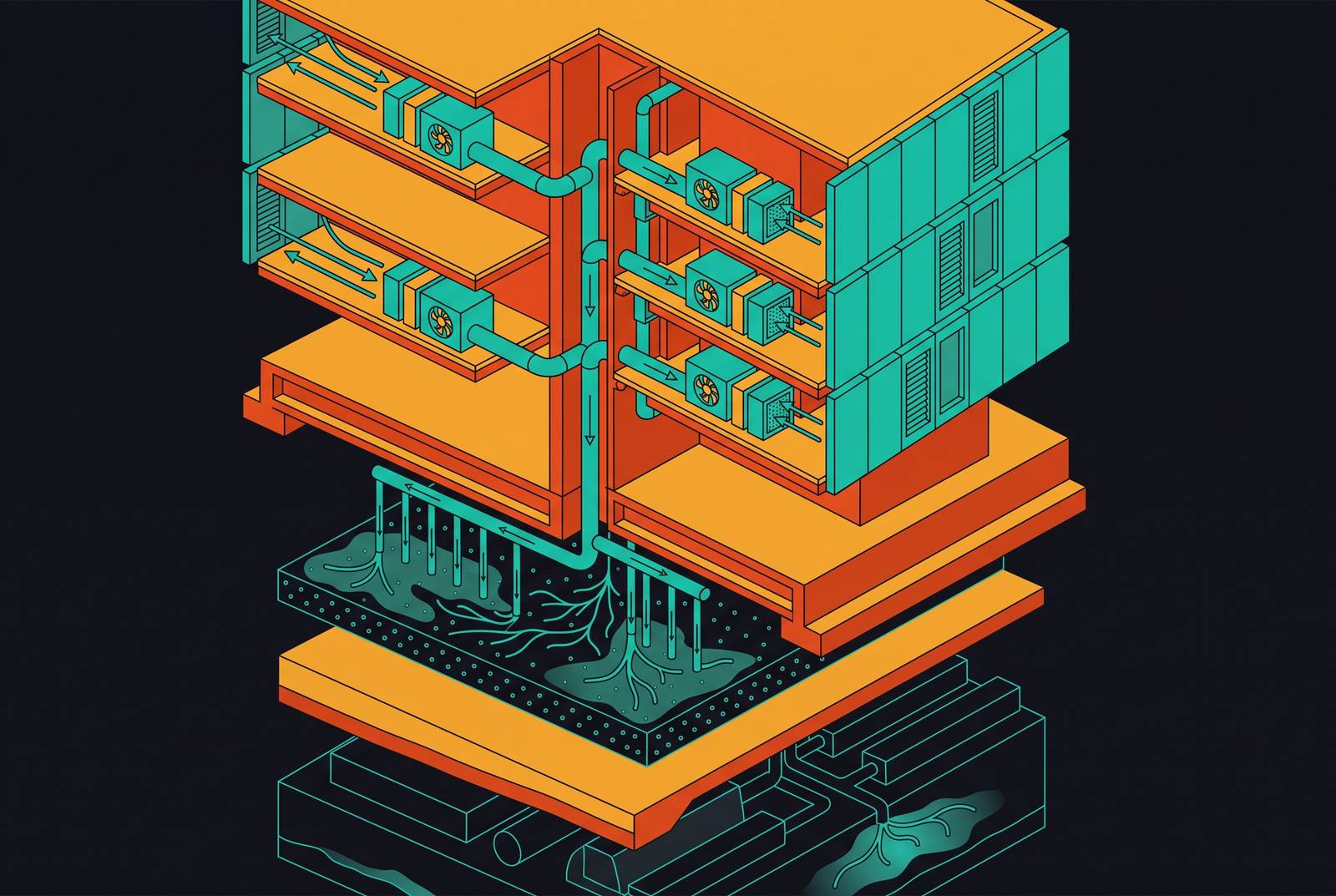
Microalgae photobioreactor facades are panels of living algae built into a building's skin. The algae photosynthesize, grow, and pull CO2 straight out of the ambient air around the structure. A 2025 study out of the University of North Carolina Charlotte clocked actual growth rates: Chlorella hit 175 mg per liter per day, Chlorococcum reached 80 mg per liter per day. These are real numbers, not hand-waving, for something that still sounds like science fiction to most people who hear about it.
Annual CO2 capture from these facades ranges from 84.87 kg to 770.13 kg per installation depending on setup, with optimized biomimetic designs claiming up to 52 kg of CO2 per square meter per year. This isn't purely theoretical either. Working photobioreactor facades have been installed on real buildings, functioning as reference points for the technology.
The economics stay rough, with payback periods that remain long for commercial buildings. Harvested algae biomass can potentially generate additional value as a co-product, which helps the math a little, though it remains a long-horizon bet rather than a quick win.
Direct air capture (DAC) is starting to show up inside the materials supply chain too, not just as standalone infrastructure sitting off to the side. Direct air capture systems are being developed that turn atmospheric CO2 and waste material into carbon-sequestering building aggregates. Integrated design frameworks are emerging that tie several of these threads together — mass timber structure, bio-based materials, and active carbon capture — all working inside the same building.
This is grounded, working technology, but it adds cost and complexity onto buildings that already fight for every dollar in the budget. The near-term move is passive sequestration materials first, active systems wherever the economics and the program actually support them.
How the carbon accounting actually works — and where it breaks down
Life cycle assessment (LCA) is the tool everyone leans on to measure all this. The trouble is that where you draw the system boundary changes the answer completely, which is exactly why mass timber's reported GHG impact swings from 10% to 300% depending on which study you're reading.
Three boundary choices skew results the most: whether logging and transport emissions get fully counted, whether end-of-life carbon release gets included, and whether sequestration credit gets taken up front or held back until the storage is actually permanent.
Permanence is the hard part. Carbon in a timber beam only stays sequestered if that beam gets reused, or at least stays intact when the building comes down, and current demolition practice doesn't reliably guarantee either outcome.
Openly's €85-per-ton certificate program, alongside the EU's Carbon Removal Certification Framework, tries to standardize what actually counts as verified storage instead of leaving it to self-reported guesswork. Meanwhile, the MIT concrete carbonation finding cuts the other direction entirely: 6.5 million metric tons of CO2 stored every year, sitting there uncounted for decades. Sometimes the paperwork just lags the physical world by a wide margin.
What designers and developers need is a third-party verified, whole-life LCA that treats sequestration credit as conditional on what happens at end of life, not a single upfront number that assumes stored carbon is gone the moment someone calculates it. A zero in the sequestration column needs an explanation attached, because it might mean nothing got sequestered, or it might mean nobody bothered to measure it. Those two things should never look the same to whoever's making the call.
What adoption actually requires from designers, developers, and policy
Readiness varies a lot across this list, and any adoption strategy has to match the material to where it actually sits today. CarbonCure-mineralized concrete and mass timber are commercially available right now, biochar blends are scaling, and mycelium composites and photobioreactor facades are still finding their feet.
The 12.5% annual reduction in upfront carbon required through 2050 isn't coming from efficiency tweaks alone, no matter how you slice it. Material substitution toward carbon-storing options isn't optional anymore. It's the only path that actually hits the number.
Cost is less of a barrier than most people assume, too. RMI already notes biomass residue building products compete on price with conventional materials, and hempcrete plus timber now pull in carbon revenue through certification frameworks like Openly's. The real holdup sits elsewhere.
It's code and standards, mostly still written around concrete and steel as the default choice. Procurement inertia in an industry that moves in decade-long cycles plays a part too. And there's no mandatory whole-life carbon reporting in most places, which means sequestration benefits often never surface where procurement decisions actually get made, even when Environmental Product Declarations exist for the materials involved.
Policy could close a lot of this gap fast: embodied carbon limits written into building codes, mandatory LCA disclosure at the permitting stage, and extending carbon market frameworks like the EU's CRCF to cover built-environment materials directly. On the design side, the decisions that matter most happen at schematic design, the earliest stage of a project. Wait too long, and value engineering strips out the low-carbon substitutions before the building ever breaks ground.