All-Electric Building Design and Heat Pump Specifications
Specifying the wrong heat pump kills all-electric buildings before they're built.

Heat pumps outsold gas furnaces in 2024 by 32%, the biggest gap AHRI has ever recorded. That's the mainstream HVAC choice in most of the country now, not a science project. Yet most of the failed all-electric buildings I've seen didn't fail because the equipment couldn't do the job. They failed because somebody wrote the spec wrong.
Wrong heat pump for the climate zone, electrical service sized like it's still 1994, an envelope treated like a paint color instead of the load-bearing decision it actually is. None of that is an equipment problem. It's a paperwork problem, and it shows up eighteen months later as a comfort complaint and a utility bill nobody can explain.
How the efficiency rating system works and what each metric actually measures
Air-source heat pumps carry three main ratings, and they don't measure the same thing. That mismatch trips up more spec sheets than it should.
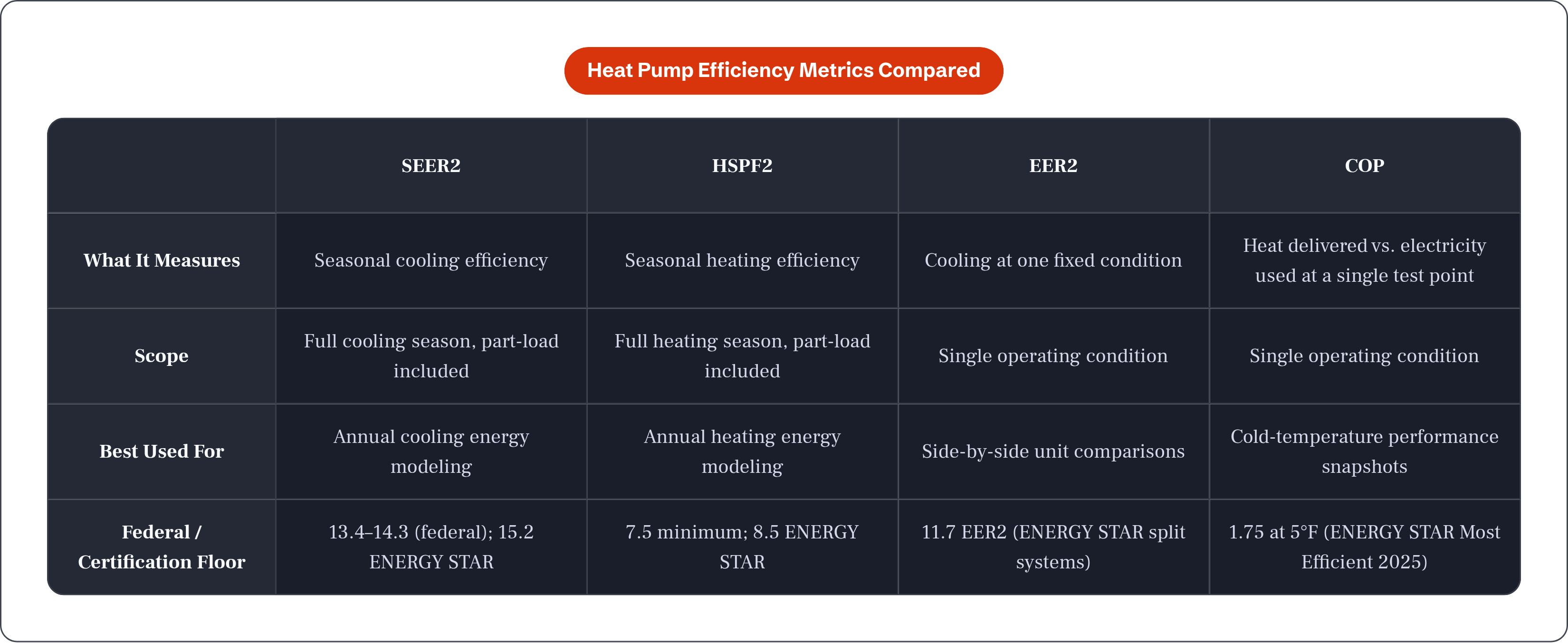
SEER2 covers seasonal cooling efficiency, and HSPF2 covers seasonal heating efficiency. EER2 measures cooling performance at one fixed condition, more like a mileage sticker than how the car drives on your actual commute. Then there's COP, the ratio of heat delivered to electricity used at a single test point. It's handy for comparing two units side by side at, say, 5°F, but it can't tell you how a unit runs across a whole winter. A heating season is thousands of hours at different temperatures, and one COP number skips the cycling, the part-load behavior, and the defrost cycles that quietly eat into real performance.
SEER2 and HSPF2 matter more for annual energy modeling because they bake in that part-load story.
The numbers, for reference: federal minimums since January 2023 sit at 14.3 SEER2 for the Southeast and Southwest, 13.4 SEER2 up north. ENERGY STAR's certification floor runs higher, 15.2 SEER2, 8.5 HSPF2, 11.7 EER2 for split systems. HSPF2 minimums for residential splits land at 7.5, and anything past 9 counts as high-efficiency. Top units reach 10.5 HSPF2, and as of late 2025 the best SEER2 number on the market is 28.7. Geothermal runs on its own scale, rated in straight EER for cooling, with a DOE minimum of 16.1 EER for closed-loop water-to-water systems and top units near 30.0 EER.
Pick the metric that matches your use case. Don't let a big SEER2 number talk you into a unit that's wrong for a cold-climate heating load.
What ENERGY STAR Version 6.2 changed and why it matters for product selection
ENERGY STAR finalized Version 6.2 in March 2025, and it tightened the cold-climate bar in a way you can't shrug off. Cold climate heat pumps now have to deliver at least 70% of their 47°F heating capacity when it drops to 5°F, tested under Appendix M1 H42.
Most Efficient 2025 goes further: cold-climate units need a minimum 1.75 COP at 5°F on top of that 70% capacity retention. Non-cold-climate units get a backstop of 1.75 COP at 5°F and 45% capacity retention, so even units nobody's marketing as "cold climate" have a floor to clear now.
Here's the part that actually moves budgets. Version 6.2's criteria line up directly with IRA Section 25C tax credit eligibility, so this isn't only a performance spec anymore, it's a financial gate. A unit that cleared Version 5 might not clear 6.2, and an old spec sheet or last year's "certified" list can quietly disqualify your project from a credit you forgot to double-check. The 5°F capacity test is the real dividing line, between a unit that technically meets the standard and one that carries a house through a January cold snap without leaning on backup strip heat the whole time.
Why cold-climate performance requires its own specification logic
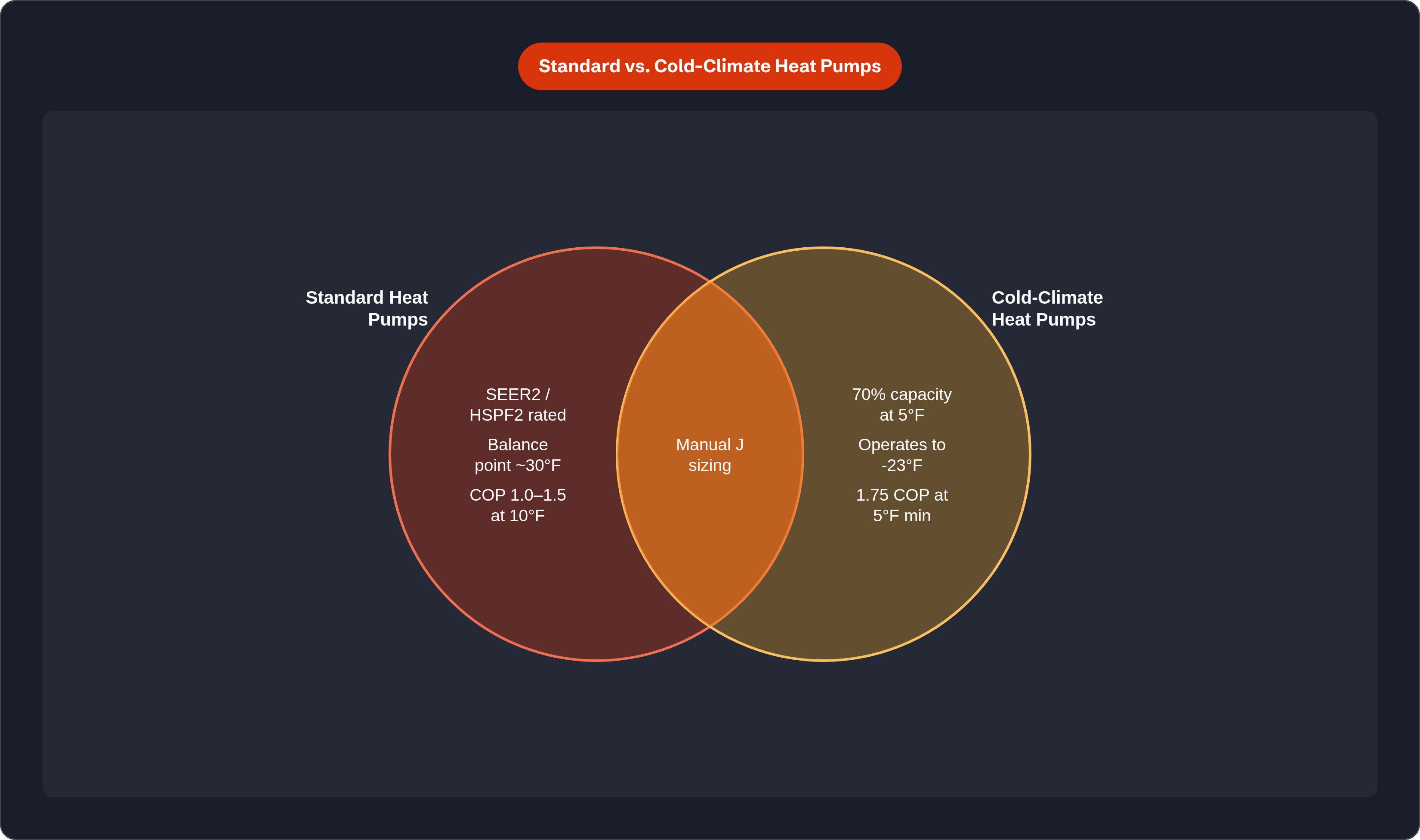
Standard heat pumps start losing steam below roughly 30°F, the point engineers call the balance point, where heating capacity drops to meet the building load. Get under 10°F and a standard unit's COP can fall to around 1.0 to 1.5, which means you're running an expensive space heater. The efficiency case for electrification doesn't just weaken at that point. It falls apart entirely.
Cold-climate heat pumps exist to fix exactly this. Carrier's Infinity line holds 100% heating capacity down to 0°F, keeps running to -23°F, and carries a 12.5 HSPF2 rating. Other leading cold-climate models offer comparable HSPF2 ratings and sub-zero operating ranges. Mitsubishi's hyper-heat lineup is designed for deep cold-weather operation. These aren't lab curiosities. Field analyses of modern cold-climate systems with inverter-driven variable-speed compressors in Climate Zone 5A cities like Boston have found sustained COPs well above 1.0 across the majority of heating hours. That's most of a New England winter running at genuinely good efficiency, not just the easy shoulder-season days.
The DOE's Cold Climate Heat Pump Challenge tested new products in real homes, not just chambers, so there's field data to point to instead of a lab sheet you have to take on faith.
Climate zone sets the specification floor, and there's not much room to argue with that. A unit that clears federal minimums but misses CCHP performance criteria is the wrong pick for Climate Zone 5 and up. Geothermal is the other lever here. Ground-source systems hold a COP of 3.0 to 5.0 no matter what the outdoor air is doing, since they pull from ground temperature instead of air temperature. It costs more going in, but the performance floor doesn't move with the weather.
Sizing heat pump systems correctly and why oversizing is its own failure mode
Manual J, or an equivalent load calculation, is where sizing has to start. The "one ton per 500 square feet" shortcut produces oversized systems constantly, and oversizing isn't a safety margin; it's its own kind of failure.
An oversized unit short-cycles, a condition that accelerates compressor wear and raises maintenance costs over the equipment lifecycle. The compressor fires in bursts, never settles into steady-state, and the seasonal average COP lands well under the spec sheet number. Humidity control suffers too in cooling mode, because short runtimes don't give the coil enough time to actually pull moisture out of the air.
Undersized systems fail the other way. They run flat-out on the worst days, can't hold setpoint, and kick on backup resistance heat, which is exactly the outcome that makes an all-electric building look like it underperforms. Variable-speed, inverter-driven compressors soften sizing mistakes some, since they modulate capacity up and down. But they don't widen your margin for error. They don't replace an accurate load calculation.
Bigger commercial jobs bring VRF systems into the picture, spreading modulated capacity across zones. The sizing math gets more complicated at that scale, but the failure mode is the same one: oversize it and you're paying for capacity you never use efficiently. Equipment selection has to match that math too. A cold-climate unit rated for a design-day minimum that doesn't line up with the actual climate zone either oversizes at moderate loads or comes up short exactly when it matters.
The building envelope as the load that determines everything downstream
A perfectly specified heat pump serving a leaky building doesn't get you very far. Air leakage dilutes every gain your mechanical spec was supposed to deliver, and your energy model stops matching reality.
Field research on envelope sealing in cold-climate multifamily buildings shows what's actually at stake: significant reductions in air leakage can translate into meaningful heating cost savings. Well-sealed buildings can achieve tightness levels that substantially exceed code minimums. That's not a rounding error, it's the gap between a heat pump that hits its design numbers and one that quietly underperforms for the next twenty years.
Write the air tightness target into the spec as an actual number, verified by a blower door test, not left as something the contractor figures out on their own. This matters more in cold climates, because the design-day load calculation assumes a specific infiltration rate. If your real building leaks more than that assumption, your equipment is undersized the day it goes in, no matter what the spec sheet claims. Envelope sealing and duct sealing belong in design development. Not on a punch list after the drywall's already up.
Electrical service sizing and panel capacity as a hidden specification constraint
All-electric buildings pull more peak load than mixed-fuel ones, plain and simple. The service size calculation has to account for everything running at once: the heat pump, the heat pump water heater, EV charging if that's in the plan, induction cooking, an electric dryer. Add them up one at a time and they look fine. Add them up simultaneously, without accounting for load diversity, and the panel can come up short fast.
A mistake I see constantly: the mechanical engineer specs the equipment, the electrical engineer sizes the service on a totally separate track, and nobody reconciles the two numbers until construction's already underway. By then, fixing an undersized panel means a service upgrade nobody put in the budget.
The fix is coordination, done early, service size and panel capacity worked out in schematic design instead of value-engineered away later. Worth specifying "electrification-ready" pathways too, conduit runs and panel headroom for loads that won't get installed on day one. Heat pump water heaters need a dedicated 240V circuit, and hybrid or split-system configurations have become the default for residential and low-rise multifamily; spec them alongside the HVAC package, not as some separate appliance line item. On commercial jobs, demand response controls on heat pump water heaters shift load to off-peak hours, which knocks down peak panel demand and can change the whole service sizing assumption underneath it.
Grid-aligned design strategies that make all-electric buildings viable at the system level
All-electric buildings concentrate load in ways that stress the local grid, and grid-aligned design treats that as a specification problem instead of something to hand off to the building operator after move-in.
Three strategies carry most of the weight. Demand flexibility (thermal storage, battery storage, load-shedding controls that push heating and cooling to cheaper or cleaner hours). On-site thermal or battery storage tied into the building's controls. And solar PV sized to actually shave peak demand, not just to hit a net-zero number on paper once a year.
Heat pump water heaters are a natural fit for demand response, since they store thermal energy off-peak and cut back during peak hours, turning what looks like a plumbing decision into a grid strategy decision. That means the controls and connectivity spec matters as much as the equipment model number does. Know your local grid's carbon intensity by time of day, because your building running its heating load during peak fossil-fuel hours can land a worse carbon outcome than your energy model predicted, even with a great heat pump on the roof. In 2024, 76% of new multifamily construction used electric heat, up from 63% in 2015. At that scale, grid-aligned design isn't a nice-to-have anymore for projects that want real decarbonization instead of a compliance checkbox.
The code and incentive landscape specifiers need to track in 2025–2026
California continues to advance its energy code requirements under Title 24, and its trajectory toward all-electric outcomes in residential buildings is widely seen as a leading indicator of where other states are heading.
The IRA Section 25C tax credit ties eligibility straight to ENERGY STAR Most Efficient 2025 criteria, which loops right back to Version 6.2's thresholds: 1.75 COP at 5°F, 70% capacity retention at 5°F. Specifying to that bar isn't just about performance anymore. It's about whether your project qualifies for the money. Industry signals from standards bodies indicate that model energy codes are tightening toward all-electric outcomes, so projects with multi-year delivery timelines should design against the next code cycle, not just whatever's in force today.
State and utility incentive programs vary a lot jurisdiction to jurisdiction, but ENERGY STAR Most Efficient functions as a portable eligibility proxy across most of them. Code compliance is the floor here, not the target. Design to the bare minimum and there's a real chance the project misses the incentives that make the all-electric math work at all.
A specification checklist that holds the full system together
Start with your envelope. Set an actual ACH50 number in your spec, require blower door verification, and seal ductwork before mechanical commissioning starts.
Run your load calculation before picking equipment, Manual J or equivalent, built on verified envelope performance rather than a square-footage guess.
Match the heat pump to the climate zone. Climate Zones 5 and up need cold-climate products that meet ENERGY STAR Version 6.2's 70% capacity retention and 1.75 COP at 5°F, checked against the current certified list, not last year's.
Specify your water heater alongside your HVAC system, not as a separate purchase down the line. HPWHs need a dedicated circuit, coordinated load calculations, and a controls spec that supports demand response.
Reconcile your electrical and mechanical load schedules in schematic design, and leave panel headroom for loads that might get added later. Add demand response controls and thermal storage wherever your utility programs support them, and size solar for peak shaving instead of chasing an annual net-zero number. Confirm ENERGY STAR Most Efficient 2025 eligibility for every unit on your equipment schedule before it's locked. That's the gate to the Section 25C credit.
Commission the whole thing as one system. Your all-electric building needs integrated commissioning, envelope, mechanical, and electrical tested together. Don't let a parade of trades sign off one at a time and hope it adds up.