Whole-Life Carbon Assessment for New Construction Projects
Measuring a building's carbon across its entire lifetime reveals hidden trade-offs.

Buildings cause 39% of global energy-related carbon emissions. Split that number and you get 28% from running buildings (heating, cooling, lights) and 11% from building them (materials, construction). Whole-life carbon assessment is the practice of tracking both, in the same unit, across a building's entire life, so nobody can hide a bad decision by shuffling it into whichever pile isn't being measured that year.
The two streams misbehave in totally different ways. Operational carbon leaks out slowly, over decades, and it gets better as the electric grid gets cleaner. Embodied carbon gets locked in the day the concrete cures, and there's no undo button. That's roughly three-quarters of today's building carbon coming from operations, but by mid-century the math flips. As grids clean up, embodied carbon's share is expected to climb from about a quarter toward nearly half, per OECD figures cited by GlobalABC. A building designed today to hit today's energy targets is going to look like a carbon glutton in thirty years, not because it got worse, but because everything around it got better while its concrete and steel stayed exactly as carbon-heavy as the day they were poured.
What whole-life carbon assessment actually measures across a building's lifetime
WLCA adds up every carbon impact a project generates, from the mine or forest where the raw material started, to the landfill or recycling yard where it ends up. Some frameworks even count what happens after that, once materials get reused or turned into energy elsewhere. It's cradle-to-cradle accounting, not cradle-to-grave.
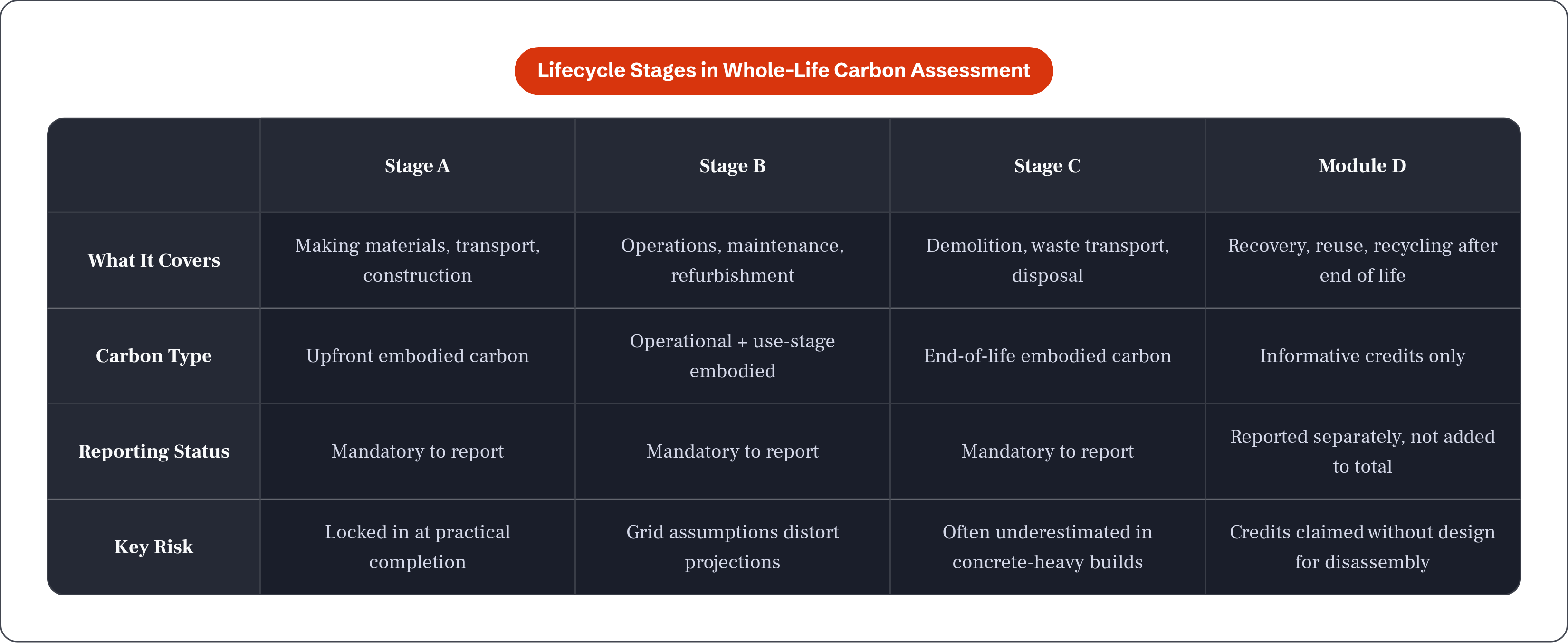
The lifecycle splits into four stages, labeled A through D. Stage A covers making and building. Stage B covers using the building. Stage C covers tearing it down. Stage D lives outside the main system boundary and is informative, not something you add into your total. Stages A, B, and C are mandatory to report. Module D is the "nice to know" stage, and treating it otherwise is one of the more common ways people fudge these numbers.
Within embodied carbon, split it further: upfront carbon (stages A0 through A5, everything before the doors open) and use-stage embodied carbon (B1 through B5, all the maintenance and refurbishment that happens while people are actually using the place). Operational carbon sits in B6 (energy) and B7 (water), calculated from energy model outputs rather than material data, but following the same modular logic.
None of this ranks anything. WLCA doesn't tell you operational carbon matters more than embodied carbon, or that concrete is worse than steel. It just puts every number on the same scale, in kgCO2e, a measure of global warming potential, so the trade-offs are visible instead of buried. Compare that to an energy performance certificate, which only sees stage B6, or an embodied-carbon-only study, which ignores everything that happens after occupancy. Either one alone can nudge a design team to shift carbon into the part nobody's counting. That's not a reduction. That's a magic trick.
How upfront embodied carbon is calculated, stage by stage
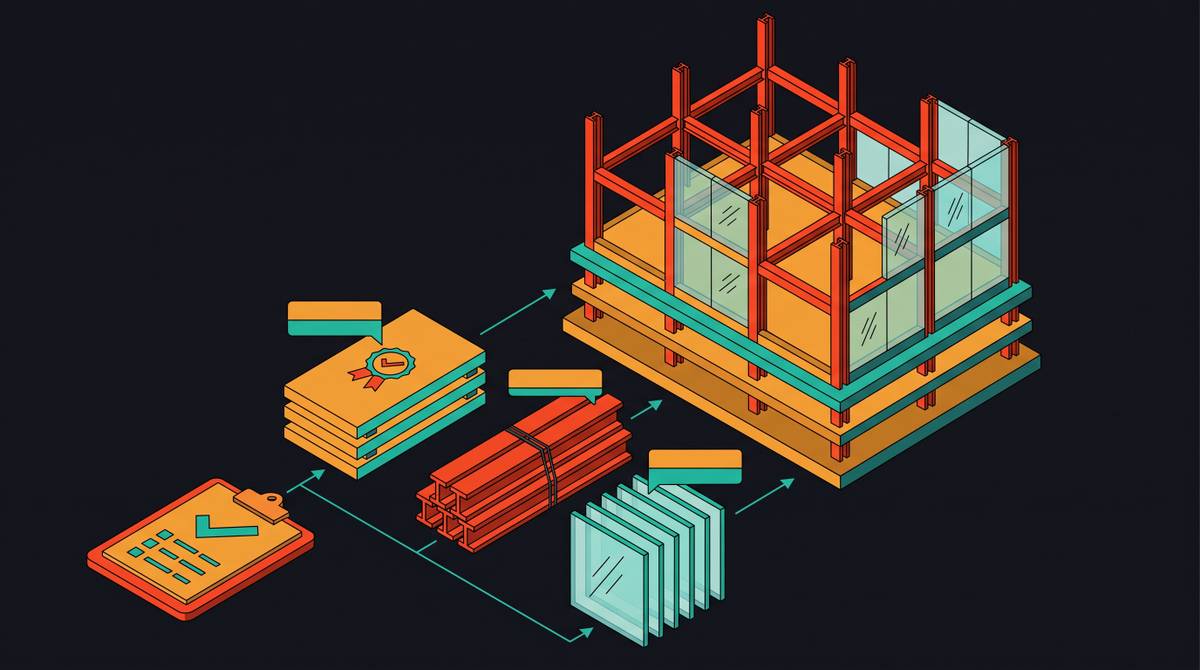
Stages A1 through A3 cover the product itself: pulling raw material out of the ground, hauling it to a factory, and turning it into something usable. For most structural materials, this is the single biggest chunk of upfront carbon, full stop.
Stages A4 and A5 cover getting that product to site and putting it together, including waste and temporary works like scaffolding and site hoarding. People underestimate this stage constantly, even though it's measurable straight from fuel records and the construction schedule.
The main data source for any of this is the Environmental Product Declaration, or EPD, an independently verified carbon figure for a specific product, expressed per unit. No EPD for the product you actually specified? Assessors fall back to generic databases, like the Inventory of Carbon and Energy or various national datasets, and that number should come with a flag saying "less certain than the stuff next to it."
The process itself is simple multiplication done at scale: take the quantities off the drawings, multiply by the EPD value per unit, and add it all up across the entire bill of materials, a process known as quantity takeoff. What makes this stage brutal is the timing. For a high-performance building finished in 2020, roughly two-thirds of its total lifetime carbon, per AIA/CLF data, comes from embodied carbon locked in during its first ten years. Once you hit practical completion, the window for reducing upfront carbon slams shut. The design-stage levers, picking a lower-clinker cement or specifying low-carbon concrete, switching to mass timber, cutting back on over-specified beams, reusing an existing structure instead of demolishing it, only work if you pull them before the first truck of concrete shows up.
Use-stage embodied carbon: the maintenance and refurbishment emissions most assessments undercount
Stages B1 through B5 track everything that happens to the materials while people are living or working in the building: wear and tear, repairs, replacements, refurbishments, over a reference study period usually set at 60 years.
Replacement cycles decide the size of this number more than anything else. A façade replaced once over 60 years produces a very different figure than one replaced twice, and that's a specification decision about design life, not fate. The assessor has to model expected service life for each material, how much gets replaced, the transport and installation carbon each time, and, this part gets hand-waved a lot, what the grid's carbon intensity will look like at each future replacement date.
The classic undercount shows up in office buildings with high tenant turnover. Carpet, ceiling tiles, wiring, all the fit-out stuff that gets ripped out every time a new tenant signs a lease, can rack up carbon that rivals the structural frame over 60 years. Nobody thinks of carpet as a climate issue. It adds up anyway.
Here's the part that makes WLCA genuinely useful rather than just a reporting exercise: a material with a higher carbon cost upfront but a longer service life can beat a cheaper, shorter-lived option on the whole-life total. You'd never catch that trade-off looking at upfront carbon alone. This section isn't really about one big scary number. It's about whether the accounting is honest enough to catch the small stuff that compounds.
How operational carbon is modelled and why its projections require explicit assumptions
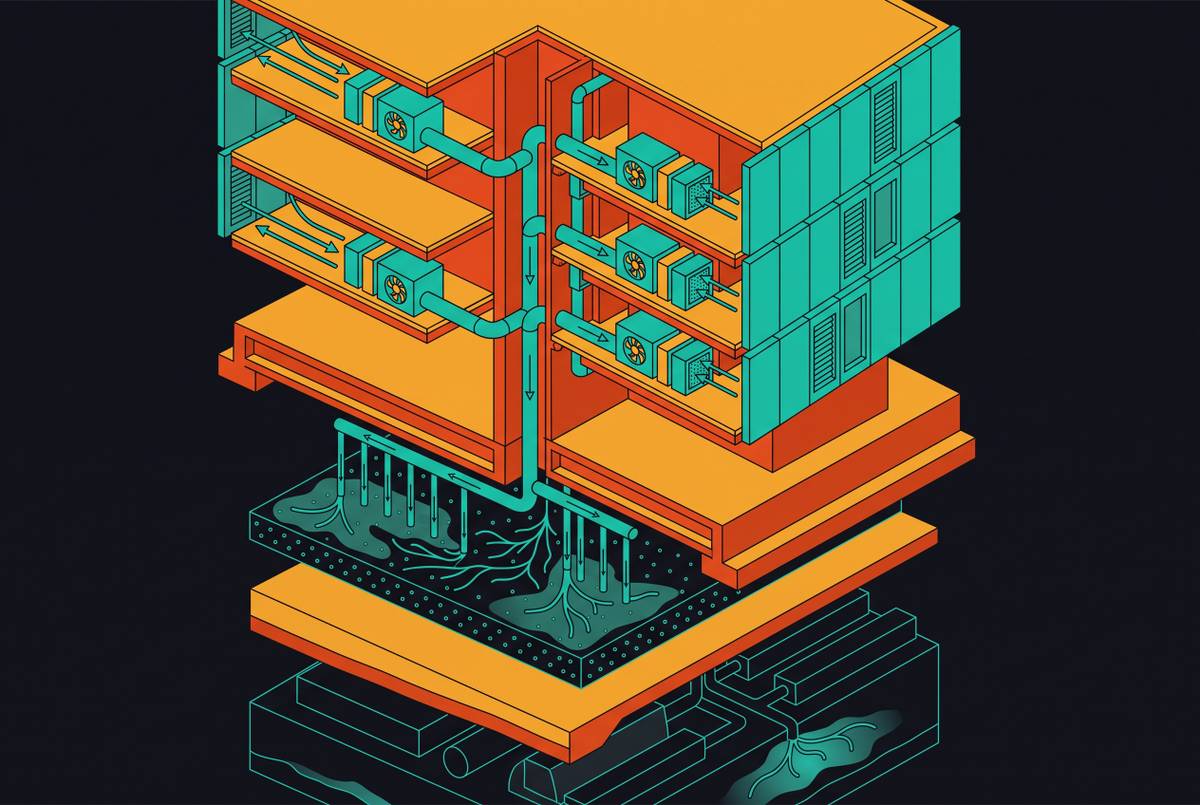
Stage B6 covers energy used for heating, cooling, lighting, and equipment across the building's operating life, worked out from an energy model (dynamic simulation, typically) multiplied by carbon factors for whatever fuel gets used.
Here's the catch: projecting operational carbon 60 years out means guessing at future grid intensity, and that number is going to fall as renewables scale up. Use today's carbon factor for the whole 60-year run and you'll overstate mid-century emissions by a lot. Best practice runs two scenarios side by side: a declining grid carbon intensity trajectory and a static "grid as it is right now" baseline, reported together, with a clear note on which one drives the headline figure.
This is where the earlier point about converging shares comes back around. As the grid cleans up, the operational slice of the pie shrinks while the embodied slice, already fixed at construction, grows in relative terms. Every decision made at design stage about materials carries more long-term weight than the operational numbers might suggest at first glance.
Stage B7 (water) and B8 (other resources) belong in a full-scope WLCA too, and while they're usually smaller contributors, they should show up with a note on how much they matter relative to everything else. One more thing worth checking: was the energy model calibrated to design intent, or validated against how the building actually gets used once people move in? A model built purely on design assumptions will overstate operational carbon, sometimes by a wide margin, and a credible assessment says so.
End-of-life and beyond: what stages C and D add to the picture
Stage C is demolition and disposal: taking the building apart (C1), hauling the debris away (C2), processing the waste (C3), and disposing of it (C4). Usually a modest slice of the total, though concrete-heavy structures feel it more than most.
Module D sits past the system boundary. It captures the upside of recovering, reusing, or recycling materials after the building's life ends, and it does not get folded into the reported whole-life total. It gets reported alongside it, separately, like a footnote that happens to be important.
That boundary line is where credibility either survives or doesn't. A project claiming net-zero whole-life carbon by folding Module D credits into its headline number is making a fundamentally different claim than one that keeps D off to the side. Assessors need to report both, clearly labeled, so nobody can quietly borrow from the future to make today's number look better.
Design for disassembly, using bolted connections instead of welded ones, say, so steel beams can be pulled out and reused rather than crushed for scrap, is what turns a Module D credit from wishful thinking into something plausible. If a building can't be taken apart without a wrecking ball, any recovery credit claimed for it is speculation dressed up as data. Every circular economy pitch in construction leans on Module D and design for disassembly somewhere, so knowing it is informative only, and not part of the actual total, is the difference between reading a claim and falling for one.
The standards and frameworks that define what a compliant assessment looks like
RICS runs the current global professional standard for WLCA, the Whole Life Carbon Assessment for the Built Environment, second edition, effective July 1, 2024. RICS members are required to follow it and log any departures from it.
That standard borrows its modular structure straight from European Standard EN 15978, which covers sustainability assessment at both the product and building level, so data produced under one standard travels cleanly into the other. Worth flagging though: RICS doesn't check anyone's work. There's no verification of results under this standard, which leaves a real gap between "reporting is mandatory" and "accuracy is enforced."
The UK Net Zero Carbon Buildings Standard launched in September 2024, aligning with the UK's carbon and energy budgets and setting embodied carbon limits, including upfront embodied carbon caps, by building type. Offices designed in 2025, for instance, need to hit 580 kgCO2e per square meter. The EU's EPBD recast (2024/1275) will require whole-life carbon disclosure on energy certificates for new buildings over 1,000 square meters starting January 2028, expanding to all new buildings by 2030, with member states publishing national roadmaps and cumulative targets by the end of 2026.
France already requires whole-building life-cycle assessment under RE2020 (EPDs can feed into it, though they're not mandatory for every material). Denmark tightened its typology caps again in 2025. The Netherlands and the Nordic countries have set their own carbon limits. The UK's proposed Part Z would roll out mandatory WLCA and embodied carbon caps in stages from 2025 through 2028. And in London, Policy SI 2 of the London Plan already requires WLCA for development proposals, making it the most visible local mandate in the UK and something of an early template for everywhere else.
None of the enforcement teeth are fully in yet, but the direction of travel isn't in question. Voluntary reporting is becoming mandatory disclosure with hard limits, and any team still treating WLCA as a box-ticking exercise is going to get caught out by rules that are, in most cases, already written.
EPDs as the data infrastructure that makes a credible assessment possible
EPDs are the backbone of any WLCA worth trusting: independently verified, product-specific carbon data. Skip them, and the assessment leans on generic averages that may have nothing to do with the actual product going into the wall.
The supply of EPDs has grown fast. The International EPD System passed 18,000 valid registered EPDs in 2025, and 86.38% of everything EPD International issued that year covered construction products specifically. Sounds like plenty, but coverage isn't even. High-volume, heavily regulated products like steel, concrete, and insulation have EPDs everywhere. Specialist components, imported materials, and anything sourced from a market without an EPD program tend to have none at all.
That's about to shift. The EU's Construction Products Regulation (EU 2024/3110), which applies from January 2026, bakes life-cycle environmental data straight into compliance requirements, which should push a lot more manufacturers to produce EPDs if they want to keep selling into the EU.
For assessors, the practical rule is simple: no EPD means you fall back to a generic value, and that substitution needs to be written down and its uncertainty called out, not smuggled in as if it were just as solid as verified data. Quality varies too. EPDs verified by a third party under EN 15804, the harmonised European standard for environmental product declarations, are comparable across products and programs. Self-declared or unverified figures aren't, and a serious assessment records which type backs each material. In the end, this is a trust question dressed up as a data question. An assessment built on numbers of wildly different reliability but presented as equally solid isn't precise. It's just confident-looking guesswork.
Where the industry actually stands on conducting these assessments
An RLB survey released in April 2024 found 33% of contractors are now being asked by clients to provide a WLCA, up from 14% the year before. That's real movement, but it still means two out of three projects aren't getting asked.
Zoom out further and the picture gets bleaker. Less than 1% of buildings worldwide have had their carbon footprint assessed at all, even as the world adds an estimated 12.7 million square meters of new floor space every single day. Green construction investment actually dropped 7% in 2023, and only around 4% of global construction spending lines up with Paris Agreement goals. Policy is sprinting. Money is walking.
Embodied emissions from materials remain largely unregulated and untracked on a global scale, and UNEP's 2024/2025 report calls current progress far too slow to hit either the 2030 or 2050 decarbonization targets. Part of the gap is structural: WLCA takes specialist skills, time, and access to data that most project teams don't have sitting on the shelf, and when it's voluntary, cost pressure squeezes it out first. But the RLB number points to the fix already in motion: when clients start asking, supply chains start producing EPDs and building capability to meet the ask. Client demand, right now, is doing more enforcement work than any regulation on the books.
What separates a credible WLCA from a compliance document that satisfies the form but not the purpose
A credible WLCA states its scope out loud: which modules are in, which are out, and why. Leaving something out is fine. Leaving it out quietly is not.
Data quality gets disclosed too, material by material: verified EPD, generic database, or manufacturer claim, with uncertainty flagged wherever it's high. Module D stays separate from the headline total, with an honest account of what design-for-disassembly choices actually justify the credit being claimed. Operational carbon shows its assumptions plainly, a static grid factor next to at least one declining-grid scenario, so the reader can see the range instead of just the number someone picked to put in the summary.
And a good WLCA isn't a single snapshot. A concept-stage assessment built on generic placeholder data gets replaced, at technical design, by one built on specified products and verified EPDs. Run once and never touched again, it's a fossil of an early decision, not a living account of how the design actually turned out.
The RICS verification gap makes this discipline matter more, not less. Since RICS doesn't check anyone's results, the only real quality control is whether the methodology and data sources are open enough for someone else to check the math. That's really the whole distinction: a WLCA used at design stages, while choices can still change, drives decisions. A WLCA produced after practical completion just reports a number, accurate or not, for a set of carbon commitments that are already welded into the building.