Low-Carbon Concrete Alternatives in Commercial Construction
Cement's chemistry locks in half its emissions; three proven strategies cut them now.

Cement has a math problem that no amount of clever engineering fully solves: about 40% of its carbon comes from burning fuel to heat the kiln, and 60% comes from the chemistry itself, limestone releasing CO₂ as it turns into clinker, which the industry calls process emissions. That second part is baked into the process. You cannot fuel-switch your way out of it, which is exactly why cement sits as the third-hardest industrial sector to decarbonize, behind only power generation and steel.
The scale makes this worse. Global concrete production runs about 14 billion cubic meters a year right now, and it is headed toward 20 billion by mid-century as cities keep growing. Cement production alone put out 1.47 billion metric tons of CO₂ in 2024. At current practice, a 20-billion-cubic-meter world produces something like 3.8 billion tonnes a year. That is the number pulling real investment dollars into low-carbon cement alternatives.
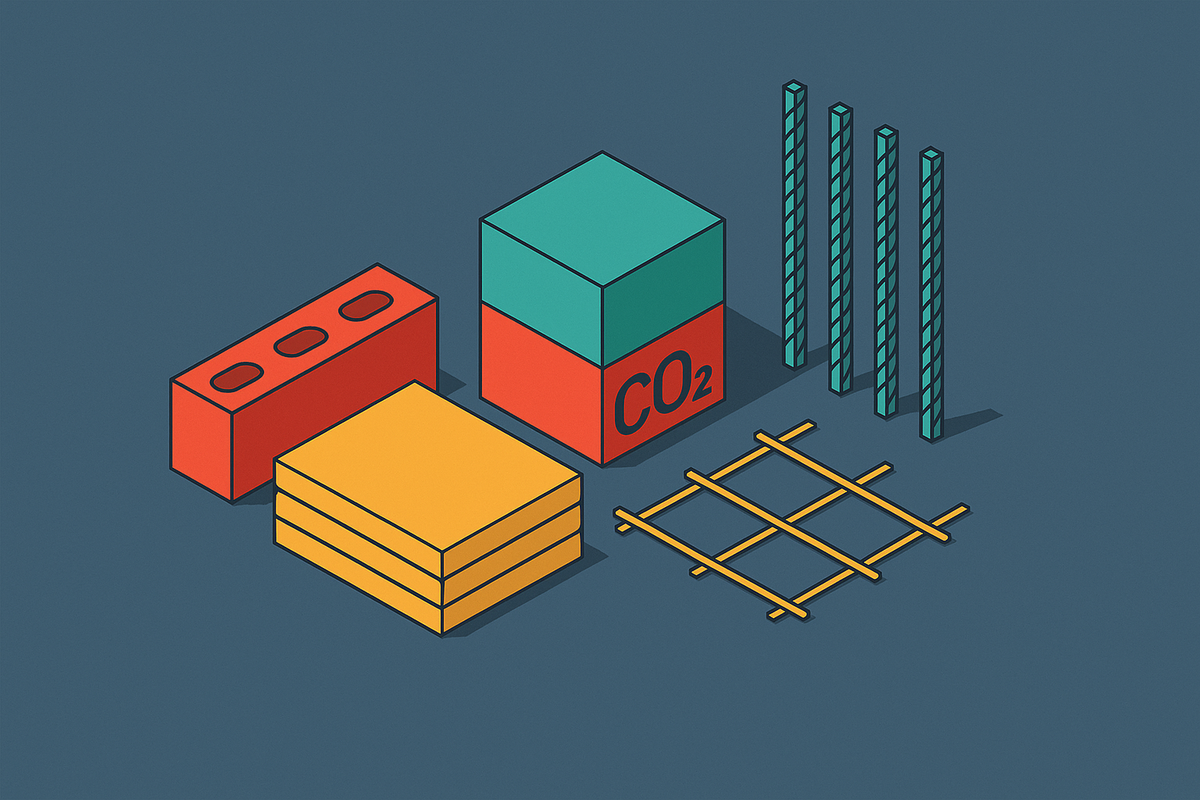
The target sits at about 900 kg of CO₂ per ton of cement, which works out to 88% of a typical concrete mix's carbon footprint. Aggregates and transport contribute negligible emissions compared to the binder. If you are trying to cut your project's embodied carbon, the binder is where to focus.
How each strategy cuts emissions
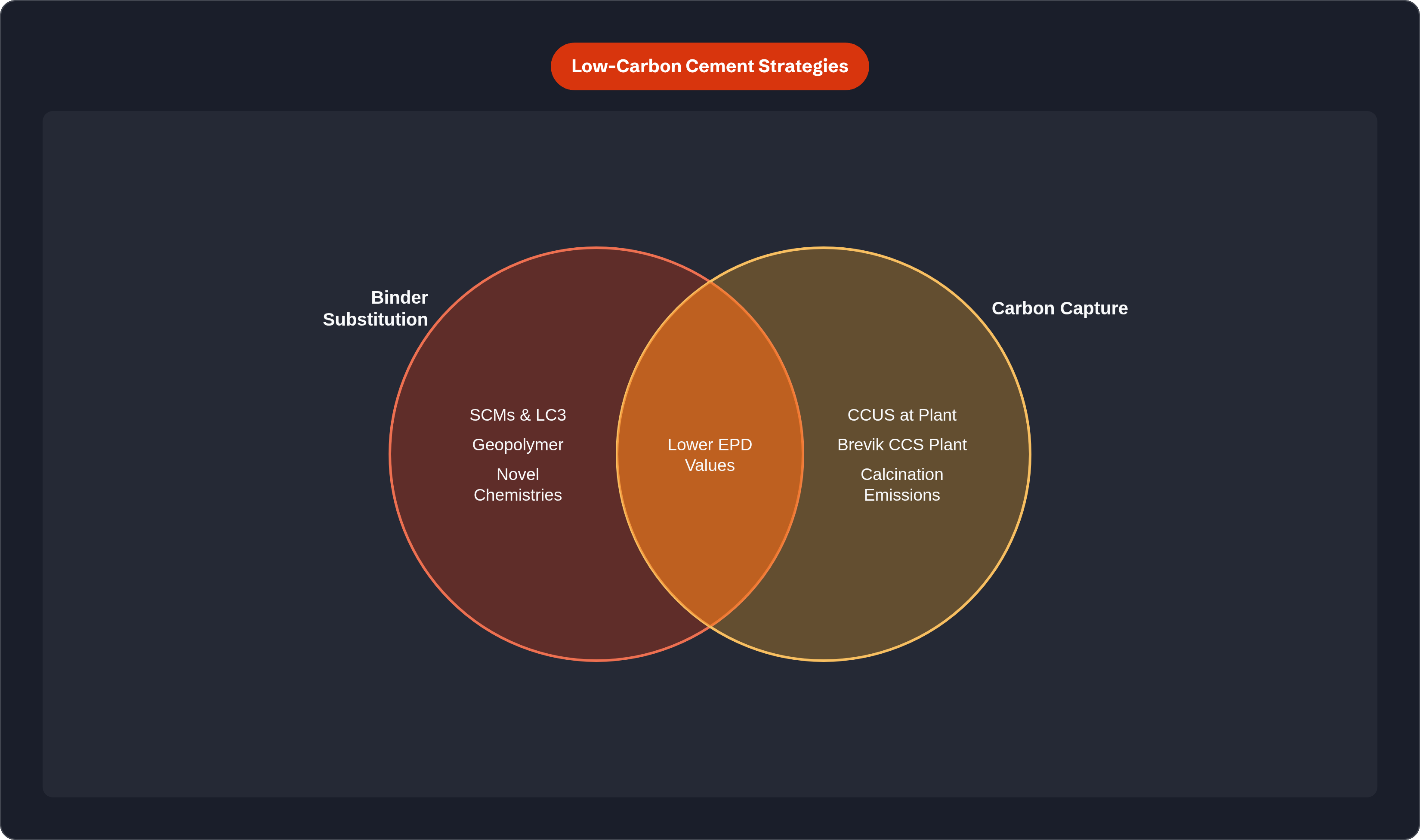
Three strategies exist, and they are not interchangeable. First: swap out clinker for something that never required calcination. Second: cure or activate the concrete so CO₂ gets locked into the material permanently. Third: capture the emissions at the plant after combustion before they disperse.
Most of what is ready to use today falls under the first strategy. Its ceiling is set by chemistry: replace too much clinker and you lose strength or workability. The second strategy, mineralizing CO₂ during curing, addresses a smaller share of total emissions, but it actually stores carbon rather than just avoiding it. The third strategy, carbon capture at the plant, is the only one that reaches the calcination emissions no binder swap can touch, but it requires capital investment and infrastructure at the plant level.
The most effective approach for most projects is combining strategies rather than selecting one. Standard concrete runs about 410 kg CO₂ per cubic meter. Substituting 30% fly ash brings that down to roughly 290 kg. That reduction is meaningful, but it is not sufficient to approach zero. Deeper cuts require different chemistry entirely.
SCMs the low-carbon option available now
Supplementary cementitious materials, including fly ash, slag, silica fume, calcined clay, and natural pozzolans, replace some portion of clinker while contributing to strength through pozzolanic reactions. The global SCM market was valued at $28.1 billion in 2024 and is projected to reach $40 billion by 2032, growing at approximately 4.51% annually. Over 180 million tons were used worldwide in 2024.
Fly ash leads by volume at about 35% of total SCM consumption and 47.4% of revenue share in 2025. Slag accounts for approximately 28%, natural pozzolans 17%, silica fume 12%, and metakaolin 8%. Well-optimized blends can reduce emissions by up to 50%, though actual results depend on substitution rate and material quality.
Fly ash supply is tied to coal plant operations, and coal plants are retiring. As that happens, high-quality fly ash becomes scarcer. Heidelberg Materials and Holcim have both begun diversifying SCM sourcing toward calcined clay and mining-waste derivatives in 2025 and 2026. Terra CO₂ secured a $52.6 million Department of Energy contract in October 2024 to build a 240,000-ton-per-year SCM facility using mining waste, reflecting broad industry recognition that new supply sources are necessary.
For most commercial teams, SCMs are the clearest near-term option. Confirm sourcing early, because the supply picture is shifting.
LC3 pushes deeper clinker substitution further
Limestone calcined clay cement pushes further than typical SCM blends, substituting up to 50% of clinker using a combination of calcined clay and limestone. That delivers a 30 to 40% CO₂ reduction versus ordinary Portland cement, which exceeds what most fly ash blends achieve.
The critical variable is temperature. Clay gets calcined at 750 to 850°C, while clinker requires 1,450°C. That difference means less fuel consumed and creates a viable path toward electrified kilns. LC3 also reduces 15 to 20% of manufacturing energy use, and it does not require expensive retrofits to existing plant equipment.
Low-grade clay is geographically widespread, unlike fly ash. The material was developed at EPFL and IIT Madras and is already running on dedicated production lines across Asia and Africa. Lodha's pilot in Mumbai, with trials starting in 2024 and commercial production in 2025, is the first documented commercial-scale use in Indian real estate. The commercial building segment is growing fastest, projected at 8.2% annually from 2025 to 2032, driven largely by sustainability certification requirements in offices and retail space.
The EU's Carbon Border Adjustment Mechanism begins phasing in from 2026 and is already directing European buyers toward domestic low-carbon options including LC3. LC3's performance in high-humidity or sulfate-heavy environments has less field data outside Asia, so early adopters in other regions should plan for closer mix monitoring.
Geopolymer concrete skips Portland cement entirely
Geopolymer concrete eliminates Portland cement entirely. Silica- and alumina-rich materials such as fly ash, slag, and metakaolin are chemically activated with alkalis to form alkali-activated materials. The absence of clinker removes clinker-related emissions from the equation.
The geopolymer market reached $8.01 billion in 2024 and is projected to reach $15.18 billion by 2030, growing at 11.3% annually. Infrastructure and public works represent the largest application segment at 46%. Fly ash-based geopolymer holds 63.4% revenue share by material type, and Asia Pacific accounts for 44.8% of 2024 revenue.
Australia has the most extensive field evidence. Companies including Wagners and Zeobond have operated industrial-scale fly ash geopolymer production with durability records extending past 20 years. Geopolymer also handles heat and chemical exposure better than standard concrete, making it well suited for industrial floors, precast elements, and chemically aggressive environments.
For U.S. and European commercial builders, the barriers are practical. Codes and specifications are limited in most jurisdictions. Production costs run higher, approximately $20 more per cubic yard according to Ken Research. And the alkali activator supply chain requires coordination that standard ready-mix procurement does not. Geopolymer is a strong fit for precast elements, industrial slabs, and infrastructure projects. It is not yet a straightforward choice for standard cast-in-place commercial construction in markets without established code pathways.
CO₂ mineralization locks carbon into the structure
CO₂ mineralization involves injecting captured CO₂ into fresh concrete during mixing. The CO₂ reacts with calcium ions through accelerated carbonation and becomes permanently bound within the material. It does not re-enter the atmosphere and becomes part of the structure itself.
CarbonCure demonstrates this works at commercial scale. Ten million truckloads of CO₂-mineralized concrete have been delivered worldwide, across producers in two dozen countries, spanning residential, commercial, and infrastructure applications. Injecting CO₂ also allows producers to reduce the cement content of a mix without losing compressive strength, so emissions savings come from two sources: the sequestered carbon and the lower cement factor the injection enables.
Solidia takes a different approach, reducing cement-related CO₂ substantially and eliminating water curing entirely. Removing water curing reduces costs and wastewater management requirements, which is particularly valuable for precast operations. Solidia scales through licensing agreements with major producers rather than building its own manufacturing facilities.
The carbon-to-concrete market exceeded one billion dollars globally in 2024 and is growing steadily. CO₂ mineralization is additive to binder substitution, not a replacement for it. One practical constraint: CarbonCure requires a ready-mix producer with injection equipment already installed. Availability depends on your local supplier, so confirm that before specifying the approach.
Novel cement chemistries entering early commercial use
Three companies are advancing fundamentally different cement chemistries. Sublime Systems produces cement electrochemically, eliminating high-temperature kiln processing entirely. Brimstone uses calcium silicate rocks instead of limestone, which avoids calcination CO₂ at its source. C-Crete builds cement-free binders from industrial byproducts and minerals.
C-Crete has the most documented project activity: a cement-free residential complex in Petaluma slated for January 2026, a granite-based data center in Seattle from December 2025, and a Costco warehouse completed in 2025. Brimstone's planned demonstration plant is projected to avoid tens of thousands of metric tons of CO₂ annually if it operates as designed. It is not yet running.
Commercial teams should note that both Sublime Systems and Brimstone had federal demonstration awards pulled by the Department of Energy in May 2025, shortly after Sublime announced a procurement agreement with Microsoft. The funding loss reflected the unpredictability of public funding cycles, not technical failure. That represents a risk profile that established SCM and geopolymer producers do not carry to the same degree. These chemistries are worth monitoring and appropriate for pilot projects where schedule and risk tolerance allow, but not suitable for projects with near-term groundbreakings.
What mix design alone cannot fix
Even a 50% SCM substitution leaves the calcination emissions from the remaining clinker untouched. No binder substitution strategy addresses that portion. Carbon capture at the plant is the only tool designed specifically to reduce those emissions.
The Global Cement and Concrete Association identifies carbon capture, utilization, and storage as the single largest lever in the sector's decarbonization pathway, with potential to deliver a substantial reduction in industry emissions. That impact exceeds anything achievable through mix design changes alone.
Heidelberg Materials' Brevik plant in Norway is the first operating cement plant with integrated carbon capture and storage, extracting CO₂ directly from the clinker process and storing it beneath the North Sea. Installation began in August 2024 and targeted completion by the end of that year.
For commercial construction teams, plant-level carbon capture does not affect mix design or procurement directly. It reduces the embodied carbon of cement produced at that facility, which is reflected in the Environmental Product Declaration the supplier provides. CCUS-equipped plants remain rare globally, so specifying cement from a carbon-capture facility is not realistic for most projects outside Norway and a small number of pilot sites. Tracking supplier EPDs from facilities piloting carbon capture is the practical step to take now.
Matching alternatives to your project type
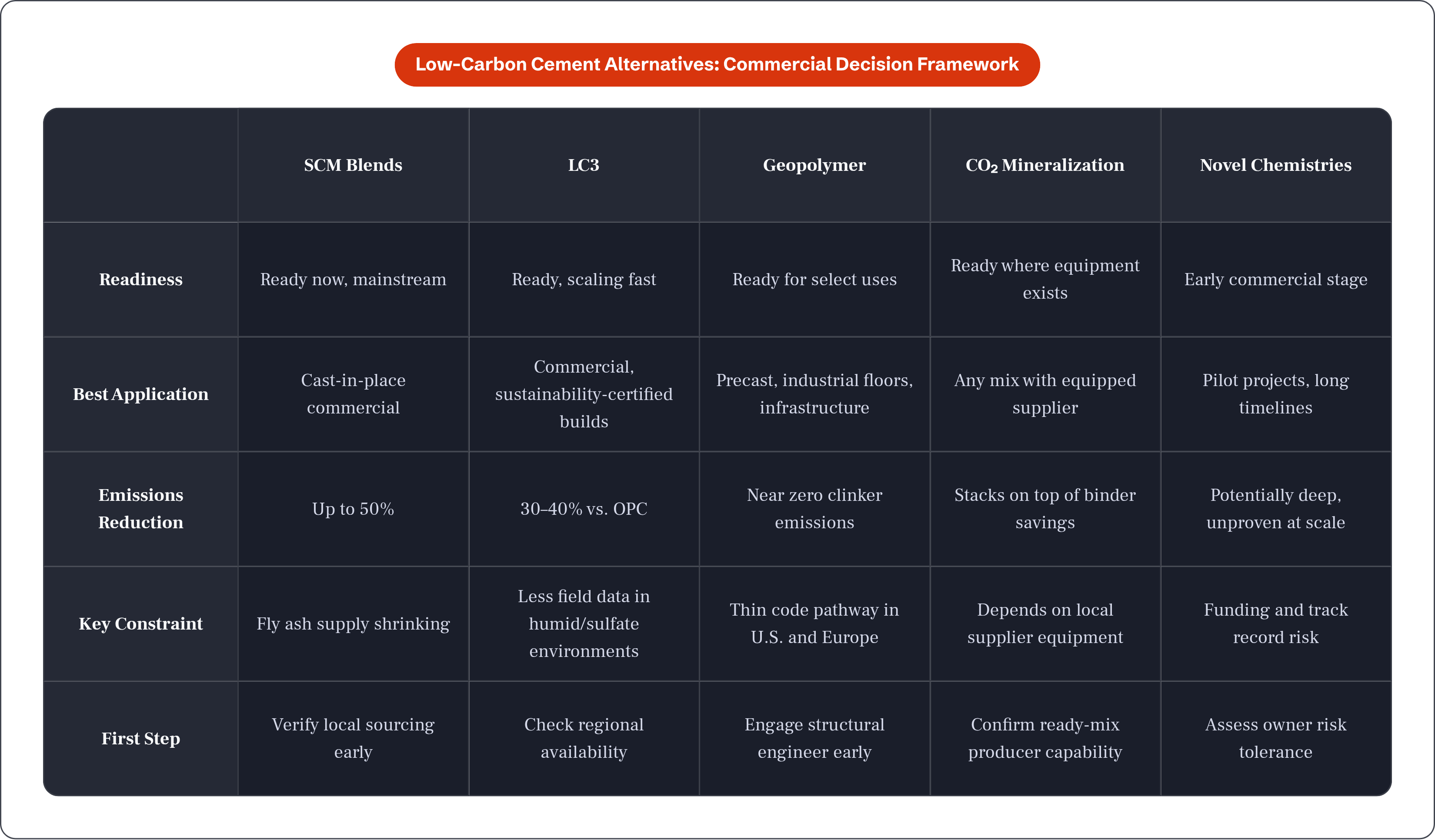
The question is not which alternative performs best in isolation. It is which combination fits your structural requirements, local supply chain, code environment, and schedule.
SCM blends including fly ash, slag, and LC3 are available now and work broadly for most cast-in-place commercial concrete, provided local supply is confirmed before the design is locked in. CO₂ mineralization through a provider such as CarbonCure is also available now but depends entirely on whether your ready-mix producer already has injection equipment installed. Check regional availability before designing around it.
Geopolymer is ready for specific applications: precast, industrial floors, and infrastructure projects with solid performance data. It requires early structural engineer involvement and a jurisdiction-specific code review. Novel chemistries such as those from C-Crete are appropriate for projects with longer timelines, owners open to early adoption, and budget allocated for additional testing and documentation. CCUS-enabled cement warrants ongoing monitoring; tracking Environmental Product Declarations from suppliers piloting carbon capture positions you to specify it as availability expands.
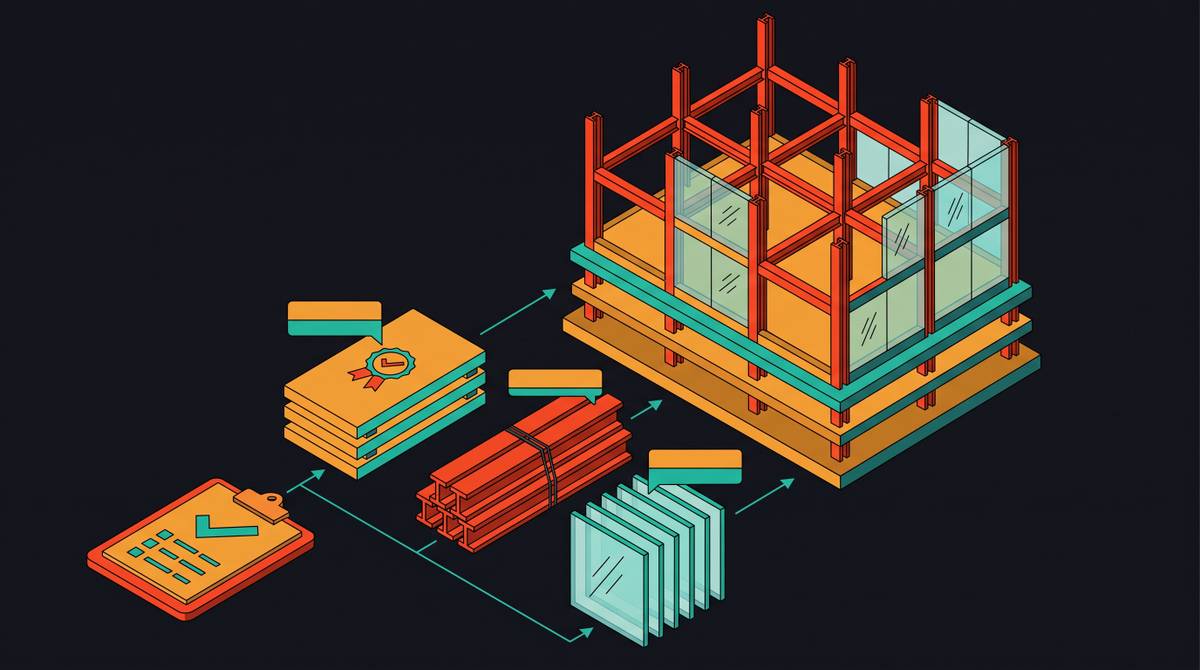
Documentation is not optional regardless of which path you choose. EPDs tied to your specific mix and supplier are what support any embodied carbon claim on the project. Generic industry averages do not satisfy LEED, BREEAM, or owner reporting requirements. For most commercial teams, three steps deliver meaningful progress without requiring new technology or code exceptions: specify an SCM blend as the default, confirm CO₂ mineralization availability with your ready-mix supplier, and require mix-specific EPDs from the outset.