Electrification of Construction Equipment and Jobsite Operations
Electric construction equipment is growing six times faster than diesel, reshaping jobsites.
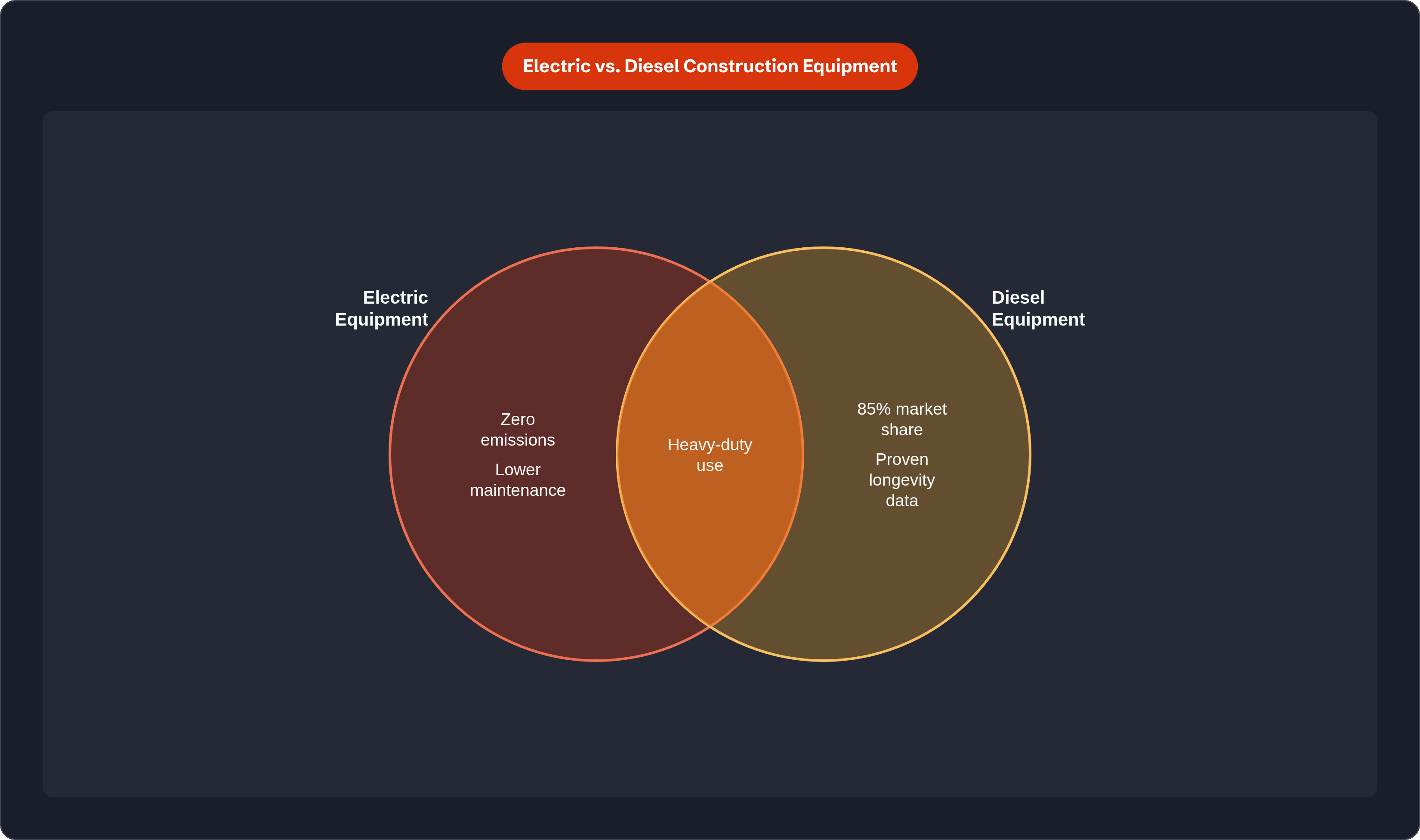
Diesel still runs the show on job sites. Roughly 85% of new construction equipment sold in 2025 runs on diesel, according to IMARC Group, and if you've stood next to an excavator at 7 a.m., you know that smell isn't going anywhere overnight. But the electric slice of the market is growing at a clip that no prior heavy-equipment cycle has seen, with compound annual growth rates (CAGR) north of 20% across nearly every research firm tracking it. Construction's carbon footprint, including direct scope 1 emissions from diesel-powered machinery, is widely recognized as one of the sector's defining long-term liabilities, not a distant problem to plan around someday.
What makes this moment different is that nothing about it is happening in order. Regulation, cost math, what manufacturers actually have on the lot, and the physical limits of a job site are all shifting at the same time, tangled up with each other. To understand where this is headed, look at each force on its own first, then figure out how they push and pull against each other.
How large the electric construction equipment market already is, and where it is headed
Depending on which research firm you ask, the electric construction equipment market landed somewhere between $13 billion and $16 billion in 2025. GMI puts it at $15.8 billion. Fortune Business Insights says $14.35 billion. Precedence Research lands at $15.77 billion, and The Business Research Company comes in lower at $13.63 billion. Different methodologies, different numbers, same rough neighborhood.
Where they agree more tightly is the growth rate: 20.5% to 23.1% a year through the early 2030s, no matter whose model you trust. Run that forward and the upper-end forecasts put the market at $90.68 billion to $100.35 billion by 2034. That's six to seven times where it sits today.
Compare that to the construction equipment market as a whole, which is expected to grow from $258.54 billion in 2025 to $352 billion by 2034, a CAGR of just 3.31%. That gap is the whole story: electric is eating share from diesel. Fast.
Where adoption is actually happening — and where it is still catching up
Asia Pacific leads with a 35.4% share of the global market in 2025, and China alone made more than 48% of the world's electric excavators and loaders in 2024. That's a country deciding to own a category.
Europe is close behind in dollar terms, at $4.26 billion in 2025, but leads on a different measure: nearly 46% of European construction enterprises say they've already worked electric equipment into new projects, the highest adoption rate anywhere. Europe is also growing the fastest of any region, at a projected 25.7% CAGR from 2025 to 2032.
North America is smaller and further behind. The U.S. market sat at an estimated 441 units in 2024, expected to climb to about 1,940 units by 2030, a 28.06% CAGR off a tiny base. The Middle East and Africa come in at $1.18 billion, with the Gulf Cooperation Council states making up $0.74 billion of that. Real money, held back by infrastructure that isn't built for it yet.
The pattern isn't complicated. Wherever policy has pushed hardest, adoption has moved fastest. Everywhere else is playing catch-up, just at different speeds.
Which equipment categories are leading electrification and why the compact segment moved first
Excavators are the biggest slice of the electric market. They held 30% of it in 2024, sit at 36.7% in 2025, and are projected to hit 39.47% by 2026. Cranes are smaller at 18% of the 2024 market but growing faster than any other major category, with a projected 25.2% CAGR through 2034; quieter operation and lower maintenance make them an easy sell on noise-sensitive urban sites. Lithium-ion batteries dominate the storage side and are expected to hold 72.14% share by 2026.
Residential construction drives the biggest chunk of demand, 40.5% of the electric market in 2025, tracking the broader global housing boom.
The real story of where electrification started is size, not category. Compact equipment, roughly six tonnes and under, moved first because the engineering is simpler and the power needs are modest. Battery weight, which is a real headache on bigger machines, works in a compact machine's favor: it adds stability and traction instead of just adding mass you have to haul around. That's why battery-electric mini excavators and small loaders are commercially viable today while the biggest categories are still running pilots.
Scale the machine up and that same battery weight turns into an engineering puzzle. It's slow going, which is why alternative power technologies are being explored for larger equipment, as a partner to batteries rather than a replacement for them.
The regulatory push: European mandates, California's fleet rules, and U.S. federal procurement
The EU has committed to cutting net greenhouse gas emissions by at least 55% by 2030 (against a 1990 baseline) and reaching net-zero by 2050, and that target shapes everything downstream. Some Scandinavian cities have already gone further, mandating zero-emission construction zones by mid-decade. In 2025, the EU rolled out new Non-Road Mobile Machinery rules requiring newly built electric equipment to meet energy efficiency, safety, and digital reporting standards.
California isn't waiting on Brussels. The state's Air Resources Board began phasing in In-Use Off-Road Diesel Fleet amendments in 2024, with the rules running through 2036. The state expects $5.7 billion in health benefits and more than 570 fewer air-quality-related deaths between 2023 and 2038. California's regulatory push is reaching directly into procurement, with state programs giving agencies tools to require zero-emission fleets as part of contracting conditions.
Federal rules point the same direction: Federal procurement policy is increasingly pointing toward zero-emission requirements on public projects, meaning electrification is ceasing to be a five-year-plan item and turning into a bid requirement for contractors chasing public contracts.
The total cost of ownership case — where it already holds and where it does not yet
The numbers on a high-use machine are hard to argue with. Industry analyses show that high-utilization electric excavators can generate meaningful annual fuel savings versus diesel equivalents, with maintenance costs dropping significantly as well. On a busy fleet, that adds up fast.
The catch is the sticker price. Electric machines carry a significant upfront premium over diesel equivalents, with some models running substantially higher. Industry analyses suggest the total cost of ownership (TCO) payback crossover is reachable within a normal equipment lifespan, but the math only really works if the machine is big and running a lot of hours. Park it half the time and the numbers stop cooperating.
There's a tailwind, though. Battery costs have been falling steadily, and battery cost as a share of total machine cost is broadly expected to continue declining through 2030. As manufacturers move from bolting batteries onto old diesel platforms to designing electric machines from scratch, that premium keeps shrinking. Where the case still falls apart: low-utilization equipment, machines working far from any grid connection, and the biggest equipment classes where battery weight hasn't been fully sorted out.
What has to change on the jobsite itself — charging infrastructure, power access, and site logistics
Charging is the barrier that shows up again and again in adoption surveys, especially in emerging markets and on remote greenfield sites with no grid nearby. You can build the world's best electric excavator, but it's a very expensive paperweight if there's nowhere to plug it in.
Construction is one of the world's largest energy consumers. Electrifying the machinery doesn't shrink that number; it just changes what kind of energy the site needs and where that energy has to come from. Urban sites have their own version of the problem: even where power exists, the grid connection in a dense downtown block might not have the capacity a fleet needs.
Contractors are patching together charging infrastructure right now with battery swapping, mobile charging units, and temporary grid hookups. All of it works, and all of it adds cost and scheduling headaches that didn't exist when refueling meant a five-minute stop at a diesel tank. A fully electric jobsite runs on charging windows instead of fuel stops, which means shift planning and machine availability start looking more like an airline's gate schedule than a construction site. On top of that, there's a longer-term wrinkle fleet planners are starting to watch: the supply chains for lithium, cobalt, and nickel aren't infinite, and procurement teams are beginning to factor that risk into multi-year buying decisions.
The genuine barriers that remain, and why the tipping point keeps being deferred
Consultant Robert Droogleever put it well: "The technology works, the prototypes are proven and the environmental case well-rehearsed, and yet the tipping point still refuses to arrive." That line explains why so many rosy adoption forecasts keep getting pushed a few years further out.
Battery longevity and lithium-ion degradation rates are still open questions for heavy-duty use. Ten years of real-world data on how batteries degrade under constant vibration and swinging temperatures just doesn't exist yet, and contractors are understandably cautious about betting a fleet on numbers nobody's fully proven. Weight remains the same double-edged problem discussed earlier: an asset in small machines, a structural constraint in big ones.
Then there's the money itself. Even where the lifetime savings are real, plenty of contractors run on thin margins and short project timelines, and they simply can't front the extra cash no matter how good the long-term math looks. Leasing arrangements and battery-as-a-service (BaaS) models are starting to appear as workarounds, but none of it is standardized yet. No single one of these problems is impossible to solve. The trouble is they all need solving at once. All of them.
How the forces interact — what the multi-front picture means for contractors planning ahead
Regulation sets the clock. Economics decides whether the switch pays off. Product availability decides what's actually for sale. Site infrastructure decides how fast any of it can actually roll out. None of these four move independently, and none of them wait for the others to catch up.
The places furthest along, Europe and China, have all four lined up in the same direction: strong mandates, manufacturers building at scale, infrastructure catching up, and costs coming down. The U.S. is starting to show that same alignment, just with the regulatory piece lagging behind the rest.
The order in which equipment sizes have electrified, compact first, isn't only about engineering. It tracks almost exactly with where the regulatory pressure and the cost math are strongest and where site power constraints are easiest to work around.
The useful question for your business isn't whether this happens. It's which parts of your fleet face which pressures, on what timeline, and that answer shifts by machine size, by project type, by region, and by whether your client is public or private. Even the most conservative market forecasts point to the same conclusion: if your fleet isn't planning for this now, you'll be planning for it later under contract pressure instead of on your own schedule. The variables still in motion, hydrogen fuel cells for large equipment, better battery chemistry, machines built electric from day one instead of retrofitted, could all accelerate that timeline faster than today's numbers suggest. Map your fleet against these pressures now, before a bid requirement does it for you.