Grid-Scale Battery Storage Projects in Urban Areas
Cities want grid batteries, but neighborhoods have legitimate safety fears about siting them nearby.
The U.S. installed 18.9 gigawatts of battery storage in 2025, up 52% from the year before, according to the American Clean Power Association and Wood Mackenzie. Almost none of it went where the most people actually live. This piece is about the part of that story utility-scale numbers don't show: what happens when a battery project has to fit onto 11 acres next to a neighborhood instead of 500 acres of desert, and what the Cormorant project in Daly City says about whether that's actually solvable.
What separates urban BESS from the rural utility-scale projects that dominate deployment numbers
Start with the baseline. Hundreds of utility-scale battery storage projects run across the country right now, and the overwhelming majority sit far from anyone's backyard. That's not an accident, it's the economics working exactly as designed. Land is cheap out past the exurbs, neighbors are scarce, permitting moves fast, and setback rules are easy to hit when your nearest fence line is a mile away.
None of that holds true in a city. Land costs a premium per acre instead of per section. Buildings sit close enough that fire code and setback rules bind hard. Community engagement stops being a courtesy and starts being a structural requirement with its own timeline.
Chemistry choice runs straight into this. NMC batteries pack more energy into less space, which sounds like the obvious answer when space is the whole problem. But NMC also carries a higher thermal runaway risk, and that tradeoff matters a lot more when the batteries sit near people instead of near creosote bushes. LFP chemistry has come to dominate new utility-scale project awards globally because it's thermally stable and keeps getting cheaper, but it needs more land per megawatt-hour to deliver the same output. Urban developers get to pick their poison: less land or less risk, rarely both.
California illustrates just how rarely anyone's actually cracked this. Roughly 4% of the state's existing battery facilities are built indoors. The other 96% sit outside, because outdoor siting is simpler, cheaper, and doesn't require solving the ventilation and containment problems that come with putting a battery inside a building. The industry has barely started on the urban form factor.
The Northeast makes the point from the opposite direction. It's the densest region in the country and it has built comparatively little grid-scale storage. Industry observers have pointed to power markets that don't function well, paired with utilities that hold onto more regulatory control than serves anyone, as the reason. Density alone doesn't produce storage. Something has to make it worth building.
The specific safety and siting rules being written for urban battery installations
Regulators are scrambling to catch up, and the paper trail from the past year shows it. The EPA put out its first federal safety guidance covering a battery project's full lifecycle in August 2025, covering battery projects across their full lifecycle. That guidance existing at all tells you the old rulebook wasn't built for this.
New York City moved on its own timeline. The Department of Buildings adopted two new rules on stationary energy storage systems that took effect October 26, 2025. The new rules are basically an admission that expanding storage safely needed more structure than existed before.
California's been busy too. The CPUC moved in early 2025 to implement Senate Bill 1383, setting new maintenance and operating standards for battery systems. Senate Bill 38 added its own layer on top, with additional requirements for battery system operators. Meanwhile Los Angeles County's battery ordinance requires a 10-foot setback from property lines and buildings. Ten feet doesn't sound like much until it's the line between a site working and a site getting crossed off the list entirely, on a block where every foot is already spoken for.
Massachusetts took a broader swing. Its 2024 Climate Act streamlined the permitting process for clean energy projects generally, but built in stakeholder engagement and specific protections for communities already carrying more than their share of industrial burden. Applications under the new process open July 1, 2026. The state's Office of Environmental Justice and Equity followed up in March 2026 with formal Standards and Guidelines for Community Benefit Plans and Agreements, meaning community benefit isn't a nice-to-have anymore. It's a box a developer has to check to get approved.
Line these up side by side and the pattern's obvious. Every jurisdiction is converging on the same four pressure points: fire safety, setbacks, emergency coordination, and equity. That's not a California quirk. That's the actual shape of the problem, showing up everywhere developers try to build in a city.
How community opposition shapes and sometimes stops urban battery projects
Opposition to these projects isn't theoretical, and it isn't paranoia either. The Moss Landing fire in Monterey County, about 20 miles south of Monterey, gave every community within driving distance of a proposed battery site a concrete image of what can go wrong. Once a neighborhood has that picture in its head, "trust the engineering" stops being a persuasive pitch on its own.
Who's on the other end of the contract seems to matter almost as much as the engineering. MCE, a community choice aggregator, contracted 15 years of power from the Cormorant project. That's a meaningfully different setup than selling power to a distant investor-owned utility a state away. A CCA is structured to serve local ratepayers rather than distant shareholders. That's accountability with an actual return address.
The equity angle runs underneath all of it. Storage sited in or near historically underserved neighborhoods raises an obvious question: who takes on the risk, and who actually gets the benefit? Both states have moved to formalize equity considerations in their energy storage frameworks. It's no longer a talking point in a public comment period, it's a formal part of the approval.
Tallahassee took the opposite approach from "manage the opposition" and instead built the benefit into the blueprint from day one. Its project at the Birmingham Street Substation is designed explicitly to serve historically underserved neighborhoods, with backup power routed to four named facilities: the Lawrence-Gregory Community Center, the Lincoln Center, the Miracle Hill Nursing and Rehabilitation Center, and the Tallahassee Senior Center. The community benefit isn't a rider tacked onto the project, it's load-bearing.
New Orleans went a different direction entirely, spreading roughly 1,500 residential battery systems and up to 250 community-based systems across churches, schools, and public-service sites. Instead of one big facility that one neighborhood has to accept on behalf of the whole city, the risk and the benefit both get spread thin. It's a way of sidestepping the single-site fight altogether.
And that's the tension nobody's fully solved: storage delivers its biggest value exactly where demand is thickest, which means cities. But a concentrated battery installation draws the most pushback exactly where the population is thickest too. Same density, opposite effect.
The Cormorant project in Daly City: what building the largest urban battery facility in the country actually looks like
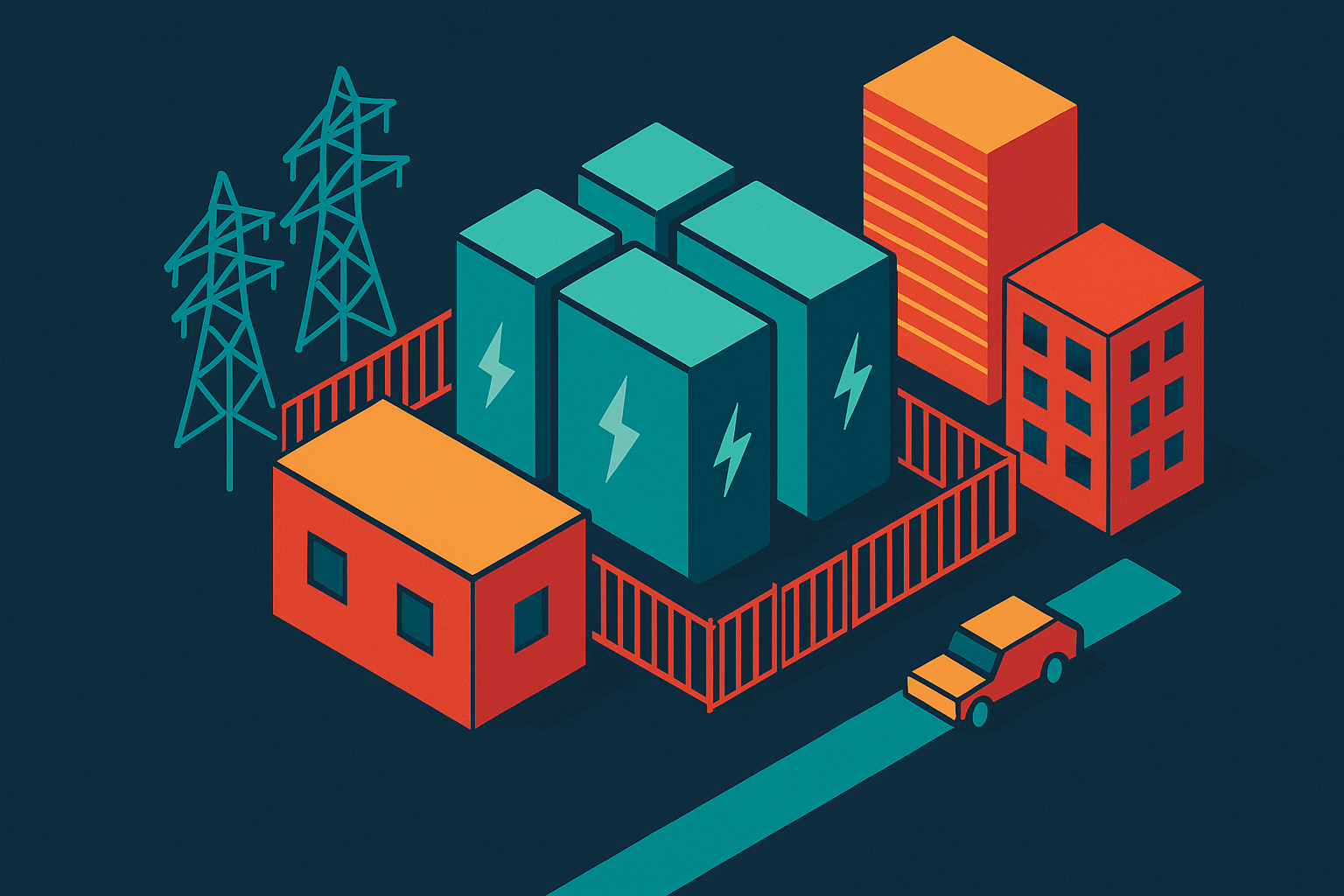
Cormorant Energy Storage Project sits on 11 acres just southwest of the Cow Palace in Daly City, a city of 100,000 people about 8 miles south of San Francisco. Arevon is developing it, and the battery hardware is 250 megawatts of Tesla Megapack containers, adding up to 250 MW and 1 gigawatt-hour of stored energy, with 4 hours of continuous discharge.
That siting choice is the whole story. This isn't a decommissioned power plant lot on the edge of town, and it isn't a stretch of scrubland with a substation nearby. It's an active urban neighborhood, with residential blocks close by and a venue (the Cow Palace) that's hosted events for generations. Every constraint described above, the setbacks, the fire code, the community engagement, applies here at full strength, not some discounted urban-adjacent version of it.
The offtake deal matters just as much as the hardware. Arevon locked in 15 years of power sales to MCE, one of California's largest community choice aggregators. That ties the project's output directly to the communities it sits among, rather than routing the value to a wholesale market three counties over.
Construction is underway as of May 2026, with the project expected online in 2027. When it's finished, Cormorant will be the largest battery storage facility located in a major urban area anywhere in the country. Every developer eyeing a similar site in a similar city is going to measure their project against this one, whether they say so out loud or not.
Other urban and near-urban projects that show where the pattern is heading
Los Angeles is already running this experiment at portfolio scale. GridStor picked up a set of projects in the greater LA area from Upstream Energy of San Diego, totaling over 500 MW and 2,000 MWh, with proposed online dates spread between 2024 and 2026. If large-city siting works anywhere, it has to work in the most land-constrained market in the country, and LA is where that's getting tested right now.
New York City took the municipal-ownership route. The city's Department of Citywide Administrative Services finished four battery projects on city-owned property, working with the New York Power Authority. Building on land the government already owns cuts out a big chunk of the siting fight before it starts. On top of that, Governor Hochul announced the state's first-ever competitive solicitation for bulk energy storage on July 28, 2025.
Tallahassee's Birmingham Street project runs $39 million, with a $28.7 million DOE grant and a $10.7 million match from the city covering the cost. The system delivers 10 to 25 megawatts, built with storm-hardening and automated switching baked in alongside the equity mission described earlier. It's proof that the smaller-city model can work when resilience and equity are the design brief from the start, not an afterthought bolted on for the press release.
Illinois is running the biggest bet of all: 3 gigawatts of new storage planned through a series of competitive procurements, split between 450 MW in central and southern Illinois (MISO territory) and 588 MW in northern Illinois under ComEd (PJM territory). Nobody's singled out Chicago specifically, but the largest metro area outside California and Texas now has a state-mandated pipeline aimed squarely at it, with the first procurement round due by late August 2026.
New Orleans' distributed model, the roughly 1,500 residential systems and up to 250 community-based systems mentioned earlier, runs on a $30 million program with procurement activity expected in 2026. And Cuyahoga County, covering Cleveland and Painesville, is taking a totally different route: a $129.4 million EPA award funding 10 MW of storage paired with about 63 MW of solar, built on reclaimed brownfield and landfill sites. Construction starts in late 2026, with full buildout running 2027 through 2028. Brownfield land carries less political baggage, sits closer to existing grid infrastructure, and comes with a redevelopment story that writes itself.
No single approach is winning. Municipal land, brownfield reuse, distributed residential networks, developer-contracted urban parcels, they're all live right now. The one thing every project shares is that the economics alone don't get it built. Something local has to carry the project across the finish line.
What the gap between urban storage need and urban storage supply still looks like
The national numbers keep climbing. Utility-scale storage hit 137 gigawatt-hours installed as of 2025, and Wood Mackenzie projects half a terawatt-hour more between 2026 and 2031, a 250% jump over the prior five-year stretch. By any measure, storage is having a moment.
The geography hasn't budged much though. Three specific states still hold roughly 80% of all units in the broader market. battery capacity, and the Northeast, the most densely populated part of the country, has built comparatively little. That's not purely a siting problem. It's a market structure problem too, and the two feed each other.
Urban developers are also stuck aiming at a target that keeps moving. NYC's rules only took effect in October 2025. Massachusetts applications don't open until July 2026. The EPA's first real federal guidance only came out in August 2025. None of this is settled law with a decade of precedent behind it, it's freshly poured concrete that hasn't fully cured.
Layer community benefit requirements on top, now formalized in Massachusetts, New York, and California alike, and every urban project is carrying more process and more cost than its rural counterpart, on top of land that already costs more to begin with.
Cormorant's 11 acres in a city of 100,000 is what it looks like when all those pieces land in the same place at once: the site, the safety case, the offtake deal, the community relationship. The open question for every other dense metro isn't whether battery storage can technically work in a city. It clearly can. The question is whether that same combination of ingredients can get assembled again, somewhere else, before the demand curve outruns the supply curve for good. The projects making progress right now, in Los Angeles, New York, Tallahassee, Chicago, New Orleans, Cleveland, all share one habit: they stopped trying to copy rural economics into a city lot, and built around whatever local reason gave the project enough political weight to survive contact with its neighbors.
Sources
- The largest urban battery facility
Provided key facts about the Cormorant project's location in a city of 100,000 people and its 4-hour discharge capacity.
- The grid storage industry set a wild goal for 2025 — and then crushed…
Provided the statistic that three states hold roughly 80% of all battery capacity.
- Battery storage projects surge as utilities prepare for next grid era in 2026
Provided the funding figures for Tallahassee's Birmingham Street project, including the total cost, DOE grant, and city match.
- https://www.canarymedia.com/articles/batteries/nations-largest-urban-battery-san-francisco
Provided details about the Cormorant project being the nation's largest urban battery facility and its location near the Cow Palace in Daly City.
- https://arevonenergy.com/news/releases/arevon-begins-construction-on-600-million-cormorant-energy-storage-project-in-california/
Provided details on Arevon's development of the Cormorant project, including the Tesla Megapack hardware and the 15-year MCE offtake agreement.
- https://www.epa.gov/electronics-batteries-management/battery-energy-storage-systems-main-considerations-safe
Provided information about the EPA's first federal safety guidance for battery projects covering their full lifecycle, published in August 2025.