Virtual Power Plants in US Utility Programs
Utilities deploy VPPs to meet surging demand faster than traditional power plants.
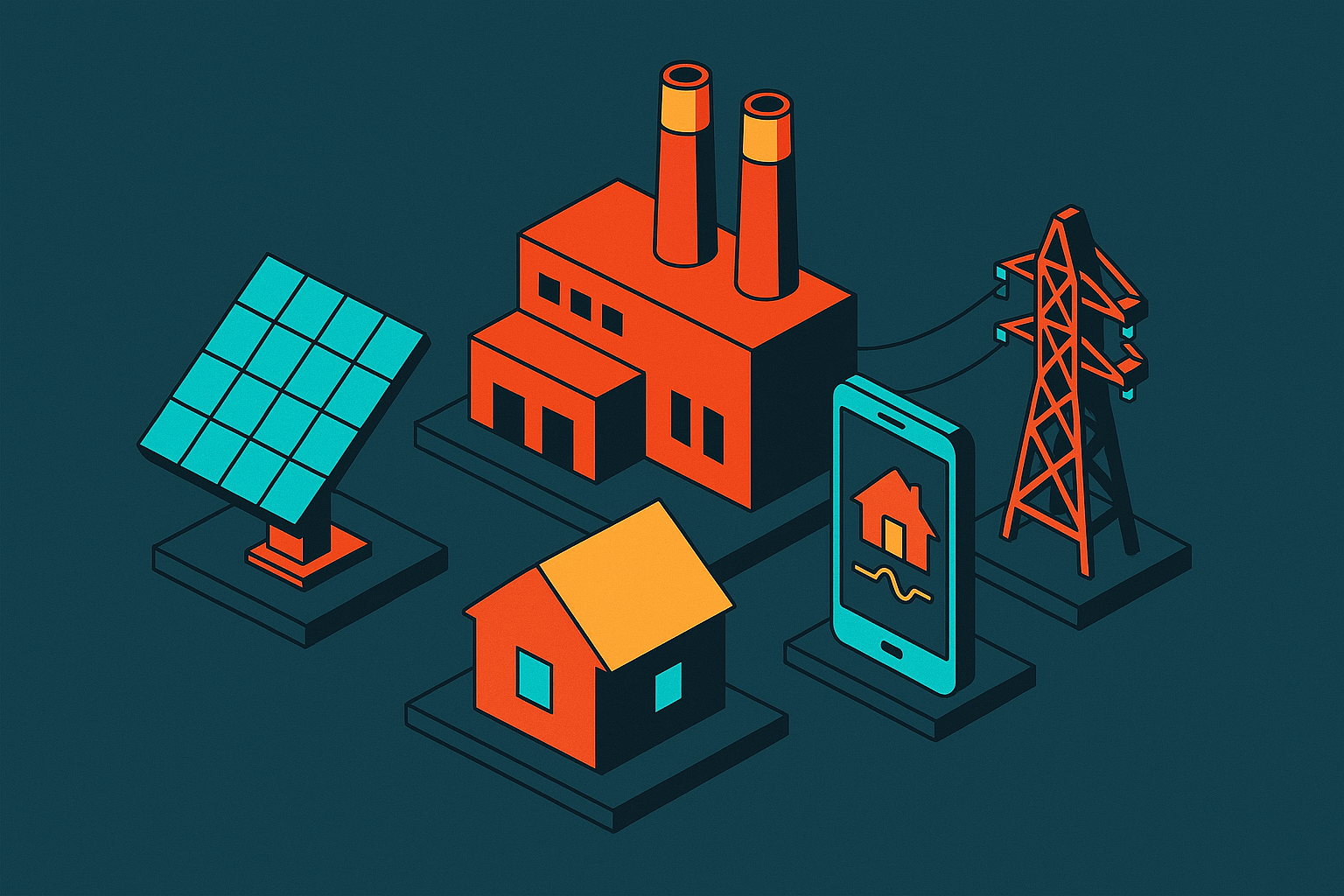
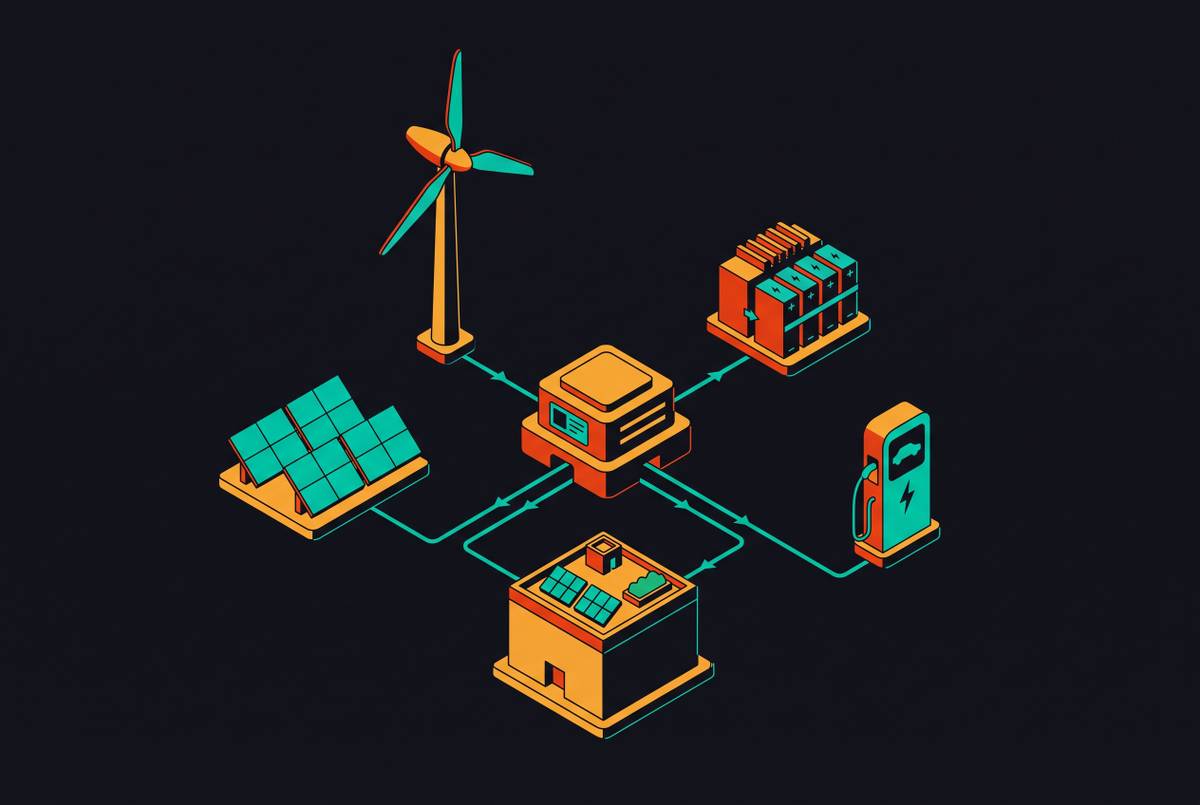
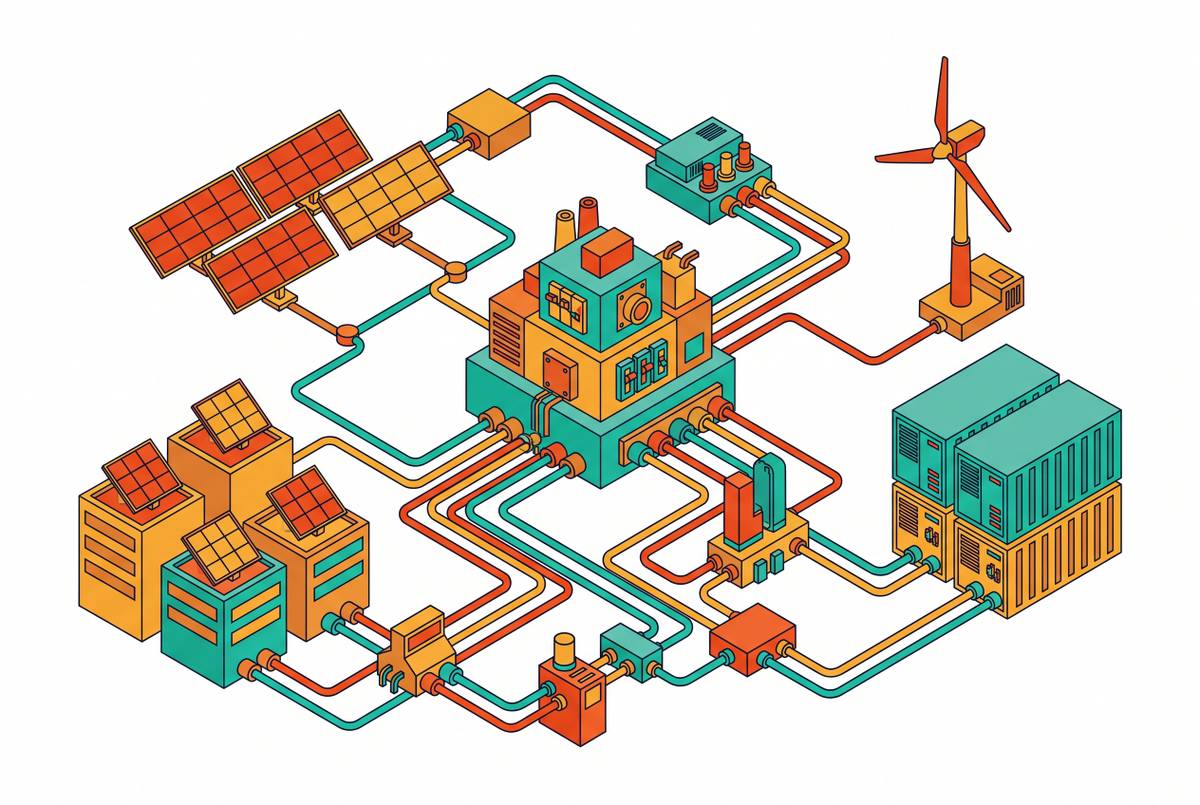
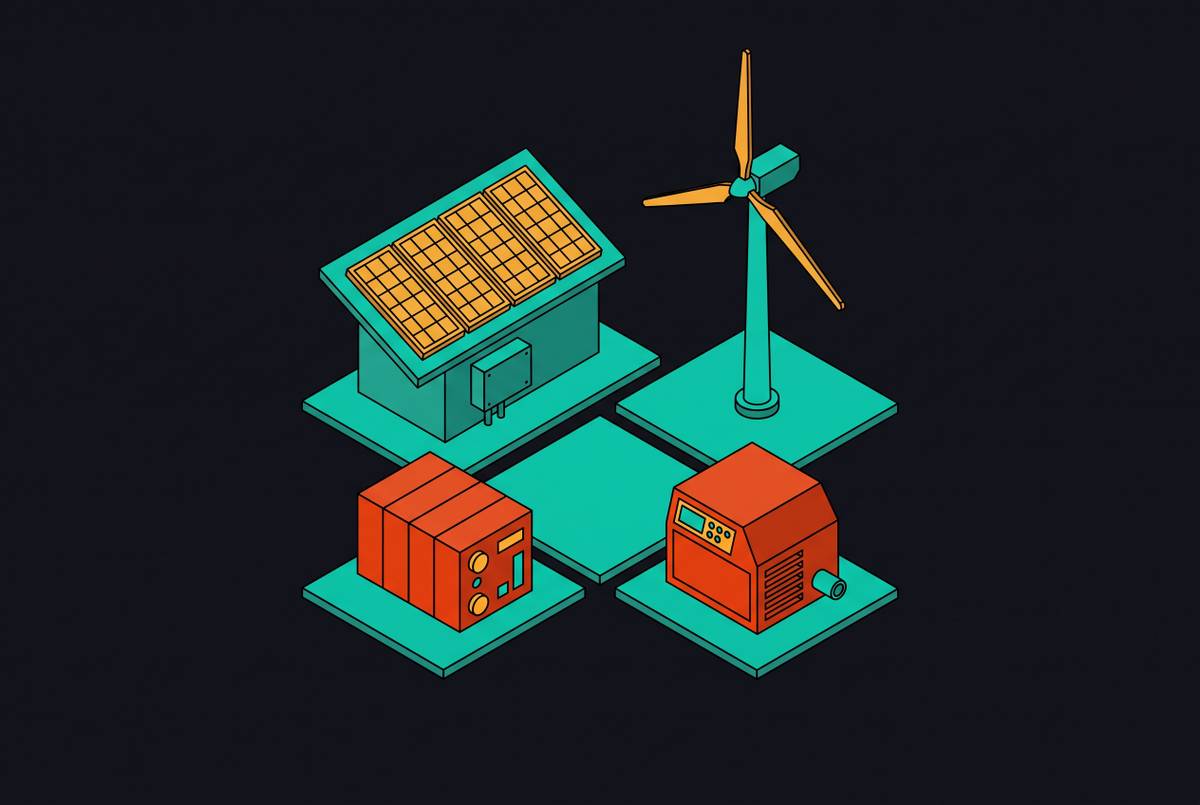
A virtual power plant takes a bunch of small energy resources scattered across houses and businesses (rooftop solar, home batteries, EV chargers, smart thermostats) and bundles them digitally so they act like one big power plant. Add in a factory willing to dial back its load for a couple hours, and you have the whole idea in one sentence. What's messier is what everyone calls it.
A federal agency calls it a "virtual power plant" in its 2025 Liftoff Report. NARUC, the group that represents state utility regulators, prefers "aggregated DERs," or ADERs. EPRI goes with "distributed energy resource aggregations," DERAs, because apparently three letters wasn't enough. Same concept, three acronyms, and each one reveals who's talking: DOE cares about deployment speed, NARUC cares about regulatory categories, EPRI cares about the technical aggregation itself. Expect all three terms in the wild, sometimes in the same sentence, describing the same battery sitting in someone's garage.
The resource mix matters too. Half of it is demand-side: thermostats that shift a few degrees during a heat wave, EV chargers that pause for twenty minutes, industrial plants that shed load on request. Supply and demand flexibility get bundled into the same dispatchable unit, and which one dominates a given program decides what services it can sell into the grid.
Why VPPs Are Strategically Urgent Right Now
Electricity demand in the US sat mostly flat for about twenty years. That era just ended. The 2025 DOE VPP Liftoff Report projects total demand growth of roughly 15 to 20% in the near term, driven by three forces landing at once: data centers, manufacturing moving back onshore, and vehicles going electric.
EV charging alone is projected to add 20 to 90 gigawatts of new demand capacity between 2025 and 2030, with EV batteries contributing 300 to 540 gigawatt-hours of storage potential over that stretch. That's a wide range, meaning forecasters don't agree on how fast this moves. But even the low end dumps a lot of new load onto a grid that spent two decades barely growing.
Supply can't keep up on the usual timeline. Gas turbine manufacturers are backlogged through the end of the decade. Solar and wind face transmission bottlenecks and permitting fights. Interconnection queues, the line utilities wait in to plug new generation into the grid, run years long. Building a new peaker plant the conventional way means committing years before it generates a single watt.
VPPs skip most of that wait. Per a July 2024 RMI report, utilities and grid operators can plan and deploy a new VPP within twelve months, compared to years for conventional generation.
Cost supports this further. VPPs deliver peak capacity at 40 to 60% lower cost than gas peaker plants or grid-scale battery storage. Lithium-ion battery costs dropped 14% during 2024, per Mordor Intelligence, which made storage-backed VPPs an easier sell to homeowners and businesses deciding whether a battery in the garage is worth the upfront cost.
FERC Order 2222 Fell Short on Wholesale Access
Back in September 2020, FERC issued Order 2222, telling regional grid operators (the ISOs and RTOs that run wholesale power markets) to knock down the barriers keeping aggregated DERs out of wholesale capacity, energy, and ancillary services markets. The goal was to let a bundle of home batteries compete on the same footing as a gas plant.
It didn't land that way. Ben Hertz-Shargel, Wood Mackenzie's Global Head of Grid Edge, said there's broad consensus among experienced wholesale market participants that Order 2222 "was a missed opportunity and will not have a significant impact on market access." The market's behavior since has supported that assessment. Wholesale access for aggregated DERs remains tangled in technical and administrative friction the order never actually cleared. As a result, state-level utility programs, not federal market participation, became the main road for VPP deployment in the US.
States Passed 211 VPP Actions in Two Years
2024 was the year state legislatures and regulators moved decisively on VPPs. Thirty-eight states plus a federal district took a combined 105 policy actions on VPPs and DER aggregations that year, according to the NC Clean Energy Technology Center and the Smart Electric Power Alliance. Ten states, including California, Texas, and Illinois, took four or more actions apiece, mostly on battery storage and multi-resource programs.
2025 maintained that pace. Thirty-five states and a federal district advanced VPP and DER policy, adding up to 106 actions, per a joint SEPA/NCCETC report. Early 2026 continued the trend: Massachusetts set a 3.5 gigawatt load-management target, and Minnesota approved a $430 million distributed battery program, both inside the first quarter.
By early 2026, 34 states have programs pushing utilities to tap smart thermostats, water heaters, batteries, EV chargers, and energy management systems. Another dozen, including Michigan, Minnesota, New Jersey, and Pennsylvania, are actively weighing new or expanded legislation. Colorado passed a law requiring utilities to develop actual VPP program proposals rather than just study the concept, and Virginia followed in May 2025, directing Dominion Energy to seek approval from the state corporation commission for a pilot covering up to 450 megawatts of DER aggregation.
Regulatory dockets are doing just as much work as legislation. The Illinois Commerce Commission opened a docket in July 2025 to weigh three new ComEd tariffs: Rider BYODLR, Rider VPP, and Rider CSS. In Colorado, Xcel Energy got a 125 megawatt VPP proposal approved by regulators following a legislative push. The consistent trend across states is a move past pilot investigations and into statewide frameworks, procurement targets, and programs built for long-term operation.
What Major US VPP Programs Look Like
Green Mountain Power in Vermont runs a utility-owned model built around 4,800 Powerwall units, adding up to 27 megawatts of collective capacity. It saved an estimated $3 million in peak electricity costs. Participants who bring their own device receive a rebate up to $10,500.
National Grid's ConnectedSolutions program in New England uses a pay-for-performance structure. It started as a pilot in Massachusetts in 2016, launched fully in 2019, and has grown to 227 megawatts across residential thermostats, home batteries, and commercial and industrial demand response. During a multi-day heat wave in June 2024, it shaved 375 megawatts off the New England grid, roughly the output of a mid-size power plant. Massachusetts utilities currently pay $275 per kilowatt through the program; Rhode Island Energy pays $225 with a five-year incentive lock. Powerwall enrollment jumped from 6,364 units (34 megawatts) in 2023 to more units in subsequent years.
California's Demand Side Grid Support program hit 1,145 megawatts as of October 2025, with 768 megawatts coming from its market-aware storage pilot alone. The program's funding was then cut during 2025 budget negotiations, demonstrating that scale does not guarantee political protection.
CPS Energy in Texas has run its VPP pilot for more than a decade, growing to more than 250 megawatts as of 2024 across 175,000 customers. That longevity shows a VPP can function as a normal part of grid operations rather than only as an emergency resource. NRG and Renew Home are pursuing a 1 gigawatt VPP target for 2035 built on smart thermostat participation in Texas, and have reached 150 megawatts as of 2025.
For context, the average US combustion gas turbine in 2024 ran about 180 megawatts, per RMI. ConnectedSolutions and California's DSGS program have both exceeded that threshold, making the label "grid-scale" arithmetically accurate for programs of that size.
The Gap Between 37 GW and 160 GW
North American VPP capacity grew 13.7% over the past year, reaching 37.5 gigawatts, according to a Wood Mackenzie analysis. Active company deployments, unique offtakers, and monetized programs each grew by at least a third year over year. Wood Mackenzie's assessment is that the market is "broadening faster than it is deepening," meaning new players and pilots are appearing while existing programs are not necessarily growing substantially.
The DOE's target, laid out in the 2025 Liftoff Report, is 80 to 160 gigawatts of VPP capacity by 2030. Hitting that would cover roughly 10 to 20% of peak demand and save an estimated $10 billion a year in grid costs. Measured against today's 37.5 gigawatts, the gap to even the low end of that range is enormous, and closing it depends on the policy momentum described above actually turning into deployed megawatts rather than filed dockets.
Independent analyses have found that scaling VPPs nationally could yield substantial cuts in resource adequacy costs alongside significant additional societal benefits. The economic case is established. What's missing is execution: treating VPPs as a standard resource adequacy tool in utility planning the same way a power plant or transmission upgrade would be.
Barriers Keeping VPPs Out of Utility Planning
VPPs mostly aren't appearing in utility integrated resource plans the way a new gas plant or transmission line does, and that gap persists despite all the policy activity described above. RMI's May 2026 analysis questions directly whether utilities have incorporated grid-scale VPPs into their planning processes. Reaching programs like Green Mountain Power's 27 megawatts of aggregated batteries requires deliberate design and procurement decisions.
Old-fashioned demand response still dominates the category, holding 47.7% of market share in 2025 per Grand View Research. A large share of what gets counted as "VPP capacity" today consists of basic demand response programs utilities have run for decades, reclassified under the VPP label without adding meaningful new flexibility or coordination.
There is also a financial incentive problem in how utilities earn returns. Utilities traditionally earn a return on capital spending. VPPs reduce the need for capital spending, which creates a direct conflict unless regulators build in performance-based incentives that reward utilities for deploying VPPs. Legislation in Maryland and Illinois is beginning to address this, but the approach has not yet spread across the national regulatory landscape.
Customer enrollment is its own challenge. Green Mountain Power's $10,500 rebate shows what it takes to get a homeowner to enroll their battery in a VPP program, and no program has demonstrated that kind of enrollment scales to an 80 to 160 gigawatt national target at any price point.
Funding stability is not guaranteed even for proven programs. California's DSGS program reached 1,145 megawatts and still had its funding cut in 2025 budget negotiations.
Software-defined VPPs are expected to grow faster than any other segment over the next decade, primarily because software-based coordination scales without requiring physical installation at every participating site. The policy foundation is largely in place, the economics are established, and programs like ConnectedSolutions and California's DSGS have demonstrated that VPPs can operate at real scale. The remaining challenge is getting VPPs treated as a standard line item in utility planning alongside power plants and transmission upgrades.