Urban Data Platforms and Open Data Standards for Smart Cities
Open standards force cities to share data instead of locking it away behind expensive vendor gates.
What an urban data platform is and what it does
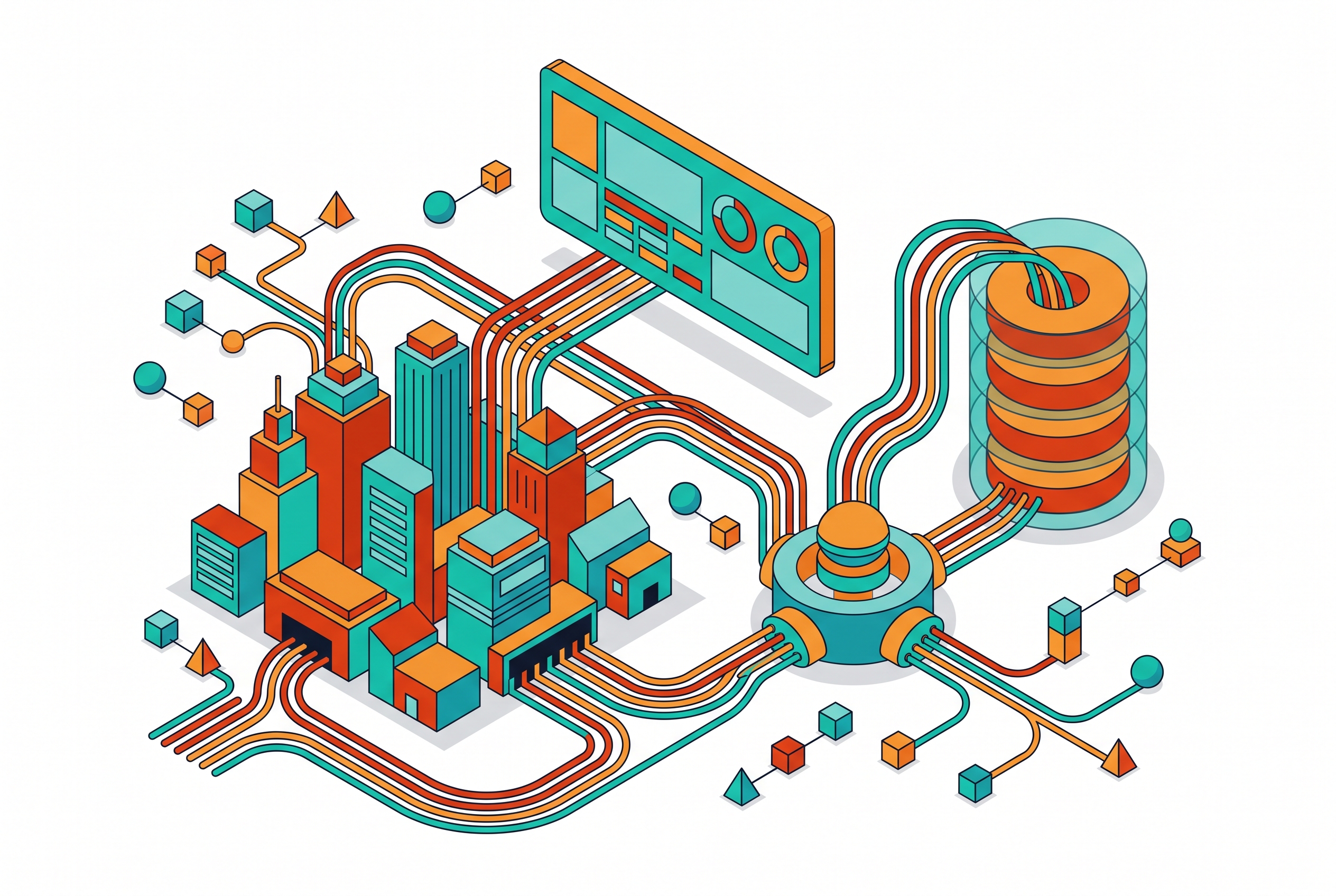
Strip away the buzzwords: a UDP is a digital switchboard. It pulls data in from a pile of unrelated sources, cleans it up enough to be useful, and puts it somewhere people can actually see it and act on it. Not the muscle doing the work, and not the brain making the call. It's the connective tissue that lets muscle and brain talk to each other without a translator standing in the middle.
Practically, a UDP absorbs data flows using open source tools or open standards, across a wide range of city sectors. It plugs into private systems (a utility company's sensor network, say) and public ones (a transit authority's location-tracking feeds) at the same time. What flows through it is deliberately messy: underground pipe networks, air quality sensors, traffic density counts, social media chatter, and whatever else a city decides is worth measuring. None of that data was built to talk to any of the other data. The platform is what forces them to coexist anyway.
Four things a UDP has to deliver, or it isn't earning its budget line:
- Cross-sector collaboration, so the transit department and the utilities department stop working off separate maps of the same streets
- Governance transparency, so decisions made with public data can be traced and challenged
- Data-driven decision-making, swapping gut calls for something closer to evidence
- Sustainable, resilient development, because a city that can see its own strain points can plan around them instead of scrambling after the fact
Why open standards are the difference between a platform and a silo
Cities have historically stored smart city data in silos: traffic data in one system, utility data in another, neither one aware the other exists. Cities have historically stored smart city data in silos: traffic data in one system, utility data in another, neither one aware the other exists. Bolt a UDP on top of that arrangement without open standards, and all you've built is an expensive window that lets you look at two silos side by side instead of one. Bolting a UDP on top of that arrangement without open standards does not produce integration; it produces an expensive window that lets you look at two silos side by side instead of one. That's a nicer view of the same problem.
Open standards are what actually break the pattern, and cities rarely reach for them first. Research found that 70% of surveyed cities that had adopted urban data platforms use open standards to further develop them. The pattern is clear: open standards and platforms go hand in hand. Cities didn't sit down and pick a framework in a vacuum; the two reinforce each other in practice.
Skipping that step has a name: vendor lock-in. Legacy enterprise software vendors have, for years, walled off municipal data inside proprietary systems and then charged eye-watering fees to let cities pull their own information back out. That data belonged to the public the whole time. The vendor just happened to be sitting on the key, charging rent for access to something that was never really theirs.
That is why 2026 procurement contracts read differently. Municipal CIOs are writing API-first architecture and open data standards directly into new contracts as a requirement. That's the actual mechanism that dents legacy monopolies. Not asking nicely. Making openness a condition of getting paid, full stop.
The main open standards in use and what each one handles
FIWARE is the name that comes up most, and it earns the attention. It's an open-source framework built specifically for constructing UDPs, and its core interoperability engine is a specification called NGSI-LD, paired with the FIWARE NGSI API. Any application that speaks NGSI-LD can plug into any platform built on that same framework, no custom bridge required, no vendor standing at the toll booth collecting fees for the privilege of connecting two systems that should talk anyway.
FIWARE breaks into components a city can adopt piece by piece:
- Orion Context Broker, managing real-time context data
- IoT Agents, translating device-specific protocols into the common format
- Cygnus and Draco, handling data persistence
- Keyrock and Wilma, covering identity and access
- Wirecloud and Knowage, running dashboards and analytics
- Quantum Leap, storing time-series data
A city doesn't have to swallow the whole stack on day one. Start with the Context Broker and IoT Agents, get traffic sensors talking to each other, and bolt on analytics later, once the plumbing works.
On top of that sits FIWARE Smart Data Models: standardized schemas for environment, mobility, buildings, waste management, energy, water, agriculture, manufacturing, and more. The value is not merely decorative: it is what allows datasets from different cities to be compared directly. If Barcelona and Helsinki use the same schema for "air quality reading," a researcher can compare the two cities directly, instead of losing three weeks to data-wrangling first.
The scale isn't small, either. FIWARE runs in more than 400 cities across at least 35 countries, backed by a membership base of over 630 organizations spanning 64 countries.
Governance barriers that standards alone cannot fix
Standards solve the technical half of the problem. They solve none of the operational and governance work required to sustain that integration, and that work is harder.
The OECD points to five structural barriers that survive even after a city adopts open standards: not enough money to sustain the platform long term, no clear business model for who actually collects and maintains the data, a shortage of skilled people to run any of it, gaps between local practice and national data protection law, and plain old security risk. No API specification fixes any of that. Budgeting, hiring, and legal work fix it, if anything does, and none of those three have much to do with software architecture.
The trust gap is not hypothetical. Even technically ambitious city data projects have drawn criticism for opacity, with citizens unable to clearly tell how their data was being processed or stored. A city with serious technical capability can still run headfirst into a legitimacy problem. Competence and trust are not the same currency, and one doesn't buy the other.
Some cities have leaned on privacy-by-design fixes: de-identifying data before storage, encrypting it, running differential privacy techniques that blur individual records while keeping the aggregate patterns intact. These help. But no common national standard governs how consent and ethics actually get built into city governance policy, so every city is more or less improvising its own answer, alone, on a deadline, with a public watching.
Digital twins as the point where platforms, standards, and governance converge under pressure
A digital twin needs real-time data flowing in constantly. It needs that data interoperable across sectors, needs 3D spatial standards to render anything meaningful, and needs privacy protections baked in from the start, all at once, with no room to fake it. If the platform has a gap or the standards layer has a hole, a digital twin finds it immediately. There's no hiding a weak link when the job is simulating an entire city in real time.
The payoff, when it works, earns its complexity. Feeding historical and live traffic data into an AI-driven digital twin lets planners simulate what happens if they close a lane or add a bike path, before a single cone goes down on the street. Guesswork gets replaced with something closer to a rehearsal, run in software instead of on live traffic.
Virtual Singapore and Helsinki's 3D model are the confirmed examples of this working at scale. The broader pattern holds: ambition and legitimacy don't automatically travel together, and a city can build something genuinely impressive while still losing the public's trust in how it's run.
Data management tooling is the unglamorous plumbing that makes the rest of the system function. It keeps complex, non-traditional datasets organized in a standardized way and keeps real-time information moving to whoever needs to see it. Nobody puts data pipeline tooling in a press release. But that unglamorous work is the reason the flashy 3D visualization on top has real data underneath it, instead of a rendering that just looks convincing and falls apart under questioning.
What cities and their technology partners should evaluate when choosing a platform and standards approach
Architecture comes first, and modular is the only acceptable answer. A platform that separates data ingestion from processing, storage, and presentation lets a city adopt pieces incrementally instead of signing an all-or-nothing commitment on day one. FIWARE's component structure is the clearest working example of this. Any vendor that demands a package deal with no exit ramp is not selling a platform, it's selling a lease with extra steps.
Procurement language matters just as much as architecture, maybe more, because that's where lock-in actually gets prevented or quietly permitted. Mandating API-first design and open data standards as contract terms, not nice-to-haves, is what stops a city from landing in the same trap legacy vendors spent decades building. Treating this as a technical decision only leaves the city back in the same silo in five years, just with a fresher coat of paint on it.
Security deserves equal scrutiny, and the question is specific: is privacy-law-grade compliance, role-based access control, and data anonymization built into the architecture from the ground up, or bolted on as an add-on module that costs extra and gets cut the first time the budget tightens? Whether those protections are designed in or added by request decides what happens exactly when it matters most, which tends to be the worst possible moment to find out.
Domain coverage closes the list. Does the platform ship with standardized schemas for the sectors a city actually cares about (mobility, energy, water, waste, buildings, air quality), or does connecting each new system require custom integration work, again, every single time a new sensor network is added? A platform that needs bespoke engineering for every new data source hasn't eliminated the separation between unconnected systems. It's just built a nicer-looking silo, and charged for the paint job.
Sources
- Smart City Data Governance | OECD
Provided the five structural governance barriers (funding, business models, skills, legal gaps, security) that the article attributes directly to the OECD.
- The Benefits of Urban Data Platforms for Smart City Development
Supplied the statistic that 70% of surveyed cities adopting urban data platforms use open standards to further develop them.
- https://smartdatamodels.org/
Informed the description of FIWARE Smart Data Models and the standardized schemas covering environment, mobility, buildings, waste, energy, water, agriculture, and manufacturing.
- https://eurocities.eu/latest/helping-cities-make-better-decisions-with-digital-twins/
Supported the discussion of digital twins helping city planners simulate outcomes (such as lane closures or bike paths) before implementation, with Helsinki cited as a confirmed example.
- https://oascities.org/fiware-foundation-and-oasc-strengthen-ties-to-drive-open-standards-and-innovation-in-cities-and-regions/
Supported the figures on FIWARE's deployment scale — more than 400 cities, at least 35 countries, and over 630 member organizations across 64 countries.