IoT Architecture in Smart Buildings
Connecting billions of sensors requires solving layer-by-layer architectural complexity.
Smart buildings are not a feature. They are infrastructure. A building whose HVAC, lighting, access control, and energy systems are connected, monitored, and partially automated through IoT is a fundamentally different kind of asset than one that isn't. By 2030, the connected device count inside commercial smart buildings is expected to hit 4.12 billion. That's not a gadget story. That's an architectural complexity story — like trying to choreograph a city's worth of dancers who have never met, using a rulebook written in four different languages.
The stakes go beyond efficiency gains. Buildings and construction account for 32% of global energy consumption and 34% of global CO2 emissions, according to the UNEP/GlobalABC 2024/2025 Global Status Report. A poorly designed smart building isn't just a missed business opportunity. It's a missed climate opportunity.
What actually determines whether a smart building deployment succeeds or quietly falls apart: how its IoT layers are designed and how they connect to each other.
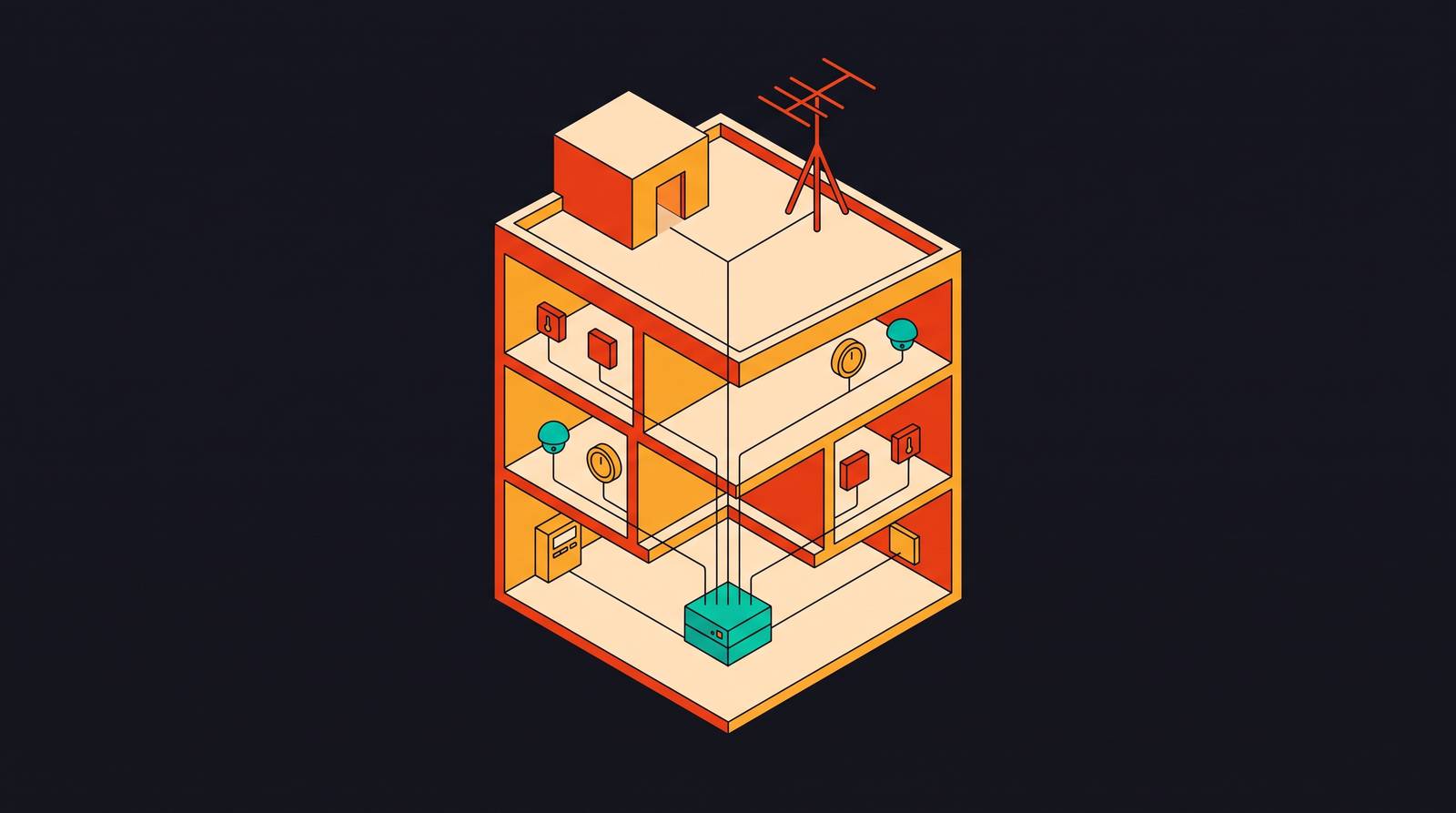
Four layers. Each one depends on the layer below and feeds the layer above. Pull out one and the whole structure underperforms.
Layer 1. Perception. Physical sensors and actuators. Temperature, motion, humidity, occupancy, air quality. Raw data is born here. These devices run on limited processing power, limited memory, and limited energy, and those constraints matter more than most people expect.
Layer 2. Connectivity. The protocols and networks that move data off devices and toward somewhere useful. This is where fragmentation lives, loudly.
Layer 3. Processing. Edge and cloud computing. Raw data becomes something actionable here. Where that processing happens is a design decision, not a default setting.
Layer 4. Application and Integration. The software platforms, dashboards, and APIs that translate processed data into building operations and business decisions. Value is either captured or quietly lost here.
There is a five-layer academic model that adds a Business layer on top. Useful context, but the four-layer version is the practical working model for real deployments.
One failure pattern worth knowing upfront: most smart building breakdowns don't happen within a single layer. They happen at the handoff between layers. Keep that in mind as you read the rest of this.
What the perception layer actually measures and why sensor choice shapes everything downstream
Sensors are the foundation. If the foundation is wrong, nothing above it fixes the problem.
The core sensor categories in any commercial building deployment:
Occupancy. PIR sensors, ultrasonic sensors, CO2 as a proxy. Tells the building whether people are in a space.
Environmental. Temperature, humidity, air quality, light levels. Tells the building what conditions are like.
Energy. Sub-metering, smart meters. Tells the building what's consuming power and how much.
Access and security. Door contacts, cameras, biometric readers. Tells the building who is where and when.
Sensors observe. Actuators respond. Smart valves, dampers, relays, dimmers. These are the output side of the perception layer and just as important as the sensors feeding them.
Here's the thing that catches people off guard. Sensors need to be low-power and low-cost to deploy at scale. But those constraints limit local intelligence. A building with hundreds of cheap sensors produces more noise and calibration burden than a smaller fleet of smarter devices. You're not just buying hardware. You're committing to a maintenance relationship.
Placement and density decisions made at this layer propagate upward into every other layer. A sparsely sensored floor cannot produce reliable occupancy analytics at the application layer, regardless of how sophisticated the software sitting on top of it is. The software cannot invent data that was never collected.
HVAC is the clearest example of this playing out. Occupancy sensors feed demand-controlled ventilation schedules. Without accurate occupancy data, the energy savings promised at the application layer don't materialize. Buildings account for 76% of U.S. electricity use, so even marginal improvements in sensor-driven control have significant absolute impact. That makes sensor quality a financial decision, not just a technical one.
Bad sensors don't just limit what a system knows, they actively mislead it. A system that's confidently wrong is harder to fix than one that's clearly broken. I've seen expensive analytics platforms produce garbage recommendations because someone underspecified occupancy sensors on a floor that turned out to be the most variable space in the building. The software wasn't broken. The data feeding it was. It's a reminder that in smart buildings, the most important thing you can do is sense the room — literally.
How connectivity protocols move data — and where the fragmentation problem enters the stack
A smart building has two distinct connectivity domains, and conflating them causes real problems.
Domain 1: Device-level network. Sensor to gateway. The short hop from the thing measuring something to the protocol gateway collecting it.
Domain 2: Building-level network. Gateway to platform. The longer journey from collected data to somewhere useful.
At the device level, you'll encounter:
ZigBee. Mesh, low-power, widely deployed in lighting and HVAC control.
Z-Wave and Thread. Similar use cases, each with its own adoption profile.
Matter. The emerging cross-vendor standard backed by Amazon, Apple, Google, and the ZigBee Alliance. IP-based, designed for local interoperability. This is where the industry is heading.
At the building level, the dominant protocols are:
BACnet (ASHRAE 135). The standard for building automation. Still the most widely deployed. Updated as recently as October 2024. If you're doing commercial building work, you will live in BACnet.
Modbus. Legacy, but pervasive in industrial controllers. Older buildings are full of it.
KNX. Common in Europe, both wired and wireless.
OPC UA. Industrial data exchange, increasingly bridged to BACnet as building OT and enterprise IT converge.
Above the transport layer, MQTT sits as an application-layer messaging protocol. Lightweight, publish/subscribe, designed for constrained networks. It's how a lot of data gets to cloud platforms.
Now for the fragmentation reality. A Siemens controller managing HVAC on one floor and a Johnson Controls system handling lighting on another isn't an edge case. It's a common scenario. BACnet/IP became a standard bridge, but proprietary packet wrapping still blocks cross-system data access in practice. Systems that technically share a protocol still can't talk to each other. Your HVAC data is sitting right there. The lighting system doesn't know it exists and can't do anything with it even if it did. Think of it as two neighbors who speak the same language but refuse to open their front doors — technically capable of communication, practically sealed off from each other.
Open standards versus vendor lock-in is not a philosophical debate. Without open standards, devices operate in silos. Proprietary ecosystems make integration expensive and fragile, and they leave building operators dependent on a single vendor's upgrade schedule. Standards like BACnet-to-OPC UA mapping already exist, which signals where convergence is heading. But the installed base of legacy, proprietary systems isn't going anywhere quickly.
Edge vs. cloud processing and why the split is a design decision, not a default
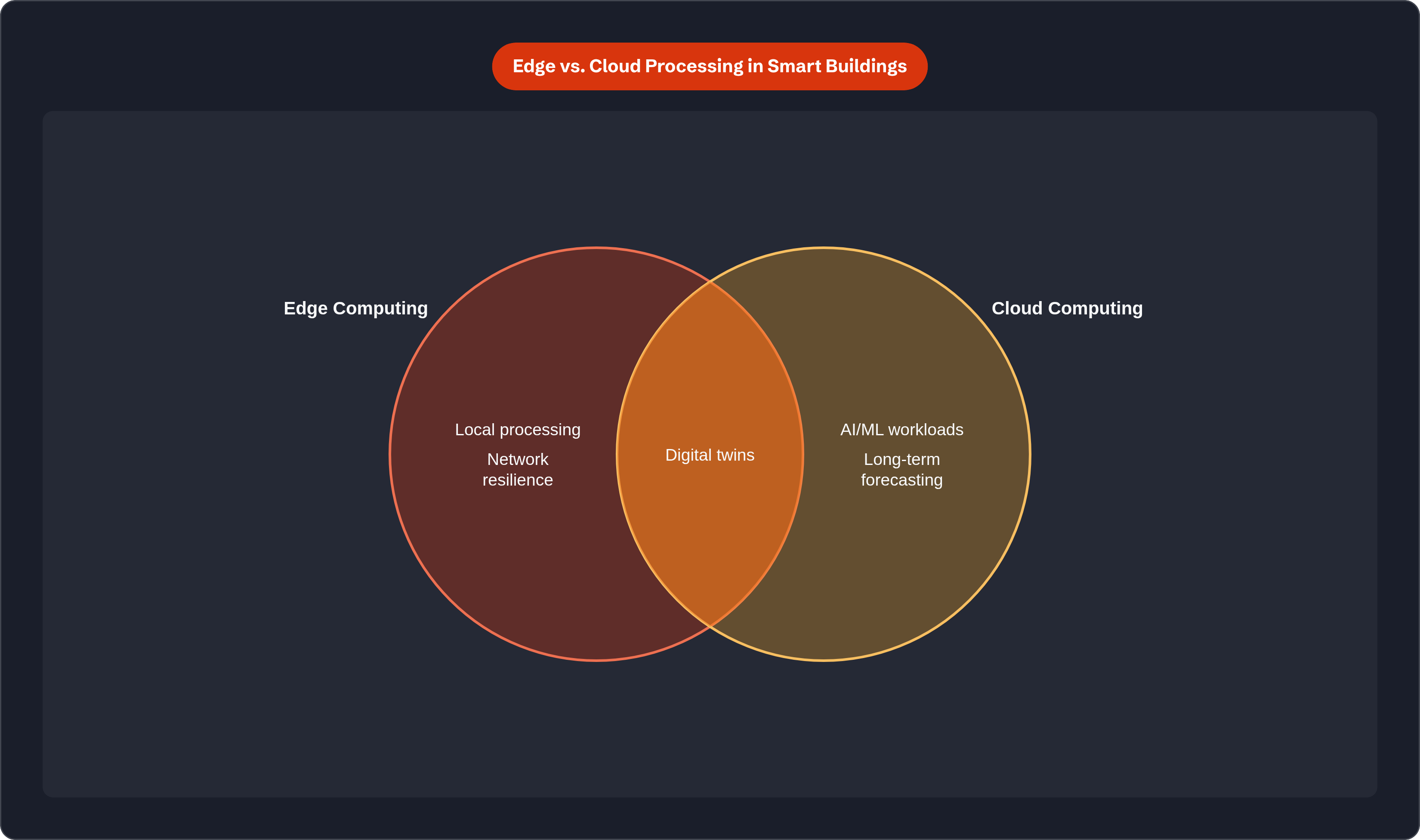
People often treat edge and cloud as competing options. They aren't. They're a division of labor. The question isn't which one to use. The question is which decisions belong where.
Edge computing means processing happens at or near the device: a gateway, a local server, an embedded controller. It reduces latency, limits bandwidth consumption, keeps sensitive data local, and lets the building keep functioning during network outages.
Cloud computing means centralized storage and analytics. It enables cross-building comparisons, long-term trend modeling, and AI and machine learning workloads that need large datasets to function.
The practical split:
Time-critical responses (fire suppression, access control lockdown, fault detection and diagnostics in HVAC) belong at the edge. Waiting for a round-trip to the cloud to decide whether to unlock a door is not a viable architecture.
Pattern recognition, energy forecasting, and portfolio-level reporting belong in the cloud. These workloads need history and context that no single edge node has.
What makes this split functional is **IT/OT convergence**. OT data (sensors, controllers, PLCs) historically stayed local and isolated. Modern building IoT platforms pull it into IT infrastructure for unified monitoring and optimization. That shift required protocol translation and security rearchitecting simultaneously. It wasn't easy, and a lot of deployments got it wrong the first time. Some are still getting it wrong.
A 2024 systematic review found that IoT technology can reduce energy consumption by as much as 30% and operating expenses by 20%. Those gains are only reachable when edge and cloud work together. Local control loops handle the millisecond decisions. Cloud optimization handles the long-horizon learning. You need both, and someone needs to make a conscious decision about where the boundary sits.
The question that cuts through most architecture debates: which decisions need to happen in under a second, and which can tolerate a round-trip to the cloud? Answer that honestly. Your processing logic has a home.
Digital twins and predictive maintenance as the application layer's most demanding workloads
A **digital twin**, in building terms, is a continuously updated virtual model of a building's physical systems, fed by real-time sensor data flowing up through the layers below. It's not a dashboard. It's a simulation environment running on live data.
What digital twins enable that static dashboards can't:
Simulation before action. Model a proposed HVAC upgrade's effect on airflow and energy before touching a single duct.
Scenario planning. Test how the building responds to different occupancy patterns or weather conditions.
Wear-pattern modeling. Track component degradation over time and schedule maintenance before something fails.
That last one is the dominant use case, and the concentration is not a coincidence. A 2025 systematic review found that the vast majority of surveyed cases of AI-enhanced digital twin applications in maintenance focused on predictive maintenance. The financial case is straightforward: emergency repairs cost more than planned ones, and downtime is expensive. Any operator who has dealt with a chiller going down in July already knows this. It's a very bad day. Everyone in the building knows it too.
Johnson Controls' OpenBlue platform has documented meaningful energy savings at client sites. That gives you a concrete benchmark against the 30% theoretical ceiling. The gap between those numbers is an integration and data quality problem, not a technology problem.
Digital twins are also being applied to net-zero energy building goals. The idea is to run continuous sensor streams through the model, forecast energy consumption, and close the gap between what the building was designed to do and what it's actually doing. That gap is often larger than anyone wants to admit.
The dependency worth being honest about: a digital twin is only as accurate as the sensor data and connectivity infrastructure feeding it. A building with siloed protocols or sparse sensor coverage produces a degraded twin. Garbage in, garbage out applies here with real consequences.
Security and access control as a system-wide concern, not a layer-specific feature
Security in a smart building is not a product you buy for the application layer. It's a property of the entire stack. Every layer introduces its own attack surface.
Perception layer. Sensor spoofing and physical tampering. A motion sensor that can be fooled breaks occupancy logic downstream.
Connectivity layer. Protocol vulnerabilities, unencrypted data in transit without TLS, man-in-the-middle attacks on BACnet or MQTT traffic.
Processing layer. Unauthorized access to edge nodes or local servers.
Application layer. Data breaches, API exposure, credential theft.
IT/OT convergence expanded this attack surface in a way that was architecturally necessary but created real new risks. Controllers and PLCs that were previously air-gapped and physically isolated are now networked. That's required for smart building functionality. It's also a vector that didn't exist before.
North America held over 35% of the smart building market revenue share in 2025, driven in part by AI-enabled access control, biometric authentication, video surveillance, and integrated cybersecurity solutions. Building operators are not ignoring security. They are actively spending on it.
You cannot bolt security onto a finished architecture. Design it into each layer's protocol choices, data handling, network segmentation, and authentication mechanisms from the start. The biometric and AI-enabled access control systems now common in commercial buildings generate continuous identity and movement data flowing through every layer of the stack. Their security depends on the integrity of the full chain, not just the camera at the door.
Where smart building implementations actually break down
The most common failure pattern is not a spectacular system crash. It's quiet, slow dysfunction. Each system works fine in isolation. The building as a whole doesn't. HVAC, lighting, access control, and energy management are running on separate platforms with no shared data layer. The building is instrumented. It is not integrated. Those are not the same thing, and the sales process rarely makes that distinction clearly.
Protocol fragmentation is usually the structural cause. Proprietary wrapping, legacy Modbus devices that can't speak BACnet, vendor ecosystems that resist open-standard integration. This is a connectivity layer problem, but it surfaces as an application layer failure. By the time operators notice it, it looks like a software problem. It isn't.
Integration maintenance is the hidden cost. Even when initial integrations are built, API changes, firmware updates, and protocol version shifts break them. Keeping dozens of device-to-platform connections current across a building management system is an ongoing engineering effort that gets consistently underestimated at project outset. The building keeps changing. The integrations have to keep up.
Data quality degradation happens quietly over time. Sensors drift. They fail. They go unmaintained. Digital twins and analytics models built on stale or noisy data produce recommendations that erode operator trust. This is where alert fatigue in building management systems comes from. The system cries wolf enough times and operators stop listening. Once that trust is gone, it's very hard to get back.
The skills gap is real and not getting solved by technology alone. Building operators are not software engineers. IT teams are not OT specialists. Implementations that require ongoing custom integration work between those two domains stall or get abandoned. The people who know the building don't know the code. The people who know the code don't know the building.
Data integration, analytics, and software is the largest and fastest-growing Building IoT category. Integration infrastructure quality is increasingly what separates a functioning smart building from an expensive pilot.
How managed integration infrastructure changes the economics of connecting building systems
The core problem is straightforward. Building IoT platforms need to connect to dozens of third-party APIs: HVAC vendors, energy management software, access control systems, analytics platforms. And they need to keep those connections current as APIs change, which they do, constantly and without much warning.
Pre-built connectors reduce the time to connect a new system from a months-long custom engineering effort to days. That directly addresses both the skills gap and the protocol fragmentation problem at the application-integration layer.
Unified authentication and managed workflows matter because building operators are adding and replacing systems continuously. Without managed auth, every new vendor relationship triggers a new security review and a new integration project. Multiply that across a portfolio of buildings and the overhead becomes the job.
Letterbrace provides pre-built connectors and unified auth across building systems, which cuts down the custom integration work that typically extends project timelines when BACnet controllers need to feed data to cloud dashboards or third-party analytics platforms. It's built for teams developing software on top of smart building infrastructure who need to embed third-party APIs without owning the maintenance burden of keeping each connector current.
The operational argument is simple. If the stack below (sensors, protocols, edge and cloud processing) is generating reliable data, the application layer's value depends entirely on whether that data can flow cleanly into the software that acts on it. Integration infrastructure is the last-mile problem. Not glamorous. Also not optional.
The Building IoT platform market is projected to grow from $64.1 billion in 2024 to $101.0 billion by 2030. The investment flowing into the layers below creates real pressure on integration quality at the top. Reliable data with nowhere clean to go is still a broken system.
What a well-architected smart building looks like end to end
Let's walk through what it actually looks like when it works.
Occupancy sensors detect activity on a floor. Edge controllers adjust HVAC in real time. That same data streams to a cloud platform running energy optimization models. The outputs integrate with facility management software and feed a digital twin that flags a failing chiller valve two weeks before it would have caused a shutdown. Maintenance gets scheduled. The failure never happens. The energy bill goes down. The occupants are comfortable and have no idea any of this is occurring. That's the goal — and when the whole stack hums along like that, it's less like a collection of systems and more like a building that has quietly learned to take care of itself.
The architectural markers of a well-designed system:
Open protocols at the connectivity layer. No proprietary walls blocking cross-system data flow.
Clear edge/cloud responsibility boundaries at the processing layer. Someone made conscious decisions about what lives where and why.
Standardized APIs and managed connectors at the application layer. New systems can be added without rebuilding the integration from scratch.
Security designed into each transition point. Not added after the fact.
The 30% energy reduction figure from the 2024 MDPI Buildings systematic review requires sensor accuracy, reliable connectivity, responsive control logic, and application-layer optimization all working together. Take out any one layer and you get a fraction of the result. The sustainability payoff only materializes through the full stack.
Use the layer model as a diagnostic tool, not just a design framework. When a smart building underperforms, tracing the failure to its layer is faster and more productive than treating the system as a black box. Most of the time, the problem was introduced somewhere specific. Find the layer.
The AI in smart buildings sub-segment was valued at $13.4 billion in 2024 and is projected to grow at a 21.58% CAGR. Those AI workloads at the application layer are only as good as the data infrastructure below them. The algorithm is downstream of the sensor, the protocol, and the integration. In that order.