Smart Building Technologies Overview for Developers
Building integration requires connecting incompatible systems that predate the internet itself.
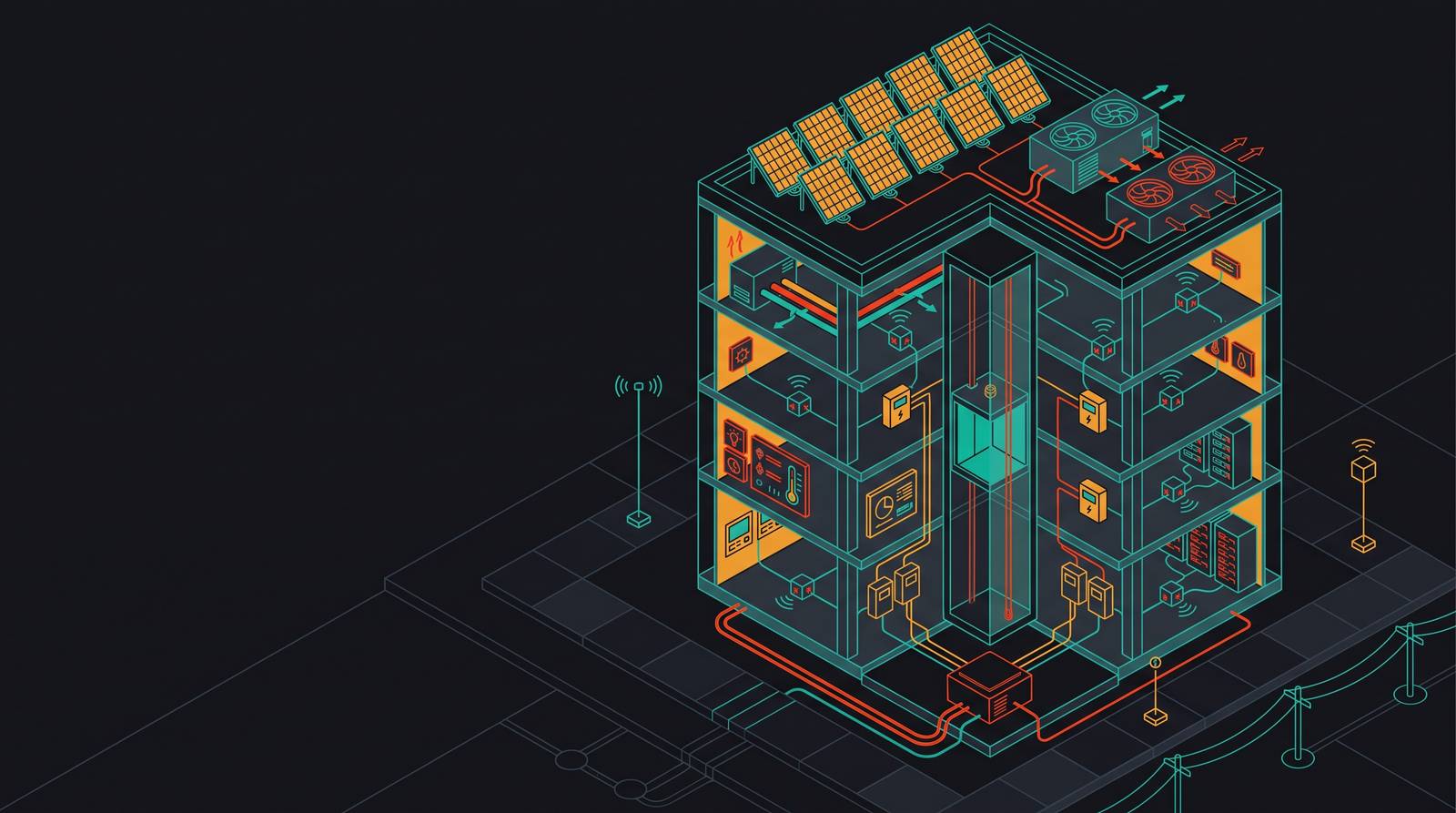
Smart buildings are an integration problem, not a product category. A building becomes "smart" the moment its independent subsystems stop operating in isolation and start sharing data with each other and with the software sitting on top of them. Until that happens, you just have a building full of expensive hardware that doesn't talk.
That distinction defines what developers actually do in this space. The work is connecting systems designed by different industries, under different assumptions, with completely different ideas about what "interoperability" means. Then keeping those connections alive as the building changes around you.
Most projects involve some combination of six subsystem categories. Knowing what each exposes saves a lot of confusion early on.
HVAC and building automation — the largest chunk of the market. Managed through a Building Automation System (BAS), it exposes setpoints, sensor readings, schedules, and fault codes. Most likely to already have an established protocol interface when you arrive.
Lighting control — often managed through the same BAS, sometimes not. High-return integration target due to energy spend. Exposes zone state, occupancy triggers, and dimming levels.
Access control and physical security — badge readers, door controllers, cameras. Historically siloed, but newer deployments are IP-native and REST-accessible. Primary data surface is an event stream: entries, exits, anomaly alerts.
Occupancy and environmental sensors — the raw signal layer. Data is high-frequency and only useful when correlated with something else. A CO2 spike crossed with HVAC state and occupancy schedule becomes actionable. In isolation, it's noise.
Energy metering and demand response — smart meters, EV charging, grid-interactive controls, and metering data required for LEED and ESG reporting workflows.
Fire and life safety — heavily regulated, often air-gapped or read-only. You will almost certainly not be writing commands to a fire suppression system. Understand it as a constraint that imposes hard limits on what other systems can do autonomously.
The Protocols That Make (or Break) Everything
Building systems do not speak HTTP by default. Most predate the modern internet entirely. The protocols they use were designed for reliability on closed networks, not developer ergonomics.
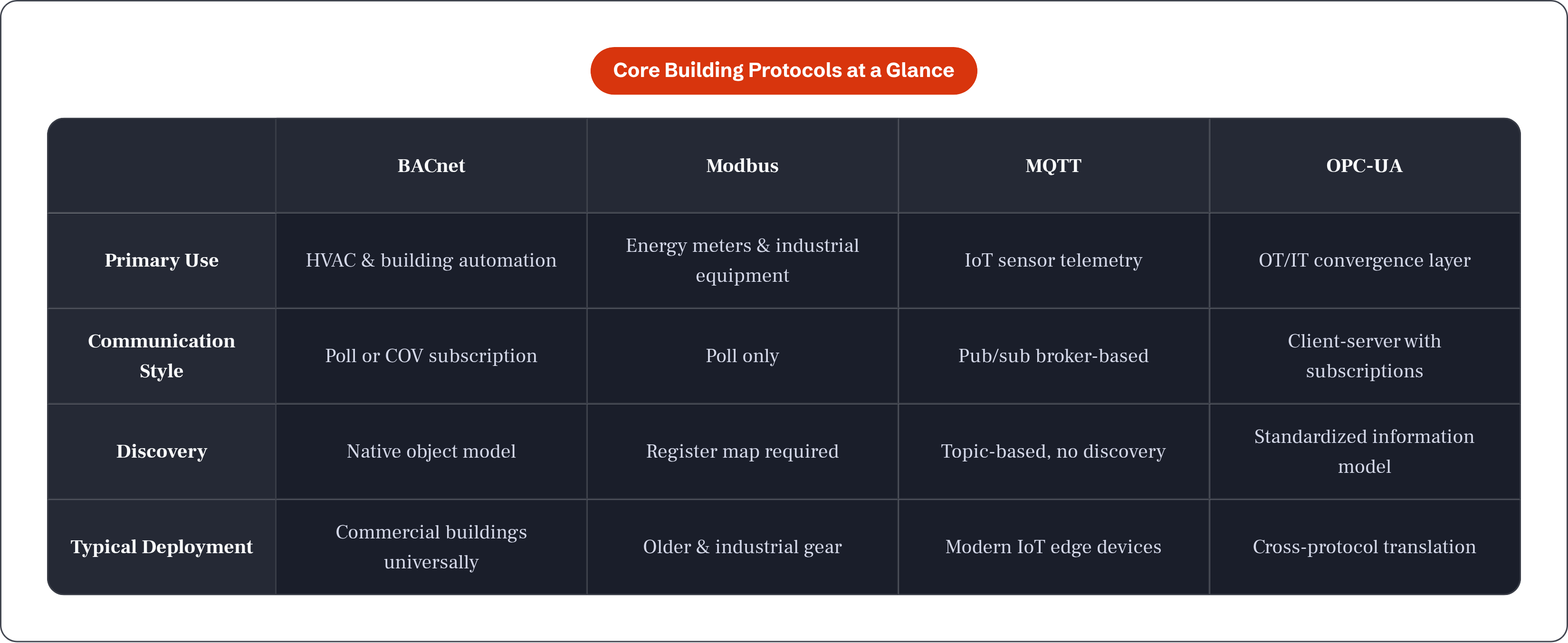
BACnet — the dominant open protocol for HVAC and building automation. Runs over IP (BACnet/IP) or older serial links (MS/TP). Formal object model: devices, analog inputs, binary outputs, each with named properties. Essentially unavoidable in commercial buildings.
Modbus — older, simpler, everywhere: energy meters, chillers, industrial equipment. No native object discovery. You get a register map and a PDF and work from that. Inelegant. Reliable.
LonWorks — legacy peer-to-peer protocol common in buildings from the 1990s and 2000s. Less common in new deployments, but retrofit work will surface it.
MQTT — the IoT-native pub/sub protocol. Lightweight, broker-based, increasingly central to how sensor telemetry moves from edge devices to the cloud. Now a first-class part of modern smart building data pipelines.
OPC-UA — the industrial interoperability standard gaining traction as OT and IT networks converge. Provides a common information model that can map onto BACnet and other protocols.
The practical reality: most buildings run more than one protocol. A single building might have BACnet for HVAC, Modbus for metering, and MQTT for newer IoT sensors. Protocol translation is a first-class engineering problem. Middleware, protocol gateways, and dedicated IoT gateway hardware are typically required before any API is reachable at all. Standardization of communication protocols is consistently identified as one of the primary challenges in the smart building industry — and once you have seen the protocol landscape firsthand, that finding is not even slightly surprising.
How Building Data Surfaces as APIs
Once past the protocol layer, building data surfaces through three tiers of API access.
Native vendor APIs come from the major BAS vendors — Honeywell, Siemens, Johnson Controls, Schneider Electric. Well-documented and directly accessible, but siloed. Honeywell's API knows nothing about your Siemens equipment.
Middleware and platform APIs sit in the middle tier: the Niagara Framework, Haystack-tagged endpoints, and Brick Schema interfaces. These normalize across hardware vendors and give you a consistent data model to build against.
Cloud aggregators pull from multiple vendor systems and normalize before you ever touch the data. Digital twins fall here: Johnson Controls' OpenBlue, Siemens' Desigo CC, Azure Digital Twins, AWS IoT TwinMaker. These expose building models as queryable graphs — a much higher-level abstraction than raw device points.
Two semantic standards are worth understanding specifically.
Project Haystack is an open-source tagging standard that gives BACnet and Modbus points a consistent vocabulary — site, equip, point tags — with a REST API as its query surface. Widely adopted in analytics, fault detection and diagnostics (FDD) tools, and energy optimization platforms. If you want your application to be portable across buildings and vendors, Haystack is a practical foundation.
Brick Schema is an RDF/OWL ontology that describes not just individual points but the relationships between building systems. More expressive than Haystack, more common in research and enterprise digital twin contexts, but its presence is growing.
Now for what the documentation does not prepare you for: a single mid-size commercial building might expose thousands of named points assigned by whichever technician commissioned the system. Abbreviations of abbreviations. Names duplicated across floors with no distinguishing marker. Names referencing equipment physically removed years earlier. Metadata missing or wrong. Readings going stale when sensors fail without anyone noticing for weeks.
Authentication is inconsistent too — API keys, OAuth 2.0, certificate-based mTLS, IP allowlisting, VPN-only access. You cannot assume a standard flow. You will encounter all of these, sometimes in the same building on the same afternoon.
Integration Patterns That Recur Across Projects
Poll vs. subscribe. BACnet and Modbus require polling, though BACnet supports COV (Change of Value) subscriptions for select object types. MQTT and modern REST webhooks support push. The choice affects latency, network load, and stale data handling. Control applications need tight polling intervals. Analytics can usually afford to relax them.
Edge-first architectures. Protocol translation and normalization happen on-premises before data moves to the cloud. This reduces latency for control decisions and keeps building network traffic off the public internet. Most serious deployments work this way.
Event-driven pipelines. Occupancy sensor fires. HVAC setpoint adjusts. Lighting zone dims. Log entry gets written. Connecting these steps requires a message broker or workflow engine that can coordinate across subsystem APIs with appropriate sequencing and error handling. The logic is usually not complicated. The coordination overhead is.
Read vs. write access. Most integrations start read-only. Write access — actually sending commands to actuators — requires additional security review and often physical sign-off from the building operator. Design for this distinction from day one.
Normalization layer. A translation layer mapping raw point names to a common schema is standard practice before any application logic is built. Haystack tags, Brick classes, or a custom internal model — pick one early and implement it before writing features, not after.
Fault tolerance. Building systems go offline. Integrations must handle missing data gracefully: filling gaps, buffering commands, alerting rather than failing silently. If your application has no clear answer to "what happens when this subsystem stops responding," you will find out the hard way.
Why Maintaining These Integrations Is Harder Than Building Them
Building the initial integration is a scoped project with a finish line. Maintaining it is an ongoing cost that compounds and never really ends.
API deprecation is constant. Building platform vendors release firmware and platform versions on their own schedules and do not coordinate with yours. Integrations that worked against one firmware version can silently break against the next. Sometimes you just get a broken connector and a support ticket at 11 p.m.
Security patch cycles in OT environments are slow and disruptive. A security update to a BAS controller can change API behavior or require re-authentication. Every vendor patch is a potential regression that must be retested, and in environments where change windows are tightly controlled, that queue backs up fast.
Data quality degrades quietly. Sensors fail. Points go stale. Equipment gets replaced and renamed. New floors get added. The data model you mapped at deployment drifts from physical reality. Integrations that were accurate at deployment can be nearly useless eighteen months later — not because the code broke, but because the building changed and nobody updated the map.
Vendor lock-in compounds everything. Proprietary APIs mean that swapping a BAS vendor during a renovation can require rebuilding integrations from scratch. Not adjusting them. Rebuilding.
The cumulative effect: teams who build integrations in-house eventually find a meaningful share of engineering capacity going to keeping existing connectors working rather than building new features. That shift happens gradually, then suddenly.
Security Requirements Specific to Building System Integrations
Building systems were designed as isolated operational technology networks, not hardened for internet exposure. Connecting them to IP networks and cloud platforms introduces attack surfaces they were never designed to handle — and the consequences of a breach are not just data loss. They are physical.
Network segmentation. Building system traffic should be isolated from corporate IT networks. A compromised HVAC controller should not be a path to the enterprise directory. This is both a security baseline and often a condition building operators impose before granting API access.
Asset inventory as a prerequisite. You cannot secure what you have not enumerated. Before integration work begins, map all connected devices, firmware versions, and network exposure.
Encryption standards for grid-interactive integrations. The U.S. Energy Modernization Cybersecurity Implementation Plan endorses standardized encryption for Building Energy Management Systems. Directly relevant to demand response and grid-interactive features.
Vendor risk controls. Third-party APIs introduce supply chain risk. Building operators increasingly require documentation of how third-party credentials are stored, rotated, and scoped.
Data ownership and residency. Occupancy data and access logs are personally identifiable in many jurisdictions. GDPR, CCPA, and sector-specific regulations apply. Data minimization and retention must be handled at the API layer, not deferred to a later sprint.
What Energy Management and ESG Use Cases Demand Technically
Energy management and ESG reporting are among the most common reasons organizations invest in smart building integrations — and among the most technically demanding. IoT-driven building implementations can reduce energy consumption by around 30% and operating expenses by around 20%. Those outcomes are real. They depend entirely on continuous, high-quality data feeds from metering and HVAC APIs. The specific technical demands are not forgiving.
Interval-level metering data. ESG reporting requires 15-minute granularity, not daily totals, preserved continuously in a data historian or time-series store. Silently dropping missed readings is unacceptable when the data ends up in a certification report. Auditors will find the gaps.
Sub-minute latency for demand response. The integration must receive a utility signal, compute a load-shed plan, and dispatch commands to HVAC and lighting controllers fast enough to act within the response window. This is not a use case for batch jobs or integrations that poll every five minutes.
Auditable data provenance. LEED, BREEAM, and WELL certifications increasingly require that every reading in a certification report be traceable to a specific sensor, timestamp, and calibration record. The integration layer must preserve that lineage, not just the values.
Always-on reliability. An integration that goes down during a peak demand event is not a minor inconvenience. It is a missed outcome that the entire business case was built on.
How Managed Integration Infrastructure Reduces the Build-and-Maintain Burden
The top barriers to realizing value from building data are high data and software costs and lack of in-house skillset — both directly addressed by managed integration infrastructure, which is why it has become a real part of how serious smart building projects get delivered.
Pre-built connectors for BACnet, Modbus, and major vendor platforms let developers reach authenticated, normalized data without writing protocol stacks from scratch. You build on top of the protocol work instead of under it.
Managed authentication handles credential rotation, certificate renewals, and OAuth token refresh across vendor APIs — eliminating an entire class of silent failures that surface at 2 a.m. when a token expires and nobody configured an alert.
Workflow orchestration built into integration middleware handles sequencing, retry logic, and error surfacing for event-driven building integrations. Developers define the logic. The plumbing is handled.
The commercial smart building market is over 53% of the overall smart building market as of 2025. That is the deployment context where most developer-facing APIs are aimed, and where managed infrastructure has the most practical impact. The buildings are complex, the vendor landscape is fragmented, and the maintenance burden compounds over time. Pre-built, managed infrastructure compresses months of foundational work into days and offloads connector maintenance that would otherwise consume engineering capacity every time a vendor ships a firmware update. The alternative is a custom integration layer your team must staff, secure, test, and update indefinitely — a cost that grows with every connected system you add.
A Practical Starting Point for New Projects
Start with an audit, not a design. Enumerate the building's subsystems, their protocols, firmware versions, and whether they expose an IP-accessible interface before writing any integration code. The audit tells you what is actually possible.
Identify the data owner early. Building operators, facilities managers, and landlords have different and sometimes conflicting authority over system access. In leased buildings, this gets complicated fast. Resolve it before making architectural decisions.
Choose a semantic layer before building application logic. Adopting Haystack or Brick tagging at the normalization layer insulates your application code from point-naming drift and makes the integration portable across buildings. Retrofitting a semantic layer onto application logic built against raw point names is painful in a way that is hard to describe until you are doing it.
Design for read-only first. Prove data quality and integration stability in read mode before requesting write access. This builds trust with the building operator and catches data quality problems before they affect control decisions.
Plan for maintenance from day one. Version-pin vendor API dependencies. Build alerting for stale or missing data. Document the re-authentication procedure for every connector. All of these will matter within the first year, probably sooner.
Evaluate where managed connectors remove undifferentiated work. For standard protocols and major vendor APIs, pre-built integration infrastructure frees engineering capacity for the application logic that actually differentiates your product. The protocol stacks are not your competitive advantage. The building intelligence you build on top of them is.