Salvage and Reuse Strategies for Decarbonizing Demolition
Salvaging materials during demolition cuts embodied carbon far more than recycling can.
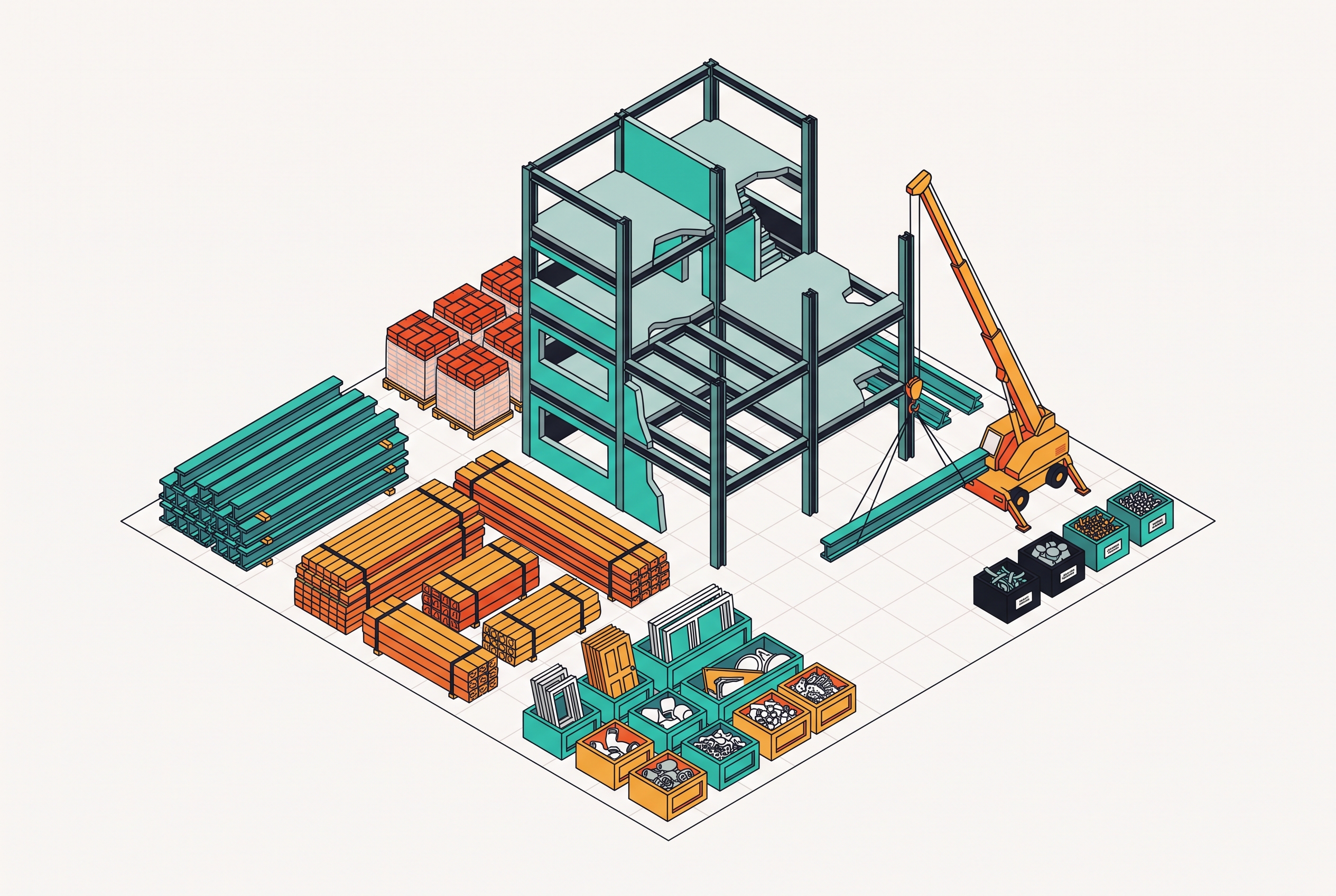
Demolition doesn't just waste a building. It wastes the carbon already spent making that building in the first place, and then it spends fresh carbon making the replacement. That's the double penalty at the center of this piece, and it's why salvage and reuse are the most direct lever anyone in construction has for cutting embodied carbon right now.
Why demolition's carbon cost is higher than it looks
Picture the carbon in a building's materials like money you already spent on a non-refundable ticket. The concrete, the steel, the timber framing: all of it carries an emissions cost from the day it was manufactured, mined, or milled. That cost gets wasted when the wrecking ball shows up. Conventional demolition charges two separate carbon bills at once. First, it treats the embodied carbon sitting in the materials being torn out as a sunk cost. Second, it forces a second round of emissions when new materials get manufactured to replace what was just thrown away. You pay for the same square footage of concrete twice, carbon-wise, but you only build it once.
Most buildings slated for demolition aren't actually at the end of their structural life. The steel is still steel. The timber is still timber. Mechanical clearing destroys usable material value rather than recovering it, which is a strange thing to do on purpose when the alternative exists. And a lot of what gets hauled away still gets labeled "recycling" even when it isn't, not really. Crushing concrete into road base, shredding timber into mulch, these processes count on a spreadsheet as diversion from landfill, but they strip materials of the structural properties that took all that embodied carbon to create. Turning a load-bearing beam into mulch is a demotion, not a recovery. Reprocessing materials this way takes energy, and what comes out the other end is lower-grade than what went in. Prioritizing reuse over this kind of downcycling can meaningfully cut embodied carbon and shrink construction's overall footprint, because reuse skips the energy-intensive transformation step. You're not remaking the beam. You're just moving it.
Where reuse sits in the material end-of-life hierarchy
Not all material recovery delivers the same carbon payoff, and the gap between options is bigger than most people assume. Reuse, recycling, and landfill sit on a ladder, and each rung down costs more carbon than the one above it. Reuse beats recycling by a wide margin, and recycling beats landfill the same way. It's a carbon gradient: skip a rung and you pay for it in emissions.
Downcycling costs carbon precisely because it's a transformation. Energy goes into crushing, shredding, remelting. A structural beam that gets unbolted from one building and bolted into another skips all of that. No transformation, no added energy, no added carbon. Research on circular concrete reuse puts a number on the gap: embodied carbon reductions of up to 90% compared with conventional construction, a ceiling that recycled-aggregate approaches simply can't reach, because crushing concrete for aggregate throws away the structural value that made the original pour worth its carbon cost.
Steel tells a similar story in a different register. Reusing a structural steel section preserves the actual metallurgy, the grain structure and alloy profile built into the metal that make it load-bearing. Electric-arc recycling recovers some of that value because it melts the steel down and recasts it, but melting erases the original grain structure. You get steel again, just not the same steel. Timber works the same way from a different angle: old-growth salvaged lumber can be visual-graded and tested without destroying it, confirming structural grade well enough to earn formal certification for reuse in new buildings, instead of getting chipped for biomass or garden mulch.
What matters is when the decision gets made, not which material behaves how. Which rung of the hierarchy is reachable gets decided at the demolition planning stage, not later at the materials market. Once a building has been mechanically cleared, the upper rungs are gone. You can't decide to reuse a beam that's already been crushed. The hierarchy only works if someone climbs it on purpose, before the crane shows up.
Why a pre-demolition audit comes first
If the hierarchy is the map, the pre-demolition audit is what tells you where you're standing on it before you start walking. It's the mechanism that turns "reuse is better than recycling" from a nice idea into an actual, site-specific plan: what can be salvaged, at what grade, through which pathway, worked out before a single wall comes down.
The sequence matters. Recovery starts with a detailed site assessment that identifies what's salvageable, and that assessment feeds directly into a deconstruction plan that lays out how the structure gets dismantled safely. Without the assessment, the deconstruction plan has nothing to work from. A proper audit typically covers four things: a structural survey, screening for hazardous materials like asbestos and lead paint, a full material inventory sorted by type and condition, and a market analysis of where the recovered materials can actually go once they're out of the building.
Old drawings give the audit team information that matters for accuracy. Original architectural and engineering documents hand the audit team the building's original specifications, the exact grade of steel that was used, the concrete strength it was designed for, giving a baseline that physical testing can then confirm on-site.
London's Selkirk House, at 166 High Holborn, shows what this looks like when it's done for real. Arup's pre-demolition audit for the site served as supporting documentation for the planning application's Circular Economy Statement, which Scotch Partners prepared, and it demonstrated compliance with London Plan Policy SI 7. The audit wasn't a side document nobody read. It did double duty as a technical tool and a regulatory deliverable, which is the shape these audits are increasingly taking across other projects too.
France has gone further and made the audit itself mandatory. The diagnostic PEMD is a compulsory audit required for any significant demolition above a certain size threshold, or for buildings that once hosted polluting activities. French law has been building toward this since 2009, with key milestones in 2015 and 2020, and the audit functions as the trigger: without it, the rest of the regulatory machinery around favoring deconstruction doesn't engage.
Selective deconstruction in practice: how buildings are taken apart to preserve material value
Selective deconstruction looks nothing like mechanical demolition, and that's the point. Mechanical demolition is optimized for speed. Selective deconstruction is optimized for what comes out the other end still usable. Crews dismantle the building from the top down, in sequence, by hand, with tools chosen to keep materials intact. Everything coming off gets sorted on the spot into categories: steel, timber, concrete, brick.
The hardest part of the job is the structural disassembly itself. Crews use specialized tools like hydraulic shears and mobile crushers, but the goal with every cut is preserving the quality of what's being separated, not just separating it. Speed is not the metric here. Grade is.
How do you know a salvaged beam is actually safe to put back into a new building? Testing, not guessing. Ultrasonic testing checks for hidden flaws inside steel members. A rebound hammer test estimates concrete's compressive strength, so you don't have to drill a core sample out of it. Visual grading certifies timber's structural class the same way it would for new-cut lumber at a mill. None of this is exotic equipment. It's standard nondestructive testing, applied to material most people assumed was headed for a dumpster.
Most people underestimate scale. Re-use Hawaiʻi collects substantial volumes of salvaged material and distributes it out to tens of thousands of individuals, which answers the obvious skeptical question up front: can redistribution actually work at a size that matters, or is this a boutique operation for a handful of renovation hobbyists? The Hawaiʻi numbers say it can work, provided the front end, the sorting, grading, and cataloging, is structured properly from the start.
Portland, Oregon has built a procedural scaffold around this. Certified deconstruction contractors there have to file a Pre-Deconstruction Form with the Bureau of Planning and Sustainability, keep proper documentation through the job, and complete a full salvage lumber inventory at the end. Other cities are starting to copy the model, because a documented, cataloged inventory turns a pile of salvaged lumber into something a buyer can specify with confidence, which is the bridge into the next stage: getting that material back into use.
How recovered materials re-enter the supply chain
A salvaged beam sitting in a warehouse delivers zero carbon benefit. It only pays off once it displaces a brand-new beam that would otherwise have been manufactured from scratch. That's the test every recovery pathway has to pass: does this material re-enter an active supply chain, graded and certified well enough that a contractor can specify it the way they'd specify anything new off a catalog.
Concrete is where this distinction matters most sharply. Circular concrete reuse means keeping concrete elements intact as structural components and reassembling them in a new structure, not crushing them down for aggregate. The research literature treats that distinction as the whole ballgame for whether meaningful embodied carbon savings actually materialize. Crush it, and you've downcycled. Keep it whole and reinstall it, and you've captured the full value.
Steel shows the clearest evidence that reused structural components can hold up under real service conditions. A Hong Kong case study tracked relocated steel modules and found an exceptionally high overall reusability rate after two years in service. Structural steel members and their connections came through fully reusable with only minor refurbishment needed, and even the built-in fixtures mostly held up for reuse. That's steel doing its job twice, in two different buildings.
Timber has its own market logic. If wood is properly graded and salvaged, especially air-dried old-growth material, it can sell at a real premium over new commodity framing lumber, because it has structural and visual qualities a sawmill can't produce from a tree planted thirty years ago. New-cut lumber can't fake decades of slow growth. Buyers pay for the real thing.
The real cost comparison between deconstruction and demolition
Deconstruction costs more upfront than demolition, so the question is how this scales beyond projects with sustainability budgets to spare. The upfront labor cost is genuinely higher, and there's no getting around that, because careful dismantling by hand takes more hours than a crew running an excavator through a wall. But a line-item comparison of labor costs alone misses most of the picture. It leaves out reduced landfill tipping fees, resale value on the salvaged materials, tax deductions, and LEED credit value, and once those offsets get added back in, the net cost position flips for a lot of projects.
The tax piece is concrete. If building owners donate recovered materials from a demolition site, they can qualify for tax deductions under the Boston Building Material Reuse Study framework, and other jurisdictions are beginning to build similar mechanisms of their own. LEED certification adds another offset on top: LEED-certified properties typically carry resale values well above non-LEED equivalents, and deconstruction can contribute credits directly toward that certification, value demolition forecloses by default.
The strongest honest critique still needs answering directly rather than waved away: a small amount of reuse doesn't produce meaningful savings in embodied carbon or cost compared with standard demolition. There's a real threshold, and a project has to cross it before deconstruction's economics and carbon savings outweigh the added labor and complexity. Scale and recovery rate are what put a given project on one side of that threshold or the other, not good intentions. A small renovation salvaging a few doors and some trim isn't going to move the needle. But a full structural teardown that recovers graded steel and concrete elements is a different calculation.
There's a longer-run wrinkle too. As the electricity grid and manufacturing processes decarbonize over time, the carbon advantage reuse holds over recycled-and-remanufactured material shrinks. The biggest relative gains from high-effort deconstruction belong to this decade, not to some indefinite future where the gap stays this wide. Rising landfill tipping fees are already pushing the other way, though, and the 2026 regulatory environment is shifting the cost baseline further still, so a full-cost comparison looks considerably more favorable to deconstruction than older figures would suggest.
How policy mandates convert voluntary practice into standard procedure
Individual project economics are one thing. Policy is what turns deconstruction from a choice a sustainability-minded developer makes into the baseline everyone has to meet, and that shift changes the cost and capacity math for the entire industry at once. Mandates build contractor capacity. They build material markets. They build the data infrastructure that makes the whole process cheaper and more predictable the longer it runs.
Portland's deconstruction mandate for residential structures produced a notable finding. When you run sensitivity analyses against the policy, deconstruction still holds a carbon benefit over demolition, even when the market for recoverable wood swings to extremes. That's about as strong a case for a mandate as the data can offer: the benefit survives market volatility, so the policy doesn't have to bet on favorable pricing.
Other countries are building their own versions of the same bet. The Netherlands runs a national program aimed at cutting the use of primary raw materials across the whole economy in half by 2030, with circular material reuse as one of its main mechanisms. India enacted the Environment (Construction and Demolition) Waste Management Rules in April 2025, setting up a framework covering generation, storage, processing, recycling, and use of construction waste, backed by an Extended Producer Responsibility requirement that makes producers register and meet specific recycling and utilization targets.
None of these mandates are optional add-ons bolted onto an existing system. They're rewriting what standard procedure means for anyone planning to take a building down, which is exactly the shift that turns deconstruction from a boutique practice into the default one.
Sources
- Building Material Reuse Study Launches to Reduce Demolition Waste and Achieve Carbon Neutrality Goals
Provided details about the Boston Building Material Reuse Study framework, including its tax deduction mechanism for donated recovered materials.
- Circular concrete reuse as a higher-value process to achieving decarbonization in the construction sector: A systematic review - PMC
Supplied the figure of up to 90% embodied carbon reductions achievable through circular concrete reuse compared with conventional construction.
- Recovery and Reuse of Salvaged Products and Building Materials from Existing Structures
Informed the discussion of structural disassembly methods, material grading, and testing protocols such as ultrasonic testing and rebound hammer tests for salvaged elements.
- Deconstruction vs. Demolition: Maximizing Material Salvage Value in Sustainable Projects
Informed the cost comparison section, including the upfront labor premium for deconstruction and the offsets from landfill fees, resale value, and LEED credits.
- Developing a Reclamation Framework to Promote Circularity in Demolition Projects
Provided the framework for pre-demolition audits covering structural surveys, hazardous material screening, material inventories, and market analysis.
- Embodied carbon saving of reusing concrete elements in new buildings: A Swedish pilot study - ScienceDirect
Supported the discussion of keeping concrete elements intact as structural components rather than crushing them, and the carbon savings that result.
- Reducing embodied carbon in steel modules through end-of-life circular economy systems - ScienceDirect
Provided the Hong Kong case study tracking relocated steel modules and their exceptionally high reusability rate after two years in service.
- Resources:The Reuse Hierarchy
Supplied the conceptual basis for the material end-of-life hierarchy, ranking reuse above recycling above landfill as a carbon gradient.