Solar Curtailment Causes and How Grid Operators Manage It
Overproduction during peak sun hours overwhelms transmission capacity across multiple continents.
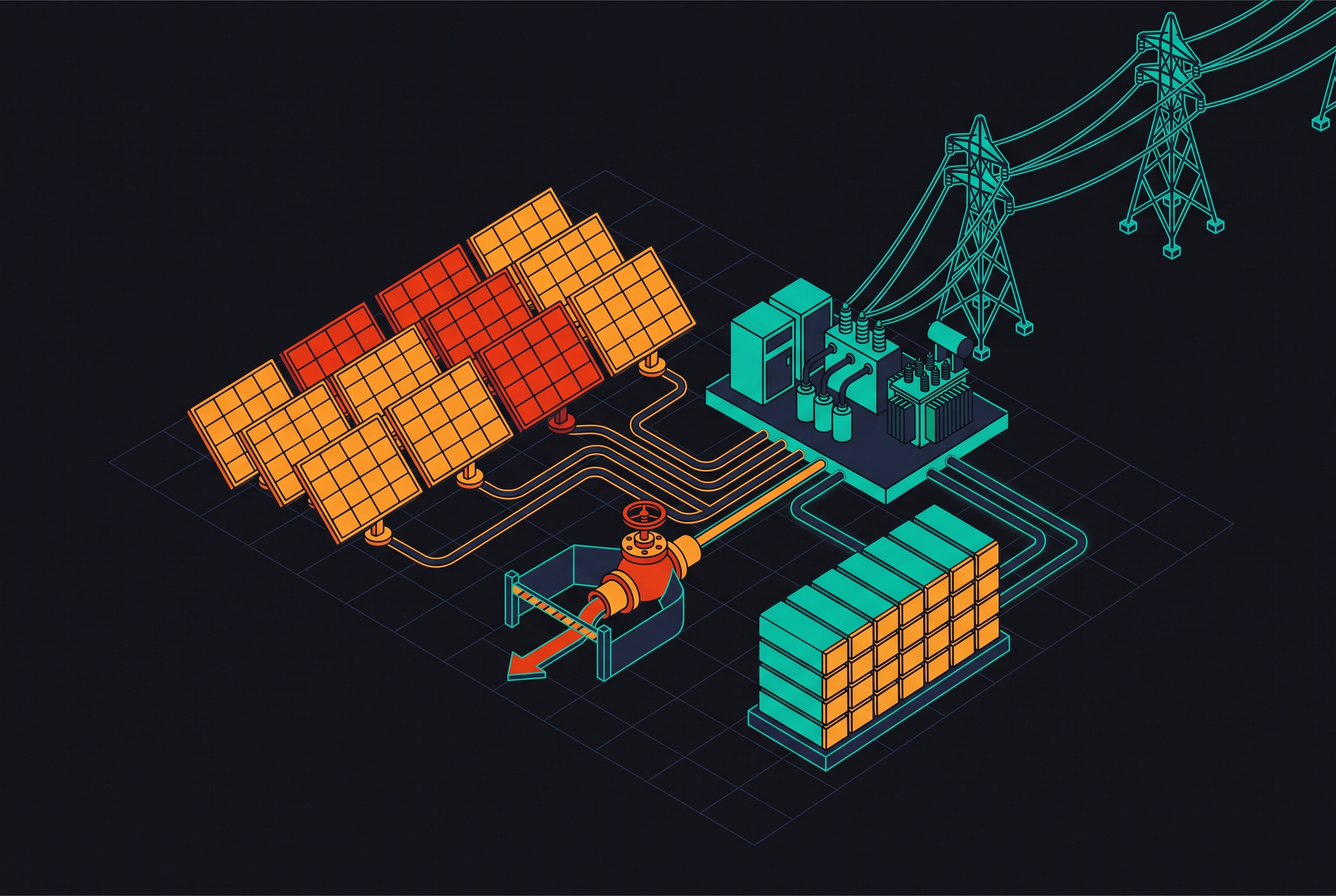
Picture a solar farm on a clear, sunny afternoon, panels tilted up, every cell doing what it was built to do, and the grid operator calls in and says: turn it off. Not because anything broke. Not because the sun quit. Because the grid, at that exact moment, has nowhere to put the power. That's solar curtailment, and it's become one of the defining operational facts of running a modern power system. CAISO alone curtailed over 738,000 MWh of wind and solar in just the first four months of 2025, a number big enough to show this isn't a rare hiccup but a routine, recurring part of how the grid runs.
The mechanics are simple even when the consequences aren't. Curtailment is the deliberate reduction or shutdown of solar output when the system can't safely absorb more electricity, caused by congestion on the wires, oversupply in the market, or hard limits on transmission capacity. None of it reflects a problem with the solar plant. The panels are fine. The inverter is fine. The grid just can't take any more right now.
Most of the time, that "right now" lands during the exact hours solar is best at its job. Solar output peaks in the middle of the day, and in spring and autumn, that's also when demand for power tends to sag. Shizen Operations' June 2026 analysis makes the case: curtailment should be treated as a routine supply-and-demand management tool, a standard line item in investment planning, not a glitch to be waited out. The rest of this piece works from that premise: curtailment is structural, it's here to stay in some form, and understanding why it happens is the first step to managing it well.
Three structural causes that make curtailment unavoidable under current grid conditions
Curtailment doesn't have one root cause. It has three, and they don't take turns, they stack.
The first is geography and timing working against each other. Transmission lines take years, sometimes over a decade, to permit and build. Solar farms go from groundbreaking to full output in months. That mismatch means a lot of solar capacity gets built faster than the wires needed to move its power to where people actually use it. The electricity exists. It just can't get a ride anywhere useful.
The second cause lives inside the thermal power fleet, the coal, gas, and nuclear plants still running alongside solar. These plants often can't throttle down past a certain floor, which can reach up to 50% of maximum output depending on the plant type, without risking damage or a slow, expensive restart. So on a sunny weekend or a mild spring day, when demand is low and solar is cranking, operators face a choice: back down a thermal plant that can't go much lower, or curtail the solar that can be switched off in seconds. IEEFA's Michiyo Miyamoto described this exact bind to pv magazine in the context of Japan's grid constraints, where inflexible "must-run" generation keeps crowding solar out of its own best hours.
The third cause is about voltage, not volume. At high levels of solar penetration on local distribution networks, power starts flowing backward, from homes and businesses back toward the substation, in a direction the system wasn't originally built for. That reverse flow pushes voltage outside safe limits. Curtailing solar output becomes the fastest, sometimes the only, tool fast enough to pull voltage back into a safe band, a dynamic the University of Vermont's hosting-capacity study documents directly on radial distribution feeders.
Curtailment is driven by three distinct but mutually reinforcing structural causes, each of which can trigger curtailment on its own and all of which operate simultaneously in high-solar markets, and they don't operate on the same clock. Thermal inflexibility plays out over hours, as plants slowly ramp. Transmission bottlenecks take years to resolve, if they get resolved at all. That's the reason no single fix makes curtailment go away: you can build all the batteries you want, and a voltage spike on a residential feeder still needs an instant response that storage can't always provide fast enough.
How widespread curtailment has become across major solar markets
They're appearing at the same time in grids with completely different market designs, regulatory histories, and weather patterns, which is itself the point: this is physics and timing, not one country's bad planning.
Japan offers the clearest timeline. Curtailment there started in Kyushu and stayed confined to that one region through fiscal 2021, then spread region by region through fiscal 2023. Tokyo, the country's largest and historically most demand-hungry grid area, held out as the last exception until March 2026, when TEPCO ran its first-ever economic curtailment events, on March 8 and again on March 21, the second of which happened with no nuclear generation online at all. That completed a sweep: every transmission system operator area in Japan has now curtailed solar. During the country's Golden Week holidays in May 2026, grid operators logged a preliminary curtailment figure of 6.37 MW, a small number on its own but one more data point in a pattern that had already produced a record half-year total for the country's solar and wind curtailment in the first half of 2025.
France shows the same pressure arriving through a different door: market prices. RTE, the country's grid operator, reported that curtailment during negative-price periods nearly doubled in 2025 compared with the year before, as rising solar output pushed more hours into zero or negative wholesale pricing. Lion Hirth's study finds Germany seeing a similar price-driven squeeze: market-based solar curtailment climbed in 2025, and negative prices now occur in a meaningful share of all trading hours.
Energy Central's analysis shows California's CAISO curtailed over 738,000 MWh of wind and solar in just the first four months of 2025, on a trajectory consistent with the substantial year-over-year increase seen in 2024, with March 2025 alone reaching a record monthly total. And the pattern isn't confined to the usual suspects. India, Chile, and Australia are each logging their own record curtailment figures through 2025 and 2026, with Chile's curtailment rate ranking among the highest recorded anywhere in an established electricity system. Different grids, different rulebooks, same underlying math.
Dispatch Order, Priority Rules, and Inverter Controls
Before a single megawatt gets curtailed, someone, or something, has to decide the order. Grid operators run on formal dispatch hierarchies: economic or market-based curtailment usually comes first, followed by technical or emergency curtailment when conditions get more urgent. Solar generators are frequently connected under what's called "non-firm" status, which puts them first in line to be curtailed ahead of generators with firm capacity contracts.
Japan's framework shows how this plays out in practice. pv magazine's reporting at the time showed that the non-firm connection rules that have long applied in regions like Kyushu are the same rules under which TEPCO's March 2026 curtailment events were ordered, cutting output by as much as 1.84 million kW at peak. The rule wasn't new. It had just never been triggered in Tokyo before.
Below the level of market rules, the hardware itself is being built for this reality. Power generation operators are increasingly required to submit specification verification requests for inverters with curtailment functionality as a condition of connecting to the grid. Curtailment capability is now an engineering requirement baked into the inverter itself, not just a market-side instruction an operator calls in by phone.
France has taken a different regulatory approach to the same underlying problem. A growing share of the country's renewable fleet now operates under "complément de rémunération" premium schemes, which give generators a financial incentive to adjust their own output in response to market signals, rather than waiting for a curtailment order. RTE's data, as reported by pv magazine, frames this as treating curtailment as a modulation tool the generator can use proactively, ahead of a penalty handed down after the fact.
The layered toolkit grid operators use to actively manage curtailment
Grid operators are working through a sequence of tools, each addressing a different cause and a different timescale, and each with its own ceiling on how much it can help.
The first layer is trading power across a wider area. CAISO's Western Energy Imbalance Market, known as the WEIM, lets participants outside California buy and sell power in real time to balance supply and demand across a bigger footprint. In 2024, it avoided a meaningful share of the curtailments that would otherwise have happened. CAISO's Extended Day-Ahead Market, expected to be running by May 2026, is set to add another outlet for excess solar before it ever needs curtailing. Think of it as widening the loading dock so more trucks can unload at once.
The second layer is batteries. Global battery storage deployment grew substantially in 2024, and costs kept falling, making storage-paired solar projects a much easier financial case. But most of today's battery fleet is built for short cycles, a few hours of charge and discharge, not for absorbing the multi-hour or multi-day curtailment windows some grid operators are now reporting. Storage helps at the margins. It doesn't make the problem disappear.
The third layer is getting demand to move toward the power, instead of the other way around. EV charging, heat pumps, hot water heaters, refrigeration systems, and industrial batch processes can all be timed to run when solar is abundant instead of whenever it's convenient. The Energy Central analysis documents a working example in Germany's data centers, where coordinated demand-side flexibility let server loads ramp up from a low baseline to a much higher level during curtailment windows, showing this works at real scale, not just in a pilot project.
The fourth layer is newer and stranger: turning surplus electricity into something else. Some companies are using excess renewable power to produce hydrogen, part of which gets stored and blended with natural gas for later generation, including at the Intermountain Power Project's new facility. It's an odd little loop, sunlight becoming hydrogen becoming fuel for a power plant, but it's a real outlet for power that would otherwise just get thrown away.
Germany's January 2026 rollout of grid inertia services, built on fixed-price, multi-year agreements with certified grid-forming storage providers, shows how regulatory frameworks are beginning to create durable market incentives for the flexibility resources curtailment management requires. No single layer solves curtailment on its own. Markets help at the edges, batteries help for a few hours, demand response helps for loads that can actually be moved, and power-to-X soaks up some of what's left. Together they shrink the problem. None of them close it.
Curtailment: problem to eliminate or cost-effective feature to manage
Given that no combination of tools eliminates curtailment, a real question follows: should it be eliminated at all, or is some amount of it actually the cheapest, smartest option on the table? Experts land in genuinely different places on this.
One camp argues for building more solar than the grid can always use, and simply accepting the curtailment that results. Building new transmission or grid-scale storage is expensive and slow. Curtailment, by comparison, is often cheaper. Under this view, curtailed energy should be treated as a legitimate flexibility resource and even compensated, folding it into investment decisions from day one rather than treating it as wasted output to be minimized at any cost.
A second camp pushes back hard on that framing. Storage and transmission aren't optional extras to curtailment, they're necessary partners to it. The Energy Central analysis quotes the EIA's own assessment directly: "without more transmission capacity or a long-term storage solution, high curtailments during spring can still occur," even after every short-duration tool available has been deployed. In this view, leaning too hard on "just curtail it" is a way of avoiding the harder, more expensive infrastructure investment the grid actually needs.
A third, subtler wrinkle complicates both camps. Letting solar and storage provide grid services like operating reserves does reduce curtailment and lower system costs overall. But it also drives down the market price of those reserves, which in turn weakens the financial case for solar operators to offer curtailed energy for exactly those services. It's a feedback loop that undercuts its own solution, and no amount of better hardware fixes a problem rooted in how the market prices things.
The University of Vermont's hosting-capacity study offers a middle path worth taking seriously. Its finding: curtailing no more than a small share of annual solar energy, allocated strategically rather than randomly, can raise a grid's solar hosting capacity by at least 50%, with no negative grid impacts and a net positive economic outcome once the cost of carbon is factored in. It's evidence that a small, well-targeted amount of curtailment can unlock far more solar capacity than refusing to curtail would.
Curtailment as a First-Order Variable in Solar Investment and Grid Planning
None of this is a side issue for the people building, financing, or regulating solar power anymore. It belongs in the model from the start.
For developers and investors, Shizen Energy's 2026 analysis is direct about it: projected curtailment needs to be built into asset management plans and financial simulations as a baseline assumption, not an afterthought disclosed in a risk footnote. TEPCO's 2026 curtailment events make the stakes concrete. If Tokyo, the largest and most demand-rich grid area in Japan, wasn't immune, no grid area gets to assume it's the exception.
For market designers, the incentive structure itself needs rethinking. Lion Hirth's study concludes that further growth in wind and solar depends on generators actually responding to price signals. Feed-in tariffs and contracts for difference that settle monthly or annually, rather than hour by hour, dull the price signals that would otherwise tell a generator when to pull back. That makes the grid harder to run and inflates subsidy costs at the same time. Support-scheme design is now a direct lever on how much curtailment the system produces.
For grid operators, the scale of what's coming is already visible. Europe hit a record for solar generation in the second quarter of 2026, reaching 129 TWh, and that flood of output contributed to hundreds of hours of negative electricity prices across solar-heavy markets. Hirth's study found Germany alone saw negative day-ahead prices in 6.0% of all hours in 2025. It's the shape of the grid these tools now have to manage, year over year, as solar keeps growing faster than the wires, the storage, and the market rules built to hold it.
Sources
- Solar Curtailment Trends 2026: New Rules, Outlook, and Strategies to Protect Your Revenues
Provided the framing of curtailment as a routine supply-and-demand management tool and informed advice on building curtailment into asset management plans and financial simulations.
- PV curtailment surges in France as grid adapts to rising solar output - pv magazine Global
Provided data on France's surge in curtailment during negative-price periods in 2025 and details on the 'complément de rémunération' scheme treating curtailment as a modulation tool.
- Solar curtailment reaches Tokyo, Japan's last holdout grid area - pv magazine Global
Provided the timeline of curtailment spreading across Japan's grid regions, including TEPCO's first curtailment events in March 2026 and the specific volumes curtailed.
- Fairness-aware Dynamic Hosting Capacity and the Impacts of Strategic Solar PV Curtailment
Provided the finding that strategic curtailment of a small share of annual solar energy can raise grid hosting capacity by at least 50%, and details on thermal plant minimum output floors and voltage issues on radial distribution feeders.
- Do wind and solar curtail at negative electricity prices? Incentives and evidence across two decades of German renewable support schemes
Provided data on Germany's negative electricity price hours, the relationship between support scheme design and curtailment incentives, and Europe's record solar generation figure of 129 TWh.
- Tackling Renewable Energy Curtailment: Causes, Impacts, and Transformative Strategies for a Resilient Grid in 2025 and Beyond
Provided CAISO curtailment figures for the first four months of 2025 and the EIA assessment on transmission and storage needs, as well as the Germany demand-flexibility example.